
It’s a common sight in parks, backyards, and urban green spaces: a squirrel suddenly stops mid-scurry, crouches low, and stares intently at you. It doesn’t run. It barely blinks. This freeze response seems counterintuitive—shouldn’t fleeing be the best defense? Yet, for squirrels, freezing is a calculated survival tactic rooted in millions of years of evolutionary refinement. Understanding this behavior offers insight not only into squirrel psychology but also into broader patterns of animal threat assessment and predator avoidance.
The freeze reflex isn’t random hesitation—it’s a rapid neurological and physiological response to perceived danger. By analyzing the science behind this behavior, we can appreciate how even small mammals employ complex strategies to survive in environments teeming with potential threats, including humans.
The Science Behind the Freeze Response
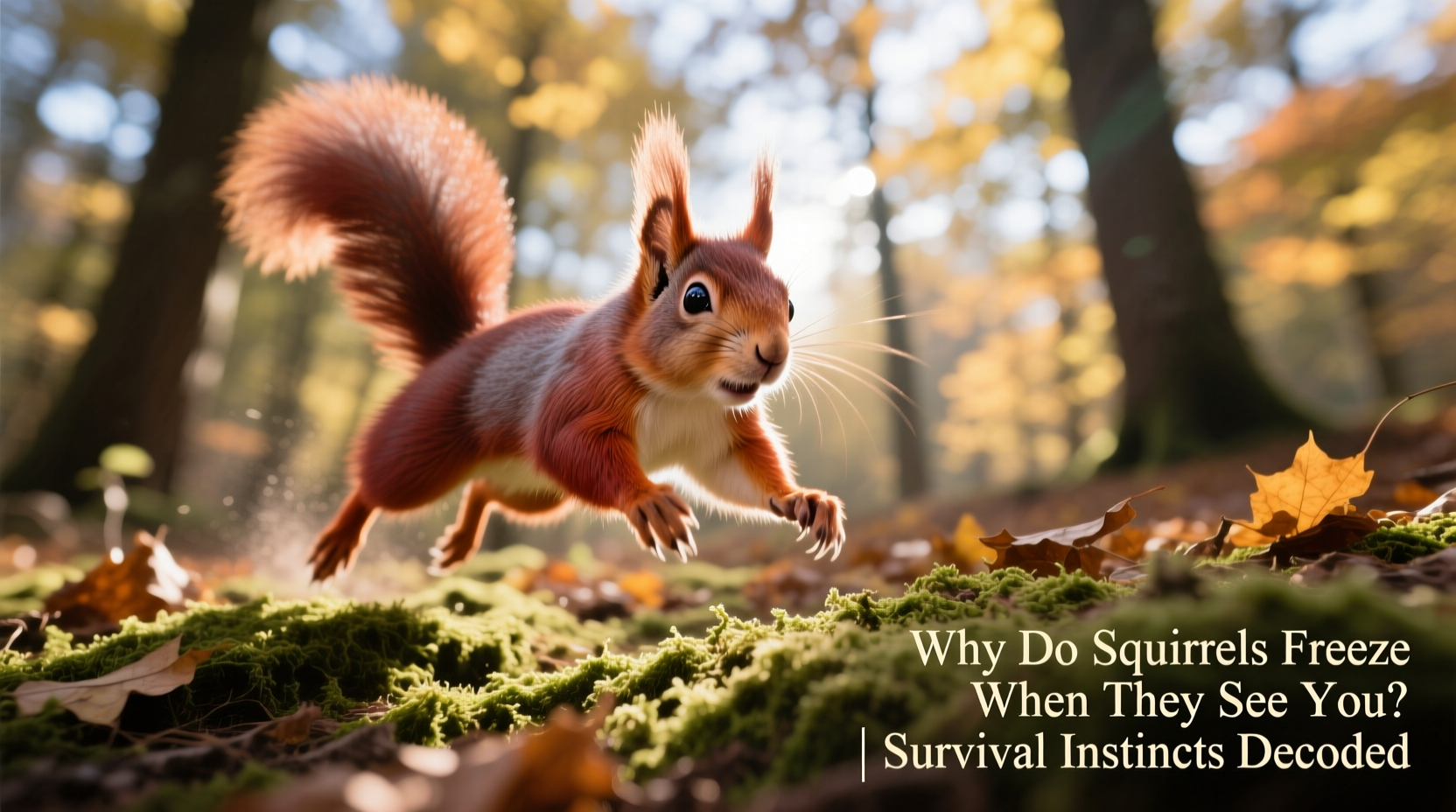
When a squirrel detects a sudden movement or an unfamiliar presence—such as a human approaching—it triggers an immediate reaction in its central nervous system. The amygdala, a region of the brain responsible for processing fear and threat signals, activates within milliseconds. This sets off a cascade of hormonal and neural events collectively known as the “freeze-fight-flight-or-faint” response.
Unlike the more familiar “fight or flight” model, the freeze response comes first. It serves as an initial data-gathering phase. During this moment of stillness, the squirrel assesses whether the stimulus poses a real threat. Is that person just walking by, or are they reaching toward the squirrel? Are there predators nearby? Movement could draw attention; staying still may mean going unnoticed.
Neurobiologically, the periaqueductal gray (PAG) region in the midbrain plays a key role in initiating immobility. Studies on rodents—a close behavioral analog—show that stimulation of specific PAG neurons induces freezing even in safe environments. In squirrels, similar mechanisms allow them to remain motionless while scanning their surroundings with acute senses.
“Freezing is not passive fear—it's active surveillance. The animal is gathering information under duress, making split-second decisions based on sensory input.” — Dr. Lena Torres, Behavioral Ecologist, University of Alberta
Evolutionary Advantages of Freezing
From an evolutionary standpoint, freezing has proven highly effective for prey species like squirrels. Here’s why:
- Camouflage enhancement: Many squirrels have mottled fur that blends with bark, leaves, and shadows. Remaining motionless amplifies this natural camouflage, reducing detection by predators relying on movement cues.
- Energy conservation: Unnecessary flight wastes energy and increases exposure. If the threat passes without escalation, the squirrel conserves calories and avoids unnecessary risk.
- Improved sensory focus: Immobility allows the squirrel to concentrate fully on auditory, visual, and olfactory inputs. A single twitch might mask the sound of an approaching cat or hawk.
- Deception strategy: Some predators lose interest if prey doesn’t react. A frozen squirrel may appear dead or inanimate, triggering disengagement in opportunistic hunters.
How Squirrels Assess Threat Levels
Squirrels don’t freeze indiscriminately. Their decision-making process involves continuous environmental monitoring and risk evaluation. Researchers have identified several factors influencing whether a squirrel freezes, flees, or resumes normal activity:
| Factor | Increase Freeze Likelihood | Decrease Freeze Likelihood |
|---|---|---|
| Distance to threat | Close proximity (<10 ft) | Far away (>30 ft) |
| Movement speed | Rapid approach | Slow, predictable motion |
| Eye contact | Direct stare | Averted gaze |
| Previous experience | Negative encounter history | Frequent benign human interaction |
| Escape routes | Limited cover or tree access | Multiple nearby trees or burrows |
This dynamic assessment illustrates cognitive sophistication. Urban squirrels, for example, often show reduced freezing responses compared to rural counterparts, having learned through habituation that most humans pose no direct threat. However, sudden gestures—like lunging or throwing objects—immediately reinstate strong freeze reactions.
A Real-World Observation: The Park Bench Encounter
Consider a typical morning in Central Park. A gray squirrel forages near a footpath when a jogger rounds the corner. The squirrel instantly freezes, flattening its body against the ground, ears forward, eyes locked on the runner. The jogger continues past, headphones on, unaware.
For five seconds, the squirrel remains motionless. Then, cautiously, it twitches its tail—a signal other squirrels interpret as “possible threat, still monitoring.” Only after the jogger is 50 feet away does it resume digging for nuts. Later, the same squirrel ignores a seated photographer who moves slowly and avoids eye contact. This selective response demonstrates learned discrimination between high- and low-risk stimuli.
This scenario reflects what scientists call **adaptive plasticity**—the ability to modify behavior based on context and experience. The squirrel didn’t default to flight because it weighed the cost (energy, visibility) against the actual danger (a distracted human). Freezing allowed optimal information gathering before committing to action.
The Role of Tail Flicking and Other Signals
While freezing, squirrels often engage in subtle communication. One of the most telling behaviors is tail flicking. Far from being random, these movements serve multiple functions:
- Alarm signaling: Rapid side-to-side tail waves alert nearby kin to potential danger.
- Confusion display: Erratic motion may startle or distract predators, buying time for escape.
- Thermoregulation: Increased blood flow during stress causes tail movement to release heat.
- Self-calming: Repetitive motor actions may reduce anxiety, similar to fidgeting in humans under stress.
Interestingly, studies using robotic squirrel models have shown that predators like rattlesnakes are less likely to strike when presented with a flicking tail, suggesting the behavior has evolved specifically as a deterrent.
Step-by-Step: How a Squirrel Decides What to Do When It Sees You
The entire threat-response sequence happens in under ten seconds, but it follows a precise internal logic. Here’s a breakdown of the squirrel’s decision timeline:
- Stimulus Detection (0–1 sec): Peripheral vision catches movement. Auditory cues (footsteps, rustling) are processed simultaneously.
- Freeze Initiation (1–2 sec): Motor inhibition occurs. The squirrel locks muscles, lowers posture, and begins scanning.
- Sensory Evaluation (2–5 sec): Determines direction, speed, and intent of the approaching entity. Assesses escape routes and cover availability.
- Risk Classification (5–7 sec): Compares current input to memory templates (e.g., “fast-moving = dangerous,” “standing still = maybe safe”).
- Action Selection (7–10 sec): Chooses one of three paths:
- Resume foraging (low threat)
- Flee to nearest tree or burrow (high threat)
- Approach cautiously (if food is involved and threat level is uncertain)
This sequence highlights the efficiency of instinctual behavior. There’s no conscious deliberation—only rapid, hardwired processing honed by natural selection.
Common Misconceptions About Squirrel Behavior
Many people misinterpret the freeze response as confusion, fear paralysis, or simple stupidity. These misunderstandings stem from anthropomorphizing animal behavior—projecting human emotions onto non-human minds. In reality, the freeze is neither irrational nor passive.
Another myth is that squirrels “play dead” like opossums. While both involve immobility, thanatosis (playing dead) is a last-resort tactic used when captured. Squirrel freezing occurs before contact and is primarily observational, not defensive surrender.
FAQ: Frequently Asked Questions
Do all squirrel species freeze when they see humans?
Most diurnal tree and ground squirrels exhibit freezing behavior, though the intensity varies by species and environment. For instance, fox squirrels tend to flee more quickly than gray squirrels, while prairie dogs combine freezing with vocal alarm calls. Habituation levels in urban populations also affect responsiveness.
Is freezing harmful to squirrels?
No—freezing is a natural, adaptive response. However, chronic exposure to stressors (e.g., constant loud noises, frequent disturbances) can lead to elevated cortisol levels, weakened immune function, and reduced reproductive success. Occasional freezing is healthy; persistent stress is not.
Can I train a squirrel not to freeze around me?
Through consistent, non-threatening interactions—such as sitting quietly at a distance and avoiding sudden movements—some squirrels may become habituated and show less freezing over time. However, this should never involve feeding wildlife, which can lead to dependency and ecological imbalance.
Expert Recommendations for Observing Squirrel Behavior
If you're interested in studying or simply appreciating squirrel behavior in your area, follow this checklist to minimize disturbance and maximize insight:
- Observe from at least 15–20 feet away
- Avoid direct eye contact, which mimics predatory focus
- Move slowly and predictably
- Visit the same location at similar times to track individual behaviors
- Keep notes on freezing duration, tail signals, and escape routes
- Never offer food or attempt physical contact
- Use binoculars for closer observation without intrusion
“The more we understand seemingly simple behaviors like freezing, the more we realize how intelligent and adaptable wild animals truly are.” — Dr. Marcus Lin, Wildlife Cognition Researcher, Stanford University
Conclusion: Respecting Nature’s Survival Strategies
The next time you see a squirrel freeze in your presence, remember: it’s not indecisive or afraid in the way humans experience fear. It’s engaged in a rapid, sophisticated threat analysis—one shaped by evolution to maximize survival in unpredictable environments. That brief moment of stillness is packed with biological intelligence, sensory acuity, and strategic calculation.
By recognizing the purpose behind such behaviors, we cultivate greater respect for wildlife and our shared spaces. Whether in city parks or forest trails, these small mammals navigate complex social and ecological landscapes every day. Understanding their instincts doesn’t just satisfy curiosity—it fosters empathy and coexistence.




 浙公网安备
33010002000092号
浙公网安备
33010002000092号 浙B2-20120091-4
Comments
No comments yet. Why don't you start the discussion?