
On a clear night, gazing at the sky reveals a tapestry of twinkling stars, some appearing white, others flashing red, blue, or green. This mesmerizing flicker—known scientifically as stellar scintillation—is not a property of the stars themselves, but rather a dynamic interaction between distant starlight and our planet’s atmosphere. Understanding this phenomenon offers insight into both astronomy and atmospheric physics, revealing how Earth’s turbulent air transforms steady beams of light from trillions of miles away into the colorful dance we see overhead.
The Nature of Starlight
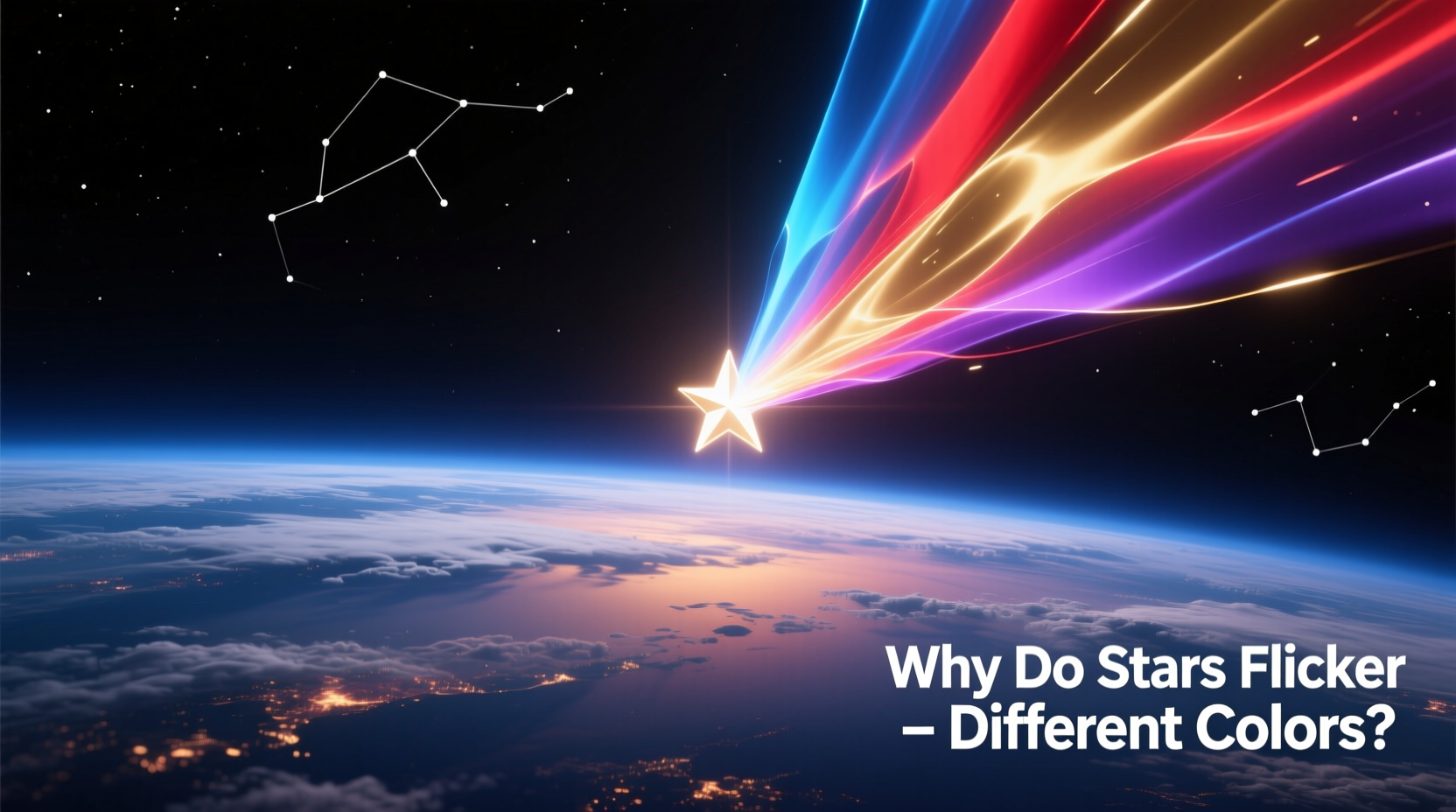
Stars emit light across the electromagnetic spectrum, but what reaches our eyes is primarily visible light. Each star has a characteristic color determined by its surface temperature. Cooler stars around 3,000 K glow red, mid-temperature stars like our Sun (about 5,800 K) appear yellow-white, and hotter stars exceeding 10,000 K shine with a bluish hue. This intrinsic color is stable and consistent over human timescales.
However, the light traveling from a star must pass through hundreds of miles of Earth’s atmosphere before reaching an observer. The atmosphere is not uniform—it contains layers of varying density, temperature, and humidity. As starlight enters this shifting medium, it undergoes refraction, scattering, and diffraction, which distort the path and appearance of the light.
Why Stars Twinkle: Atmospheric Turbulence
The scientific term for twinkling is scintillation, caused by atmospheric turbulence. Small pockets of air with differing temperatures and densities bend light slightly as it passes through. These fluctuations happen rapidly—dozens of times per second—causing the apparent position, brightness, and color of a star to jitter.
This effect is most noticeable with point sources of light, such as stars. Planets, in contrast, rarely twinkle because they are closer and appear as tiny disks rather than points. Their larger apparent size averages out the atmospheric distortions, resulting in a steadier glow.
When light refracts unevenly, shorter wavelengths (blue and violet) are bent more than longer ones (red and orange). At any given moment, one color may dominate the beam reaching your eye. As conditions shift, so does the dominant color—creating the illusion that the star is rapidly changing hues.
Color Flickering: Dispersion in Action
The rainbow-like flashes seen in bright stars like Sirius or Betelgeuse result from atmospheric dispersion. Just as a prism splits white light into its component colors, air masses act like weak, ever-changing prisms. When a star is low on the horizon, its light travels through more atmosphere, increasing the chance for dispersion.
For instance, when Sirius—the brightest star in the night sky—is near the horizon, observers often report vivid flashes of green, blue, and red. These are not emitted by the star but are artifacts of the viewing angle and atmospheric conditions. High-altitude observatories minimize this effect by situating telescopes above much of the atmosphere.
“Scintillation is not noise—it’s data. By analyzing how starlight flickers, we can infer wind speeds, temperature gradients, and even pollution levels in the upper atmosphere.” — Dr. Lena Torres, Atmospheric Physicist, University of Colorado
Factors That Influence Color Flickering
Several environmental and observational factors determine how strongly a star flickers and whether color changes are visible:
- Elevation above the horizon: Stars near the horizon pass through more atmosphere, enhancing flicker and color dispersion.
- Atmospheric stability: Calm, dry nights reduce turbulence, leading to steadier starlight.
- Observer location: Urban areas with heat rising from buildings create more turbulence than rural or mountainous regions.
- Star brightness: Brighter stars like Vega or Rigel show more noticeable color shifts because their strong signal makes transient color effects easier to perceive.
| Factor | Effect on Flickering | Best Conditions for Minimal Flicker |
|---|---|---|
| Low elevation (near horizon) | Strong flicker, vivid color changes | Avoid observation; wait until star is higher |
| High humidity | Increased refraction and scattering | Dry, cold nights |
| Urban environment | Heat turbulence amplifies scintillation | Rural or elevated sites |
| Bright star | More visible color shifts | No mitigation—part of natural observation |
| Telescope use | Amplifies flicker unless adaptive optics used | Use image-stabilized systems or long exposures |
Observing Tips: How to See (and Reduce) Color Flickering
Whether you're a casual stargazer or an amateur astronomer, understanding flicker helps you interpret what you’re seeing. Here’s how to optimize your observations:
- Observe stars when they’re highest in the sky—this minimizes atmospheric thickness and reduces dispersion.
- Avoid observing immediately after sunset when ground heat causes rising air currents.
- Choose clear, dry nights with little wind for the steadiest views.
- Use binoculars or telescopes with filters to isolate specific wavelengths and study true stellar color.
- Practice patience: Let your eyes adjust and observe a single star for several minutes to distinguish atmospheric effects from actual variability.
Mini Case Study: The Green Flashes of Sirius
In January 2022, a group of amateur astronomers in southern France reported intense green and purple flickers from Sirius during its rise over the Mediterranean. Initial speculation suggested unusual solar activity or atmospheric anomalies. However, analysis revealed typical winter conditions: cold air over warm sea water created strong convection currents just above the horizon. These turbulent layers acted as a transient prism, dispersing Sirius’s white-blue light into brief spectral flashes. Within 30 minutes, as the star climbed higher, the flickering subsided and its color stabilized to its usual icy white. This case illustrates how local meteorology can dramatically influence stellar observation—even producing rare-seeming phenomena under common conditions.
Advanced Insight: Astronomy Beyond the Twinkle
Professional observatories combat scintillation using adaptive optics—systems that deform telescope mirrors in real time to cancel out atmospheric distortion. Lasers are fired into the upper atmosphere to create artificial guide stars, allowing computers to measure distortion and correct incoming light thousands of times per second.
Space-based telescopes like Hubble or James Webb avoid the issue entirely by operating above the atmosphere. They capture starlight in its pure form, revealing true colors and fine details impossible to resolve from the ground. For example, Hubble images show stars with precise spectral classifications, free from the chromatic noise introduced by Earth’s air.
Frequently Asked Questions
Do stars actually change color?
Most stars have a stable color based on their temperature. However, some variable stars, like pulsating Cepheids or eruptive novae, do change brightness and sometimes color over days or years. The rapid color flickering seen nightly is almost always due to Earth’s atmosphere, not the star itself.
Why don’t planets twinkle like stars?
Planets appear as small disks rather than points of light. Because their light comes from a broader area in the sky, atmospheric distortions average out, resulting in a more stable image. This is why planets typically shine with a steady light, even when nearby stars are twinkling violently.
Can I photograph star color flickering?
Yes, but it requires short exposure times (1/30 sec or faster) and high frame rates. Video recordings of bright stars near the horizon often capture fleeting color changes invisible to the naked eye. Stacking multiple short exposures can reveal the full spectrum of dispersed light.
Conclusion: Embracing the Dance of Starlight
The flickering colors of stars are not flaws in the night sky—they are part of its living beauty. Each shimmer tells a story of light traveling across the cosmos, only to be briefly reshaped by the winds and waves of our own atmosphere. Rather than seeking to eliminate this effect, we can learn to read it: as a clue to weather patterns, a challenge for astronomers, and a reminder of how deeply our viewpoint shapes what we see.
Next time you watch a star flash red then blue, remember—you’re witnessing physics in motion. Step outside, look up, and let the stars remind you that even the most distant lights are touched by the world we live in.




 浙公网安备
33010002000092号
浙公网安备
33010002000092号 浙B2-20120091-4
Comments
No comments yet. Why don't you start the discussion?