
From the blocky pixels of 1980s arcade cabinets to today’s hyper-stylized protagonists in AAA titles, video game character design has undergone a dramatic transformation. One consistent trend throughout this evolution—regardless of graphical fidelity—is exaggeration. Characters often possess oversized heads, elongated limbs, impossibly large eyes, or wildly disproportionate silhouettes. At first glance, these choices might seem arbitrary or purely aesthetic, but they are rooted in technical constraints, cultural influences, and deliberate artistic decisions that serve both function and storytelling.
The exaggeration seen in video game characters isn’t just a stylistic quirk—it’s a response to the medium’s unique demands. As technology advanced, so did the creative freedom of artists, yet many of the exaggerated traits persisted, even intensified. Understanding why requires a journey through the history of game development, visual communication, and human perception.
The Technical Origins: Pixel Limitations and Clarity
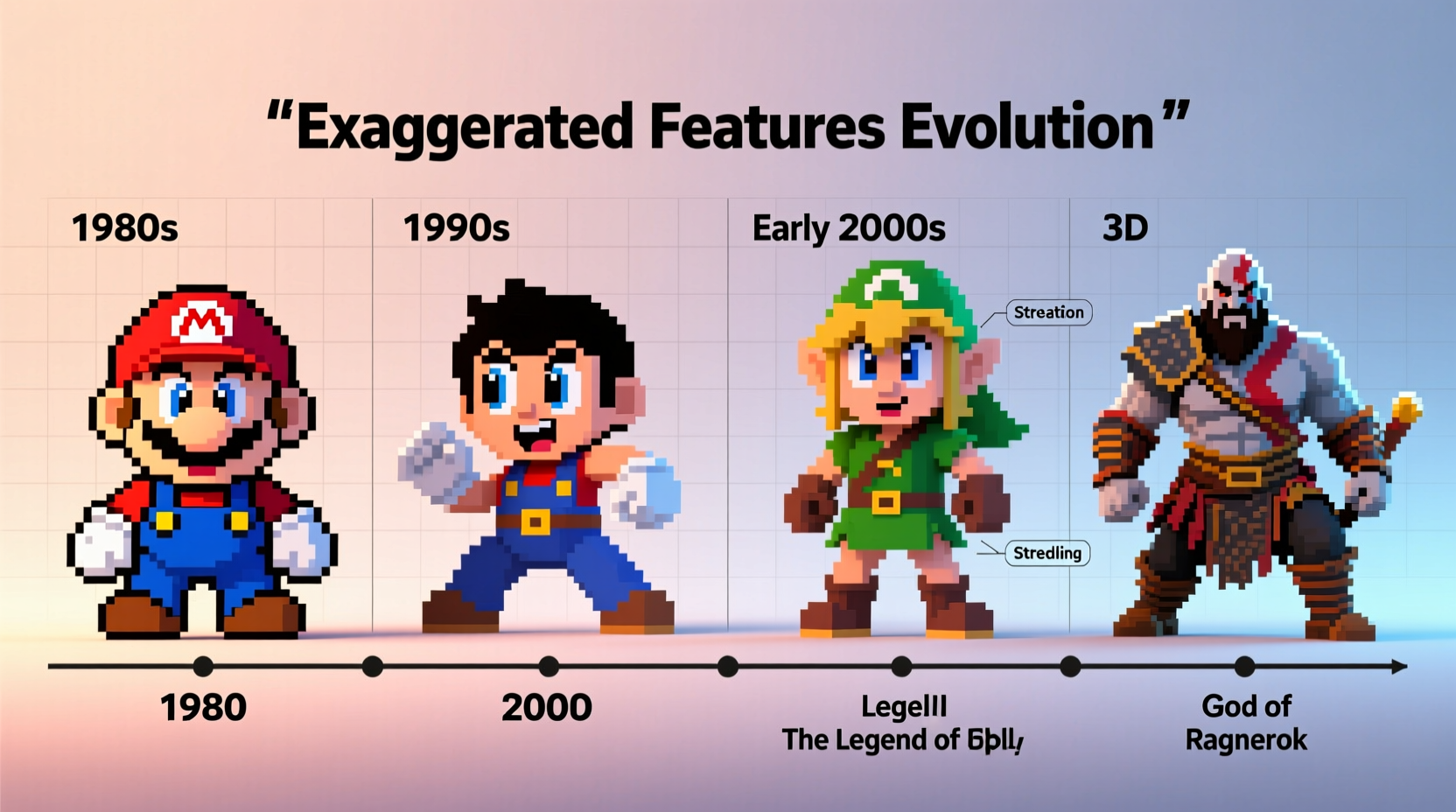
In the early days of video games, hardware dictated design. With limited processing power and low-resolution displays, developers had to work within severe constraints. A character on screen might be as small as 16x16 pixels. In such a tiny space, subtle facial expressions or nuanced body language were impossible to render. To ensure players could recognize who a character was—and what they were doing—artists leaned into exaggeration.
Take Mario, for example. His red cap and blue overalls weren’t chosen merely for visual flair; they helped distinguish him from backgrounds and enemies in a crowded side-scrolling environment. His nose is large, his mustache thick, and his eyes simple dots beneath bold eyebrows—all features designed for instant readability at a distance and on low-res screens.
This principle—designing for clarity—remains relevant even in modern games. While we now have 4K textures and motion capture, legibility during rapid gameplay is still crucial. An exaggerated feature like Kratos’ massive axe or Bayonetta’s towering heels isn’t just about style; it ensures the player can track movement and intent instantly.
Artistic Evolution: From Necessity to Expression
As graphics improved in the 1990s and 2000s, the need for extreme simplification lessened. Yet rather than moving toward realism, many games embraced stylization more boldly. This shift marked a transition from technical necessity to artistic expression. Exaggeration became a tool not for visibility—but for personality.
Characters like Sly Cooper, with his sleek thief’s mask and acrobatic proportions, or Jak and Daxter, whose designs blend cartoon logic with sci-fi edge, show how exaggeration conveys tone and narrative. A long snout might suggest cunning; broad shoulders imply strength; enormous eyes signal innocence or curiosity. These traits communicate identity faster than dialogue ever could.
Japanese game design, in particular, played a pivotal role in shaping this expressive approach. Influenced by anime and manga traditions—where emotions are amplified through physical distortion—games like *Final Fantasy*, *Persona*, and *The Legend of Zelda* adopted similar principles. Cloud Strife’s gravity-defying hair isn’t realistic, but it signals rebellion, otherness, and internal turmoil.
“Exaggeration in character design is shorthand for emotion. It allows players to ‘read’ a character in seconds.” — Naomi Tanaka, Concept Artist at Level-5
Cultural and Psychological Foundations of Exaggeration
Why do humans respond so strongly to exaggerated forms? The answer lies in cognitive psychology. Studies show that people recognize caricatures—distorted likenesses—more quickly than accurate portraits. Our brains are wired to latch onto distinctive features. In games, where attention spans are short and environments chaotic, this gives exaggerated characters a distinct advantage.
Moreover, exaggerated features often tap into universal emotional cues. Large eyes, for instance, trigger nurturing instincts—a phenomenon known as the \"baby schema.\" Characters like Pikachu or Korok from *Breath of the Wild* use this to appear endearing and memorable. Conversely, villains frequently have sharp angles, sunken eyes, or asymmetrical features to evoke unease.
Culturally, different regions developed distinct approaches. Western games, especially in the early 2000s, often pursued gritty realism—think *Gears of War* or *Max Payne*. But even there, characters were exaggerated: bulging muscles, weathered faces, and dramatic lighting pushed them beyond realism into symbolic territory. Meanwhile, Eastern studios leaned into whimsy, surrealism, and emotional expressiveness, reinforcing exaggeration as a core design language.
Timeline of Art Style Shifts in Major Franchises
The progression of art styles across long-running franchises illustrates how exaggeration has evolved—not disappeared—as technology advanced.
- 1985–1990 (NES Era): Simple shapes, minimal animation. Mario evolves from a faceless plumber to a character with clear features.
- 1996–2001 (N64/PS1 Era): Polygonal models introduce new challenges. Link in *Ocarina of Time* has a large head and hands to compensate for low-poly detail.
- 2005–2010 (PS3/Xbox 360 Era): Higher resolution allows more nuance, but stylization peaks. *Okami* uses sumi-e brushstrokes; *Mirror’s Edge* employs minimalist design with bold color blocking.
- 2013–Present (HD/4K Era): Realism competes with stylization. *Spider-Man* (Insomniac) blends comic accuracy with exaggerated acrobatics. *Fortnite* embraces full cartoon absurdity for cross-generational appeal.
Notably, even in photorealistic games like *The Last of Us Part II*, slight exaggeration remains. Facial animations push beyond naturalism during emotional scenes to ensure impact is felt across playstyles and display types.
Functional Benefits of Exaggerated Design
Beyond aesthetics and psychology, exaggerated features serve practical gameplay functions:
- Silhouette Recognition: In fast-paced multiplayer games like *Overwatch* or *Apex Legends*, each character must be identifiable at a glance—even in smoke or darkness. Tracer’s spiky ponytail or Revenant’s robotic frame make them instantly recognizable.
-
Exaggerated limbs and joints allow for broader, more readable movements. A punch thrown by a character with normal proportions may look weak; one with elongated arms feels impactful. - Emotional Feedback: When a character jumps, their body squashes and stretches slightly—a principle borrowed from traditional animation. This “squash and stretch” makes actions feel dynamic and responsive.
- Brand Identity: Exaggerated designs become iconic. Sonic’s speed lines, Pikachu’s cheeks, Master Chief’s helmet—these aren’t just visuals; they’re trademarks.
| Game | Exaggerated Feature | Purpose |
|---|---|---|
| Sonic the Hedgehog | Spikes, long legs, speed blur | Visualize velocity and energy |
| Cuphead | Cartoonish proportions, rubber-hose limbs | Evoke 1930s animation authenticity |
| Team Fortress 2 | Massive weapons, oversized heads | Class differentiation and humor |
| Zelda: Breath of the Wild | Large eyes, simplified facial features | Express emotion without complex rigging |
Mini Case Study: The Reinvention of Lara Croft
Lara Croft’s evolution exemplifies how exaggeration adapts across eras. In her 1996 debut, her polygonal form featured an impractical physique—sharp angles, exaggerated curves—dictated by both technical limits and market trends aiming for a “digital pin-up.” Over time, as cultural expectations shifted and technology improved, her design matured.
By *Tomb Raider* (2013), Lara became more anatomically plausible, yet key exaggerations remained: her wide eyes convey fear and determination; her movements are slightly amplified to emphasize effort during climbing or combat. The reboot didn’t eliminate exaggeration—it redirected it from sexualization to emotional resonance.
This shift reflects a broader industry trend: using exaggeration not for spectacle alone, but for deeper player connection. Her facial expressions during near-death moments are slightly stretched, making pain and resolve unmistakable—even during quick cutscenes.
Checklist: Designing Effective Exaggerated Characters
Whether you're a developer, artist, or enthusiast analyzing game design, consider these principles when evaluating or creating exaggerated characters:
- Define the character’s core trait (e.g., speed, wisdom, aggression).
- Identify which physical feature can symbolize that trait (long legs for speed, large head for intelligence).
- Test silhouette visibility at multiple distances and angles.
- Ensure animations amplify key actions with squash, stretch, and follow-through.
- Balance exaggeration with readability—avoid cluttering the design.
- Consider cultural context: some exaggerations may carry unintended meanings.
- Iterate based on player feedback—what reads as “cool” in concept may confuse in practice.
Frequently Asked Questions
Do exaggerated characters limit diversity in games?
Not inherently. While early exaggeration often reinforced stereotypes (e.g., hyper-muscular men, overly sexualized women), modern design uses exaggeration to celebrate diverse identities. Games like *Spiritfarer* or *Tell Me Why* use stylized forms to express emotional truth without relying on realism. The key is intentionality—ensuring exaggeration serves character, not cliché.
Can realism and exaggeration coexist?
Absolutely. Many successful games blend both. *Red Dead Redemption 2* uses realistic textures and lighting but exaggerates facial tics, posture, and gestures during key scenes to heighten drama. Motion capture provides a base, but animators enhance it for cinematic effect—proving that even in realism, exaggeration enhances storytelling.
Will AI-generated art change how we exaggerate in games?
Possibly—but not by eliminating exaggeration. AI tools can generate highly realistic models, but they often struggle with intentional distortion. Artists will still need to guide AI outputs to maintain expressive intent. If anything, AI may accelerate iteration, allowing designers to test exaggerated variants rapidly before settling on the most effective version.
Conclusion: Exaggeration as a Language of Play
Video game characters have exaggerated features not because artists lack skill, but because exaggeration is a fundamental language of the medium. Born from technical necessity, refined through cultural exchange, and validated by cognitive science, it remains one of the most powerful tools in game design. It bridges the gap between machine limitation and human emotion, ensuring that even in a split-second encounter, a character’s essence is felt.
As virtual worlds grow more complex, the need for clear, expressive design only intensifies. Exaggeration isn’t a relic of the past—it’s a future-proof strategy for creating memorable, meaningful experiences. Whether through a hero’s defiant stance or a sidekick’s goofy grin, these amplified forms speak directly to our instincts, making games not just playable, but deeply felt.




 浙公网安备
33010002000092号
浙公网安备
33010002000092号 浙B2-20120091-4
Comments
No comments yet. Why don't you start the discussion?