
In the real world, gravity pulls us down, momentum carries objects forward, and mass dictates how things move and collide. Yet in most video games, characters leap across canyons, survive fatal falls, and sprint indefinitely without breaking a sweat. From Mario’s double jumps to Kratos’ godlike strength, video game characters routinely defy the laws of physics as we know them. This isn’t a flaw—it’s intentional design. The suspension of physical realism serves gameplay, storytelling, and player enjoyment. But what exactly drives this widespread departure from scientific accuracy? And why do developers prioritize fun over fidelity?
The answer lies at the intersection of technology, creative freedom, and user experience. While modern gaming engines are capable of simulating realistic physics with astonishing precision, they often choose not to—because realism doesn’t always make for better games.
Gameplay Over Realism
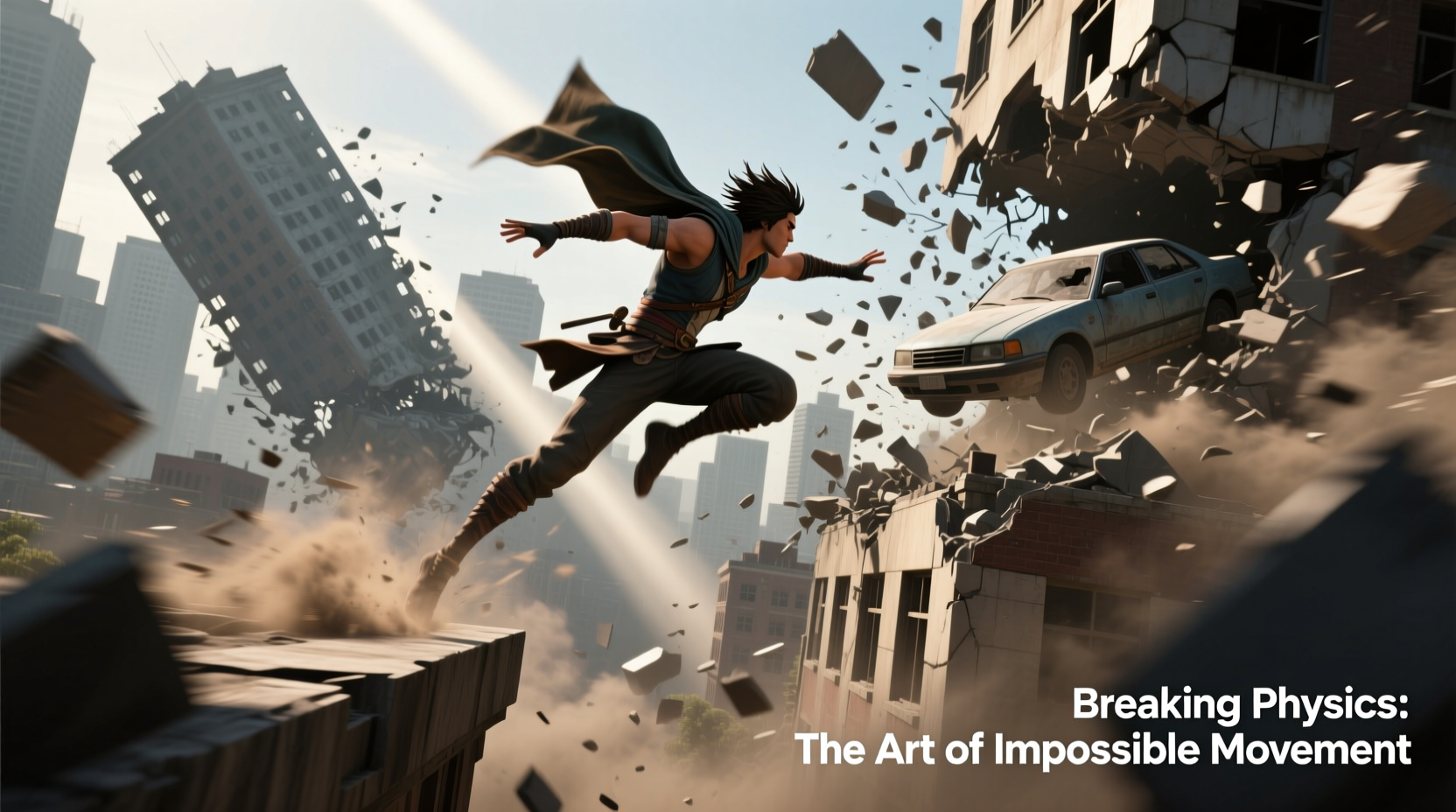
At its core, video game design prioritizes engagement. A character who adheres strictly to real-world physics would be limited by fatigue, injury mechanics, and environmental constraints that could quickly become frustrating. Imagine a platformer where every jump required perfect timing due to air resistance and wind drag, or an action RPG where falling just two stories results in permanent death. These scenarios might be physically accurate, but they’d likely alienate players seeking challenge balanced with accessibility.
Instead, game designers implement \"game feel\"—a term used to describe how responsive and satisfying controls are. Characters often have exaggerated movements because they feel more dynamic and rewarding. For example, Sonic the Hedgehog runs faster than any biological creature could sustain, yet his speed is central to the identity of the game. Removing that exaggeration would fundamentally alter the experience.
Technical Constraints and Optimization
While today’s hardware is powerful, rendering fully accurate physics for every object, character, and interaction in real time remains computationally expensive. Simulating muscle dynamics, bone fractures, or fluid resistance for thousands of entities would overwhelm even high-end systems. To maintain smooth frame rates and reduce lag, developers simplify or ignore certain physical rules.
For instance, many games use \"canned animations\" rather than procedurally generated motion. A character vaulting over a ledge may play a pre-recorded animation regardless of their actual velocity or angle. This approach sacrifices realism for consistency and performance. Similarly, collision detection is often approximated using simplified shapes (like bounding boxes) instead of precise mesh interactions.
Moreover, networked games such as online shooters must reconcile physics across multiple devices. Latency and packet loss mean that exact synchronization of physical states is nearly impossible. As a result, games apply interpolation and prediction algorithms that sometimes cause characters to appear to teleport or clip through walls—breaking physics not by choice, but necessity.
Physics Simplification Techniques in Modern Games
| Technique | Purpose | Example |
|---|---|---|
| Bounding Volumes | Faster collision checks | Using cylinders instead of detailed limbs |
| Fixed Time Steps | Stable simulation loops | Preventing jitter in ragdoll physics |
| Animation Blending | Smoother transitions | Jumping onto platforms with variable heights |
| Network Prediction | Reduce perceived lag | Players appearing to move before server confirms |
| One-Way Platforms | Design flexibility | Walking on floors from below, jumping up through them |
Narrative and Genre Expectations
Just as comic book heroes fly and superheroes punch meteors into space, video game protagonists often possess abilities far beyond human limits. These exaggerations are not only accepted but expected within specific genres. In a fantasy RPG, players anticipate magical powers; in a sci-fi shooter, enhanced reflexes and jetpacks are standard.
Consider Master Chief from *Halo* or Lara Croft from *Tomb Raider*. Both endure extreme falls, carry dozens of weapons simultaneously, and recover from injuries in seconds. These traits aren’t oversights—they reinforce the narrative of larger-than-life heroes overcoming impossible odds. Breaking physics becomes part of the storytelling language.
Genre also influences expectations. A racing simulator like *Assetto Corsa* strives for mechanical authenticity, modeling tire grip, suspension travel, and aerodynamics in detail. In contrast, *Mario Kart* features anti-gravity tracks, floating coins, and explosive banana peels—all absurdities that serve whimsy and competition. The same medium, vastly different rules.
“Games aren't about replicating reality—they're about creating compelling experiences. Sometimes that means letting go of gravity.” — Dr. Katherine Lee, Game Design Researcher at NYU Tisch School of the Arts
Player Agency and Control
One of the defining features of video games is interactivity. Unlike films or books, games require players to make decisions and execute actions in real time. This demands predictable, intuitive responses from characters. If a jump were governed by true ballistic physics, slight input variations could lead to missed landings and repeated failures—frustrating rather than fun.
To preserve agency, developers implement \"input forgiveness.\" This includes techniques like jump buffering (recording inputs slightly before a button press window opens), mid-air directional adjustments, and landing leniency. These allow players to recover from imperfect timing, making controls feel tight even when they’re technically inaccurate.
A prime example is *Super Mario Bros.*, where Mario can change direction mid-jump. In reality, momentum would prevent such sharp redirection. But allowing this control gives players greater precision and reduces trial-and-error frustration. It’s a small lie that enhances the overall experience.
Mini Case Study: The Rise of Wall-Running Mechanics
In *Titanfall 2*, players can run along walls, shoot while doing so, and chain together acrobatic maneuvers across urban environments. From a physics standpoint, this defies friction, balance, and center-of-mass principles. No human could generate enough lateral force to sustain horizontal running on vertical surfaces without support.
Yet, wall-running became one of the game’s most celebrated mechanics. Why? Because it expanded mobility in meaningful ways. Players could flank enemies, evade attacks, and traverse maps creatively. Respawn Entertainment didn’t aim for realism—they optimized for flow, speed, and skill expression. The result was a movement system that felt empowering, not deceptive.
This case illustrates a broader truth: players don’t mind broken physics as long as the outcome feels fair and controllable. When unrealistic mechanics are consistent and learnable, they become tools—not cheats.
Historical Evolution of Physics in Games
Early video games had no choice but to ignore physics. With limited processing power, developers focused on basic sprite movement and collision. Pong simulated rudimentary bounce angles, but nothing close to real-world elasticity. As technology advanced, so did simulation capabilities. By the late 1990s, titles like *Half-Life* introduced rudimentary physics puzzles using the Havok engine.
The turning point came in the 2000s with middleware like PhysX and Havok becoming widely adopted. Games began incorporating destructible environments, ragdoll corpses, and object stacking. However, even as these tools enabled realism, designers continued to override them when necessary. For example, *Portal* uses realistic momentum conservation—but only selectively. Chell maintains her velocity when exiting portals, creating a satisfying cause-and-effect loop. Yet she never tires, takes fall damage, or suffers from inertia buildup.
This selective application highlights a key principle: physics in games are tools, not mandates. Developers pick and choose which rules to follow based on context.
Checklist: When Is It Okay to Break Physics?
- ✅ When it improves player control and responsiveness
- ✅ When genre conventions expect exaggerated abilities
- ✅ When performance optimization requires simplification
- ✅ When narrative supports superhuman feats
- ✅ When consistency and fairness are maintained
- ✅ When the alternative would harm fun or accessibility
FAQ
Can’t modern computers simulate real physics accurately?
They can—but only for limited systems. Full-body biomechanics, environmental interaction, and multi-agent dynamics require immense computation. Even then, accuracy doesn’t guarantee enjoyment. Most games use hybrid models: realistic where it matters (explosions, vehicle handling), abstract elsewhere (character stamina, inventory).
Do some games actually follow real physics?
Yes. Simulation-focused titles like *Kerbal Space Program*, *Microsoft Flight Simulator*, and *Euro Truck Simulator* emphasize realism. These cater to niche audiences who value authenticity. But even they include assists and simplified modes to accommodate varying skill levels.
Does breaking physics hurt immersion?
Not necessarily. Immersion comes from coherence, not realism. If a world establishes its own internal logic—like double jumps being possible due to cybernetic enhancements—players accept it. Inconsistencies or unpredictable behavior are more damaging than rule-breaking.
Conclusion: Embracing Creative Freedom
Video game characters break physics not because developers lack understanding, but because they understand something deeper: the purpose of games is not to mirror reality, but to create meaningful, engaging experiences. Whether it's leaping ten feet into the air, surviving explosions unscathed, or carrying an arsenal of weapons, these liberties exist to empower players, enhance storytelling, and deliver joy.
The beauty of interactive media lies in its ability to transcend limitations. Just as literature uses metaphor and film bends time with editing, games manipulate physics to serve emotion, pacing, and design. Recognizing this intentionality allows us to appreciate the craft behind even the most absurd leaps and landings.




 浙公网安备
33010002000092号
浙公网安备
33010002000092号 浙B2-20120091-4
Comments
No comments yet. Why don't you start the discussion?