
In the pursuit of lifelike immersion, modern video games have achieved astonishing levels of visual fidelity. Characters wear detailed textures, move with fluid animations, and react to environments with near-human nuance. Yet one subtle but noticeable trait often remains absent: blinking. Despite being a natural, involuntary human behavior occurring roughly 15–20 times per minute, blinking is conspicuously underrepresented in many game characters. This omission raises an important question: Why do video game characters rarely blink, and what impact does this have on realism and player perception?
The answer lies at the intersection of technical limitations, artistic intent, animation priorities, and cognitive psychology. While blinking may seem like a minor detail, its presence—or absence—can subtly influence how players interpret emotion, intent, and believability in digital avatars.
The Technical Challenges of Realistic Blinking
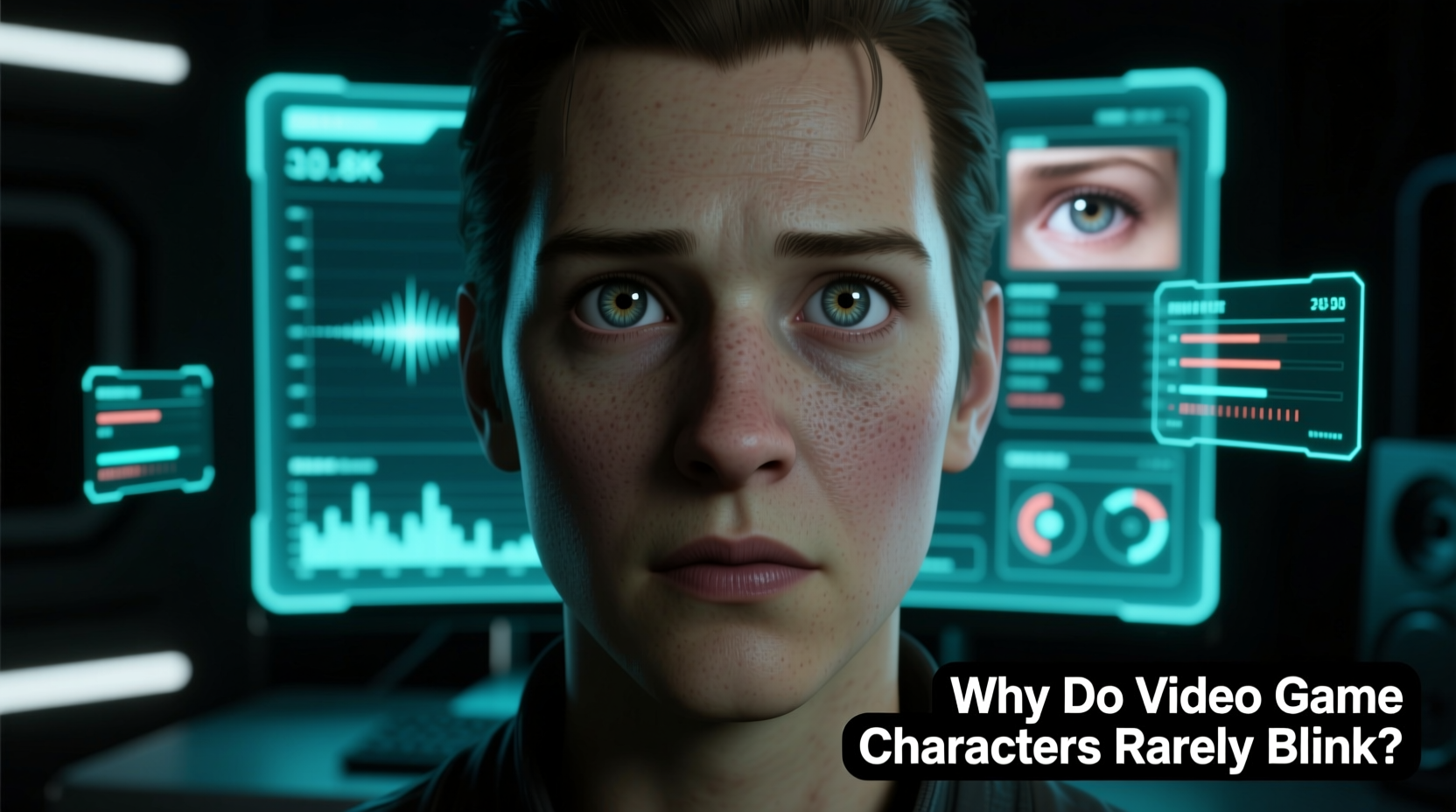
At first glance, animating a blink appears simple: close the eyelids briefly, then reopen them. But in practice, realistic blinking involves complex coordination of facial muscles, timing, and context. In real-time rendering environments like video games, every frame counts. Animators and developers must balance visual quality with performance efficiency, and blinking often falls low on the priority list.
Facial rigging—the system that controls how a character’s face deforms during expressions—requires significant computational resources. Adding nuanced eye movements, including blinks, demands additional bones, blend shapes, or morph targets. These increase the complexity of the character model and can strain hardware, especially when multiple characters are on screen.
Moreover, blinking must be contextually appropriate. Humans blink more frequently when tired, less so when concentrating. A blink at the wrong moment—such as during a dramatic line delivery—can disrupt emotional tone or make a character appear distracted. Implementing intelligent, context-sensitive blinking systems requires behavioral AI integration, which most games lack due to scope or resource constraints.
Artistic and Narrative Priorities Over Biological Accuracy
Game developers often prioritize clarity and expressiveness over strict realism. The eyes are central to conveying emotion, and keeping them visible ensures players don’t miss subtle cues during dialogue or cutscenes. A prolonged blink during a key moment could obscure a character’s gaze, diluting tension or miscommunicating intent.
This principle is especially critical in narrative-driven games where facial expressions carry emotional weight. Titles like The Last of Us Part II or Red Dead Redemption 2 invest heavily in micro-expressions—tiny muscle movements around the eyes and mouth—to communicate grief, suspicion, or affection. In such contexts, animators may suppress blinking during emotionally charged scenes to maintain visual continuity and emotional focus.
Additionally, blinking can introduce unintended comedic or unsettling effects if poorly timed. A character who blinks mid-scream might appear comical rather than terrifying. To avoid such pitfalls, studios sometimes opt for reduced or stylized blinking, particularly in high-stakes sequences.
“Facial animation is storytelling. Every twitch, every glance, every blink—or lack thereof—is a deliberate choice to guide the player’s empathy.” — Lena Torres, Senior Character Animator at Obsidian Entertainment
Performance Capture Limitations and Post-Production Gaps
Many modern games use performance capture (or “mocap”) to record actors’ movements and translate them into digital characters. While this technology captures body motion and facial expressions with impressive accuracy, eye behavior—including blinking—is not always preserved faithfully.
Eye tracking systems used in mocap setups can struggle with rapid lid movement, reflections, or lighting changes. As a result, captured blinks may appear jittery, too long, or improperly synced with speech. Rather than spend hours cleaning up inconsistent blink data, animation teams may choose to remove or manually reanimate blinks entirely.
Furthermore, post-processing pipelines often standardize facial animations across different scenes. A blink that works in one lighting condition might look unnatural in another due to shading differences on the eyelid. To ensure consistency, developers may replace organic, variable blinks with a single, loopable animation—or eliminate them altogether.
A Mini Case Study: Death Stranding and the Limits of Realism
Hideo Kojima’s Death Stranding is renowned for its hyper-realistic character models, particularly Norman Reedus’s portrayal of Sam Porter Bridges. The game uses advanced facial scanning and performance capture to recreate subtle expressions. Yet even here, blinking is noticeably infrequent.
Reviewers and fans observed that while skin pores and sweat beads were rendered in microscopic detail, Sam often went minutes without blinking—especially during monologues. This created a subtle but persistent sense of unease. Some interpreted it as intentional, reflecting Sam’s emotional detachment or constant vigilance in a hostile world. Others saw it as a technical oversight.
Behind the scenes, Kojima Productions confirmed that blink animations were selectively removed during editing to preserve emotional clarity. In one scene where Sam learns tragic news, the team eliminated a natural blink that momentarily broke the intensity of his stare. This decision, though small, illustrates how artistic control can override biological realism for narrative effect.
Psychological Impact: The Uncanny Valley and Perceived Humanity
The absence of blinking contributes to what psychologists call the “uncanny valley”—the discomfort people feel when something almost, but not quite, resembles a human. Smooth skin and accurate proportions can heighten expectations for natural behavior. When a character fails to blink, the brain registers a subtle mismatch between appearance and action, triggering subconscious unease.
Studies in human-computer interaction show that participants rate animated faces with natural blink patterns as more trustworthy, empathetic, and lifelike. Conversely, non-blinking avatars are perceived as robotic, aggressive, or emotionally detached—even when other facial features are highly realistic.
Interestingly, the effect varies by cultural context and genre. In stylized games like Fortnite or Overwatch, where exaggerated expressions dominate, missing blinks go unnoticed. But in photorealistic RPGs or cinematic adventures, the lack becomes more jarring. Players expect realism and notice its absence in intimate close-ups.
| Game Genre | Blink Frequency | Player Perception |
|---|---|---|
| Cinematic Narrative (e.g., Heavy Rain) | Low to Moderate | Noticed; affects immersion |
| Action/Adventure (e.g., God of War) | Moderate | Sometimes missed in fast scenes |
| Stylized Multiplayer (e.g., Apex Legends) | High or Exaggerated | Less critical; often ignored |
| Horror (e.g., Resident Evil) | Very Low | Enhances tension or eeriness |
Best Practices: How Developers Can Improve Blink Realism
Improving blink implementation doesn’t require overhauling entire animation systems. Small, strategic adjustments can significantly enhance realism without compromising performance or narrative flow.
Step-by-Step Guide to Implementing Natural Blinks
- Define Contextual Triggers: Program blinks to occur more frequently during idle states and less during intense actions or dialogue peaks.
- Randomize Intervals: Use a timer that triggers blinks every 3–7 seconds, varying slightly to avoid mechanical repetition.
- Integrate with Speech Animation: Ensure blinks do not coincide with phonemes requiring open-mouth visibility (e.g., “O,” “A” sounds).
- Add Partial Blinks: Include half-lids or flutter blinks for tired or emotional states to deepen expressiveness.
- Test in Cutscenes: Review close-ups to confirm blinks don’t obscure key emotional moments or create visual glitches.
Checklist for Animation Teams
- ✅ Audit current character models for blink frequency and timing
- ✅ Ensure blink animations are smooth and properly shaded
- ✅ Sync blinks with breathing and idle animations for coherence
- ✅ Avoid blinks during critical dialogue lines or emotional peaks
- ✅ Test on diverse characters (age, gender, species) to maintain consistency
Frequently Asked Questions
Do all video game characters avoid blinking?
No. Many modern games, especially those using advanced facial capture, include blinking—though often inconsistently. Games like Alan Wake 2 and Star Wars Jedi: Survivor feature more natural blink patterns, while older titles or stylized games may omit them entirely.
Can blinking be automated with AI?
Yes. Emerging AI tools can analyze voice and emotion data to predict optimal blink timing. Some middleware solutions now offer procedural blink systems that adapt to character state, reducing manual animation workload.
Is no blinking always bad for realism?
Not necessarily. In horror or sci-fi contexts, lack of blinking can signal alienness, supernatural presence, or psychological disturbance. It becomes a stylistic tool rather than a flaw when used intentionally.
Conclusion: Balancing Realism and Design Intent
The rarity of blinking in video game characters is not a sign of negligence, but a reflection of competing priorities in game development. Technical constraints, narrative clarity, and artistic vision often outweigh the need for perfect biological mimicry. Yet as players demand deeper immersion, the small details—like a well-timed blink—become increasingly significant.
Realism isn't just about polygon count or ray tracing. It's about behavior, rhythm, and the unconscious signals that make a character feel alive. While blinking may seem trivial, its thoughtful inclusion can bridge the gap between digital puppet and believable persona.
For developers, the challenge lies in integrating such subtleties without sacrificing performance or emotional impact. For players, it’s an invitation to notice the quiet humanity in a fleeting eye movement. As technology advances, we may see blinking evolve from an afterthought to a nuanced storytelling device—one blink at a time.




 浙公网安备
33010002000092号
浙公网安备
33010002000092号 浙B2-20120091-4
Comments
No comments yet. Why don't you start the discussion?