
When Mario jumps into lava, he yelps. When Lara Croft takes a bullet, she gasps. When Kratos is struck by a god’s hammer, he roars. These vocal reactions are so ingrained in gaming that their absence feels jarring. But why do video game characters scream when hit? And how did this become such a universal convention across decades of interactive entertainment?
The answer lies at the intersection of technology, psychology, and storytelling. From the earliest beeps of arcade cabinets to today’s cinematic blockbusters, voice design has evolved from technical necessity into a sophisticated narrative tool. The scream upon impact isn’t just about pain—it’s communication, immersion, and emotional feedback built directly into gameplay.
The Origins: Sound as Feedback in Early Arcade Games
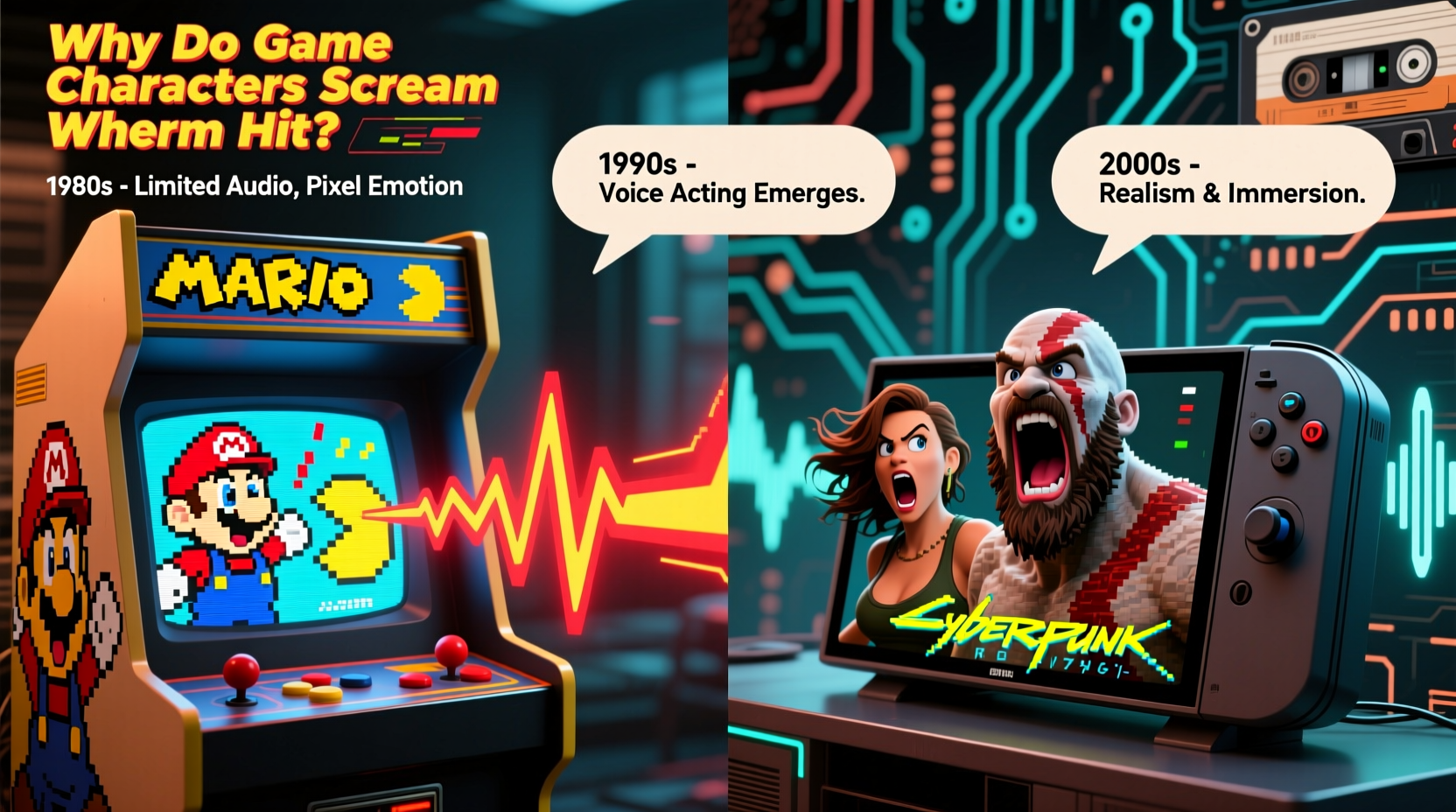
In the 1970s and early 1980s, video games had no voices. Characters were silent. Instead, sound was limited to simple tones and electronic effects generated by rudimentary chips. Yet even then, audio played a critical role in player feedback. A high-pitched beep signaled a point gained; a descending tone meant death.
As hardware improved, developers began incorporating more expressive sounds. One of the first instances of character vocalization came with Donkey Kong (1981). While Jumpman (later known as Mario) didn’t speak, his grunts and yelps were simulated through synthesized tones. These weren’t recordings of human voices but carefully crafted waveforms mimicking distress.
By the late 1980s, games like Double Dragon (1987) introduced digitized speech samples. When players landed a punch, enemies would emit short, guttural cries—“Ugh!” or “Hah!”—recorded from real actors. This marked a turning point: pain was no longer abstract. It became audible, personal, and immediate.
The Psychology of Pain Sounds: Why Screams Work
Human beings react instinctively to vocal expressions of pain. Evolutionarily, screams serve as warnings, rallying cries, or signals for help. In games, these same instincts are leveraged to create engagement. When a character cries out after being hit, it triggers a psychological response in the player—sometimes empathy, sometimes satisfaction, always attention.
Dr. Karen Collins, Canada Research Chair in Interactive Audio at the University of Waterloo, explains:
“In games, sound is often the first indicator of consequence. A scream on impact tells you not only that damage occurred but also its severity. It closes the feedback loop between action and outcome faster than visuals alone.”
This immediacy is crucial. Unlike film or literature, where time can be manipulated, games operate in real-time. Players need instant confirmation that their actions matter. A grunt, a cry, or a full-throated roar provides that confirmation far more effectively than a health bar slowly depleting.
Moreover, vocal reactions help establish character identity. Compare the dignified groan of Master Chief in Halo to the exaggerated wails of Wario. Each reflects personality, tone, and genre. The former conveys stoicism under pressure; the latter amplifies slapstick absurdity.
Technological Milestones in Voice Design
The evolution of voice design parallels advancements in gaming hardware. As storage capacity grew—from cartridges to CDs to digital downloads—so too did the complexity of vocal performances.
| Era | Technology | Vocal Capability | Example |
|---|---|---|---|
| 1980s | ROM chips, low memory | Synthesized grunts, basic digitized phrases | Street Fighter II: “Hadouken!” |
| 1990s | CD-ROM, increased storage | Full voice lines, contextual dialogue | Doom: Demon growls, player pain sounds |
| 2000s | DVD/HD media, voice acting studios | Professional voice actors, emotional range | Half-Life 2: Gordon Freeman’s suit responses |
| 2010s–Present | Streaming, motion capture, AI processing | Dynamic, context-sensitive vocal systems | The Last of Us Part II: Real-time breathing, injury reactions |
One pivotal moment came with the release of Tomb Raider (1996), which featured over 300 unique vocalizations for Lara Croft. Voice actress Shelley Blond recorded every possible reaction: falls, climbs, hits, landings, near-misses. This level of detail was unprecedented and set a new standard for immersive character design.
Fast forward to modern titles like God of War (2018) and Elden Ring, where characters don’t just scream when hit—they breathe heavily when tired, stagger audibly when injured, and mutter under stress. These layers of audio behavior make combat feel visceral and grounded.
Design Philosophy: Purpose Behind the Pain Cry
Game designers don’t add screams arbitrarily. Each vocal reaction serves one or more purposes:
- Feedback: Confirms player input (e.g., hitting an enemy).
- Pacing: Emphasizes rhythm in combat sequences.
- Immersion: Reinforces the physicality of the world.
- Characterization: Reveals personality traits (bravery, fear, arrogance).
- Emotion: Evokes empathy or tension in the player.
Consider the difference between a silent robot enemy and a humanoid soldier who cries out when shot. The latter elicits a stronger emotional response—even if unintended. This is why some games, like BioShock Infinite, use restrained vocalizations during combat to avoid desensitizing players to violence.
Conversely, over-the-top screams are common in arcade-style or superhero games. In Mortal Kombat, the infamous “Sweep!” and agonized fatalities are part of the spectacle. Here, vocal design leans into theatricality rather than realism.
Mini Case Study: The Voice of Kratos
No character embodies the evolution of pain vocalization better than Kratos, the Spartan warrior of God of War. In the original 2005 title, his roars were primal, almost non-human—more beast than man. These were performed by voiceman Terrence C. Carson, who blended rage, anguish, and exertion into a signature bellow.
Years later, in God of War (2018), Kratos returns older, quieter, burdened by regret. His screams are rarer, deeper, and more controlled. When he does cry out, it carries weight—not just physical pain, but emotional toll. Voice director Tinasha Davenport-Hines worked closely with Christopher Judge, the new voice actor, to ensure every grunt, breath, and yell reflected internal struggle.
This shift wasn’t just technical—it was narrative. The sound design mirrored Kratos’ journey from vengeance-driven destroyer to reluctant father. The screams became less frequent but more meaningful.
Modern Techniques: Dynamic Voice Systems
Today’s games use advanced systems to make vocal reactions feel organic. Rather than playing the same “hit” sound repeatedly, engines now support:
- Contextual variation: Different screams based on damage type (fire, fall, slash).
- Staggering intensity: Light grunts vs. full screams depending on health.
- Procedural layering: Combining breath, muscle strain, and vocal pitch in real time.
- Adaptive AI: Enemies react vocally to tactics (e.g., calling for help, taunting).
Games like Red Dead Redemption 2 exemplify this. Arthur Morgan doesn’t just scream when shot—he coughs blood, stumbles mid-sentence, and mutters curses. These details emerge from a complex audio system that tracks stamina, injury location, and emotional state.
Behind the scenes, voice actors record hundreds of isolated sounds—called “vocal libraries”—which are then triggered dynamically during gameplay. This approach, known as *adaptive audio*, ensures that no two reactions feel identical.
Checklist: Key Elements of Effective Hit Vocal Design
- Match vocal intensity to damage severity.
- Ensure variety to prevent repetition fatigue.
- Align tone with character personality (stoic, dramatic, humorous).
- Integrate with ambient sound and music mix.
- Test in gameplay context, not isolation.
- Use layered sounds (breath, cloth, impact) for realism.
- Consider cultural context—some sounds may carry unintended meanings.
Frequently Asked Questions
Do all games use vocal reactions for hits?
No. Some minimalist or abstract games omit vocalizations entirely. For example, Limbo uses silence and ambient sound to enhance unease. Similarly, stealth-focused titles may suppress enemy screams to maintain tension. The decision depends on tone and design goals.
Are voice actors really screaming during recordings?
Rarely. While some intense shouts are performed live, most are layered or modified. Professional voice actors train to simulate pain without damaging their vocal cords. Studios also use pitch-shifting, reverb, and sound blending to enhance raw recordings safely.
Can too many screams be annoying?
Yes. Repetitive or overly loud vocalizations can lead to “audio fatigue,” where players mute sound or disable voice channels. This is especially common in long play sessions. Good design balances expressiveness with restraint.
Conclusion: The Scream as Language
The scream when hit is more than a trope—it’s a language. It speaks to the player without words, conveying danger, effort, and emotion in milliseconds. From the pixelated yelps of the 1980s to the nuanced vocal performances of today, voice design has matured into a vital component of game storytelling.
As virtual reality and AI-driven NPCs become mainstream, the role of vocal feedback will only grow. Future characters might not just scream when hit—they’ll remember the attacker, warn allies, or beg for mercy based on past interactions. The scream could evolve into conversation.
Understanding this history helps us appreciate not just the sounds we hear, but the intention behind them. Every grunt, gasp, and roar is a deliberate choice—a tiny act of empathy engineered to connect player and character across the screen.




 浙公网安备
33010002000092号
浙公网安备
33010002000092号 浙B2-20120091-4
Comments
No comments yet. Why don't you start the discussion?