
For many students and knowledge workers, finding the right background music is a constant challenge. Silence can feel too stark, pop music too distracting, and lyrics often hijack attention. Yet one unlikely source has emerged as a powerful tool for sustained concentration: video game soundtracks. From the ambient loops of *Stardew Valley* to the dynamic scores of *The Legend of Zelda*, these compositions are increasingly being used not just for entertainment, but as cognitive enhancers during study and work sessions. But what makes them so effective? The answer lies in neuroscience—specifically how our brains process sound, regulate arousal, and maintain attention under cognitive load.
Unlike traditional music genres designed for emotional expression or storytelling, video game soundtracks are engineered for functionality. They must support prolonged engagement without becoming intrusive. This design philosophy aligns remarkably well with the brain’s need for optimal stimulation during focused tasks. By understanding the neural mechanisms behind attention, memory, and auditory processing, we can see why these digital scores outperform other types of background audio when it comes to boosting productivity.
The Neuroscience of Attention and Background Sound
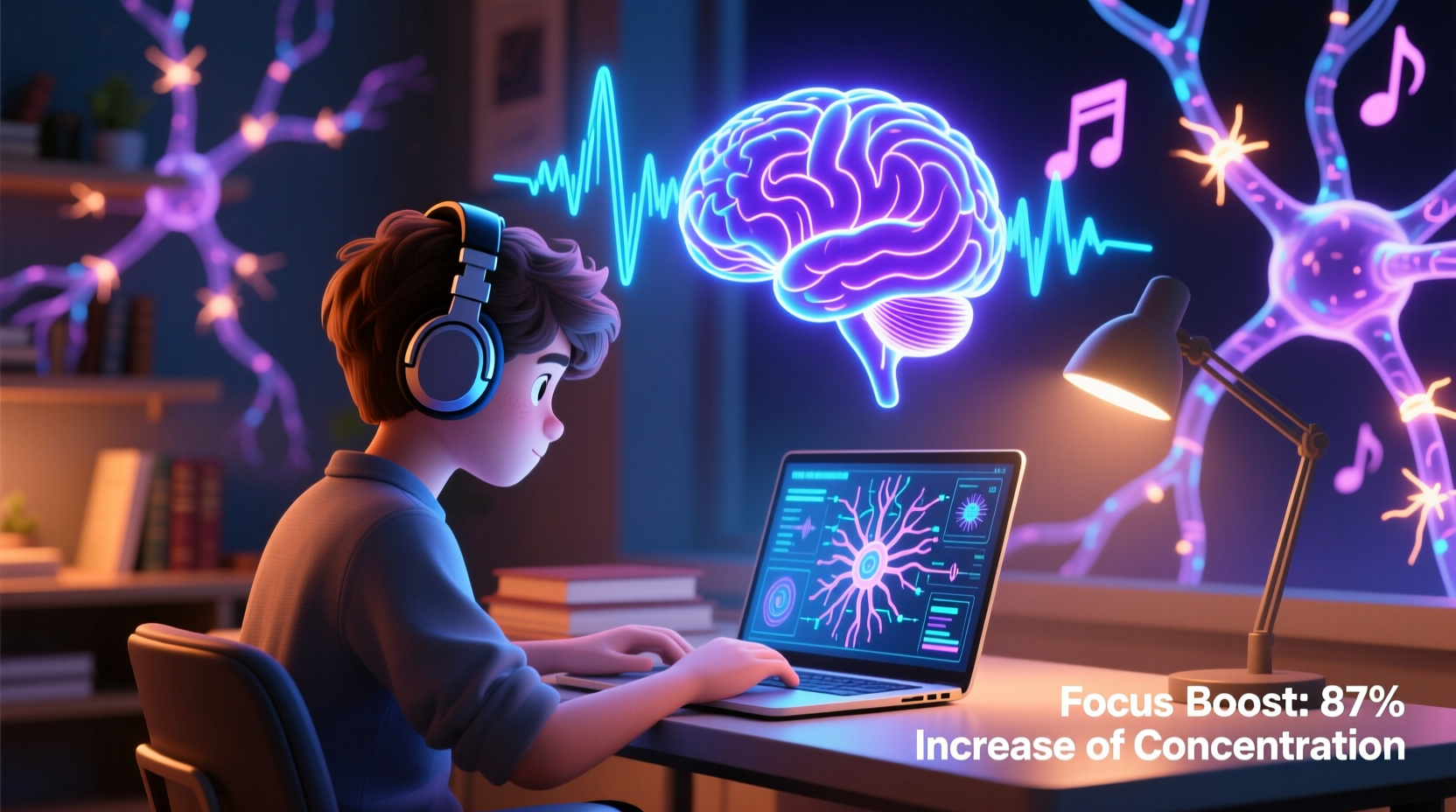
Attention is not a single switch but a network of brain systems working in concert. The prefrontal cortex manages executive control, filtering distractions and maintaining goal-directed behavior. Meanwhile, the limbic system regulates emotional responses, and the auditory cortex processes incoming sound. When studying, your brain is constantly balancing between internal focus (reading, writing, problem-solving) and external stimuli (noise, music, movement). The key to productive background music lies in minimizing interference while providing enough sensory input to prevent mental fatigue.
Research shows that moderate levels of environmental stimulation help maintain alertness through a principle known as **arousal regulation**. Too little stimulation leads to drowsiness; too much causes distraction. Video game soundtracks often hit this \"sweet spot\" by offering consistent, non-repetitive auditory textures that keep the brain engaged without demanding conscious attention.
A 2020 study published in *Psychomusicology: Music, Mind, and Brain* found that participants performing reading comprehension tasks showed improved focus and retention when listening to instrumental video game music compared to silence or lyrical pop music. Functional MRI scans revealed reduced activation in the default mode network—a brain system associated with mind-wandering—indicating deeper immersion in the task at hand.
Why Game Music Is Designed for Sustained Focus
Video game composers face a unique challenge: creating music that supports hours of gameplay without causing listener fatigue. Unlike film scores, which follow narrative arcs with dramatic peaks and valleys, game soundtracks must be adaptive, loop seamlessly, and remain unobtrusive even after repeated exposure. This functional design makes them ideal for studying.
Many modern games use a technique called **dynamic layering**, where musical elements are added or removed based on in-game events. For example, exploration themes may feature gentle piano and strings, while combat triggers percussive rhythms and intensified instrumentation. During calm phases—similar to deep study states—the music remains subdued, avoiding abrupt changes that could break concentration.
Composers like Hirokazu Tanaka (*Metroid*) and Koji Kondo (*Super Mario Bros.*) pioneered minimalist approaches using repetitive motifs with subtle evolution over time. These patterns engage the brain’s pattern-recognition systems just enough to sustain interest, but not so much that they compete for cognitive resources. This balance is crucial: music that's too predictable becomes ignored; music that's too complex pulls focus away from the primary task.
“Game music is designed to be ‘in the room’ without being ‘in the way.’ That same quality makes it perfect for environments where attention must stay on something else.” — Winifred Phillips, composer of *Assassin’s Creed Liberation* and author of *A Composer’s Guide to Game Music*
Comparing Soundtrack Types: What Works Best for Studying?
Not all video game music is equally effective for studying. The genre, instrumentation, tempo, and structure all influence cognitive performance. Below is a comparison of common soundtrack styles and their suitability for academic work.
| Type of Soundtrack | Best For | Cognitive Impact | Recommendation Level |
|---|---|---|---|
| Exploration Themes (e.g., *Skyrim*, *Journey*) | Reading, writing, brainstorming | Low distraction, high immersion | ★★★★★ |
| Battle/Action Music (e.g., *Doom*, *Halo*) | Short bursts of energy, physical tasks | High arousal, risk of overstimulation | ★☆☆☆☆ |
| Town/Calm Themes (e.g., *Animal Crossing*, *Stardew Valley*) | Long study sessions, creative work | Relaxing, promotes flow state | ★★★★★ |
| Chiptune/Retro (e.g., *Tetris*, *Pokémon*) | Repetitive tasks, coding, memorization | Moderate engagement, nostalgic focus boost | ★★★★☆ |
| Vocal Tracks (e.g., *Final Fantasy* theme songs) | Breaks, motivation, post-study review | High emotional engagement, distracts from reading | ★☆☆☆☆ |
The most effective tracks tend to share several characteristics: absence of lyrics, moderate tempo, harmonic stability, and gradual progression. These features reduce cognitive load while supporting sustained attention. In contrast, fast-paced or emotionally charged music activates the amygdala and can trigger emotional responses that interfere with analytical thinking.
Building an Optimal Study Playlist: A Step-by-Step Guide
Creating a playlist that genuinely enhances focus requires more than randomly selecting popular game themes. It involves intentional curation based on neuroscience principles. Follow this step-by-step approach to build a personalized, brain-friendly soundtrack.
- Identify your task type: Determine whether you're doing deep work (writing, coding), rote learning (flashcards, memorization), or creative thinking (brainstorming, design). Each benefits from slightly different auditory environments.
- Select instrumental-only tracks: Avoid any music with lyrics, including vocalizations in foreign languages or nonsensical syllables (e.g., “la-la” vocals), as they activate language-processing centers in the brain.
- Choose moderate tempo music (60–80 BPM): This range aligns with resting heart rate and promotes a calm, alert state. Fast tempos (>100 BPM) increase arousal but may lead to impulsive decision-making.
- Prioritize long, seamless loops: Look for tracks that are at least 3–5 minutes long and loop smoothly without jarring transitions. Platforms like YouTube and Spotify have playlists labeled “lo-fi game beats” or “study with video game music.”
- Test and adjust volume: Keep the volume low—just loud enough to mask background noise but not dominate your awareness. A good rule: if you notice the music without trying, it’s probably too prominent.
- Monitor your focus: After 20–30 minutes, assess whether the music helped or hindered. Did you lose track of time productively (flow)? Or did you catch yourself zoning out? Adjust accordingly.
Real-World Example: A Student’s Shift to Game Soundtracks
Maya, a third-year neuroscience major at the University of Toronto, struggled with maintaining focus during late-night study sessions. She had tried classical music, lo-fi hip-hop, and complete silence, but each came with drawbacks—classical pieces felt too formal and emotionally variable, lo-fi beats occasionally featured distracting vocal samples, and silence made her hyper-aware of every small noise.
On a recommendation from a friend, she experimented with the *Minecraft* soundtrack—one of the most widely used study aids in online communities. To her surprise, she found herself completing readings 25% faster with better recall. Over two weeks, she tracked her study efficiency using a simple log: time spent, pages read, and self-rated focus (1–10).
The results were striking. With *Minecraft* music, her average focus rating rose from 5.8 to 7.9, and she reported fewer interruptions from internal distractions (“I kept remembering unrelated things”) and external noises (“I didn’t notice the neighbor vacuuming until it stopped”).
Neurologically, this outcome makes sense. The *Minecraft* score, composed by C418, uses minimalist piano melodies with slow harmonic changes and ambient textures. Its predictability reduces cognitive load, while its slight variability prevents habituation—the brain’s tendency to “tune out” completely static sounds. Maya eventually expanded her playlist to include *Outer Wilds*, *ABZÛ*, and *Celeste*, all sharing similar sonic qualities.
Actionable Checklist: Optimizing Your Study Sound Environment
- ✅ Use only instrumental tracks—no lyrics or vocal samples
- ✅ Set volume below conversational level
- ✅ Choose soundtracks with tempos between 60–80 BPM
- ✅ Avoid sudden dynamic shifts (e.g., explosions, dramatic crescendos)
- ✅ Test new tracks during short sessions before using them for exams or long assignments
- ✅ Pair music with a consistent study routine (same time, space, cues) to strengthen focus conditioning
- ✅ Take occasional breaks without music to reset auditory sensitivity
Frequently Asked Questions
Can video game music improve memory retention?
Yes, but indirectly. While music doesn't directly encode memories, it can create a stable auditory environment that reduces stress and distraction—both of which impair memory formation. Studies suggest that consistent background stimuli during learning and recall can produce a mild context-dependent memory effect, meaning you may remember information better when re-exposed to the same soundtrack.
Is it better than classical or lo-fi hip-hop?
It depends on personal preference and task type, but video game soundtracks often outperform both. Classical music can have unpredictable dynamics that disrupt focus, and lo-fi hip-hop frequently includes speech snippets or beat drops that draw attention. Game music is specifically engineered for long-duration, low-interference listening, giving it an edge in sustained cognitive tasks.
What if I get nostalgic listening to certain games?
Nostalgia can be a double-edged sword. While positive emotions may boost motivation, strong memories tied to specific games (e.g., playing *The Legend of Zelda* with a sibling) can pull your mind away from studying. If you notice yourself reminiscing instead of working, switch to a less personally meaningful soundtrack. Neutral or abstract game music (e.g., ambient sci-fi scores) tends to be safer for deep focus.
Conclusion: Harnessing Sound for Smarter Learning
The growing popularity of video game soundtracks among students isn’t just a trend—it’s a reflection of how well-designed audio can shape cognition. Rooted in decades of interactive media development, these scores offer a rare combination: engaging enough to ward off boredom, yet restrained enough to respect mental bandwidth. Backed by neuroscience, their effectiveness stems from precise modulation of arousal, attention, and emotional tone—functions that traditional music often overlooks.
By treating sound as a cognitive tool rather than mere background noise, learners can transform their study environments into spaces of sustained flow. Whether you're preparing for exams, writing a thesis, or mastering a new skill, consider integrating purpose-built game music into your routine. The right soundtrack won’t just make studying more enjoyable—it might actually make you smarter.




 浙公网安备
33010002000092号
浙公网安备
33010002000092号 浙B2-20120091-4
Comments
No comments yet. Why don't you start the discussion?