
In recent years, a growing number of students and professionals have turned to an unexpected source for concentration support: video game music. From the ambient loops of *Stardew Valley* to the dynamic scores of *The Legend of Zelda*, these soundtracks are increasingly being used as background audio during study sessions and workdays. But what makes them so effective? Unlike pop songs with lyrics or classical pieces that demand emotional attention, video game soundtracks seem uniquely suited to supporting deep focus. The answer lies in a combination of musical design principles, cognitive science, and intentional compositional techniques built into gaming audio from the ground up.
The Psychology of Focus and Background Music
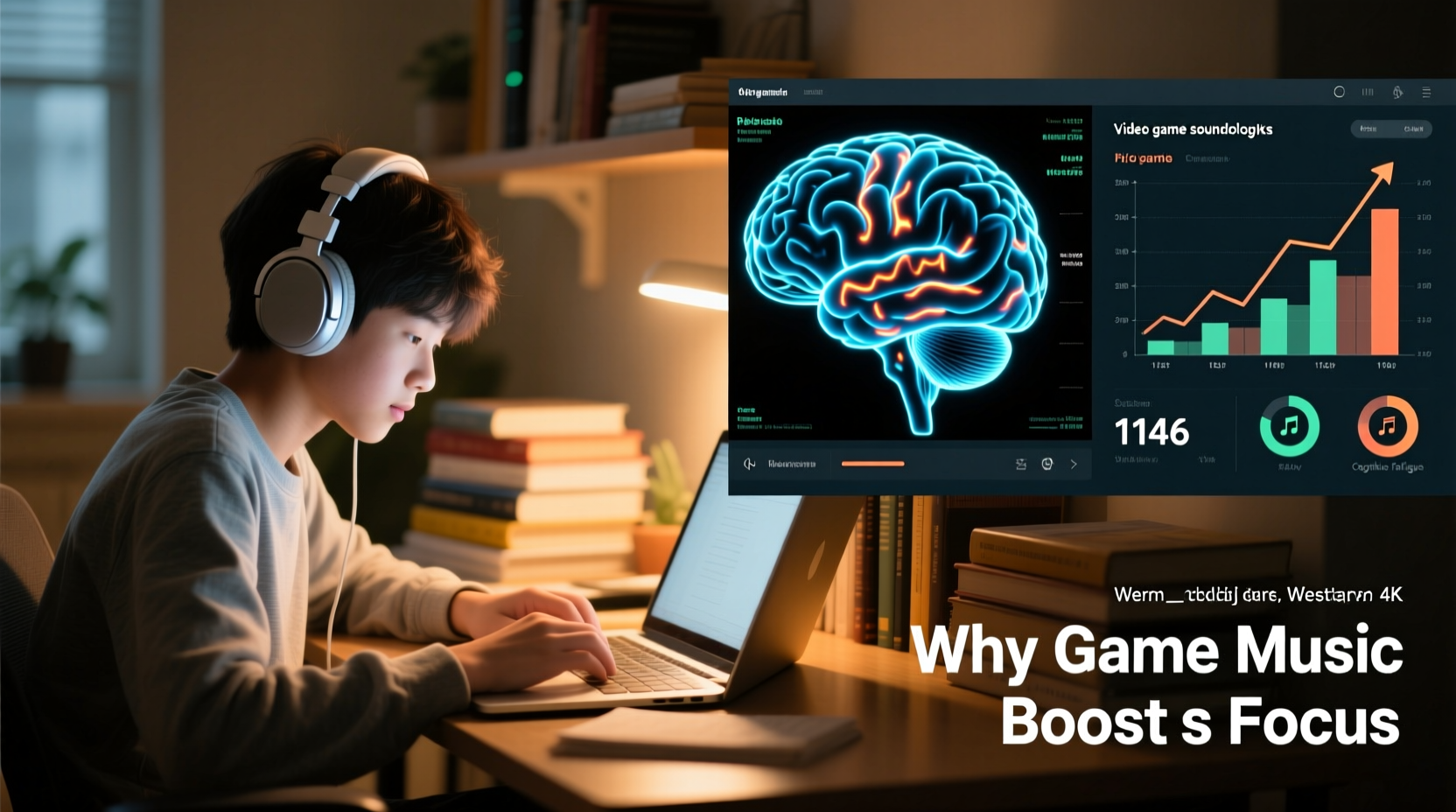
Human attention is a limited resource. When engaged in cognitively demanding tasks—such as reading dense material, writing code, or solving complex problems—the brain must filter out distractions to maintain concentration. Background music can either aid or hinder this process depending on its characteristics. Research in cognitive psychology suggests that music impacts focus through several mechanisms: arousal regulation, mood enhancement, and interference management.
Musical elements like tempo, volume, predictability, and lyrical content directly influence how well the brain can process information. Fast tempos may increase alertness but can also lead to overstimulation. Lyrics, particularly in familiar languages, activate language-processing centers in the brain, competing with verbal tasks like reading or writing. This phenomenon, known as the “irrelevant speech effect,” explains why listening to songs with words often reduces performance on memory and comprehension tasks.
Video game soundtracks, however, are engineered to avoid these pitfalls. They’re designed not to capture full attention but to exist at the edge of awareness—supporting immersion without becoming the focal point.
How Game Music Is Designed for Sustained Engagement
Unlike film scores, which follow a linear narrative arc, video game soundtracks must adapt to unpredictable player behavior. A composer cannot assume how long a player will stay in a forest clearing or whether they’ll engage in combat immediately upon entering a dungeon. As a result, game music is typically composed using looping structures, modular layers, and dynamic transitions that allow seamless repetition without irritation.
This design philosophy prioritizes non-intrusiveness. For example, many RPGs use ambient textures and repeating motifs that evolve subtly over time. These tracks maintain a consistent mood—calm, mysterious, adventurous—without sudden shifts in intensity that could break focus. In games like *Minecraft* or *Animal Crossing*, the music is intentionally sparse, featuring soft piano melodies and gentle synth pads that blend into the environment rather than dominate it.
Moreover, composers often employ techniques such as:
- Steady rhythmic pulses – Provide subtle temporal grounding without drawing conscious attention.
- Atonal or modal harmonies – Avoid strong emotional cues that might distract.
- Gradual layering – Add instruments slowly to sustain interest without abrupt changes.
“Game music walks a fine line between presence and absence—it needs to be felt more than heard.” — Winifred Phillips, Composer for *Assassin’s Creed III* and *God of War*
Neuroscience Behind the Effectiveness of Game Soundtracks
Studies in auditory neuroscience reveal that certain types of music can modulate brainwave activity associated with concentration. Alpha waves (8–12 Hz), linked to relaxed alertness, tend to increase when people listen to calming, repetitive instrumental music—precisely the kind found in exploration themes from games like *Journey* or *Celeste*.
Additionally, dopamine release plays a role. Anticipatory musical patterns—such as a rising chord progression or a delayed resolution—can trigger small bursts of dopamine, enhancing motivation and engagement. Game composers exploit this deliberately; players who feel subtly rewarded by audio cues are more likely to persist in challenging tasks. This same mechanism benefits learners and workers: low-stakes sonic rewards keep the mind engaged without inducing stress.
A 2021 study published in *Applied Cognitive Psychology* compared productivity levels across different audio conditions: silence, pop music, classical music, and video game soundtracks. Participants completing analytical tasks showed the highest accuracy and fastest completion times when listening to game-based instrumental tracks. Researchers attributed this to the “Goldilocks zone” of stimulation—neither too dull nor too stimulating—that game music occupies.
Comparison of Audio Types for Concentration
| Audio Type | Distractiveness | Mood Support | Suitability for Focus |
|---|---|---|---|
| Pop Music (with lyrics) | High | Variable | Poor |
| Classical (e.g., symphonies) | Moderate | High | Fair |
| Ambient/Lo-fi Beats | Low | Moderate | Good |
| Video Game Soundtracks | Very Low | High | Excellent |
| Silence | None | Low | Good (but may lack stimulation) |
Real-World Application: A Student’s Experience
Lena, a third-year computer science major at the University of Toronto, struggled with maintaining focus during late-night coding sessions. She tried studying in silence, then switched to lo-fi playlists, but found herself either drifting off or getting pulled into YouTube rabbit holes. One evening, she stumbled upon a YouTube playlist titled “Relaxing Zelda Music for Studying.” Skeptical but tired, she started her assignment with *Breath of the Wild*’s piano arrangements playing softly in the background.
To her surprise, she completed two hours of programming work in just over one, with fewer errors and less mental fatigue. “It wasn’t distracting, but it also didn’t let my mind wander,” she said. “There was just enough going on musically to keep me anchored.” Over the next semester, Lena curated a library of game soundtracks tailored to different tasks—fast-paced chiptune for debugging, ambient synth for writing papers, and orchestral loops for exam review. Her GPA improved by half a point, and she credits much of her success to this simple change in environment.
Lena’s experience isn’t unique. Online communities like r/gamemusic and r/StudyWithMe frequently share recommendations for focus-enhancing game tracks. Platforms like Spotify and YouTube host thousands of user-generated playlists labeled “Video Game Study Sessions” or “Focus Music from RPGs,” collectively amassing hundreds of millions of plays.
How to Use Video Game Soundtracks Effectively
Not all game music works equally well for every task. To maximize benefits, consider the nature of your work and match the soundtrack accordingly. Here’s a practical step-by-step guide:
- Assess your task type: Is it creative, analytical, repetitive, or reading-heavy? Each requires slightly different auditory support.
- Select appropriate genres:
- Exploration themes (*Zelda*, *Horizon Zero Dawn*) – Ideal for deep reading and writing.
- Chiptune or retro-style music (*Tetris 99*, *Shovel Knight*) – Great for fast-paced problem-solving.
- Ambient loops (*Minecraft*, *Outer Wilds*) – Best for meditation, planning, or brainstorming.
- Battle or tension music – Generally avoid unless doing short bursts of intense effort.
- Control volume and duration: Keep audio at a low-to-moderate level (around 50–60% of max). Use timers to limit sessions to 25–50 minutes, followed by breaks.
- Use dedicated platforms: Stream curated playlists on Spotify (“Gaming Focus”), YouTube (“Relaxing Video Game Music”), or apps like Brain.fm, which integrates game-inspired adaptive soundscapes.
- Test and refine: Track your productivity over a week using different soundtracks. Note which ones help you enter flow states faster.
Checklist: Optimizing Your Game Music Workflow
- ✅ Choose instrumental-only tracks
- ✅ Match music tempo to task intensity
- ✅ Use headphones for immersive isolation
- ✅ Limit loop length to prevent monotony (or use shuffled playlists)
- ✅ Pair with focus methods like Pomodoro or time-blocking
- ✅ Rotate soundtracks weekly to prevent habituation
Frequently Asked Questions
Can any video game soundtrack improve focus?
No—not all game music is suitable. Tracks with aggressive beats, sudden volume spikes, or vocal elements (like boss battle themes or cutscene scores) can be counterproductive. Stick to ambient, exploratory, or menu music designed for downtime.
Is there a risk of becoming dependent on music for focus?
Potential dependency exists with any external focus aid, but moderate use of background music is generally healthy. To mitigate reliance, alternate between music, white noise, and silence. This builds flexibility in concentration strategies.
Are official soundtracks better than fan-made remixes?
Official OSTs are usually preferable because they preserve the original intent and balance. Fan remixes, especially those with added vocals or heavy electronic drops, may introduce distracting elements. However, some instrumental remix albums (like those from OverClocked ReMix) are carefully crafted for listening and can be excellent choices.
Conclusion: Harnessing the Power of Play for Productivity
Video game soundtracks represent a powerful yet underutilized tool for enhancing mental performance. Their unique blend of structure, subtlety, and emotional resonance makes them ideally suited for environments where sustained attention is key. By understanding the principles behind their design and applying them thoughtfully, students and professionals alike can transform their workspaces into zones of calm efficiency.
The next time you sit down to tackle a challenging project, consider loading up a familiar game theme—not to play, but to focus. You might find that the same music that guided a hero through ancient ruins can also guide you through a mountain of emails or a difficult algorithm.




 浙公网安备
33010002000092号
浙公网安备
33010002000092号 浙B2-20120091-4
Comments
No comments yet. Why don't you start the discussion?