
Vintage Christmas decorations are more than nostalgic ornaments—they’re quietly appreciating assets with measurable financial upside and deep cultural resonance. Unlike mass-produced seasonal items, pre-1970s glass baubles, hand-painted figural ornaments, mid-century aluminum trees, and Depression-era tinsel garlands have seen consistent 6–12% annual appreciation over the past two decades, outperforming many traditional collectibles. This growth isn’t accidental. It reflects converging forces: dwindling supply, rising demand from interior designers and Gen X collectors, heightened awareness of material authenticity, and a broader cultural pivot toward meaningful, tactile holiday traditions. Understanding *why* these objects gain value—and how to navigate the market with discernment—is essential for both seasoned collectors and newcomers seeking purposeful, enduring acquisitions.
The Scarcity Imperative: Why Supply Shrinks Over Time
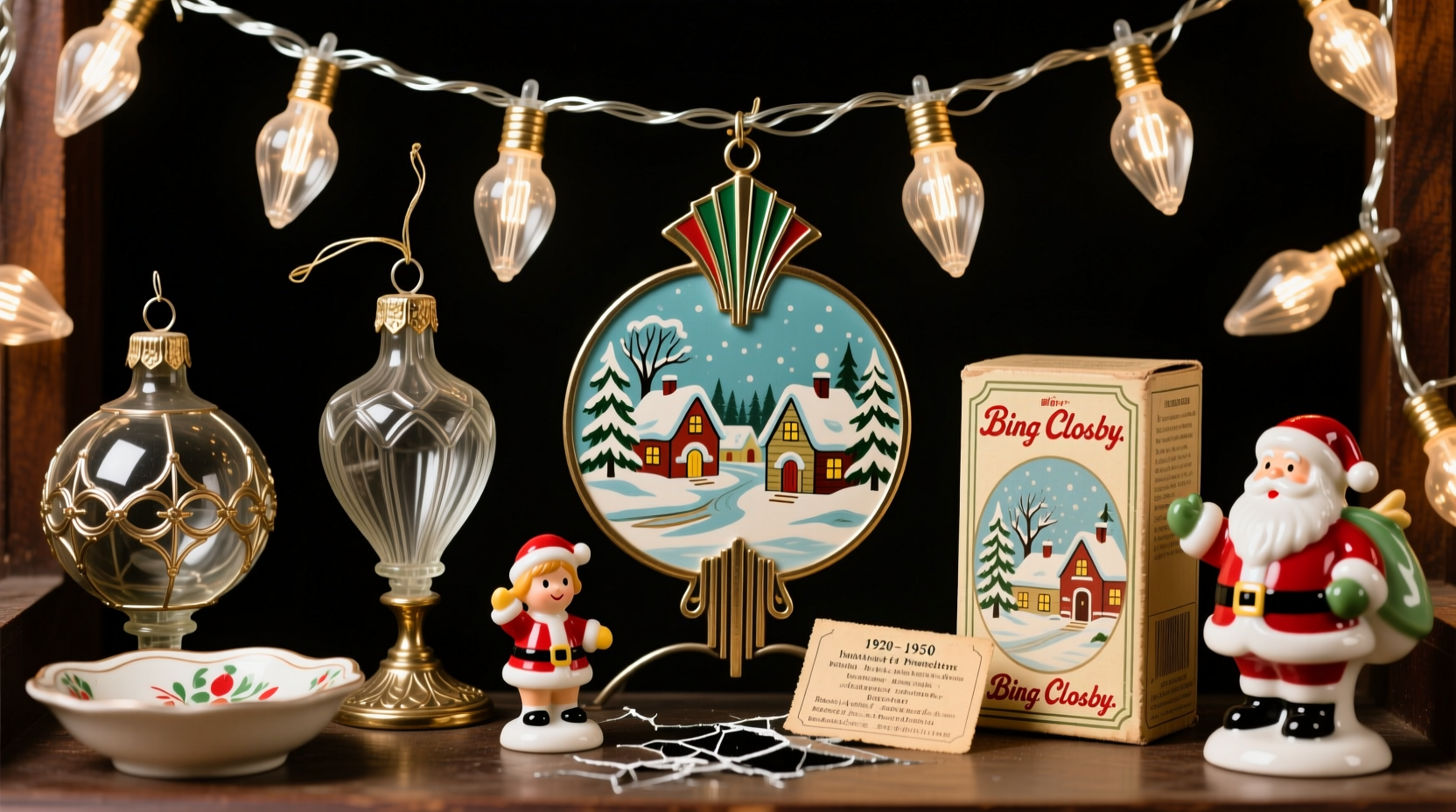
Scarcity is the bedrock of appreciation. Vintage Christmas decorations face irreversible attrition—not through deliberate destruction, but through everyday fragility and historical circumstance. Hand-blown glass ornaments from Lauscha, Germany (1880s–1930s) were often made with thin, delicate walls and fragile silver nitrate linings. Many were discarded after breakage, fading, or tarnishing. During World War II, U.S. manufacturers shifted production to war materials, halting domestic ornament runs; postwar imports from Europe remained limited until the 1950s. Even robust items like tin lithographed Santa figures (1920s–1940s) suffer from rust, flaking paint, and bent wire hangers—conditions that degrade structural integrity and visual appeal.
Crucially, unlike stamps or coins, Christmas decorations were rarely archived. Families used them annually, stored them haphazardly in cardboard boxes or paper bags, and passed them down without documentation. Few kept original packaging, instruction sheets, or manufacturer tags—elements that now command significant premiums. A 1935 Shiny Brite “Candy Cane” glass ball with its original red-and-white box and celluloid hanger sold for $425 at a 2023 Rago Auctions sale—nearly five times the value of an identical ornament lacking provenance.
Craftsmanship as Currency: The Irreplaceable Human Touch
Pre-industrial and early industrial ornament-making relied on techniques impossible to replicate economically today. Lauscha’s “kugel” ornaments began as blown glass spheres dipped in molten metal (often mercury-based silvering), then hand-painted with fine brushes using mineral pigments. Each step introduced variation: subtle thickness differences in glass walls, unique brushstroke textures, and slight color shifts due to kiln firing variance. These “imperfections” are now hallmarks of authenticity—and desirability.
In contrast, modern reproductions use automated dipping, acrylic paints, and standardized molds. They lack the weight, depth of luster, and micro-textural nuance of originals. Collectors recognize this intuitively: a 1928 German “Pickle” ornament with hand-applied green enamel and visible tool marks on its stem will consistently outperform a flawless 2005 replica—even when priced identically at first glance. As antique dealer and ornament historian Eleanor Voss notes:
“The moment you hold a 1910s Dresden paper lace ornament, you feel the pressure of the cutter’s hand, the slight asymmetry of the die, the whisper-thin edge where glue was applied. That’s human intention—not algorithmic precision. Markets reward intentionality, especially when it’s vanishing.” — Eleanor Voss, Curator, The American Christmas Archive, 2022
This craftsmanship premium extends beyond glass. Mid-century aluminum trees (1958–1965) required precise stamping, anodizing, and hand-assembly of hundreds of individual branches. Their geometric purity and reflective brilliance—designed to catch light from rotating color wheels—cannot be duplicated with today’s cheaper extruded alloys. Surviving examples in full sets with original wheels and bulbs routinely exceed $1,200 at auction.
Cultural Resonance & Generational Shifts
Appreciation accelerates when objects become cultural touchstones—symbols that anchor collective memory. Vintage Christmas decorations embody distinct eras: the Victorian reverence for natural motifs (pinecone clusters, wax fruit), the Jazz Age’s embrace of glamour (mirrored stars, beaded garlands), the Depression’s resourcefulness (popcorn strings, handmade felt animals), and the Atomic Age’s optimistic futurism (space-age Santas, chrome-plated bells). Each era’s aesthetic carries emotional weight for those who experienced it—and increasingly, for younger generations seeking authenticity amid digital saturation.
Interior designers now specify vintage ornaments for high-end residential and commercial holiday installations. A 2023 report by the American Society of Interior Designers found that 68% of luxury clients requested “heritage-inspired” holiday decor—citing “timelessness,” “storytelling potential,” and “textural richness” as key drivers. This professional adoption validates aesthetic value and expands buyer pools beyond hobbyists into design studios, boutique hotels, and film/TV prop departments—markets willing to pay premiums for narrative coherence and visual distinction.
Market Mechanics: What Drives Real-World Appreciation
Three interlocking market forces sustain and amplify value growth:
- Demographic momentum: Baby Boomers and Gen Xers—raised with these decorations—are now downsizing, gifting heirlooms, or investing in legacy collections. Their purchasing power and emotional connection drive baseline demand.
- Authentication infrastructure: Organizations like the Antique Christmas Tree Ornament Society (ACTOS) and resources such as the Ornament Collector’s Price Guide provide standardized grading (e.g., Mint, Excellent, Good) and attribution frameworks. Reliable identification reduces buyer risk and increases transaction velocity.
- Supply chain constraints: Unlike art or furniture, vintage ornaments lack institutional repositories. Museums hold fewer than 2,000 documented pre-1950 ornaments globally—less than 0.001% of estimated production. The rest resides in attics, estate sales, and private hands—making each new discovery a finite event.
| Ornament Type | Era | Avg. Appreciation (2013–2023) | Key Value Drivers |
|---|---|---|---|
| Lauscha Glass Kugels | 1880–1930 | 9.2% annually | Silvering integrity, original hangers, rare colors (cobalt blue, cranberry) |
| Shiny Brite Wire-Stemmed | 1935–1944 | 7.8% annually | Original red/green boxes, undamaged stems, figural designs (birds, angels) |
| Dresden Paper Lace | 1890–1914 | 11.5% annually | Full symmetry, crisp embossing, no insect damage, original stringing |
| Mid-Century Aluminum Trees | 1958–1965 | 6.3% annually | Complete sets (10+ branches), original color wheels, working motor |
| Depression-Era Tin Litho | 1925–1940 | 8.1% annually | Minimal rust, vibrant color retention, iconic brands (Gem, Gault) |
Building a Purposeful Collection: A Practical Framework
Appreciation isn’t guaranteed—it requires strategy, not sentimentality. Successful collectors follow a disciplined approach grounded in research, condition assessment, and long-term stewardship.
Step-by-Step: Building a Resilient Collection
- Define your focus: Choose one category (e.g., German glass, U.S. figural, paper lace) or era (pre-1920, WWII, 1950s). Specialization builds expertise faster than generalism.
- Master authentication: Study manufacturer marks, construction methods, and period-correct materials. Join ACTOS or attend regional antique fairs to handle verified pieces.
- Prioritize condition hierarchy: For glass: check for chips, cracks, and silvering loss. For paper: assess brittleness and pest damage. For metal: examine rust, bending, and finish wear.
- Document rigorously: Record measurements, markings, provenance notes, and high-resolution photos. Use acid-free archival sleeves and label with graphite pencil—not ink.
- Store with conservation intent: Keep ornaments in temperature-stable, low-humidity environments (ideally 40–50% RH). Use padded compartment boxes—not plastic bins—to prevent scratching and static buildup.
Collecting is iterative. Your first acquisition may be a modest 1940s Shiny Brite ball—but your tenth should reflect refined judgment, sharper eye for detail, and deeper understanding of context. That progression compounds value far beyond any single piece.
Mini Case Study: The Miller Family Collection
In 1998, Sarah Miller inherited her grandmother’s cedar chest containing 42 ornaments—mostly 1930s–1940s Shiny Brite and a few hand-blown German balls. Initially dismissed as “old junk,” Sarah began researching local antique fairs. She learned that her grandmother’s neighbor had been a Shiny Brite distributor in Philadelphia—and that several ornaments bore faint, nearly invisible “SB” stamps near their hangers. With guidance from ACTOS, Sarah authenticated six pieces as early-production, wire-stemmed variants. By 2010, she’d acquired three matching 1937 “Santa on Sled” ornaments with original boxes. In 2022, she consigned the group to Theriault’s Auction. The set sold for $2,875—more than 14 times her initial insurance appraisal. Crucially, Sarah didn’t chase trends. She focused on continuity: same era, same manufacturer, shared provenance. That coherence attracted serious buyers, not just browsers.
Frequently Asked Questions
How important is original packaging for value?
Extremely—especially for U.S. ornaments (Shiny Brite, Coro, Gem) and German kugels. A complete, undamaged box with legible text and intact flaps can add 40–100% to value. Even partial packaging (a lid, a base tray) provides critical evidence of age and origin.
Are reproductions ever valuable—or just deceptive?
Most reproductions hold only decorative value. However, early 20th-century “revival” pieces—like 1950s Lauscha reissues made using original molds and techniques—can appreciate meaningfully, particularly if marked “Made in West Germany” and accompanied by period-correct documentation. Always verify maker’s marks and consult reference guides before assuming revival status.
Should I clean or restore vintage ornaments?
No—unless performed by a certified conservator. DIY cleaning risks irreversible damage: ammonia-based cleaners cloud glass, water swells paper fibers, and polishing compounds abrade patinas. Surface dust can be gently removed with a soft sable brush; stubborn residue requires professional assessment. Preservation, not perfection, sustains value.
Conclusion: Collect with Intention, Not Just Nostalgia
Vintage Christmas decorations appreciate because they are irreplaceable intersections of artistry, history, and human ritual. Their value grows not in isolation, but as society revalues slowness, substance, and stories embedded in physical objects. Every intact silvered kugel, every crisp Dresden silhouette, every humming aluminum tree speaks to craftsmanship that refused shortcuts—and to holidays that prioritized presence over polish. You don’t need generational wealth to begin. Start with one well-researched piece. Learn its origins. Handle it with care. Document its journey. Let your collection grow not as inventory, but as a curated archive of joy, resilience, and quiet beauty.
Value appreciation follows attention. Attention follows understanding. Understanding begins with asking—not “How much is this worth?”—but “What does this tell me about who we were, and who we might choose to be?”




 浙公网安备
33010002000092号
浙公网安备
33010002000092号 浙B2-20120091-4
Comments
No comments yet. Why don't you start the discussion?