
Vintage Christmas records carry a nostalgic charm that modern digital formats struggle to replicate. The crackle of the needle, the warm analog sound, and the familiar holiday melodies evoke memories of decades past. But many collectors have noticed a peculiar issue: their beloved holiday vinyl skips or distorts only when played near certain electronic devices. This isn’t just coincidence—it’s physics in action. Understanding the root causes behind this phenomenon helps preserve these fragile recordings and ensures uninterrupted seasonal joy.
The interaction between vintage records and nearby electronics stems from electromagnetic interference (EMI), mechanical vibration, and the inherent sensitivity of analog playback systems. Unlike digital media, which can correct for minor errors, vinyl relies on a precise physical relationship between the stylus and the groove. Any disruption—whether magnetic, vibrational, or electrical—can manifest as audible skipping, distortion, or tracking issues. This article explores the science behind the problem, identifies common culprits, and provides actionable solutions to safeguard your holiday collection.
How Vinyl Records Work: A Brief Technical Overview
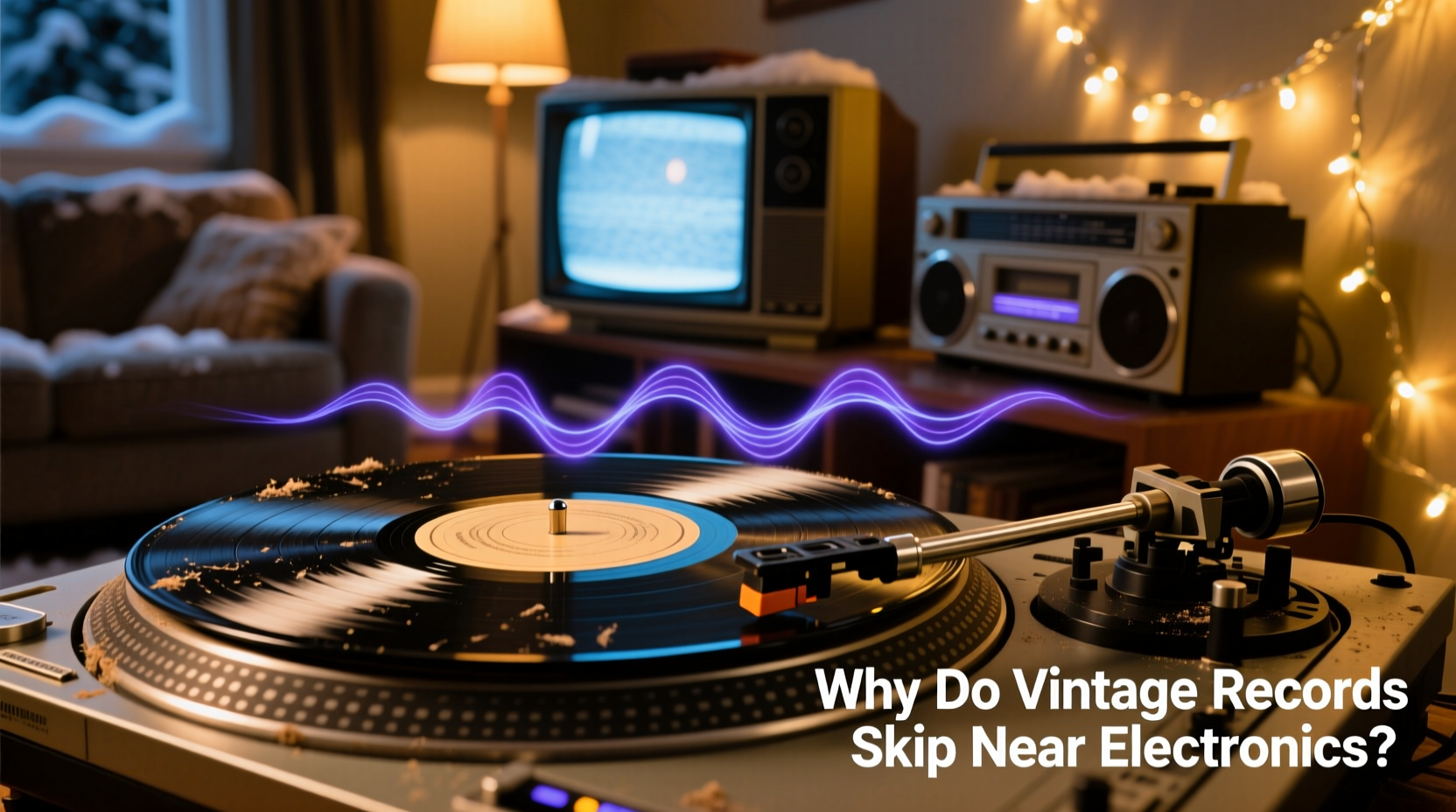
To understand why interference occurs, it's essential to grasp how vinyl records produce sound. When a record spins on a turntable, the stylus (or needle) rides along microscopic grooves etched into the surface. These grooves contain physical undulations that correspond to the original audio waveform. As the stylus moves through the groove, its vibrations are converted into electrical signals by the cartridge, then amplified and sent to speakers.
This entire process is highly sensitive to external disturbances. Because no error correction exists—unlike CDs or streaming files—even the slightest deviation can disrupt playback. Vintage Christmas records, often pressed in the 1950s–1970s, may already suffer from wear, warping, or dust accumulation. Their age makes them more vulnerable to environmental factors, including proximity to active electronics.
The key components involved in playback—turntable motor, tonearm, cartridge, and phono preamp—are all susceptible to different types of interference. Some affect the mechanical stability of the system; others interfere with the low-voltage signal generated by the cartridge. Together, these vulnerabilities explain why placing a working turntable near a television, router, or even a smartphone can lead to unexpected skipping.
Electromagnetic Interference (EMI): The Invisible Culprit
One of the primary reasons vintage records skip near electronics is electromagnetic interference. EMI refers to radiation emitted by electronic devices that can disrupt nearby electrical circuits. While most modern electronics are shielded to minimize such emissions, older or poorly designed devices may leak significant electromagnetic fields.
Turntable cartridges, especially magnetic types like moving magnet (MM) or moving coil (MC), generate extremely low-level signals—typically in the millivolt range. These weak signals are easily overwhelmed by stray electromagnetic fields. When a strong EMI source is nearby, it can induce currents in the cartridge wiring or even directly influence the stylus movement, leading to audible pops, hums, or erratic tracking that mimics skipping.
Common household devices known to emit EMI include:
- Cathode ray tube (CRT) televisions and monitors
- Fluorescent lighting ballasts
- Wi-Fi routers and cordless phones
- Power adapters and transformers
- Microwave ovens
- Unshielded speakers or amplifiers
“Analog playback systems are inherently more sensitive to electromagnetic noise than digital ones. Even a small unshielded transformer can introduce enough interference to destabilize tracking.” — Dr. Alan Reeves, Audio Engineering Consultant
Mechanical Vibration and Resonance Effects
Beyond electromagnetic forces, physical vibration plays a major role in record skipping—especially with vintage pressings. Many classic Christmas albums were produced using lower-quality vinyl compounds and less precise pressing techniques. Over time, repeated use and improper storage have left many of these records slightly warped or brittle, increasing their susceptibility to vibration-induced skipping.
Electronic devices don’t just emit electromagnetic fields—they often vibrate mechanically. Televisions with internal fans, refrigerators with compressors, subwoofers, and even HVAC systems produce low-frequency vibrations that travel through floors and furniture. When a turntable sits on the same surface, these vibrations can cause the stylus to bounce out of the groove, resulting in what sounds like random skipping.
Additionally, resonance becomes an issue when the frequency of external vibration matches the natural resonant frequency of the turntable’s plinth or tonearm. This amplifies the effect, making minor disturbances far more disruptive. For example, a nearby speaker playing bass-heavy music might not visibly shake the room but could still throw off delicate tracking on a lightweight turntable.
Real Example: The Holiday Living Room Setup
Consider a typical scenario: Sarah sets up her vintage record player on a wooden cabinet beneath her old CRT television to play classic Bing Crosby holiday tunes during family gatherings. Each time she starts “White Christmas,” the record plays fine for a few seconds before skipping repeatedly around the same spot. She cleans the record, checks the stylus alignment, and adjusts the anti-skate—but the problem persists.
After some investigation, she realizes the issue only occurs when the TV is powered on. Even though the TV isn’t connected to the audio system, its internal deflection coils and power supply generate both EMI and subtle vibrations. Once she moves the turntable to a separate, isolated table across the room, the skipping stops entirely. This case illustrates how seemingly unrelated electronics can combine EMI and mechanical effects to disrupt analog playback.
Identifying Problem Devices: A Diagnostic Checklist
If your vintage Christmas records skip only under certain conditions, follow this checklist to identify and eliminate interference sources:
- Observe when skipping occurs: Does it happen only when specific devices are on? Try turning off lights, TVs, routers, or appliances one by one.
- Relocate the turntable temporarily: Move it to a different room or surface to see if the issue resolves.
- Check cable routing: Ensure audio cables aren’t running parallel to power cords or near power strips, which can induce hum and interference.
- Inspect for grounding issues: A poorly grounded turntable or amplifier can act as an antenna for EMI.
- Use battery-powered devices: Test playback using a portable amplifier or powered speakers running on batteries to rule out ground loops.
- Listen for audible cues: Hums at 50/60 Hz suggest AC line interference; buzzing may indicate switch-mode power supplies or Wi-Fi devices.
| Symptom | Possible Cause | Solution |
|---|---|---|
| Skipping only when TV is on | EMI from CRT or internal circuitry | Move turntable away or use shielded cables |
| Intermittent popping or static | Wi-Fi/router interference | Relocate router or use wired Ethernet |
| Consistent hum during playback | Ground loop or poor shielding | Install ground wire or use isolation transformer |
| Skipping worsens with bass-heavy audio | Vibration from nearby speakers | Add isolation pads or separate speaker stands |
| Records skip only on certain surfaces | Floor or furniture resonance | Use dense, non-resonant platform (e.g., marble slab) |
Protecting Your Collection: Best Practices for Interference-Free Playback
Preserving the integrity of vintage Christmas records requires both preventive care and strategic setup. While you can’t control the age or condition of the vinyl itself, you can significantly reduce the risk of interference through proper equipment placement and maintenance.
Step-by-Step Guide to Minimizing Electronic Interference
- Choose a stable, isolated location: Place your turntable on a dedicated stand or shelf away from large electronics, especially those with motors or high-power components.
- Use isolation materials: Place the turntable on a dense, vibration-damping surface such as a slate slab, sorbothane pads, or specialized isolation feet.
- Upgrade cabling: Use shielded RCA cables with high-quality connectors to reduce EMI pickup in the signal path.
- Manage power sources: Plug your turntable and audio gear into a single, clean power outlet or use a power conditioner to filter electrical noise.
- Audit nearby devices: Identify and relocate or replace older electronics that emit strong EMI, such as dimmer switches or unshielded transformers.
- Store records properly: Keep vintage albums upright in a cool, dry place to prevent warping, which increases sensitivity to vibration.
Frequently Asked Questions
Can Wi-Fi really make my records skip?
While Wi-Fi signals themselves don’t physically move the stylus, the router emitting them often produces electromagnetic noise that can interfere with the turntable’s low-level audio signal. This interference may cause distortion or erratic behavior that appears as skipping. Moving the router further away or switching to wired connections usually resolves the issue.
Do LED lights affect vinyl playback?
Most modern LED lights are safe, but cheaper models with poor driver circuits can emit high-frequency noise. If flickering or buzzing coincides with audio issues, try replacing the bulbs with high-quality, fully regulated LEDs or temporarily turning them off during playback.
Why do only my old records skip near electronics?
Vintage records are more prone to skipping due to wear, warping, and shallower groove modulation. Combined with aging turntable components (like dried-out suspension or worn belts), they’re less capable of maintaining consistent tracking under interference. Newer pressings typically have deeper, cleaner grooves and are played on better-shielded equipment, making them more resilient.
Conclusion: Preserving the Spirit of Analog Holidays
Vintage Christmas records offer a timeless connection to the past, but their analog nature demands thoughtful handling. The skipping that occurs near electronic devices isn't magic or malfunction—it's the result of real physical forces interacting with delicate playback mechanisms. By understanding electromagnetic interference, vibration transmission, and proper setup techniques, you can enjoy your holiday collection without interruption.
Taking simple steps like repositioning your turntable, upgrading cables, and auditing nearby electronics can dramatically improve playback stability. These records survived decades to reach your home; with a little care, they’ll continue spinning smoothly for generations to come. Protect them not just from dust and scratches, but from the invisible influences of the modern digital world.




 浙公网安备
33010002000092号
浙公网安备
33010002000092号 浙B2-20120091-4
Comments
No comments yet. Why don't you start the discussion?