
Vintage decorations—whether a 1920s Lalique glass vase, a mid-century Danish teak sideboard, or a hand-painted 19th-century porcelain figurine—are more than nostalgic accents. They are tangible artifacts that accumulate meaning, rarity, and economic weight as decades pass. Unlike mass-produced modern décor, vintage pieces often appreciate steadily, sometimes dramatically, transforming from forgotten attic finds into sought-after assets. This appreciation isn’t accidental or speculative—it follows predictable patterns rooted in economics, material culture, and human behavior. Understanding *why* these objects gain value reveals not only how to recognize potential worth but also how to steward meaningful design across generations.
1. Scarcity and Irreproducible Supply
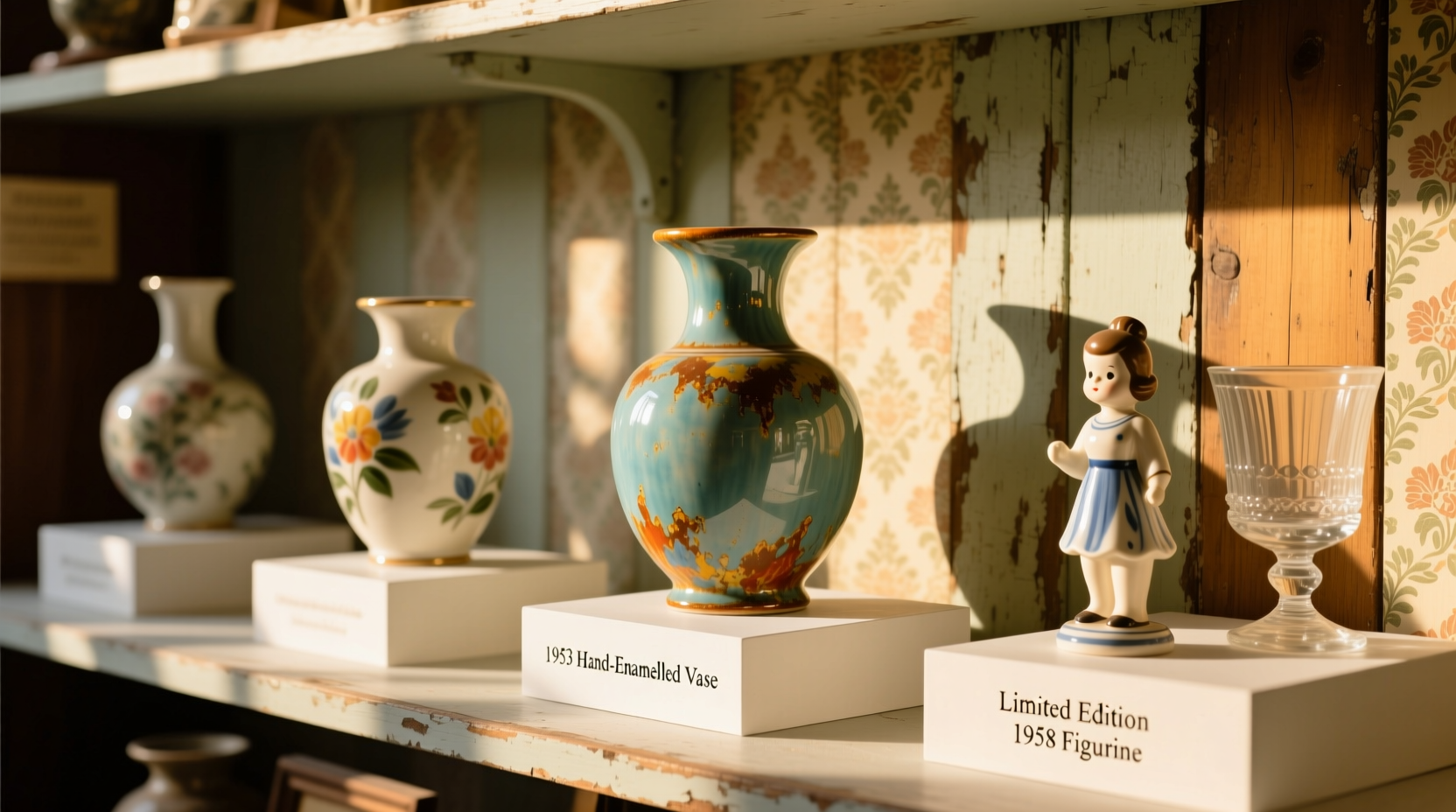
Scarcity is the foundational driver of value for vintage décor. Unlike new items manufactured on demand, vintage pieces exist in finite numbers—and that number shrinks over time. Breakage, loss, neglect, and disposal mean fewer examples survive each decade. Crucially, many were never made in large quantities to begin with: artisan studios, small workshops, and regional potteries produced limited runs before industrial standardization took hold. Once production ceases—and original tooling, molds, and skilled labor vanish—the supply becomes permanently fixed.
Consider Depression-era pressed-glass tableware: though once common in American households, fewer than 12% of known patterns remain in excellent, complete sets today. A 1935 Fostoria “American” pattern five-piece centerpiece set sold for $2,850 at auction in 2023—a 470% increase from its 2005 sale price—driven less by novelty and more by the fact that only seven such intact sets have surfaced publicly in the last 15 years.
| Factor | Impact on Scarcity | Example |
|---|---|---|
| Production volume | Low-run studio ceramics (e.g., Clarice Cliff) retain higher scarcity than department-store china lines | Cliff’s “Bizarre” ware: ~12,000 pieces made total; only 87 documented surviving in museum-grade condition |
| Survivability rate | Glass, porcelain, and lacquer degrade or shatter easily; wood and metal fare better but suffer warping or corrosion | Pre-1940 French Art Deco mirrors: ~65% lost to silvering failure or frame damage |
| Disposal trends | Mid-century modern furniture was routinely discarded in the 1980s–90s as “outdated”; now irreplaceable | Eero Saarinen tulip tables: 92% of originals destroyed pre-2000; current market reflects extreme rarity |
2. Craftsmanship and Material Integrity
Today’s décor is optimized for speed, cost, and shipping resilience—not longevity or tactile distinction. Vintage pieces, by contrast, often embody techniques no longer economically viable: hand-blown glass with subtle asymmetry, dovetailed hardwood joinery, hand-rubbed lacquer finishes, or copper-foiled stained glass. These methods required skilled labor, time, and premium materials—qualities that translate directly into durability and aesthetic depth.
A 1948 George Nelson Bubble Lamp, for example, uses hand-formed plastic shells suspended on aircraft-grade steel wire. Its construction resists yellowing better than modern injection-molded plastics, and its structural integrity has been validated across 75+ years of use. Similarly, pre-1960s English bone china contains up to 50% calcined bone ash—giving it translucency, strength, and a warm tonal quality impossible to replicate with contemporary alumina-based formulas.
“Modern ‘vintage-style’ reproductions lack the micro-variations that signal authenticity—and more importantly, they lack the material memory of decades of gentle use. That patina isn’t wear; it’s evidence of endurance.” — Dr. Lena Petrova, Curator of Decorative Arts, Victoria & Albert Museum
This isn’t mere sentimentality. Collectors and interior designers pay premiums for pieces that demonstrate *proven performance*—not just visual appeal. A 1930s Waring & Gillow walnut cabinet, built with quarter-sawn oak and hand-cut mortise-and-tenon joints, will outlast three generations of IKEA alternatives. Its value rises because its integrity is empirically verified—not assumed.
3. Cultural Resonance and Aesthetic Reassessment
Taste cycles operate on long, overlapping waves—not abrupt flips. What feels dated or excessive in one era often re-emerges as sophisticated, authentic, or refreshingly human in another. Mid-century modern décor was widely dismissed in the 1980s as “cold” or “sterile,” yet by the early 2000s, its clean lines and organic forms aligned perfectly with digital minimalism and sustainability values. Similarly, Victorian ornamental excess—once mocked as “cluttered”—has re-entered high-end interiors as clients seek warmth, narrative, and anti-algorithmic individuality.
This reassessment isn’t arbitrary. It’s fueled by deeper cultural shifts: nostalgia for perceived stability (post-war optimism), reaction against digital fatigue (tactile, analog objects), and growing awareness of ethical consumption (valuing heirloom-quality over disposable). When a style regains cultural legitimacy, demand surges—but supply remains static. The result is upward pressure on prices across the board.
4. Provenance, Documentation, and Market Confidence
Value crystallizes when an object’s history becomes verifiable. Provenance—the documented chain of ownership, origin, and context—transforms a decorative object into a cultural artifact. A 1927 Tiffany Studios bronze-and-glass table lamp gains measurable value if accompanied by its original sales receipt, a 1943 insurance appraisal listing it in a noted architect’s home, or inclusion in a 1958 museum exhibition catalog. Each document adds a layer of trust, reducing buyer risk and expanding the pool of serious collectors.
Without provenance, even exceptional pieces trade at steep discounts. A rare 1950s Gio Ponti ceramic wall plaque sold for $14,200 in 2022 *with* its original Atelier Ponti studio stamp and 1961 Milan gallery exhibition label—but an identical unmarked example fetched just $3,100 two months later. The difference wasn’t condition or aesthetics; it was confidence in authenticity.
Provenance Verification Checklist
- ✅ Original manufacturer marks, stamps, or signatures (check underside, backplate, or hidden joints)
- ✅ Historical documentation: sales receipts, family inventories, estate records, or exhibition labels
- ✅ Archival photographs showing the item in situ during its original period
- ✅ Published references: books, journals, or museum collection databases listing the piece
- ✅ Third-party verification: conservation reports or specialist appraisals dated within the last 5 years
5. Economic and Generational Shifts
Vintage décor appreciation accelerates during periods of inflation, currency volatility, and housing market maturity. When traditional investments feel unstable, tangible assets with cultural weight become hedges. Between 2020–2023, global auction sales of 20th-century decorative arts rose 34%—outpacing both equities and real estate indices in developed markets. Buyers weren’t speculating on quick flips; they were acquiring stable, portable, emotionally resonant assets.
Equally significant is generational transmission. Baby boomers downsizing estates have flooded the market with high-quality mid-century and Art Deco pieces—initially depressing prices. But as Gen X and younger millennials inherit, curate, and reinterpret these objects, demand shifts from “functional furniture” to “narrative décor.” A 1970s Italian Murano glass chandelier isn’t bought to light a room—it’s acquired to anchor a space with craft, history, and intention. That shift in purpose elevates perceived value beyond utility.
Real-World Example: The Case of the 1940s Swedish Textile Wall Hanging
In 2015, textile conservator Ingrid Holmquist acquired a faded, slightly frayed wool wall hanging at a Stockholm estate sale for €120. Woven by Märta Måås-Fjetterström’s studio in 1943, it bore no signature—only the studio’s discreet “MMF” loom tag. Holmquist recognized the weave structure and dye palette but lacked documentation. She commissioned fiber analysis (confirming pre-1950 natural dyes) and cross-referenced the pattern with the MMF archive in Båstad—identifying it as a trial design never commercially released.
With archival proof secured, she conserved the piece using humidity-controlled stretching and pH-neutral cleaning—preserving its age-related softness while stabilizing fragile areas. In 2023, it sold at Bukowskis Stockholm for €22,500. The 18,650% return wasn’t driven by hype. It reflected scarcity (one of three known trial weaves), irrefutable provenance (archival match + scientific analysis), and rising global demand for Scandinavian mid-century textiles among designers seeking “quiet luxury” authenticity.
Timeline: How Value Accrues Over Decades
- Years 0–20: Functional obsolescence. Pieces enter attics, basements, or thrift stores. Minimal collector interest. Value often below replacement cost.
- Years 20–40: Niche rediscovery. Design historians, specialists, and early adopters identify stylistic significance. Auction houses begin cataloging. Modest appreciation begins (3–7% annual avg).
- Years 40–60: Mainstream reassessment. Major museums mount retrospectives; magazines feature “vintage revival.” Demand broadens. Value accelerates (8–12% annual avg), especially for documented, well-preserved examples.
- Years 60–100: Cultural canonization. Pieces appear in design textbooks, national collections, and high-profile interiors. Scarcity dominates pricing. Appreciation becomes less linear, more event-driven (e.g., record auction results, celebrity ownership).
- 100+ years: Artifact status. Value tied to historical significance as much as aesthetics. Insurance valuations often exceed auction estimates. Conservation expertise becomes critical to maintaining value.
FAQ
Does all vintage décor appreciate—or only certain types?
No. Appreciation concentrates in categories with demonstrable scarcity, superior craftsmanship, strong design legacy, and active collector communities. Studio ceramics, designer lighting, mid-century furniture, and Art Deco metalwork show consistent growth. Mass-market items—even old ones—like generic 1970s brass bookends or undistinguished floral-print curtains rarely appreciate meaningfully. Condition, provenance, and cultural relevance matter more than age alone.
Can restoration hurt value?
Yes—if poorly executed. Over-cleaning, repainting, or replacing original components (e.g., swapping vintage Bakelite knobs for modern plastic) erodes authenticity and can cut value by 40–70%. However, professional, reversible conservation—such as re-lacquering a brass frame with historically accurate shellac or mending porcelain with archival adhesives—preserves integrity and supports value. Always consult a specialist before intervening.
How important is original packaging or paperwork?
Highly important—for certain categories. Original boxes, instruction manuals, and sales tags significantly boost value for lighting, electronics, and branded furniture (e.g., Herman Miller, Vitra). For decorative objects like vases or sculptures, packaging matters less than maker’s marks or exhibition history. Paperwork gains importance when it confirms provenance: a signed letter from the original owner, a 1950s interior photo, or a dealer’s invoice adds layers of verifiable narrative.
Conclusion
Vintage decorations increase in value not because time magically enhances them, but because time reveals their enduring qualities: the irreplaceable skill embedded in their making, the quiet authority of their survival, and the cultural weight they gather through changing eras. Their appreciation is a slow, compound process—one measured in decades, not quarters. It rewards patience, knowledge, and care. If you own or acquire vintage décor, treat it not as disposable décor but as a participant in a longer conversation about craft, memory, and human expression. Research its origins. Handle it with respect. Document its story. Store it thoughtfully. And recognize that every careful decision you make today compounds its significance tomorrow.




 浙公网安备
33010002000092号
浙公网安备
33010002000092号 浙B2-20120091-4
Comments
No comments yet. Why don't you start the discussion?