
Most people have experienced it: you record yourself speaking, press play, and immediately cringe. “That’s not what I sound like,” you think. But it is—your voice, exactly as others hear it. The disconnect between how we perceive our own voice and how it actually sounds when played back is one of the most universal yet misunderstood quirks of human perception. This phenomenon isn’t just about vanity or insecurity; it’s deeply rooted in neuroscience, auditory processing, and self-perception. Understanding why we dislike our recorded voice reveals fascinating insights into how our brain constructs reality—and how we relate to ourselves.
The Science Behind the Dissonance
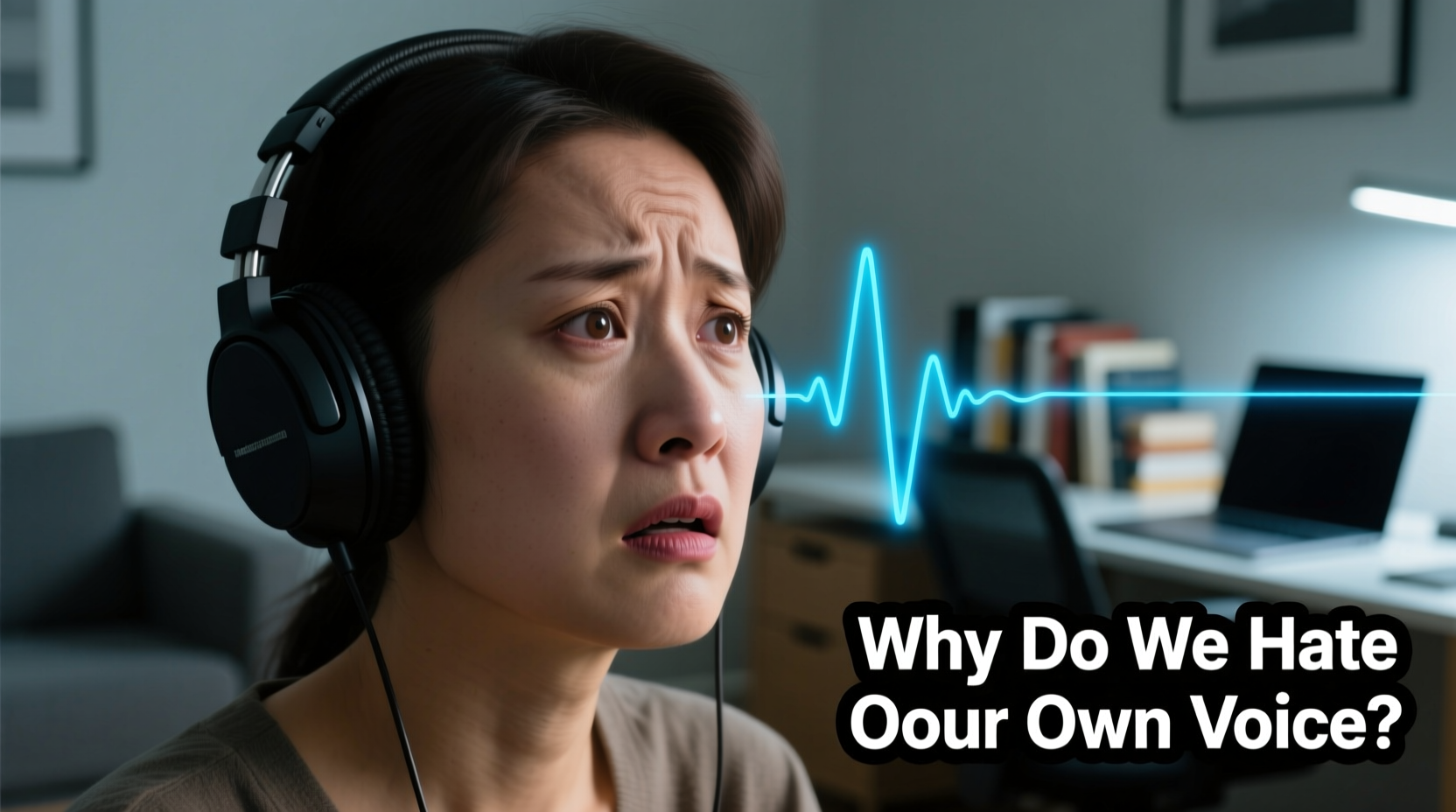
When you speak, two pathways deliver sound to your inner ear: air conduction and bone conduction. Air conduction carries sound waves from your vocal cords through the air, into your ear canal, and then to the cochlea. Bone conduction, however, transmits vibrations directly through the bones of your skull. This dual pathway enriches the sound you hear when speaking, making your voice seem deeper, fuller, and more resonant than it actually is to others.
Recordings, on the other hand, capture only the air-conducted version—the same way everyone else hears you. When you listen to a recording, you're missing the internal vibration component. As a result, your voice sounds thinner, higher, and unfamiliar. This mismatch between expectation and reality triggers cognitive dissonance—a psychological discomfort arising from conflicting beliefs or perceptions.
“Your brain expects to hear the rich, low-frequency tones generated by bone conduction. When the recording fails to deliver that, it feels alien—even though it's objectively accurate.” — Dr. Sarah Langston, Cognitive Psychologist at University of Edinburgh
This dissonance isn’t just auditory—it’s emotional. You’ve spent decades forming an identity tied to how you believe you sound. A recording shatters that illusion, creating a jarring sense of self-alienation. It’s not vanity; it’s identity disruption.
Psychological Mechanisms at Play
The aversion to hearing your recorded voice involves several overlapping psychological processes:
- Self-Perception Theory: We form our self-image based on internal cues. Since we never naturally hear our voice as others do, our mental model is built on distorted input. A recording contradicts that model, leading to rejection.
- Confirmation Bias: Once we decide our voice “sounds bad,” we selectively focus on flaws in recordings, ignoring neutral or positive aspects.
- Negative Primacy Effect: First impressions matter. If your initial exposure to your recorded voice was negative (as it often is), that impression sticks, coloring all future experiences.
- Social Anxiety Component: Many worry their voice sounds unprofessional, weak, or annoying. These fears amplify discomfort when confronted with objective evidence.
A 2020 study published in *The Journal of Acoustic Society of America* found that over 75% of participants rated their recorded voice as less pleasant, trustworthy, and competent than strangers did. This gap highlights how subjective self-evaluation can be—and how harsh we are toward ourselves.
How Familiarity Can Rewire Perception
Interestingly, repeated exposure reduces discomfort. Researchers call this the **mere exposure effect**: the more we encounter something, the more we tend to like it. In one experiment, participants listened to their recorded voices daily for two weeks. By day ten, nearly 60% reported reduced aversion, and some even began to prefer the recording over their internalized version.
The Role of Media and Technology
In the past, most people rarely heard their own voice. Today, smartphones, video calls, podcasts, and social media make self-recording routine. This increased exposure should, in theory, normalize the experience—but paradoxically, it may intensify anxiety.
Platforms like Instagram, TikTok, and Zoom place emphasis on vocal performance. Users critique pitch, tone, pacing, and clarity—not just content. This scrutiny magnifies insecurities. Moreover, digital compression and microphone quality can distort voices further, making them sound tinny or robotic, compounding dissatisfaction.
Yet technology also offers solutions. Voice training apps, real-time feedback tools, and AI-powered speech analyzers help users adapt. Some professionals now use these tools not to change their voice entirely, but to align their self-perception with external reality.
Case Study: Emma, the Podcast Host
Emma, a marketing consultant, launched a podcast to share industry insights. Excited at first, she became paralyzed after hearing her first episode. “I sounded nasal, monotone, and awkward,” she recalls. She almost quit—until her producer suggested a simple exercise: transcribe her own episodes and listen while reading.
Within weeks, Emma began focusing less on tone and more on content delivery. She noticed nuances she hadn’t before—her pacing, emphasis, and natural warmth. After six months, she re-listened to her debut episode. “It still wasn’t perfect,” she says, “but it didn’t disgust me anymore. It sounded like… me.”
Her story illustrates a key truth: familiarity doesn’t require perfection. It requires acceptance.
Do’s and Don’ts of Voice Acceptance
| Do | Don't |
|---|---|
| Listen to recordings in short bursts to avoid overload | Compare your voice to celebrities or influencers |
| Focus on clarity and message, not tone | Assume others judge your voice as harshly as you do |
| Use recordings to improve articulation and confidence | Edit excessively to “fix” perceived flaws |
| Ask trusted friends for honest but kind feedback | Record yourself under stress or fatigue |
| Practice speaking exercises to build vocal awareness | Avoid recordings altogether out of fear |
How to Reconcile With Your Recorded Voice: A Step-by-Step Guide
Disliking your recorded voice is normal—but it doesn’t have to be permanent. Here’s a practical approach to building comfort and confidence:
- Start Small: Record a 30-second message—something casual, like a reminder or a note to yourself. Avoid high-pressure topics.
- Delay Playback: Wait 10–15 minutes before listening. This creates psychological distance, reducing emotional reactivity.
- Focus on Content: Listen once for meaning, not tone. Ask: Was my point clear? Did I stay on topic?
- Listen Again for Delivery: On the second pass, note pacing, pauses, and word choice—objective metrics, not judgments.
- Compare Over Time: Save recordings weekly. After a month, compare early and recent clips. You’ll likely notice improvement and growing comfort.
- Normalize the Experience: Share a clip with a friend. Chances are, they won’t react negatively—and their neutral response can recalibrate your expectations.
“The goal isn’t to love your voice instantly. It’s to stop letting it undermine your message.” — Dr. Marcus Tran, Speech and Communication Researcher
Frequently Asked Questions
Is it normal to hate my recorded voice?
Absolutely. Studies show that over 90% of people experience discomfort when first hearing their recorded voice. It’s a near-universal reaction rooted in physiology and psychology, not personal flaw.
Does everyone hate their own voice?
Not permanently. While initial reactions are typically negative, most people acclimate with repeated exposure. Professional speakers, actors, and broadcasters often grow comfortable—or even indifferent—to their recorded voice through regular practice.
Am I the only one who thinks my voice sounds weird?
No. The sensation of “weirdness” comes from the absence of bone-conducted sound in recordings. Everyone experiences this discrepancy. What differs is how long it takes to adjust. Some adapt in days; others take months. Patience is key.
Action Plan: Building Vocal Confidence
If you’re ready to shift your relationship with your voice, here’s a checklist to guide you:
- ✅ Record yourself speaking for 1 minute daily (e.g., summarizing your day)
- ✅ Listen back within 24 hours, focusing only on clarity and structure
- ✅ Identify one strength per recording (e.g., steady pace, good vocabulary)
- ✅ Avoid editing or re-recording unless necessary for a project
- ✅ Share a clip with someone you trust every two weeks
- ✅ Track progress monthly by revisiting older recordings
Remember: your voice is a tool, not a verdict. It carries your ideas, emotions, and personality. Others don’t analyze it with the same scrutiny you do. They care about what you say—not whether your pitch matches your self-image.
Conclusion: Embrace the Real You
Hearing your recorded voice is like seeing an unfiltered photo: momentarily shocking, but ultimately truthful. The discomfort stems not from how you sound, but from the collision between self-perception and reality. That gap is natural—and bridgeable.
Instead of resisting the recording, use it as a mirror. Not to fix yourself, but to understand how you’re perceived. Every time you press play, you’re practicing authenticity. You’re aligning your internal narrative with the world outside.




 浙公网安备
33010002000092号
浙公网安备
33010002000092号 浙B2-20120091-4
Comments
No comments yet. Why don't you start the discussion?