
It’s a reflex so ingrained in daily life that most people do it without thinking: after making a hopeful statement—“I’ve never been late to work”—we rap our knuckles against the nearest wooden surface. “Knock on wood” (or “touch wood,” as it’s known in some regions) is more than just a quirky habit; it’s a centuries-old superstition with deep cultural roots stretching across continents and civilizations. But where did this practice begin? And why has it endured so long in an age of science and reason?
The gesture transcends language and geography, appearing in variations from North America to Eastern Europe, and even parts of Asia. While today it may seem like a harmless tic or a joke among friends, knocking on wood once carried serious spiritual weight. Understanding its origins reveals not only how humans have historically tried to control fate but also how ancient beliefs subtly shape modern behavior.
Ancient Roots: Pagan Beliefs and Nature Spirits
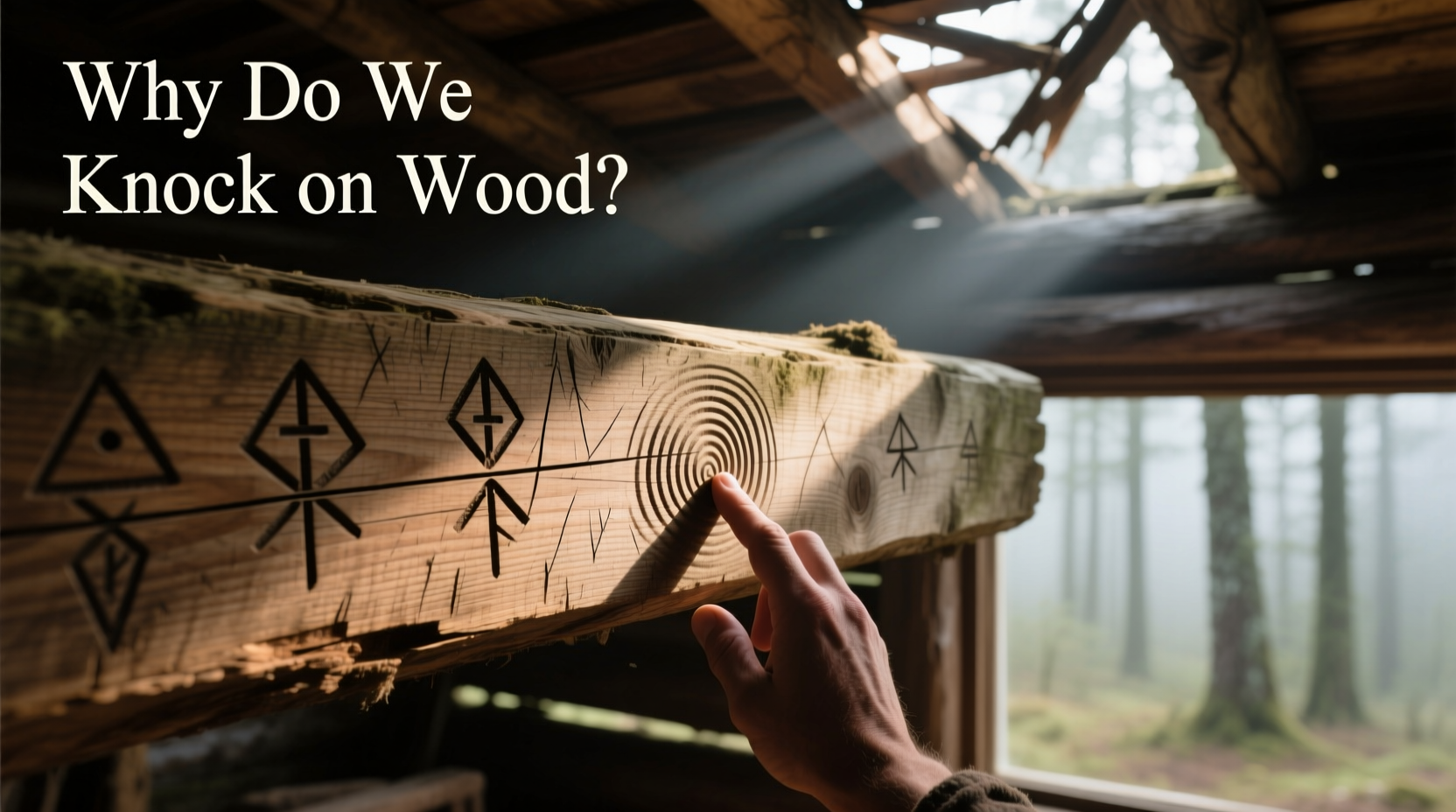
The earliest recorded traces of knocking on wood lead back to pre-Christian Europe, particularly among Celtic and Germanic tribes who believed that spirits resided within trees. These cultures practiced animism—the belief that natural objects, including trees, possess souls or spiritual essence. Oaks, ash, and rowan trees were especially sacred, often associated with protective deities or nature spirits.
In this worldview, announcing good fortune could attract the attention of malevolent forces or jealous spirits. To counteract this risk, people would physically acknowledge the divine presence by touching or tapping wood, essentially thanking the spirit for its protection or asking it to continue shielding them from misfortune. This act was both reverent and strategic—a way of staying humble in the face of luck.
“We didn’t speak too boldly about fortune, lest we anger the unseen guardians. A touch of bark was a small offering for continued favor.” — Dr. Lena Petrosyan, Anthropologist specializing in European folk traditions
This idea aligns with similar taboos found in other cultures: avoiding direct praise of children, using euphemisms during hunting, or spitting over the shoulder to ward off evil. The core principle is the same—boasting invites imbalance, and rituals restore it.
Jewish and Christian Adaptations
As Europe converted to Christianity, many pagan customs were absorbed and reinterpreted rather than eradicated. The practice of knocking on wood may have gained renewed significance through association with the Christian cross. Because crosses were traditionally made of wood—the symbol of Christ’s sacrifice—touching any wooden object could serve as a subtle invocation of divine protection.
In some Jewish traditions, there is a custom called *bitul kabala*—nullifying an omen—where one knocks or taps to cancel out potentially negative consequences of predictive speech. Though not identical, the psychological function mirrors that of knocking on wood: disrupting a verbal claim of future certainty to avoid inviting divine retribution or ill fate.
By the 18th and 19th centuries, references to touching wood for luck appear in British folklore collections. One early written account from 1857 describes children in rural England rapping their knuckles on wooden desks after saying, “I’ll pass my exam,” followed by “touch wood” to seal the plea for protection.
Global Variations and Cultural Parallels
While “knock on wood” is most common in English-speaking countries, similar practices exist worldwide:
- Russia & Eastern Europe: Saying “стучи по дереву” (“stuchi po derevu”) while knocking on wood, often repeated three times.
- Turkey: People knock on wood and say “Kapıya dokun” (“touch the door”), believing doors deflect evil.
- Italy: Some tap their heads or knock on wood while saying “In bocca al lupo” (“into the wolf’s mouth”), a phrase wishing good luck.
- Japan: Though not identical, the concept of *engawa* (thresholds) as liminal spaces reflects a respect for boundaries between fortune and misfortune, sometimes marked by wooden structures.
These variations suggest a universal human impulse: when speaking of desired outcomes, we instinctively seek ways to neutralize perceived risks. Whether through wood, metal, or symbolic gestures, the mechanism remains consistent—an attempt to hedge against uncertainty.
Psychological Function: Why We Still Do It Today
In an era dominated by logic and empirical evidence, why does knocking on wood persist? Psychology offers compelling answers. The act functions as a form of “magical thinking”—a subconscious strategy to regain a sense of control in unpredictable situations.
Dr. Emily Tran, cognitive psychologist at the University of Toronto, explains: “When people make optimistic predictions, they experience mild anxiety about jinxing it. Knocking on wood provides a quick, low-effort ritual that reduces that discomfort. It’s not about belief in spirits—it’s about emotional regulation.”
Studies in behavioral psychology show that rituals, even arbitrary ones, can improve performance under pressure. In one experiment, participants who performed a short personal ritual before a memory test scored significantly higher than those who didn’t—regardless of whether they believed in the ritual’s power.
In this light, knocking on wood isn’t irrational; it’s adaptive. It serves as a mental reset, a pause that acknowledges hope while tempering overconfidence. For many, it’s less about superstition and more about mindfulness.
Common Misconceptions and Etiquette
Despite its widespread use, certain nuances are often overlooked. Here’s what etiquette and tradition suggest:
| Misconception | Reality |
|---|---|
| You must knock three times. | No fixed number exists; repetition varies by region but isn't required. |
| Only real wood counts. | Symbolic intent matters more; laminate or painted wood still “works” socially. |
| It's childish or silly. | Even skeptics use it—often unconsciously—as a linguistic placeholder. |
| You have to say “knock on wood” aloud. | Many use the gesture silently, especially in professional settings. |
Mini Case Study: The Job Offer Jinx
Sophie, a marketing professional in Chicago, landed a dream job after months of searching. When her friend asked how the interview went, Sophie replied, “I think I nailed it—they’ll probably call me Monday.” Immediately, she felt uneasy. “I said it too confidently,” she later recalled. Without thinking, she tapped the wooden armrest of her couch and added, “Knock on wood.”
Monday came, and the offer arrived. “I know it wasn’t the knocking that got me the job,” she said, “but doing it made me feel like I’d done something to protect that moment of hope.” Her story illustrates how the ritual persists not because people believe wood holds magic, but because it anchors emotion in action.
How to Use the Ritual Mindfully
If you find yourself knocking on wood automatically, consider turning it into a moment of reflection. Instead of merely performing the gesture, use it as a cue to pause and assess your mindset. Here’s a simple step-by-step approach:
- Recognize the trigger: You’ve just said something hopeful or confident about the future.
- Pause and knock: Perform the gesture deliberately, not reflexively.
- Reframe mentally: Acknowledge gratitude for current blessings, not just future hopes.
- Act accordingly: Follow up optimism with practical steps—preparation beats superstition.
“Rituals aren’t about changing fate. They’re about centering ourselves within it.” — Dr. Alan Fong, Cultural Psychologist
FAQ
Is knocking on wood considered bad in any religions?
Generally, no major religion prohibits knocking on wood. However, some conservative religious groups discourage superstitious practices if they’re seen as replacing faith in divine will. Most modern interpretations treat it as a cultural idiom rather than a religious act.
Can you knock on anything besides wood?
Purists insist on wood, but adaptations exist. In some cultures, people knock on metal, stone, or even their own heads. The key is symbolic substitution—using a familiar gesture to achieve psychological comfort, regardless of material.
Does knocking on wood have any scientific basis?
Not directly. There’s no evidence that tapping wood affects outcomes. However, research confirms that rituals reduce anxiety and increase perceived control, which can indirectly improve focus and decision-making.
Final Thoughts: Tradition, Psychology, and the Human Need for Ritual
Knocking on wood endures not because we believe trees house spirits, but because we remain deeply human—prone to hope, fear, and the search for meaning in uncertainty. What began as a pagan offering has transformed into a global tic, stripped of doctrine but rich in psychological utility.
Whether you see it as a throwback to ancient reverence or a quirk of modern speech, the ritual connects us to a shared heritage of trying to navigate fate with humility. In recognizing that, we don’t have to believe in magic to appreciate the wisdom behind the knock.




 浙公网安备
33010002000092号
浙公网安备
33010002000092号 浙B2-20120091-4
Comments
No comments yet. Why don't you start the discussion?