
Deadlines are meant to focus us. They create urgency, structure time, and ideally push us toward action. Yet for many, a deadline doesn’t trigger productivity—it triggers paralysis. The closer the due date looms, the more tempting it becomes to scroll through social media, reorganize a desk, or suddenly develop an intense interest in 15th-century pottery. This pattern isn't laziness. It’s procrastination, a deeply rooted psychological behavior shaped by emotion regulation, brain chemistry, and cognitive biases.
Understanding why we delay tasks despite knowing the consequences requires moving beyond self-judgment and into the science of avoidance. Procrastination is not a time management problem—it’s an emotional management problem. By unpacking the mechanisms behind this behavior, we can replace guilt with strategy and transform avoidance into action.
The Brain’s Battle: Present Self vs. Future Self
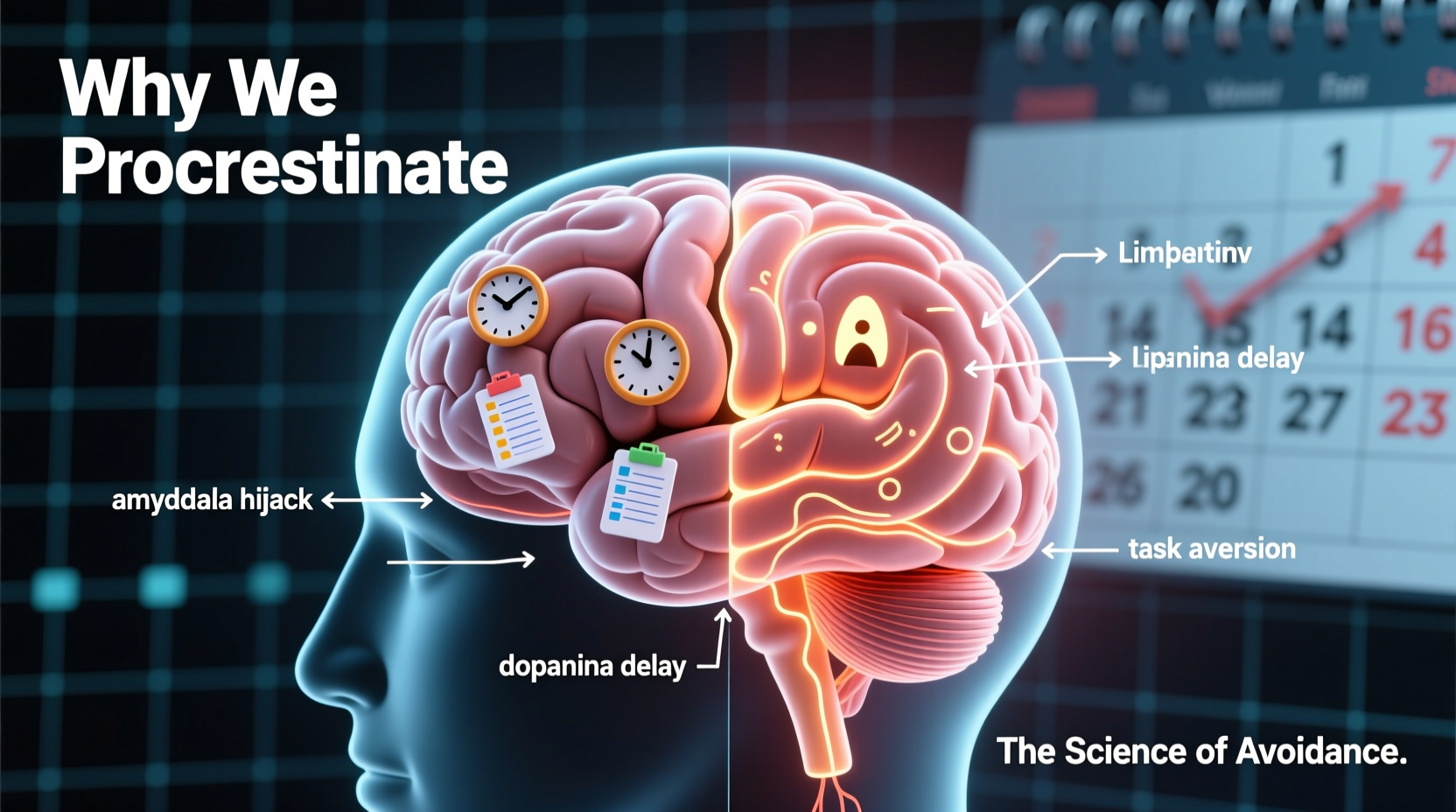
At the heart of procrastination lies a conflict between two versions of you: the present self and the future self. The present self craves immediate comfort and relief from discomfort. The future self bears the cost of today’s delays. Neuroscientists refer to this as \"temporal discounting\"—the tendency to value immediate rewards more highly than future ones, even when the future outcome is objectively better.
Brain imaging studies show that when making decisions about future events, different neural networks activate depending on whether we’re thinking about ourselves or someone else. When envisioning our future selves, the brain often responds as if thinking about a stranger. This disconnect reduces empathy for the person who will face the consequences of our current inaction.
“We don’t procrastinate because we don’t care about the future. We procrastinate because our present emotional state feels more real and urgent than any abstract future benefit.” — Dr. Hal Hershfield, UCLA Behavioral Scientist
This neurological bias explains why “just start” is rarely effective advice. Starting often involves short-term discomfort—fear of failure, boredom, uncertainty—which the brain instinctively avoids, even at the expense of long-term goals.
The Role of Emotion Regulation in Task Avoidance
Traditional views frame procrastination as a failure of discipline. Modern psychology reveals a more accurate picture: it’s a failure of emotion regulation. When a task evokes negative emotions—such as anxiety, insecurity, or overwhelm—the automatic response is to escape. Procrastination becomes a form of mood repair.
Dr. Fuschia Sirois, a leading researcher on procrastination, emphasizes that people don’t delay tasks because they enjoy wasting time. They delay because the act of doing the task feels emotionally threatening. Writing a report may trigger fear of judgment. Preparing a presentation might stir imposter syndrome. Even seemingly simple tasks can carry hidden emotional weight.
The brain’s limbic system, particularly the amygdala, plays a key role here. When activated by perceived threat—even a non-life-threatening one like a work deadline—it triggers a fight-or-flight response. Since flight (avoidance) is easier than fight (engagement), the brain chooses distraction.
Why Deadlines Intensify Procrastination (And Sometimes Help)
Paradoxically, deadlines both enable and combat procrastination. On one hand, they provide structure and accountability. On the other, they create pressure that amplifies emotional distress, increasing the urge to avoid.
For chronic procrastinators, deadlines often fall into one of two categories:
- Distant deadlines: Feel abstract and easy to ignore. The brain discounts their importance.
- Imminent deadlines: Trigger acute stress, which can either force action (via adrenaline) or deepen paralysis (via overwhelm).
The phenomenon of last-minute productivity—often called “productive procrastination”—isn’t proof of peak performance under pressure. It’s evidence of the brain finally overriding avoidance due to the immediacy of consequences. The stress of missing a deadline becomes more painful than the discomfort of doing the work.
However, relying on this cycle is costly. Work produced under extreme time pressure tends to be lower in quality, higher in error rates, and more taxing on mental health. The temporary win comes at a long-term price.
Breaking the Cycle: A Science-Backed Action Plan
Overcoming procrastination isn’t about willpower. It’s about designing systems that reduce emotional friction and align with how the brain actually works. Below is a step-by-step approach grounded in cognitive behavioral therapy (CBT), neuroscience, and habit formation research.
Step 1: Reframe the Task
Instead of viewing the task as a monolithic obligation (“Write the report”), break it into micro-actions with neutral or positive framing (“Open document and write one sentence”). This reduces the activation energy required to begin.
Step 2: Use Implementation Intentions
Create specific “if-then” plans: “If it’s 9 a.m., then I will sit at my desk and work for 10 minutes.” These pre-decisions bypass hesitation when motivation is low.
Step 3: Lower the Stakes
Perfectionism fuels procrastination. Tell yourself, “I’m not writing the final version—I’m writing a terrible first draft.” Giving yourself permission to produce imperfect work removes the pressure that triggers avoidance.
Step 4: Schedule Worry Time
If anxiety about the task keeps intruding, schedule a 10-minute “worry session” later in the day. When anxious thoughts arise, jot them down and defer them. This trains the brain to contain rumination.
Step 5: Leverage Accountability
Share your progress with someone else—even if it’s just a daily text saying “I worked for 15 minutes.” Social commitment increases follow-through.
Do’s and Don’ts of Managing Deadline Pressure
| Do | Don’t |
|---|---|
| Break tasks into sub-tasks under 30 minutes | Try to complete everything in one sitting |
| Use a timer (Pomodoro technique: 25 min work, 5 min rest) | Work without breaks until exhaustion |
| Focus on starting, not finishing | Wait until you “feel ready” to begin |
| Forgive slip-ups and restart immediately | Guilt-trip yourself into further inaction |
| Track progress visually (checklists, calendars) | Rely solely on memory or vague intentions |
Real Example: From Chronic Delay to Consistent Action
Sophie, a freelance graphic designer, consistently missed client deadlines despite wanting to build a reliable reputation. She would start projects late, work through the night, and deliver stressed, subpar designs. After tracking her behavior, she realized her avoidance began not from disinterest, but from fear: “What if the client hates it? What if I’m not good enough?”
With coaching, Sophie implemented small changes. She began each project by creating a placeholder file labeled “V1 – Will Improve.” She committed to working just 10 minutes a day. She shared her progress weekly with a peer group. Within six weeks, her turnaround time improved by 60%. More importantly, her confidence grew—not because she stopped feeling fear, but because she learned to act alongside it.
Her transformation wasn’t about becoming more disciplined. It was about changing her relationship with discomfort.
Checklist: Overcoming Procrastination in 7 Steps
- Identify the emotion behind the delay (anxiety, boredom, fear of failure)
- Break the task into the smallest possible first step
- Set a timer for 5–10 minutes and commit to starting
- Create an “if-then” plan for when and where you’ll work
- Remove distractions (use website blockers, silence notifications)
- Schedule a review of progress every 24 hours
- Practice self-compassion after setbacks—no shame spirals
“Self-compassion is the most powerful antidote to procrastination. When people stop beating themselves up, they become more likely to try again.” — Dr. Tim Pychyl, Carleton University Procrastination Research Group
Frequently Asked Questions
Is procrastination the same as laziness?
No. Laziness involves a lack of desire to expend effort. Procrastination involves active avoidance despite wanting to complete the task. Procrastinators often work harder and longer than others—they just compress their effort into stressful bursts.
Can ADHD cause procrastination?
Yes. Individuals with ADHD often struggle with executive function—skills like planning, task initiation, and time estimation. These challenges make procrastination more likely, but the solution isn’t willpower. It requires structured support, external accountability, and accommodations tailored to neurodivergent needs.
Are some people more prone to procrastination?
Research shows that around 20% of adults are chronic procrastinators. Traits like high sensitivity, perfectionism, low self-efficacy, and impulsivity increase susceptibility. However, anyone can procrastinate under stress, especially when tasks feel ambiguous or emotionally charged.
Conclusion: Rewire Your Response to Deadlines
Procrastination isn’t a moral failing. It’s a predictable human response to tasks that feel emotionally threatening. The presence of a deadline doesn’t automatically override millions of years of evolution designed to avoid discomfort. But understanding the science gives us power. We can stop fighting ourselves and start working with our psychology.
The goal isn’t to eliminate procrastination entirely—that’s unrealistic. The goal is to shorten its duration, reduce its impact, and respond with compassion rather than criticism. Each time you notice the urge to avoid and choose to take one small step anyway, you rewire your brain’s response. You teach it that discomfort is survivable, and action is possible.
Start not with the full task, but with curiosity. Ask: What am I feeling right now? What’s the tiniest next move? Then do that. Repeat. Progress isn’t built in grand gestures. It’s built in moments of quiet courage—when you choose the future, one imperfect action at a time.




 浙公网安备
33010002000092号
浙公网安备
33010002000092号 浙B2-20120091-4
Comments
No comments yet. Why don't you start the discussion?