
Yawning is one of the most universal human behaviors—nearly every person, from infancy to old age, experiences it multiple times a day. But there’s a peculiar twist: seeing someone else yawn often triggers an almost irresistible urge to yawn ourselves. This phenomenon, known as contagious yawning, has intrigued scientists for decades. While yawning itself may serve physiological functions like increasing oxygen intake or cooling the brain, the reason it spreads from person to person remains more mysterious. Research increasingly suggests that this automatic response isn’t just random—it may be deeply tied to our capacity for empathy, social bonding, and even cognitive development.
The Science Behind Contagious Yawning
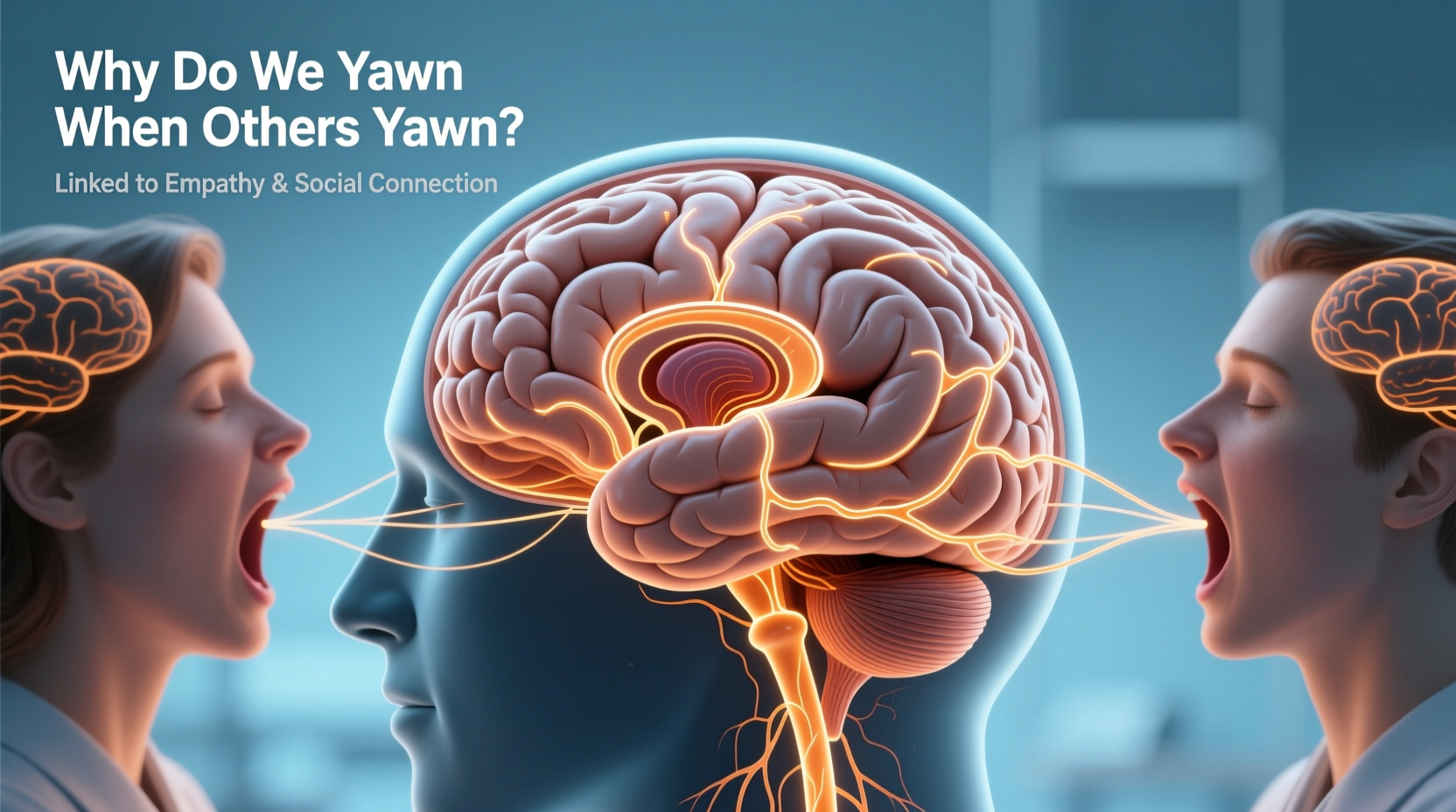
Contagious yawning occurs when observing, hearing, or even reading about someone else yawning induces a yawn in oneself. It's not unique to humans; studies have documented similar behavior in chimpanzees, dogs, bonobos, and certain bird species. What makes it particularly interesting is that it doesn't affect everyone equally. Some people are highly susceptible, while others seem immune, even in group settings where multiple people are yawning.
Neuroscientists believe contagious yawning is linked to the brain’s mirror neuron system—the network responsible for understanding and imitating the actions of others. When you see someone yawn, your brain activates regions associated with motor imitation, such as the premotor cortex. This mirroring process is thought to help us learn through observation and empathize with others’ emotional states.
A 2017 study published in *Current Biology* found that simply reading the word “yawn” or thinking about yawning could trigger the reflex in sensitive individuals. The researchers concluded that the mental representation of yawning is enough to activate the same neural pathways as witnessing it in real life.
Empathy and the Mirror Neuron Connection
The strongest evidence linking contagious yawning to empathy comes from developmental and psychological research. Children typically don’t begin to \"catch\" yawns until around the age of four or five—coinciding with the emergence of theory of mind, the ability to recognize that others have thoughts and feelings different from one’s own.
This delay suggests that contagious yawning requires a level of social cognition. You must not only perceive another person’s action but also subconsciously interpret their state—perhaps tiredness or boredom—and respond in kind. In this way, yawning becomes a subtle form of nonverbal communication.
“Contagious yawning appears to be a window into our social brain. It reflects our ability to resonate with others’ internal states—even something as simple as fatigue.” — Dr. Sophie Schwartz, Cognitive Neuroscientist, University of Geneva
Further support comes from studies comparing individuals with high and low empathy traits. People who score higher on empathy scales are significantly more likely to experience contagious yawning. Conversely, those with autism spectrum disorder (ASD), which often involves challenges with social reciprocity, show lower rates of contagious yawning—even though they yawn just as frequently for physiological reasons.
Who Is More Likely to Catch a Yawn?
Not everyone is equally susceptible to contagious yawning. Several factors influence how likely you are to yawn after seeing someone else do so:
- Social closeness: You’re more likely to catch a yawn from someone you know well—family members, close friends, or romantic partners—than from strangers.
- Age: Susceptibility increases with age during childhood and peaks in adulthood. Older adults may experience slightly reduced contagion.
- Stress and fatigue levels: Being tired lowers inhibitory control, making you more vulnerable to automatic responses like contagious yawning.
- Personality traits: Individuals high in perspective-taking and emotional sensitivity tend to yawn more contagiously.
A 2011 study at the University of Pisa demonstrated that participants were twice as likely to yawn after watching videos of close relatives compared to unfamiliar individuals. This suggests that emotional bonds enhance the mirroring effect, reinforcing the idea that yawning serves a social rather than purely biological purpose in these contexts.
Do All Animals Experience Contagious Yawning?
While yawning is widespread across vertebrates, contagious yawning appears limited to species with complex social structures and advanced cognitive abilities. Here’s a comparison of species known to exhibit—or lack—this behavior:
| Species | Exhibits Contagious Yawning? | Notes |
|---|---|---|
| Humans | Yes | Strongly linked to empathy and social bonds |
| Chimpanzees | Yes | More likely to yawn contagiously with group members |
| Dogs | Yes | More responsive to owners than strangers |
| Bonobos | Yes | Highly social; frequent yawning synchrony |
| Parrots | Limited evidence | Observed in captive colonies; possible social function |
| Cats & Rats | No | Yawn for thermoregulation, not social mimicry |
This pattern supports the hypothesis that contagious yawning evolved as a mechanism to promote group cohesion and synchronize behavioral states—such as alertness or rest—in socially interdependent species.
Mini Case Study: The Office Meeting Effect
Consider Sarah, a project manager leading weekly team meetings. Every Friday at 3 p.m., she notices a curious trend: once one person yawns, within minutes, half the room follows. At first, she assumes it’s due to post-lunch fatigue. But over time, she observes that the chain reaction only happens when her most engaged team members yawn—not when quieter or more detached colleagues do.
Intrigued, Sarah reads up on the topic and realizes the pattern aligns with empathy-based contagion. Her core team shares strong working relationships, trusts each other, and regularly collaborates. The yawning isn’t just about tiredness—it’s a subconscious sign of attunement. When one person signals a shift in energy, others unconsciously follow, reflecting their social alignment.
She begins using this insight informally: if she sees multiple people yawning early in a meeting, she takes it as a cue to switch formats—introducing movement, interaction, or a quick break—to re-engage the group. Over time, meeting productivity improves.
Debunking Common Myths About Yawning
Despite growing scientific understanding, several myths persist about yawning. Let’s clarify them with evidence-based insights:
- Myth: Yawning is caused by low oxygen or high carbon dioxide.
Reality: Controlled studies show that altering air composition (e.g., increasing CO₂) does not increase yawning frequency. Brain cooling is now considered a more plausible primary function. - Myth: Only bored or tired people yawn.
Reality: Athletes yawn before competitions. Soldiers yawn before missions. Yawning is linked to shifts in arousal states—both increases and decreases. - Myth: Contagious yawning is a sign of weakness or poor discipline.
Reality: It’s actually a marker of healthy social cognition. Resisting it entirely may indicate reduced empathic responsiveness.
Step-by-Step Guide: Understanding Your Own Yawning Patterns
To better understand whether and why you experience contagious yawning, follow this self-assessment process:
- Track your yawning episodes for one week. Note when you yawn and whether it followed someone else’s yawn.
- Record the context: Who was present? Were you tired, stressed, or bored? Was the environment warm?
- Identify patterns: Do you yawn more around family than coworkers? After video calls with close friends?
- Assess empathy links: Compare your results with your self-perceived empathy levels. Are you more attuned to others’ emotions?
- Experiment with suppression: Try looking away or focusing on a mental task when someone yawns nearby. Notice how hard it is to resist.
This exercise can reveal how your nervous system responds to social cues and deepen your awareness of unconscious social synchronization.
Checklist: Signs You May Be Highly Sensitive to Contagious Yawning
If you relate to most of the following, you likely have a strong empathic response to yawning:
- ☑ You’ve yawned after seeing someone yawn in a movie or video call
- ☑ You’re more likely to yawn when a loved one does it
- ☑ You notice yourself mimicking other behaviors (e.g., crossing arms, leaning forward)
- ☑ You score high on empathy or introversion scales
- ☑ You feel emotionally affected by others’ moods easily
These traits aren’t flaws—they reflect a finely tuned social brain.
Frequently Asked Questions
Is it normal to not yawn when others do?
Yes, it’s completely normal. Around 30–40% of people show little to no susceptibility to contagious yawning. This doesn’t mean you lack empathy—it may simply reflect individual differences in neural wiring or attentional focus.
Can you train yourself to stop catching yawns?
You can reduce the frequency with conscious effort. Techniques include shifting your gaze, engaging in mental arithmetic, or reminding yourself that the urge will pass. However, complete suppression is difficult because the response is largely automatic and subconscious.
Does contagious yawning happen in babies?
No, infants rarely exhibit contagious yawning. It typically emerges between ages 4 and 6, aligning with the development of social awareness and empathy. This delayed onset reinforces the cognitive component of the behavior.
Conclusion: A Tiny Act with Big Social Meaning
Contagious yawning may seem trivial, but it offers a profound glimpse into the invisible threads that connect us. Far from being a mere quirk, it reflects our brain’s deep-seated need for social harmony and emotional resonance. Whether you're the first to yawn in a group or the last to follow, your response reveals something meaningful about your relationship to others.
Next time you feel that familiar jaw stretch coming on after someone else yawns, don’t suppress it out of politeness. Instead, consider it a quiet affirmation of your humanity—a small, involuntary act of connection in a world that often feels disconnected.




 浙公网安备
33010002000092号
浙公网安备
33010002000092号 浙B2-20120091-4
Comments
No comments yet. Why don't you start the discussion?