
At first glance, \"2 + 2 = 4\" appears self-evident—a fact so basic it's taught in early childhood. Yet beneath this simple equation lies a profound structure of logic, philosophy, and mathematical rigor. Understanding why 2 + 2 equals 4 is not merely about memorizing a rule; it’s about grasping the very foundation of how we count, reason, and model reality. This truth is not arbitrary—it emerges from precise definitions and axiomatic systems that form the backbone of modern mathematics.
The Intuitive Understanding of Numbers
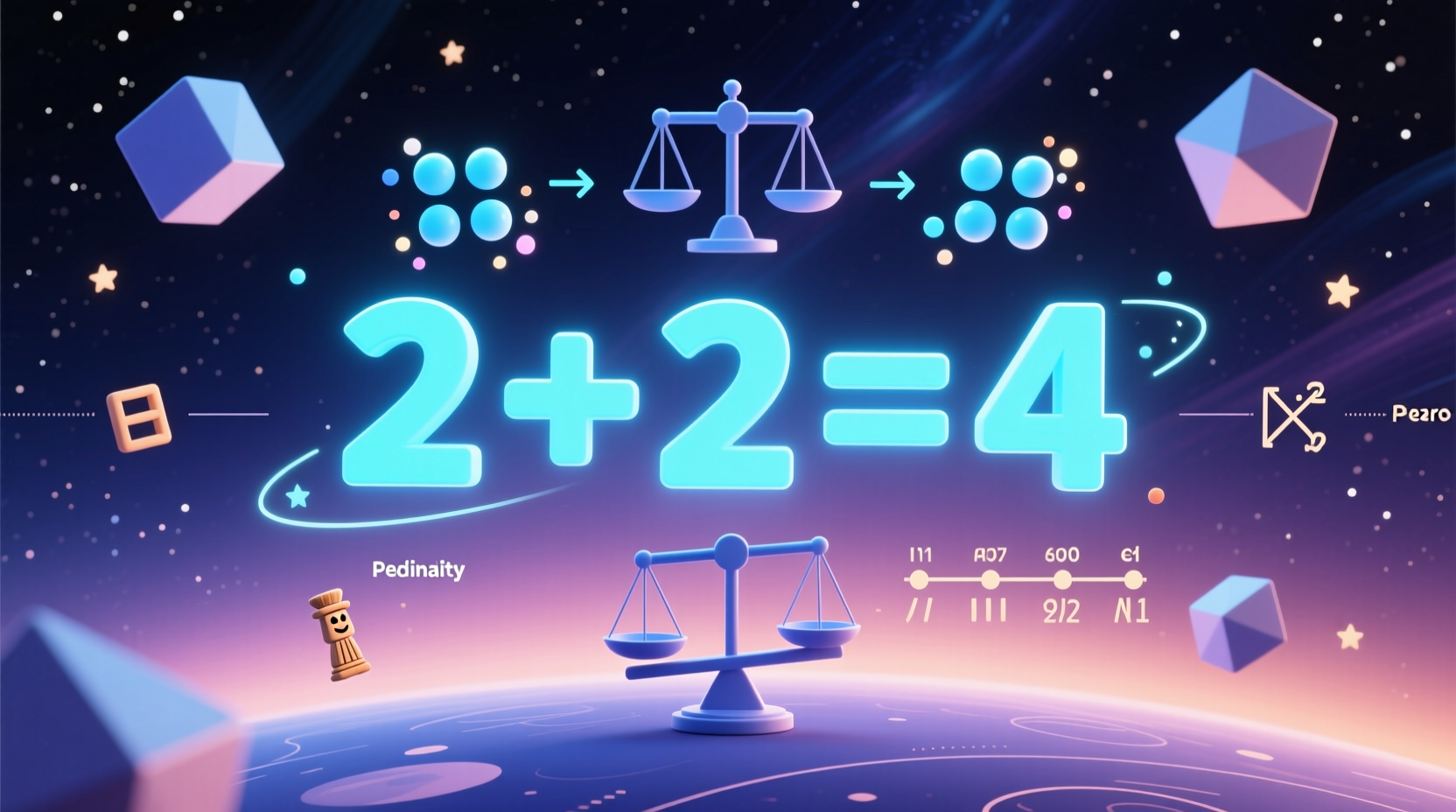
For most people, the idea that two apples plus two more apples make four apples feels immediate and undeniable. This intuitive grasp of quantity is rooted in our sensory experience. Humans and even some animals demonstrate an innate ability to distinguish small quantities without formal education—a phenomenon known as subitizing.
However, intuition alone cannot serve as proof in mathematics. While experience suggests that combining two units with another two yields four, mathematics demands a higher standard: logical derivation from agreed-upon principles. The journey from perception to proof begins with defining what numbers actually are.
Defining Numbers: From Peano to Set Theory
To formally prove that 2 + 2 = 4, we must first define the natural numbers (0, 1, 2, 3, ...). One of the most influential frameworks for doing so is the Peano Axioms, developed by Italian mathematician Giuseppe Peano in the late 19th century. These five axioms establish the properties of natural numbers using only logic and minimal assumptions:
- 0 is a natural number.
- Every natural number has a successor.
- 0 is not the successor of any natural number.
- Different numbers have different successors.
- If a property holds for 0 and propagates through successors, it holds for all natural numbers (principle of mathematical induction).
Using these axioms, we can construct numbers recursively:
- 1 is defined as the successor of 0 (S(0))
- 2 is S(S(0))
- 3 is S(S(S(0)))
- 4 is S(S(S(S(0))))
Addition is then defined recursively:
- a + 0 = a
- a + S(b) = S(a + b)
With these definitions, proving 2 + 2 = 4 becomes a step-by-step deduction:
- 2 + 2 = 2 + S(S(0))
- = S(2 + S(0)) [by recursive addition]
- = S(S(2 + 0))
- = S(S(2))
- = S(S(S(S(0)))) = 4
This proof, while abstract, shows that 2 + 2 = 4 is not assumed but derived from foundational rules. It reflects a deeper truth: arithmetic is built on structure, not assumption.
A Broader Perspective: What If 2 + 2 ≠ 4?
In everyday life, 2 + 2 always equals 4. But could there be contexts where this doesn’t hold? The answer depends on how we interpret “+” and “=”.
In modular arithmetic, for instance, operations wrap around after reaching a certain value (the modulus). In mod 3 arithmetic:
2 + 2 ≡ 1 (mod 3)because 4 divided by 3 leaves a remainder of 1. Here, “4” still exists, but equivalence is redefined within a cyclic system.
Likewise, in certain physical or computational systems, combining two entities might not yield four due to interaction effects—e.g., mixing 2 liters of alcohol with 2 liters of water results in less than 4 liters due to molecular packing. But this isn't a failure of arithmetic; it's a reminder that real-world phenomena require models beyond simple addition.
As mathematician Reuben Hersh observed:
“Mathematics is not a static set of truths etched in stone, but a living activity shaped by human thought and culture.” — Reuben Hersh, *What Is Mathematics, Really?*
This perspective highlights that while 2 + 2 = 4 holds in standard arithmetic, its validity is tied to context, definition, and application.
Historical Development of Arithmetic
The acceptance of basic arithmetic was neither immediate nor universal. Ancient civilizations developed counting systems independently, often based on practical needs like trade, agriculture, or astronomy. The Babylonians used a base-60 system, the Mayans a base-20 system, and the Egyptians additive notation without place value.
The concept of zero—as both a placeholder and a number—took millennia to emerge. Indian mathematicians around the 5th–7th centuries CE were among the first to treat zero as a full-fledged number, enabling more sophisticated arithmetic. This innovation eventually spread to the Islamic world and then to Europe, transforming mathematics forever.
The formalization of arithmetic reached new heights in the 20th century with works like Principia Mathematica by Alfred North Whitehead and Bertrand Russell. In Volume I, after hundreds of pages of logical development, they finally proved:
“From this proposition it will follow, when arithmetical addition has been defined, that 1 + 1 = 2.”
Their work demonstrated that even the simplest truths rest on layers of abstraction, logic, and symbolic precision.
Teaching the Why Behind the What
In classrooms, students often learn arithmetic procedurally: memorize facts, apply algorithms, check answers. But without understanding the underlying logic, math becomes a series of mysterious rules.
A more effective approach integrates conceptual understanding early. For example, showing children that “2 + 2” means combining two sets of two objects helps them see addition as union rather than symbol manipulation. As they grow, introducing ideas like number lines, grouping, and decomposition builds stronger mental models.
| Teaching Method | Advantage | Limitation |
|---|---|---|
| Rote Memorization | Fast recall of facts | Lacks conceptual depth |
| Manipulative-Based Learning | Bridges concrete and abstract thinking | Time-intensive |
| Number Talks | Encourages reasoning and communication | Requires skilled facilitation |
| Formal Proofs (advanced) | Builds logical rigor | Too abstract for young learners |
Mini Case Study: The Classroom Experiment
In a third-grade classroom in Portland, Oregon, a teacher introduced a week-long unit titled “Why Does 2 + 2 = 4?” Students used counters, drew pictures, wrote stories, and debated whether the equation would still hold if the items being counted changed (e.g., drops of water merging). By the end, over 80% of students could explain that addition represents combining groups, and that the result depends on clear definitions of what is being counted. One student remarked, “It’s not magic—it’s math.”
Common Misconceptions About Basic Math
Several myths persist about elementary arithmetic:
- Myth: Math is purely objective and disconnected from human thought.
Reality: While mathematical truths are consistent, the way we express and discover them is deeply human. - Myth: If you don’t instantly know 2 + 2 = 4, you’re bad at math.
Reality: Deep understanding often comes slowly, through questioning and exploration. - Myth: There’s only one way to do arithmetic.
Reality: Different cultures and systems use varied methods—all valid within their frameworks.
FAQ
Is 2 + 2 = 4 always true?
Within the standard framework of natural numbers and classical logic, yes. However, in alternative mathematical structures—like modular arithmetic or non-standard logics—the interpretation may differ. The truth of the equation depends on the definitions and rules in play.
Can machines prove that 2 + 2 = 4?
Yes. Automated theorem provers and proof assistants like Coq, Lean, and Isabelle/HOL can formally verify this result from the Peano Axioms. These tools are used in software verification and advanced mathematics to ensure absolute correctness.
Why does it matter to prove something so obvious?
Proving basic truths ensures that mathematics remains consistent and reliable. If foundational statements were accepted without proof, errors could propagate into complex theories. Rigor protects against hidden assumptions and strengthens trust in mathematical conclusions.
Conclusion: Embracing the Depth Behind Simplicity
The equation 2 + 2 = 4 is far more than a trivial fact. It is a gateway into the nature of numbers, logic, and human reasoning. From preschool classrooms to graduate-level logic courses, this simple statement invites us to ask deeper questions: What are numbers? How do we know what’s true? And how does abstract thought shape our understanding of reality?
By exploring the foundation of arithmetic, we gain not only knowledge but also intellectual humility. Even the most obvious truths deserve scrutiny, because in questioning them, we uncover the elegance and power of structured thought.




 浙公网安备
33010002000092号
浙公网安备
33010002000092号 浙B2-20120091-4
Comments
No comments yet. Why don't you start the discussion?