
At first glance, the idea that multiplying two negative numbers results in a positive number seems counterintuitive. After all, how can combining two \"opposites\" yield something positive? This rule—foundational in algebra and arithmetic—often leaves students puzzled. Yet, once explored through patterns, real-world analogies, and mathematical consistency, the logic becomes not only clear but elegant. Understanding this concept isn't just about memorizing a rule; it's about seeing how mathematics maintains internal coherence across operations.
The Pattern-Based Explanation
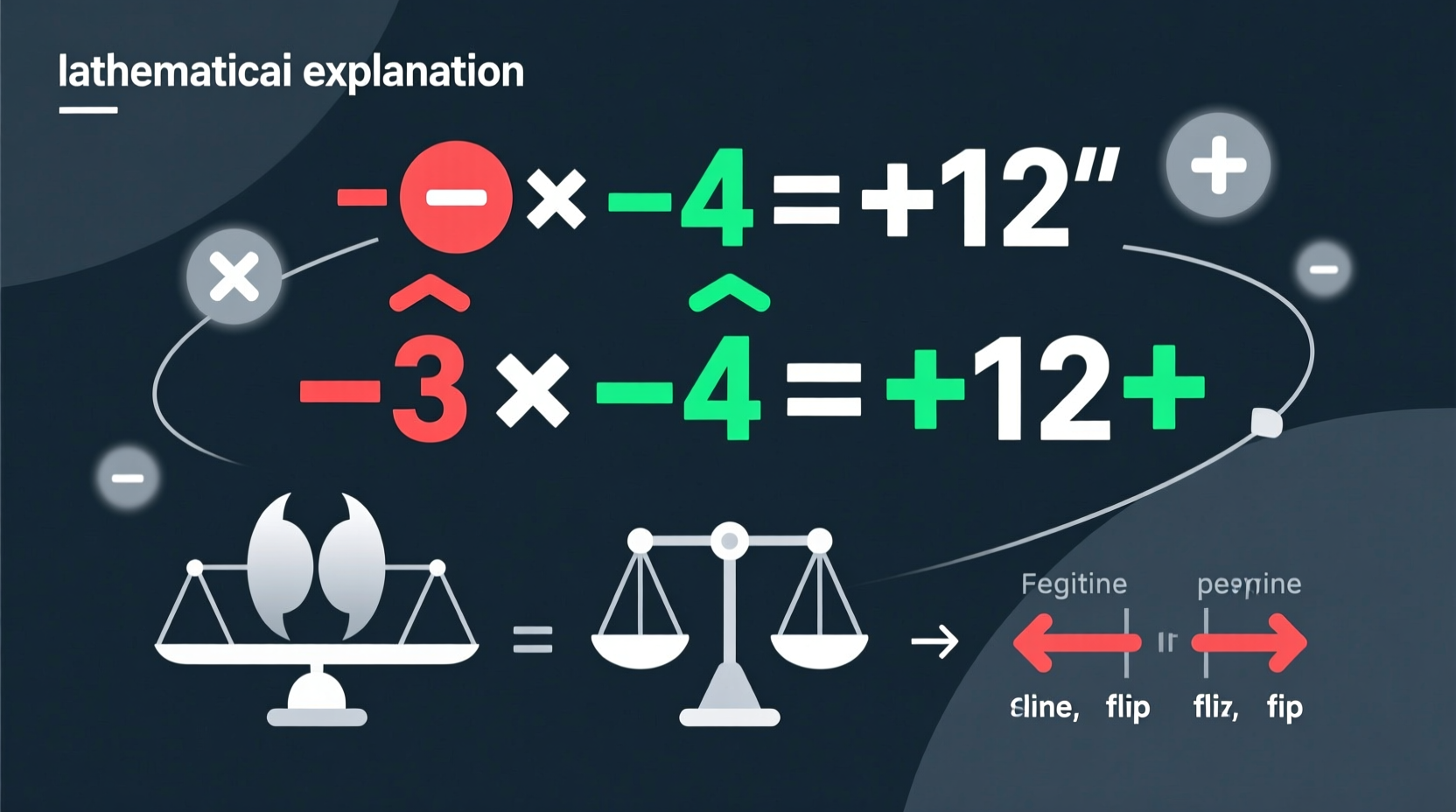
One of the most accessible ways to grasp this rule is by observing numerical patterns. Consider multiplication as repeated addition, and examine what happens when we multiply a positive number by decreasing integers—including negatives.
Take the example of multiplying 4 by descending integers:
| Multiplication | Result |
|---|---|
| 4 × 3 | 12 |
| 4 × 2 | 8 |
| 4 × 1 | 4 |
| 4 × 0 | 0 |
| 4 × (−1) | −4 |
| 4 × (−2) | −8 |
| 4 × (−3) | −12 |
The pattern shows a consistent decrease of 4 with each step. Now, apply the same reasoning when the first number is negative. Let’s examine −3 multiplied by descending values:
| Multiplication | Result |
|---|---|
| (−3) × 3 | −9 |
| (−3) × 2 | −6 |
| (−3) × 1 | −3 |
| (−3) × 0 | 0 |
| (−3) × (−1) | ? |
| (−3) × (−2) | ? |
Notice the results increase by 3 each time: from −9 to −6 to −3 to 0. Continuing this logical progression, the next result should be 3, then 6. Therefore:
- (−3) × (−1) = 3
- (−3) × (−2) = 6
This pattern-based approach doesn’t rely on abstract theory—it reveals consistency in arithmetic behavior, reinforcing that negative times negative yields a positive to preserve mathematical order.
Real-World Analogies and Contextual Meaning
Mathematics often mirrors real-life situations. While \"negative numbers\" may seem abstract, they represent tangible ideas like debt, temperature below zero, or direction in space.
Consider a scenario involving money. Suppose you owe $5 to three different people. Your total debt is 3 × (−5) = −15 dollars. Now, imagine someone forgives your debts. If one debt of $5 is removed, your financial position improves by $5. Removing a negative (debt) is equivalent to gaining a positive.
If three debts of $5 are forgiven, that’s like subtracting −5 three times: −(−5) −(−5) −(−5) = +15. Alternatively, this can be viewed as multiplying: (−3) × (−5). The “−3” represents removing three obligations, and “−5” is the debt itself. The result? A gain of $15.
In physics, direction matters. If a car moves backward (negative velocity) at 10 meters per second, and we calculate its position 3 seconds ago (negative time), we compute: (−10) × (−3) = +30. That means 3 seconds ago, the car was 30 meters ahead—consistent with reality.
“Mathematical rules aren’t arbitrary; they’re designed to model the world consistently. Negative times negative being positive ensures that equations reflect real behavior.” — Dr. Alan Reyes, Mathematics Educator
Algebraic Proof Using Distributive Property
Beyond patterns and analogies, the rule can be proven using fundamental algebraic properties. The key lies in the distributive property: a(b + c) = ab + ac.
Let’s prove that (−a)(−b) = ab using this principle.
Start with the equation:
(−a)(b + (−b)) = (−a)(0) = 0
By the distributive property:
(−a)(b) + (−a)(−b) = 0
We know (−a)(b) = −ab, so:
−ab + (−a)(−b) = 0
To balance the equation, (−a)(−b) must be the opposite of −ab—which is ab.
Therefore:
(−a)(−b) = ab
This proof relies only on accepted axioms of arithmetic—no assumptions, no guesswork. It demonstrates that for the system to remain logically consistent, a negative times a negative must be positive.
Common Misconceptions and Why They Arise
Many learners struggle because they interpret “multiplication” solely as “making bigger,” which fails when dealing with negatives or fractions. But multiplication is better understood as scaling—changing magnitude and possibly direction.
Another misconception is treating negative signs as standalone entities rather than directional indicators. In reality, the negative sign reverses direction on the number line. Multiplying by −1 flips the number to the opposite side. So, multiplying by −1 twice—(−1) × (−1)—flips it back to the original side: positive 1.
This double-flip analogy helps clarify why two negatives cancel out. It’s similar to saying “I don’t not want it,” which implies desire. In logic and language, double negatives often affirm; in math, they do too—but rigorously.
Frequently Asked Questions
Does this rule apply to all number systems?
Yes. In integers, rational numbers, real numbers, and complex numbers, the product of two negatives is positive. This consistency allows mathematical laws to function universally across domains.
What happens if I multiply three negative numbers?
The rule extends: an even number of negatives gives a positive result; an odd number gives a negative. For example, (−2) × (−3) × (−4) = (6) × (−4) = −24.
Is this just a convention, or is it provable?
It’s not arbitrary. As shown through algebraic proof and pattern preservation, this rule is necessary for arithmetic to remain self-consistent. Changing it would break foundational equations and invalidate countless mathematical models.
Step-by-Step Guide to Teaching This Concept
Whether you're a teacher or a self-learner, follow this sequence to build deep understanding:
- Start with patterns: Show multiplication sequences decreasing into negatives to reveal emerging trends.
- Introduce real-world contexts: Use debt, temperature, or motion to give meaning to negative values.
- Demonstrate the number line: Illustrate how multiplying by −1 reflects a number across zero.
- Apply the distributive property: Walk through the algebraic proof step by step.
- Reinforce with practice: Use mixed-sign multiplication problems to solidify the rule.
Mini Case Study: A Student’s Breakthrough Moment
Jamal, a seventh-grader, struggled with integer multiplication. He could recite “negative times negative is positive” but didn’t believe it made sense. His tutor used the debt forgiveness analogy: “Imagine you were supposed to pay $10 a day for 5 days—you’d owe $50. But if the company says, ‘We won’t charge you for the past 3 days,’ they’re taking away a debt. That’s like subtracting −$30, which adds $30 to your balance.”
When Jamal visualized this as (−3) × (−10) = +30, the logic clicked. He later applied the idea to temperature changes and elevation, recognizing the underlying principle of reversal and compensation. Within a week, he was explaining the rule to classmates.
Conclusion: Embracing Mathematical Consistency
The rule that a negative times a negative equals a positive is more than a quirk of arithmetic—it’s a cornerstone of mathematical integrity. From preserving numerical patterns to enabling accurate modeling of physical phenomena, this principle ensures that our calculations remain reliable and meaningful.
Understanding it requires moving beyond rote memorization and engaging with patterns, logic, and real-world relevance. Once grasped, it becomes a powerful example of how mathematics balances abstraction with practicality.




 浙公网安备
33010002000092号
浙公网安备
33010002000092号 浙B2-20120091-4
Comments
No comments yet. Why don't you start the discussion?