
At 25, two glasses of wine might have left you energized and sociable. At 55, the same amount can trigger dizziness, nausea, or a pounding headache the next morning — even if your drinking habits haven’t changed. This isn’t just “getting older.” It’s physiology in action. Alcohol tolerance doesn’t fade because of willpower or lifestyle alone; it declines due to measurable, well-documented biological shifts that begin as early as the mid-30s and accelerate after 50. Understanding these changes isn’t about restriction — it’s about reclaiming agency over your health, safety, and long-term well-being.
The Liver’s Slowing Metabolism: Less ADH, Fewer Hepatocytes
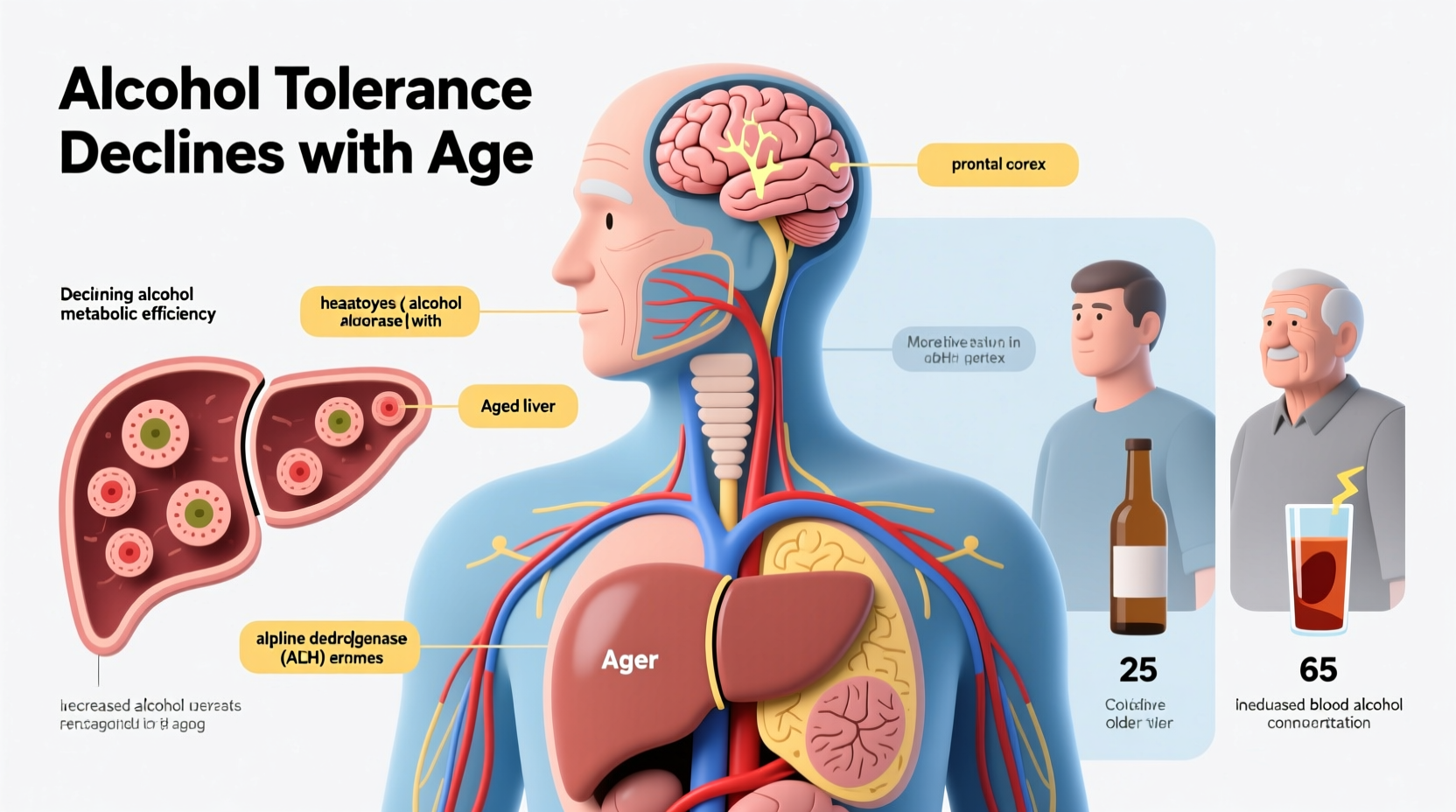
The liver processes over 90% of ingested alcohol, primarily via two enzymes: alcohol dehydrogenase (ADH) and aldehyde dehydrogenase (ALDH). With age, both enzyme activity and liver mass decline. A 2022 longitudinal study published in Hepatology tracked 1,247 adults aged 35–78 over 12 years and found that average hepatic blood flow decreased by 0.5% per year after age 40 — meaning less oxygenated blood reaches liver tissue, slowing detoxification. Simultaneously, ADH activity drops by up to 30% between ages 30 and 70, particularly in the gastric mucosa, reducing first-pass metabolism before alcohol even enters systemic circulation.
This slowdown has real-world consequences. Blood alcohol concentration (BAC) peaks higher and remains elevated longer. For example, a 65-year-old weighing 70 kg consuming one standard drink (14 g ethanol) may reach a BAC of 0.028% — comparable to a 35-year-old who drank *two* drinks. The delay in clearance also extends the window during which acetaldehyde, a toxic metabolite linked to facial flushing, inflammation, and DNA damage, accumulates in tissues.
Body Composition Shifts: Less Water, More Fat
From age 30 onward, lean body mass decreases by ~0.5–1% annually, while fat mass increases — especially intra-abdominal and visceral fat. By age 60, total body water drops from ~60% to ~50% in men and from ~55% to ~47% in women. Since alcohol is water-soluble and distributes only into body water (not fat), the same dose becomes concentrated in a smaller volume. This directly raises BAC.
Consider this: A 180-lb (82 kg) 35-year-old male has ~49 L of body water. A 180-lb 65-year-old male with identical weight but higher adiposity may have only ~41 L. Consuming 28 g of ethanol (two standard drinks) results in a theoretical BAC of ~0.042% in the younger man — but ~0.050% in the older man. That 0.008% difference exceeds the legal driving limit in many countries (0.05%) and correlates strongly with impaired reaction time and balance in clinical gait assessments.
| Age Group | Avg. Body Water % (Men) | Avg. Body Water % (Women) | Impact on BAC (vs. Age 30) |
|---|---|---|---|
| 30–39 | 60% | 55% | Baseline |
| 50–59 | 55% | 50% | +12–15% higher BAC for same dose |
| 70+ | 50% | 45% | +25–30% higher BAC for same dose |
Neurological Sensitivity: GABA Receptors, Synaptic Plasticity, and Sleep Architecture
Alcohol enhances inhibitory neurotransmission by binding to GABAA receptors. With age, receptor density in the prefrontal cortex and hippocampus declines, but sensitivity to alcohol’s sedative effects paradoxically increases. Research from the National Institute on Aging shows that older adults exhibit greater cortical slowing (measured via EEG theta power) after low-dose alcohol — indicating heightened neural inhibition. This explains why one drink may cause noticeable drowsiness or confusion in a 68-year-old, while a 40-year-old feels little effect.
Compounding this is age-related disruption of sleep architecture. Deep (N3) sleep declines by ~2% per decade after 30, and REM latency shortens. Alcohol further fragments stage transitions, suppresses REM, and reduces slow-wave sleep — effects magnified in older adults. The result? Next-day fatigue, cognitive fog, and increased fall risk — not from intoxication per se, but from compounded sleep debt and neuroinhibition.
“Older brains don’t ‘handle’ alcohol worse — they respond to it more profoundly at lower doses. What looks like tolerance loss is actually heightened pharmacodynamic sensitivity.” — Dr. Elena Rodriguez, Neuropharmacologist, NIH Intramural Research Program
Medication Interactions and Reduced Renal Clearance
Over 92% of adults aged 65+ take at least one prescription medication, and 39% take five or more. Many common drugs interact dangerously with alcohol: benzodiazepines (enhanced sedation), anticoagulants like warfarin (increased bleeding risk), NSAIDs (elevated GI bleeding), and sulfonylureas (hypoglycemia). But beyond direct interactions, aging kidneys clear medications — and alcohol metabolites — more slowly. Glomerular filtration rate (GFR) declines by ~1 mL/min/year after age 40. Lower GFR means longer half-lives for drugs like diazepam (up to 100 hours in frail elders vs. 20–50 hours in younger adults) — and prolonged exposure to acetaldehyde and reactive oxygen species generated during ethanol metabolism.
This creates a triple vulnerability: slower alcohol breakdown (liver), heightened brain response (CNS), and delayed clearance of interacting compounds (kidneys). A single glass of wine with evening metformin and omeprazole may not cause acute harm — but over weeks, it contributes to mitochondrial stress in hepatocytes and accelerates neuronal oxidative damage in vulnerable regions like the cerebellum.
A Real-World Example: Maria’s Experience at 62
Maria, a retired school counselor in Portland, Oregon, enjoyed a nightly glass of pinot noir for 30 years. She never experienced hangovers, rarely felt flushed, and maintained an active hiking schedule. At 62, she began noticing subtle changes: after her usual glass, she’d feel unsteady walking up stairs; her morning blood pressure readings spiked by 15–20 mmHg; and she developed persistent dry mouth and mild tremors she attributed to “stress.” Her physician ordered liver enzymes and found mildly elevated AST/ALT and reduced albumin. An alcohol use screen revealed no dependence — but her self-reported intake was now exceeding safe limits for her age and physiology. After switching to non-alcoholic alternatives and adjusting her hypertension medication timing, her symptoms resolved within six weeks. Her case illustrates how tolerance decline often manifests not as dramatic intoxication, but as subclinical physiological strain — easily misattributed to “normal aging.”
Practical Strategies: A Step-by-Step Guide to Safer Drinking After 50
- Calculate your personal limit: Use the NIAAA’s age-adjusted guideline: no more than 7 standard drinks per week *and* no more than 3 on any single day — but reduce further if you take medications, have liver/kidney disease, or experience unexplained fatigue or balance issues.
- Hydrate strategically: Drink 125 mL of water *before* your first drink, and alternate each alcoholic beverage with 250 mL of water. This offsets dehydration-induced headache and supports renal clearance.
- Time your intake: Avoid alcohol within 3 hours of bedtime to protect sleep architecture. Consume drinks with food — especially protein and healthy fats — to slow gastric emptying and reduce peak BAC.
- Review medications quarterly: Bring all prescriptions, OTC drugs, and supplements to your pharmacist. Ask specifically: “Does any of this interact with alcohol — even small amounts?”
- Track physical signals: Keep a simple log for two weeks: drink type/amount, time consumed, and notes on energy, mood, balance, and sleep quality. Patterns often reveal thresholds you didn’t know existed.
What You Can Control: A Checklist for Healthier Choices
- ✅ Swap high-ABV beverages (e.g., 14% wine, 40% spirits) for lower-alcohol options (e.g., 10–11% wine, alcohol-free craft beer)
- ✅ Use standardized pour tools — most people over-pour by 30–50% when free-pouring wine or spirits
- ✅ Prioritize antioxidants: Include berries, leafy greens, and walnuts daily to support glutathione synthesis (critical for acetaldehyde detox)
- ✅ Move daily: 30 minutes of brisk walking improves hepatic blood flow and insulin sensitivity, both of which aid ethanol metabolism
- ❌ Skip “hair of the dog”: Morning alcohol worsens dehydration and delays acetaldehyde clearance, prolonging symptoms
FAQ
Can I rebuild my alcohol tolerance with regular drinking?
No — and attempting to do so is medically unsafe. Tolerance in younger adults reflects adaptive enzyme induction (e.g., CYP2E1 upregulation), but in older adults, chronic exposure accelerates liver fibrosis, neuronal apoptosis, and pancreatic inflammation. What appears as “rebuilding tolerance” is often masking early organ damage. Evidence shows no safe threshold for increasing intake to compensate for age-related decline.
Is red wine still “heart-healthy” after 60?
The purported cardiovascular benefits of moderate red wine consumption are not replicated in adults over 65. A 2023 JAMA Internal Medicine meta-analysis of 12 cohort studies found no protective association between alcohol and coronary events in those aged 65+, while risks for atrial fibrillation, hypertension, and falls rose significantly with any intake above 3.5 g ethanol/day (~¼ glass of wine). Heart health is better supported by exercise, Mediterranean diet patterns, and blood pressure management — not alcohol.
Why do I get hangovers faster now — even with the same amount?
Three primary reasons: (1) Reduced ADH activity allows more unmetabolized ethanol to circulate; (2) Slower ALDH function causes acetaldehyde to accumulate longer, triggering inflammation and vasodilation; (3) Age-related decline in antioxidant reserves (glutathione, vitamin C, selenium) impairs your body’s ability to neutralize oxidative stress from alcohol metabolism. It’s not “weaker” — it’s biochemically different.
Conclusion
Declining alcohol tolerance isn’t a sign of fragility — it’s your body delivering precise, biologically grounded feedback. Every shift — in liver mass, body water, neural receptor density, kidney filtration, or medication metabolism — represents decades of accumulated wisdom encoded in your cells. Dismissing these changes as “just aging” overlooks the opportunity to align your habits with your physiology. You don’t need to stop drinking entirely to honor this reality. You need only adjust — with precision, curiosity, and respect for the complex machinery that keeps you alive and engaged. Start tonight: measure your pour, hydrate intentionally, and notice how your body responds. That awareness is the first, most powerful step toward healthier, more intentional living — at any age.




 浙公网安备
33010002000092号
浙公网安备
33010002000092号 浙B2-20120091-4
Comments
No comments yet. Why don't you start the discussion?