
Count Dooku’s elegant, sinister presence in the Star Wars prequel trilogy is defined by many traits—his aristocratic bearing, his mastery of Force lightning, and his distinctive fighting style. But one of the most visually striking elements of his character is his weapon: a sleek, silver-hilted lightsaber with a pronounced curve. Unlike the straight hilts used by most Jedi and Sith, Dooku’s blade stands out immediately. This design choice is not arbitrary; it reflects deep roots in both real-world swordsmanship and the internal logic of the Star Wars universe. Understanding why Dooku uses a curved lightsaber reveals much about his background, philosophy, and combat approach.
The Historical Roots of the Curved Hilt
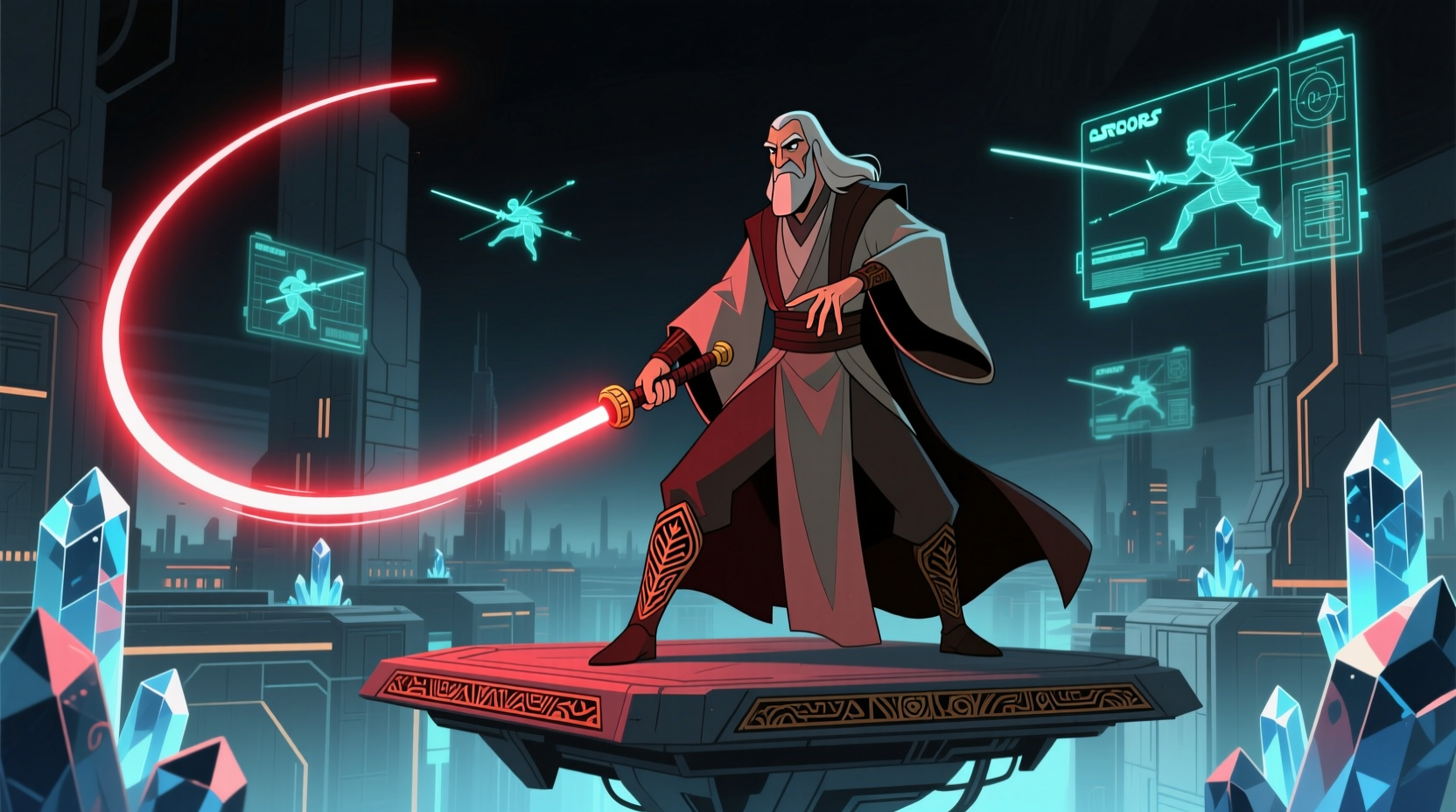
The shape of Count Dooku’s lightsaber hilt closely resembles that of a 17th-century European dueling rapier. These weapons were designed for precision, speed, and control—ideal for one-on-one combat among nobility. The curved grip allowed fencers to maintain a more natural wrist alignment, enhancing point control and reducing fatigue during prolonged engagements. In crafting Dooku’s weapon, the designers at Lucasfilm drew direct inspiration from these historical blades.
This connection isn’t merely aesthetic. Dooku himself is portrayed as a nobleman from Serenno, a world steeped in tradition and refinement. His entire demeanor echoes the aristocratic duelists of Earth’s past. By giving him a weapon reminiscent of a rapier, the filmmakers reinforced his identity as a duelist who values form, precision, and elegance over brute force.
“Dooku’s saber reflects his belief that lightsaber combat is an art, not just a tool of war.” — Pablo Hidalgo, Star Wars Lore Expert
In-Universe Combat Advantages
Within the Star Wars canon, the curved hilt serves functional purposes in lightsaber combat. The ergonomic design improves grip stability and allows for finer control during thrusts and parries. This is particularly important for practitioners of Form II (Makashi), the lightsaber combat style specialized for dueling. Makashi emphasizes precision strikes, disarms, and defensive efficiency—exactly the kind of techniques suited to a slender, curved weapon.
Dooku was once one of the greatest duelists in the Jedi Order before turning to the dark side. He refined Makashi to near perfection, adapting it to counter other lightsaber users rather than the broad-spectrum threats addressed by forms like Shien or Djem So. The curved hilt enhances wrist mobility, enabling rapid redirection of the blade and tighter defense around the body’s center line—critical for a duelist relying on timing and finesse.
A Symbol of Separation and Superiority
Beyond function, the curved lightsaber is a powerful symbol. When Dooku left the Jedi Order, he didn’t merely abandon their cause—he rejected their methods, aesthetics, and ideology. His weapon reflects this break. While Jedi typically use standardized, utilitarian hilts, Dooku’s custom design signals individuality, exclusivity, and elitism.
The polished metal finish, angular emitter shroud, and subtle curve all contribute to a sense of sophistication. It’s a weapon made not for battlefields but for private chambers and ceremonial confrontations. This aligns perfectly with Dooku’s role as a political figurehead leading the Separatist movement. He doesn’t fight like a soldier; he duels like a master swordsman asserting dominance through skill.
Moreover, the uniqueness of his lightsaber sets him apart visually from both Jedi and later Sith. Even among dark side users, few adopt such a refined weapon. This reinforces his self-image as someone above the fray—literally and figuratively.
Real-World Fencing Influence and Design Evolution
The development of Dooku’s lightsaber began during early concept work for *Attack of the Clones*. Designer Doug Chiang explored various ways to distinguish Dooku from other characters. Since Obi-Wan and Anakin wielded traditional straight hilts, Chiang wanted Dooku’s weapon to feel foreign, almost anachronistic.
He looked to classical European smallswords and rapiers, noting how their grips naturally angled into the palm. Translating this into a sci-fi context, the team crafted a minimalist hilt with a backward curve that mirrored fencing ergonomics. The result was a weapon that felt both futuristic and timeless.
This design decision also influenced how the fight scenes were choreographed. Fight coordinator Nick Gillard tailored Dooku’s movements to reflect real épée techniques—lunges, feints, and disengagements—making his duels appear more fluid and calculated than the wide swings typical of other characters.
| Feature | Purpose | Real-World Parallel |
|---|---|---|
| Curved Hilt | Improved wrist alignment and control | Rapier or smallsword grip |
| Slender Profile | Speed and precision in thrusting attacks | Foil or épée blade design |
| Silver Finish | Reflects noble status and elegance | Engraved ceremonial weapons |
| Narrow Blade Emission | Reduced energy dispersion, focused beam | High-efficiency fencing points |
Legacy and Influence on Other Characters
Dooku’s curved lightsaber has had a lasting impact on Star Wars storytelling. Though few characters replicate the exact design, its influence appears in later figures who value technique over aggression. For example, Ezra Bridger briefly experiments with a bent-hilt training saber in *Star Wars Rebels*, echoing Makashi principles. Additionally, some Legends materials feature other Makashi practitioners using subtly curved hilts, reinforcing the association between the form and ergonomic design.
The weapon has also become iconic among fans and collectors. Custom lightsaber manufacturers frequently offer “Dooku-style” builds, often citing historical fencing authenticity as a key selling point. Its popularity underscores how effective visual storytelling can be when form and function are aligned.
Mini Case Study: The Duel on Geonosis
The effectiveness of Dooku’s curved lightsaber is best illustrated in his first major confrontation: the duel against Obi-Wan Kenobi and Anakin Skywalker on Geonosis. Despite being outnumbered, Dooku dominates the fight through superior footwork and precision. His curved hilt enables quick transitions between offense and defense, allowing him to parry aggressive slashes from Anakin while simultaneously threatening Obi-Wan with precise jabs.
When he severs Anakin’s arm with a clean, economical motion, it’s not raw power that wins the moment—it’s control. The curved hilt facilitates that level of accuracy, proving that in skilled hands, elegance can be lethal.
FAQ
Did any other Jedi use a curved lightsaber?
In current canon, no Jedi are known to have used a permanently curved hilt like Dooku’s. However, some training sabers and experimental designs have featured slight bends. In Legends continuity, certain Makashi masters used similar hilts, but Dooku remains the most prominent example.
Is the curve purely cosmetic or does it affect performance?
It is not purely cosmetic. The curve enhances grip, reduces wrist strain, and improves point control—especially important for thrust-heavy styles like Makashi. While a straight hilt can perform similarly with enough skill, the curved design offers tangible ergonomic advantages in dueling contexts.
Could a curved lightsaber be weaker structurally?
In theory, a curved hilt could introduce stress points, but given the advanced materials used in Star Wars technology—such as durasteel and cortosis weave—the structural integrity remains uncompromised. The blade itself emits straight regardless of hilt shape, so combat performance isn’t hindered.
Checklist: Key Reasons Behind Dooku’s Curved Lightsaber
- Based on real-world rapier and smallsword ergonomics
- Optimized for Form II (Makashi) lightsaber combat
- Symbolizes Dooku’s noble heritage and elitist worldview
- Enhances wrist control and precision in duels
- Distinguishes him visually and ideologically from the Jedi
- Reflects his preference for strategy over brute strength
- Influences choreography and fighting style portrayal
Conclusion
Count Dooku’s curved lightsaber is far more than a stylistic flourish. It is a carefully considered fusion of historical inspiration, in-universe functionality, and symbolic meaning. From its roots in European fencing traditions to its role in expressing Dooku’s identity as a refined yet deadly duelist, every aspect of the weapon tells a story. It embodies the idea that true mastery lies not in overwhelming force, but in discipline, precision, and control.




 浙公网安备
33010002000092号
浙公网安备
33010002000092号 浙B2-20120091-4
Comments
No comments yet. Why don't you start the discussion?