
Easter Sunday is one of the most significant events in the Christian calendar, marking the resurrection of Jesus Christ. Unlike fixed holidays such as Christmas, Easter does not fall on the same date each year. Instead, it shifts across a wide range—typically between March 22 and April 25 in the Gregorian calendar. This variability often raises questions: Why does Easter move? What determines its date? The answer lies in a complex blend of astronomy, ancient tradition, and religious decree.
The method behind Easter’s shifting date dates back centuries and reflects an effort to harmonize solar and lunar calendars with theological observance. Understanding this system reveals not only the precision of historical timekeeping but also the cultural importance of aligning sacred events with natural cycles.
The Ecclesiastical Rules Behind Easter's Date
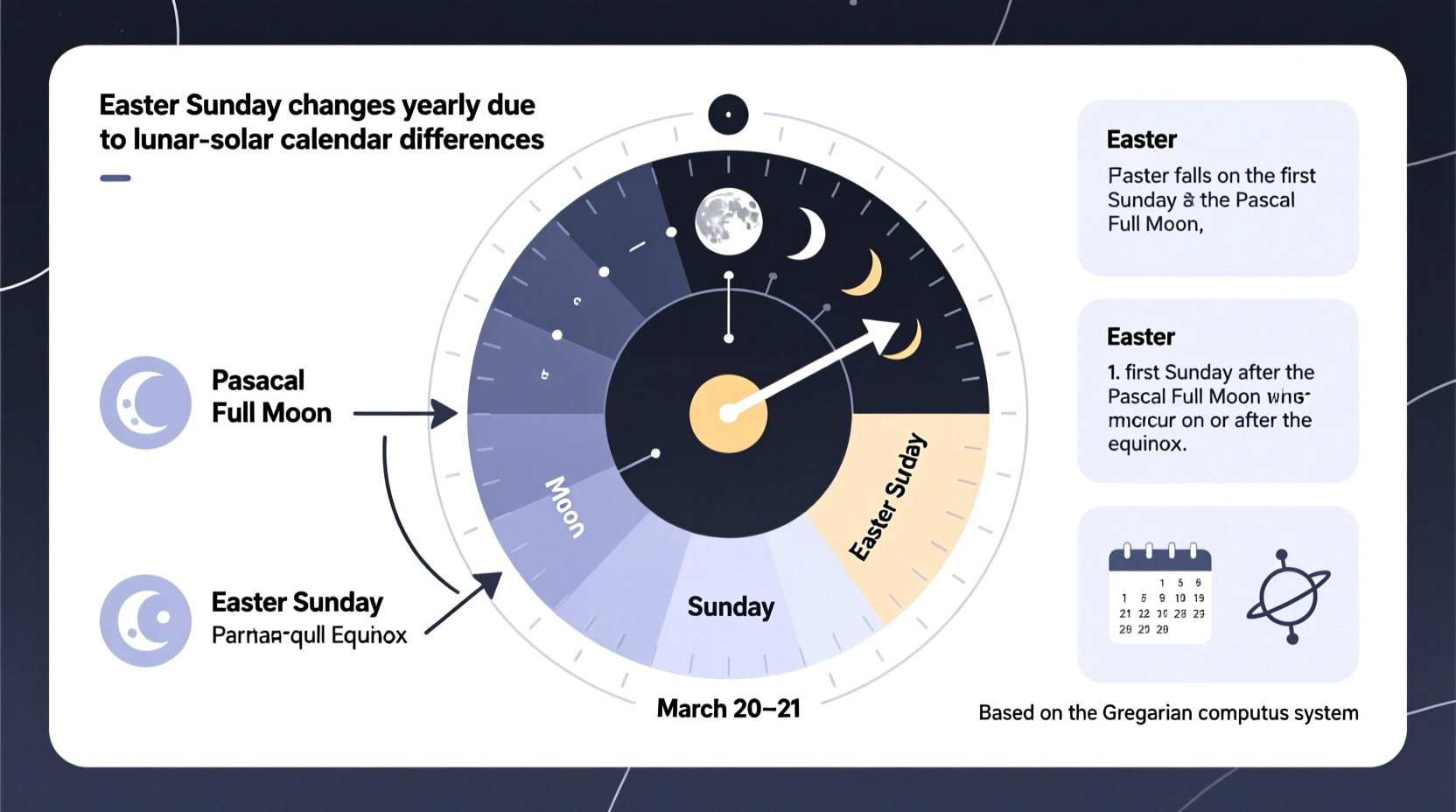
The primary reason Easter Sunday changes annually is due to its definition by ecclesiastical rules established by the First Council of Nicaea in 325 AD. At this council, church leaders sought to standardize the celebration of Easter across all Christian communities. They decreed that:
“Easter shall be celebrated on the first Sunday after the first full moon following the vernal (spring) equinox.”
This rule combines solar and lunar observations. The vernal equinox—the moment when day and night are approximately equal—is fixed in the ecclesiastical calendar on March 21, regardless of the actual astronomical event. The “full moon” referenced is not necessarily the astronomical full moon but rather the \"ecclesiastical full moon,\" determined from precomputed tables known as the ecclesiastical lunar calendar.
Because both the lunar cycle (~29.5 days) and the solar year (~365.25 days) operate on different rhythms, their alignment shifts each year. As a result, the timing of the first full moon after March 21 varies, pushing Easter Sunday forward or backward within its possible window.
How the Calculation Works: A Step-by-Step Guide
Determining the date of Easter involves a sequence of steps based on mathematical and calendrical conventions. Here’s how it works under the Gregorian calendar (used by Western Christianity):
- Set the ecclesiastical equinox: Fixed on March 21, even if the astronomical equinox occurs earlier or later.
- Determine the paschal full moon: Use ecclesiastical tables to find the first full moon on or after March 21.
- Find the next Sunday: Easter Sunday is the first Sunday following that full moon.
- If the full moon falls on a Sunday, Easter is delayed by one week to ensure it always occurs on a Sunday.
Eastern Orthodox churches use the older Julian calendar for these calculations, which results in a different set of dates for Easter in most years. Their equinox is also later (April 3 in the Gregorian calendar), and they rely on a different lunar cycle table, often placing Orthodox Easter later than Western Easter.
Why Lunar Cycles Matter: Historical and Religious Context
The connection between Easter and the moon traces back to the Jewish festival of Passover (Pesach), during which the crucifixion and resurrection occurred according to the Gospels. Passover begins on the 15th day of the Hebrew month of Nisan, which is determined by the first full moon after the spring equinox. Early Christians wanted Easter to remain linked to this timing while ensuring it was always observed on a Sunday.
As historian Dr. Rebecca Alpert notes:
“The early Church struggled to maintain both independence from Judaism and fidelity to scriptural chronology. Tying Easter to the lunar cycle was a compromise that honored both goals.” — Dr. Rebecca Alpert, Religious Historian
This lunar-solar hybrid system preserved symbolic continuity while allowing the Church to establish its own liturgical rhythm. Over time, computational methods evolved to predict Easter decades in advance, enabling consistent planning for Lent, Holy Week, and related feasts.
Modern Date Calculation: Algorithms and Tables
While the logic behind Easter’s date may seem abstract, mathematicians have developed precise algorithms to compute it. One well-known method is the Computus, used since the Middle Ages. In the 19th century, Carl Friedrich Gauss devised a formula that calculates Easter Sunday for any given year in the Gregorian calendar.
The following table illustrates Easter dates over a decade to show the pattern of variation:
| Year | Easter Sunday (Western) | Easter Sunday (Orthodox) |
|---|---|---|
| 2023 | April 9 | April 16 |
| 2024 | March 31 | May 5 |
| 2025 | April 20 | April 20 |
| 2026 | April 5 | April 12 |
| 2027 | March 28 | May 2 |
| 2028 | April 16 | April 16 |
| 2029 | April 1 | April 8 |
| 2030 | April 21 | April 28 |
| 2031 | April 13 | April 13 |
| 2032 | March 28 | May 2 |
Notice how Western Easter fluctuates between late March and late April, while Orthodox Easter often follows weeks later. In some years, like 2025 and 2028, the dates coincide due to overlapping lunar and calendar calculations.
Frequently Asked Questions
Why doesn’t Easter have a fixed date like Christmas?
Christmas celebrates the birth of Jesus and was assigned to December 25 for symbolic and historical reasons, independent of lunar phases. Easter, however, commemorates an event tied to the Jewish Passover, which follows a lunisolar calendar. To preserve this link, Easter remains dependent on the spring full moon.
Can Easter ever fall in March?
Yes. The earliest possible date for Easter Sunday is March 22, which last occurred in 1818 and will happen again in 2285. More commonly, early Easters fall on March 23 or March 31, depending on the lunar cycle.
Do all Christians celebrate Easter on the same day?
No. Most Western churches (Catholic, Protestant) follow the Gregorian calendar, while Eastern Orthodox churches use the Julian calendar for liturgical purposes. This difference usually results in separate Easter Sundays, though they occasionally align.
Tips for Remembering and Planning Around Easter
- Use digital calendars with religious holiday settings to automatically track Easter each year.
- Bookmark official ecclesiastical tables or online calculators for future reference.
- Plan school breaks, travel, and family gatherings around published Easter dates as early as possible.
- Understand regional differences—some countries observe Orthodox Easter as a public holiday instead of the Western date.
A Real-World Example: School District Scheduling
In 2024, a public school district in Minnesota faced scheduling challenges due to Easter falling unusually early on March 31. Spring break had been planned for the first week of April, but because Good Friday fell on March 29, many families requested time off earlier. The district had not accounted for the shift in Easter and received numerous complaints.
After reviewing the incident, administrators began consulting ecclesiastical calendars two years in advance. They now adjust vacation periods accordingly, especially in communities with high religious observance. This case highlights how understanding Easter’s variable date can improve institutional planning and community responsiveness.
Conclusion: Embrace the Rhythm of the Calendar
The changing date of Easter Sunday is more than a curiosity—it reflects a deep interplay between faith, nature, and mathematics. Rooted in ancient decisions and refined through centuries of observation, the system ensures that Easter remains aligned with the symbolism of renewal and light inherent in the spring season.
Whether you're organizing a family gathering, managing a school calendar, or simply curious about the rhythms of the liturgical year, understanding how Easter is calculated adds depth to your appreciation of this pivotal holiday. Stay informed, plan ahead, and respect the intricate harmony of sun, moon, and tradition that brings Easter to life—each year on a different Sunday.




 浙公网安备
33010002000092号
浙公网安备
33010002000092号 浙B2-20120091-4
Comments
No comments yet. Why don't you start the discussion?