
Fortnite remains one of the most popular battle royale games worldwide, but for Mac users, the experience often falls short of expectations. Despite Apple’s sleek hardware and reputation for performance, many players report stuttering, low frame rates, crashes, and long loading times when running Fortnite. The frustration is real—especially when you’re eliminated mid-match due to lag or a sudden freeze. The issue isn’t necessarily your Mac being “bad.” Instead, it stems from a combination of architectural limitations, software inefficiencies, and suboptimal settings. Understanding why Fortnite struggles on macOS—and what you can do about it—is key to reclaiming a playable, enjoyable experience.
The Core Reasons Fortnite Runs Poorly on Mac
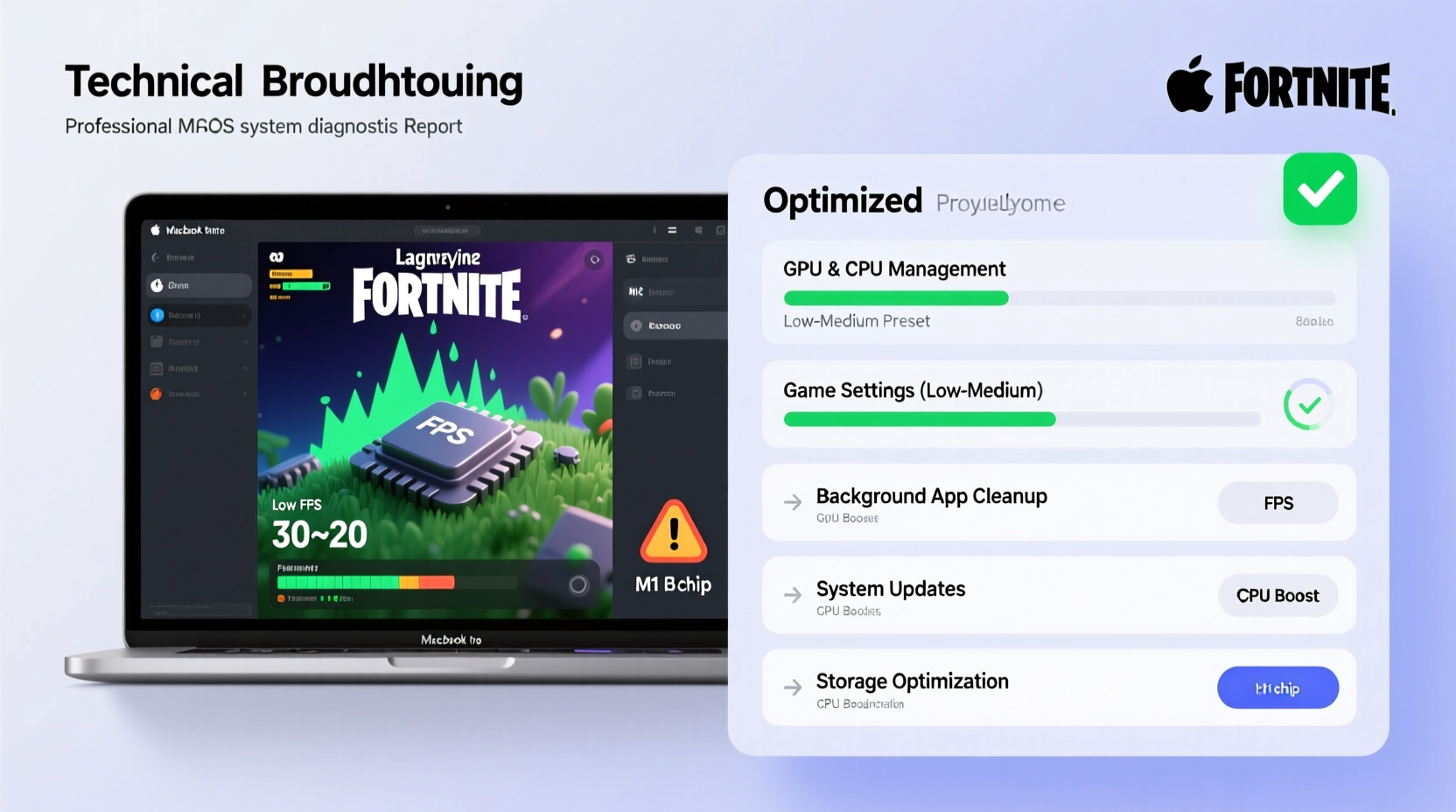
Unlike Windows, macOS is not primarily designed for gaming. While newer Macs with Apple Silicon have improved GPU capabilities, the ecosystem still lacks native support for many game engines and optimizations found in PC environments. Fortnite, developed using Epic’s Unreal Engine, relies heavily on real-time rendering, dynamic lighting, and complex physics—all of which demand robust graphics processing and efficient memory management.
Historically, Macs used discrete GPUs from AMD or NVIDIA, but recent models rely on integrated graphics within Apple’s M-series chips. While powerful for everyday tasks and creative workloads, these GPUs are not fine-tuned for sustained gaming performance. Additionally, macOS uses Metal as its graphics API instead of DirectX or Vulkan, which means developers must port and optimize games specifically for Apple’s framework. Although Epic has implemented Metal support, the translation layer between Unreal Engine and Metal introduces overhead that impacts frame pacing and efficiency.
Another major bottleneck is thermal throttling. MacBooks, especially Air and Pro models without active cooling fans (like the M1 MacBook Air), reduce CPU and GPU performance when temperatures rise. Since Fortnite is a graphically intensive game, prolonged play quickly heats up the system, forcing the chip to downclock to prevent damage. This results in inconsistent performance—even on high-end machines.
“Mac gaming has improved, but it’s still held back by thermal design and lack of driver-level optimizations that PC gamers take for granted.” — David Kim, Senior Developer at GamePort Studios
Hardware Limitations vs. Software Bottlenecks
It’s important to distinguish between hardware constraints and software inefficiencies. Some issues are inherent to your machine’s design, while others can be mitigated through configuration changes.
| Factor | Hardware Limitation | Software/Configurable Issue |
|---|---|---|
| Graphics Processing | Integrated GPU shared with system memory | Poor Metal API optimization in Unreal Engine |
| Thermal Management | No fan or limited airflow in thin MacBooks | Background apps increasing heat load |
| RAM Usage | Unified memory limits available VRAM | Too many background processes consuming RAM |
| Storage Speed | Slower SSD read speeds affect asset loading | Fragmented install or corrupted game files |
| CPU Performance | ARM-based chips require Rosetta translation for some code | Game settings too high for current thermal headroom |
This distinction matters because while you can't upgrade your Mac’s GPU or add more cooling, you *can* adjust settings, close unnecessary programs, and reconfigure system behavior to extract better performance.
Step-by-Step Guide to Optimize Fortnite on Mac
Improving Fortnite performance on your Mac requires a methodical approach. Follow this sequence to eliminate bottlenecks and maximize frame rates.
- Update Your System and Game
Ensure macOS is updated to the latest version supported by your device. Epic frequently releases patches that improve Metal compatibility and fix bugs affecting Mac performance. Open the Epic Games Launcher, go to your Library, click the three dots next to Fortnite, and select \"Verify.\" This checks for missing or corrupted files. - Adjust In-Game Graphics Settings
Launch Fortnite and navigate to Settings > Video. Apply these optimized values:- Resolution: Set to native display resolution only if stable; otherwise, try 1440x900 or 1680x1050.
- Frame Rate Limit: Cap at 30 or 60 FPS depending on stability.
- View Distance: Low or Medium.
- Shadows: Off or Low.
- Anti-Aliasing: FXAA (Fast Approximate) instead of TAA or MSAA.
- Post Processing: Low.
- Effects: Low.
- Texture Streaming: On.
- VSync: Off (reduces input lag).
- Close Background Applications
Use Activity Monitor (found in Applications > Utilities) to identify resource-heavy apps. Quit anything non-essential—especially browsers with multiple tabs, video editors, or cloud sync tools like Dropbox. These consume CPU cycles and RAM needed for smooth gameplay. - Manage Thermal Conditions
Avoid playing on soft surfaces like beds or couches that block ventilation. Use a hard desk surface. For MacBook Pro users, ensure the vents near the hinge are unobstructed. Consider using a laptop cooling pad with passive airflow channels (no noisy fans required). - Reset NVRAM and SMC (Intel Macs Only)
On Intel-based Macs, resetting NVRAM (non-volatile random-access memory) can resolve power and performance glitches. Shut down your Mac, then turn it on and immediately press Option + Command + P + R for about 20 seconds. For SMC reset instructions, refer to Apple’s official support page based on your model. - Reinstall Fortnite via Native Installer
Sometimes, leftover cache or outdated launchers cause instability. Uninstall Fortnite completely through the Epic Games Launcher (right-click > Remove). Then, download the latest .dmg installer directly from Epic’s website and reinstall fresh.
Checklist: Quick Optimization Routine Before Every Play Session
- ✅ Close all browser windows and background apps
- ✅ Plug in power adapter (prevents battery throttling)
- ✅ Lower in-game settings to Low/Medium preset
- ✅ Disable Bluetooth peripherals not in use
- ✅ Verify game files in Epic Launcher
- ✅ Restart Mac if it’s been running for over 12 hours
- ✅ Position laptop on a flat, cool surface
- ✅ Enable “Low Power Mode” in macOS Energy Saver (counterintuitively helps stabilize performance)
Real Example: Improving Gameplay on an M1 MacBook Air
Jessica, a college student and casual Fortnite player, owned an M1 MacBook Air (8GB RAM, 256GB SSD). She loved the portability but found Fortnite nearly unplayable—dropping to 15 FPS during fights and crashing after 20 minutes. After researching, she followed the optimization steps above. First, she closed Chrome (which had 37 tabs open) and quit Zoom and Spotify. She lowered all graphics settings in Fortnite to Low, disabled shadows and post-processing, and capped the frame rate at 30.
She also restarted her Mac before launching the game and placed it on a wooden desk instead of her bed. The difference was immediate: average frame rate jumped to 42 FPS, with fewer stutters. Crashes stopped entirely after she reinstalled the game client. While not ideal for competitive play, Jessica could now enjoy matches without constant frustration. Her experience highlights how much software and environmental factors impact performance—even on modern Apple Silicon.
Advanced Tweaks for Persistent Issues
If basic optimizations aren’t enough, consider deeper system adjustments.
One overlooked factor is disk space. When storage drops below 10% free, macOS slows down file access dramatically. Fortnite requires fast read speeds for textures and assets. Keep at least 15–20GB of free space on your drive. You can monitor this in > About This Mac > Storage.
Additionally, manage login items that auto-start with your user session. Too many of these degrade boot time and eat memory. Go to System Settings > General > Login Items and disable non-essential apps like Slack, Adobe Creative Cloud, or Microsoft AutoUpdate.
For advanced users comfortable with Terminal, you can clear system and app caches safely:
sudo rm -rf ~/Library/Caches/*
rm -rf ~/Library/Application\\ Support/Fortnite/*
Note: This removes saved shaders and temporary data; Fortnite may take longer to start the first time afterward, but performance often improves.
Frequently Asked Questions
Can I run Fortnite smoothly on any Mac?
No—not all Macs can handle Fortnite well. Models before 2018 or those with less than 8GB RAM will struggle severely. Even newer M1/M2 Macs can only achieve moderate performance (30–50 FPS) with aggressive setting reductions. High-refresh gameplay (90+ FPS) is unrealistic on any current Mac.
Will installing Windows via Boot Camp help?
Boot Camp is no longer supported on Apple Silicon Macs (M1 and later). On older Intel Macs, it was possible, but driver support for AMD GPUs under Windows was often spotty. Even with Boot Camp, thermal throttling remained a limiting factor. Most users saw marginal gains at best. Given the complexity and loss of macOS functionality, it's rarely worth the effort.
Is cloud gaming a viable alternative?
Yes. Services like NVIDIA GeForce NOW, Xbox Cloud Gaming (via browser), or Boosteroid allow you to stream Fortnite from remote servers. This bypasses local hardware limitations entirely. As long as you have a strong Wi-Fi connection (preferably 5GHz, 25 Mbps+), you can play at high settings with minimal input lag. This is currently the best workaround for Mac users seeking smooth Fortnite performance.
Conclusion: Take Control of Your Fortnite Experience
Fortnite’s poor performance on Mac isn’t just about weak hardware—it’s a symptom of broader ecosystem challenges. But that doesn’t mean you’re powerless. By understanding the limitations of Metal, managing thermal output, optimizing settings, and leveraging smart workflows, you can significantly improve your gameplay. Whether you're playing casually with friends or grinding ranked modes, every frame counts. Don’t accept lag and crashes as inevitable. Apply these strategies consistently, monitor your system health, and explore alternatives like cloud streaming when needed.




 浙公网安备
33010002000092号
浙公网安备
33010002000092号 浙B2-20120091-4
Comments
No comments yet. Why don't you start the discussion?