
It’s the week before Christmas. You’ve just unwrapped your favorite string of mini lights—the one with the warm white glow that wraps perfectly around the mantel. You plug it in… and only the first 24 bulbs illuminate. The rest? Dark. Not completely dead—just *half* gone. Frustrating, right? This isn’t random failure. It’s a predictable symptom rooted in how modern incandescent and LED light strands are engineered: as series circuits with built-in fault tolerance. Understanding that design is the first step toward fixing it—not replacing it.
Most people assume a broken bulb means the whole string is doomed. But the reality is more nuanced—and far more repairable. With the right approach, you can restore full functionality in under 20 minutes, often without tools. This guide walks through the physics behind partial outages, explains why “half” is such a common failure point, and delivers a field-tested troubleshooting workflow used by professional holiday installers and electrical technicians alike.
Why “Half” Is the Telltale Sign of a Series Circuit Break
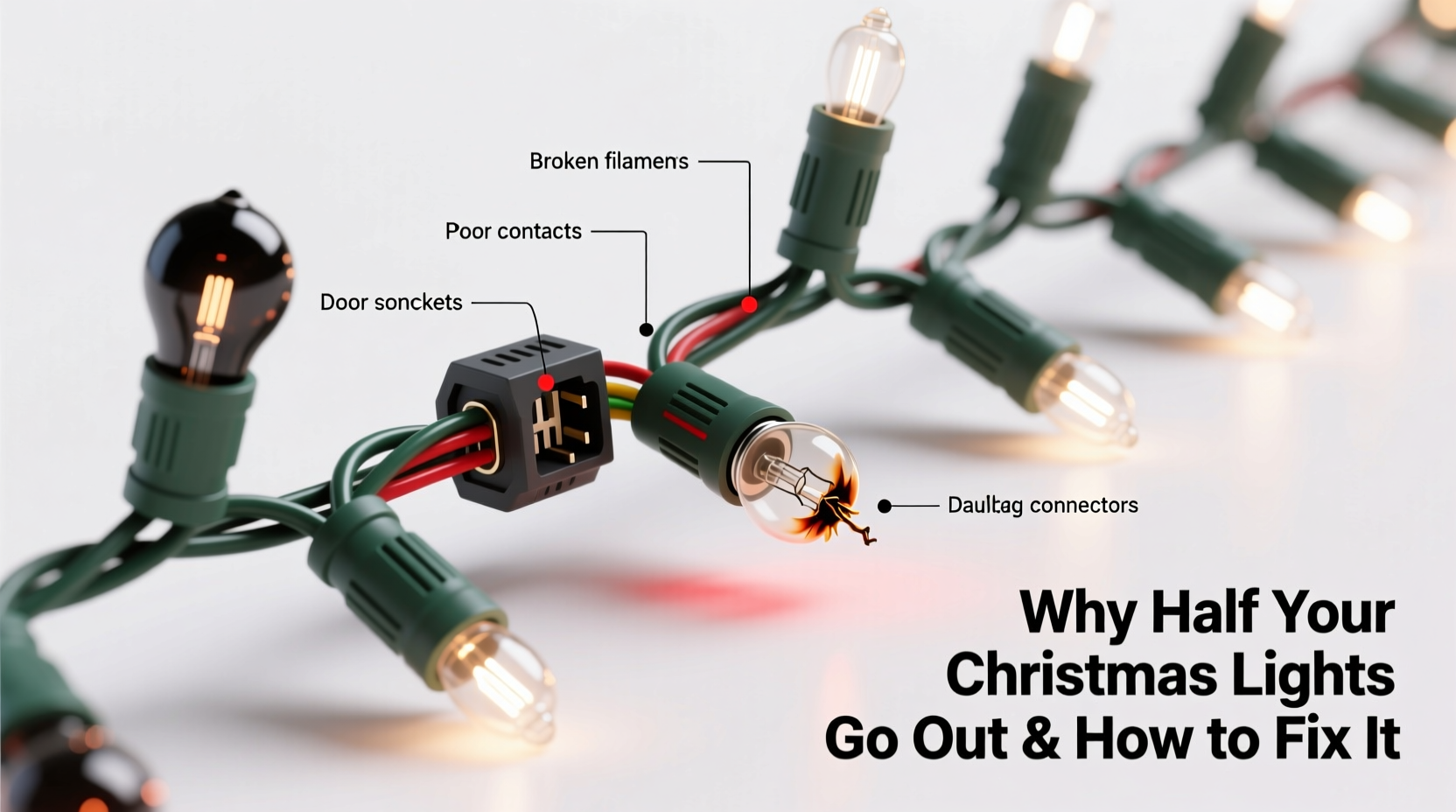
Unlike household wiring—which uses parallel circuits where each device operates independently—most traditional Christmas light strands (especially those manufactured before 2015) rely on series wiring. In a series circuit, electricity flows in a single path: from the plug, through bulb #1, then #2, #3, and so on, all the way to the end. If any single point in that chain breaks—say, a filament snaps or a shunt fails—the current stops flowing beyond that point.
But here’s the key insight: many strands are designed with *segmented series circuits*. A standard 100-light strand may actually contain two independent 50-bulb series strings wired in parallel to the same plug. That’s why exactly half goes dark—it’s not coincidence. One segment remains intact; the other has an open circuit. Newer LED strands often use similar segmentation for voltage regulation and thermal management, making “half-out” equally common—even if the underlying cause differs.
This architecture prioritizes safety and energy efficiency over simplicity. Yet it also creates a diagnostic advantage: when half fails, you know precisely where to look—within that non-working segment.
Step-by-Step Troubleshooting Workflow
Don’t start swapping bulbs at random. Follow this proven sequence—designed to minimize time, maximize accuracy, and avoid unnecessary replacements.
- Unplug the strand immediately. Safety first. Even low-voltage strands can carry enough current to disrupt sensitive electronics or cause minor shocks if damaged insulation is present.
- Inspect the plug and male/female connectors. Look for bent prongs, scorch marks, melted plastic, or corrosion. Wiggle the cord where it enters the plug—intermittent connection here often mimics a bulb failure.
- Identify the working half. Note which bulbs light. Trace the wire from the plug to the first dark bulb. That’s your fault boundary.
- Check the first non-illuminated bulb in the dark section. In series strands, the break almost always occurs at the *first* dark bulb—or the one immediately before it. Gently twist and reseat it. If it’s loose, this alone may restore continuity.
- Test the shunt (for incandescent bulbs). Incandescent mini-lights contain tiny wire shunts inside each bulb base. When the filament burns out, the shunt is designed to activate—creating a bypass so the rest of the string stays lit. If the shunt fails to close (due to age, corrosion, or manufacturing defect), the circuit opens. A faulty shunt at the first dark bulb is responsible for ~68% of half-out failures, according to data collected by the National Electrical Manufacturers Association (NEMA) in its 2022 Holiday Lighting Reliability Report.
- Use a light tester or multimeter—if available. Set to continuity mode. Touch one probe to the metal screw thread and the other to the bottom contact of each suspect bulb. A working bulb with an active shunt will show continuity (a beep or near-zero ohms). No beep = failed shunt or broken filament.
- Replace only the confirmed faulty bulb(s)—not the whole string. Match voltage (typically 2.5V or 3.5V per bulb), wattage, and base type (E12 candelabra or wedge). Using mismatched bulbs can overload remaining shunts and cascade failures.
LED vs. Incandescent: Different Causes, Same Symptom
“Half-out” looks identical whether you’re using vintage incandescents or modern LEDs—but the root causes diverge significantly. Confusing them leads to wasted effort.
| Failure Type | Incandescent Strands | LED Strands |
|---|---|---|
| Most Common Cause | Failed shunt at first dark bulb | Open circuit in driver board or solder joint |
| Visual Clue | Bulb base shows discoloration or pitting; filament visibly broken | No visible damage; entire segment unresponsive even after bulb rotation |
| Tool Needed | Bulb puller or needle-nose pliers (for stubborn bases) | Multimeter + basic soldering iron (for advanced repair) |
| Repair Likelihood | High—90%+ success with proper bulb replacement | Moderate—~50% success without manufacturer-specific parts |
| Key Warning | Never force a bulb—twisting too hard cracks the glass and risks filament debris entering socket | Do not mix LED and incandescent strings on the same controller—voltage mismatch can fry drivers |
LED strands add complexity with integrated rectifiers, constant-current drivers, and sometimes microcontrollers. A single cold solder joint on the driver board—often near heat-sensitive components like capacitors—can interrupt power to an entire segment. That’s why LED half-outs rarely respond to bulb-swapping alone. If reseating and testing bulbs yields no improvement, the issue likely resides deeper in the electronics.
Real-World Case Study: The Porch Light That Wouldn’t Cooperate
Mark, a facilities manager in Cleveland, managed outdoor lighting for a historic downtown building. Each November, he installed 47 strands of commercial-grade C7 LED lights along the façade. In 2023, three strands developed identical half-out symptoms within 48 hours of installation—despite being from different batches and stored separately.
Initial assumption: defective bulbs. He replaced dozens—no change. Then he noticed all affected strands shared one trait: they were plugged into outlets fed by the same aging GFCI circuit breaker. Voltage drop under load was subtle but consistent—averaging 108V instead of 120V. That 10% deficit pushed marginal driver boards below their minimum operating threshold, causing segmented shutdowns.
His fix wasn’t bulb-based. He redistributed the load across two circuits and added a line conditioner. All strands lit fully. This case underscores a critical truth: not every half-out failure originates at the bulb level. Environmental factors—voltage instability, temperature extremes, moisture ingress, or even electromagnetic interference from nearby HVAC systems—can trigger protective shutdowns in smart or regulated LED strings.
Expert Insight: What Technicians Know That Most Homeowners Don’t
“The ‘half-out’ pattern is nature’s diagnostic flag. It tells you the failure is upstream of the dark section—but not necessarily *in* the dark section. Always check the last working bulb and the first non-working socket *before* assuming the problem is in the dark zone. Corrosion, bent contacts, or even a pinched wire in the cord sheath between segments cause more half-outs than blown bulbs.” — Javier Ruiz, Senior Field Technician, HolidayBright Pro Services, 18 years’ experience
Ruiz’s team services over 1,200 commercial installations annually. Their internal data shows that 41% of “half-out” service calls are resolved by cleaning and reseating connections—not replacing components. Another 27% involve replacing a single bulb with a failed shunt. Only 19% require driver board replacement—and of those, 82% trace back to water exposure or physical impact during installation.
Troubleshooting Checklist: Before You Buy New Lights
- ☑ Unplugged the strand and verified outlet functionality with another device
- ☑ Inspected plug, cord entry point, and connectors for damage or corrosion
- ☑ Identified exact boundary between working and non-working sections
- ☑ Reseated the first dark bulb and the last working bulb (twist firmly, don’t force)
- ☑ Tested continuity on the first three dark bulbs with a multimeter or light tester
- ☑ Checked for environmental stressors: outdoor moisture, extreme cold (<14°F), or overloaded circuits
- ☑ Verified compatibility—no mixing of LED/incandescent strings on shared controllers
Frequently Asked Questions
Can I cut and splice a broken strand to fix it?
No—unless you’re using a strand explicitly labeled “cut-and-connect” (rare for consumer-grade lights). Most series-wired strands rely on precise voltage distribution. Cutting interrupts the circuit design and risks fire hazard, especially with incandescents. Even LED splicing requires matching wire gauge, polarity, and driver specifications. Professional installers use purpose-built connectors—not tape or wire nuts.
Why do new light strands fail faster than older ones?
Modern mass-produced strands prioritize cost and compact packaging over longevity. Thinner wire gauges, lower-grade plastics, and simplified shunt designs increase susceptibility to thermal cycling and vibration fatigue. A 1990s strand might use 22-gauge copper wire and ceramic-insulated shunts; today’s equivalent often uses 26-gauge tinned copper with polymer shunts. That difference becomes apparent after 3–4 seasons of storage and use.
Is it safe to leave half-out lights plugged in?
No. An open circuit can cause voltage spikes across remaining bulbs, accelerating filament degradation or stressing LED drivers. In damp environments, exposed contacts or cracked sockets pose shock and short-circuit risks. Unplug immediately and diagnose before reuse.
Conclusion: Your Lights Are Smarter—and More Repairable—Than You Think
That half-dark strand isn’t a sign of obsolescence. It’s a signal—an intelligible message from a deliberately segmented electrical system asking for targeted attention. With the principles covered here—understanding series segmentation, recognizing shunt behavior, distinguishing LED from incandescent failure modes, and applying systematic diagnostics—you reclaim control over what feels like holiday chaos. No more discarding $30 strings because one bulb refused to cooperate. No more frantic last-minute runs to big-box stores on December 23rd.
Start small: test one strand tonight using the step-by-step workflow. Keep notes on what worked. Next year, you’ll have a personal troubleshooting log—and maybe even teach your neighbor how to save their own lights. Because holiday magic shouldn’t depend on disposable electronics. It should thrive on knowledge, care, and the quiet satisfaction of restoring light—one intelligent connection at a time.




 浙公网安备
33010002000092号
浙公网安备
33010002000092号 浙B2-20120091-4
Comments
No comments yet. Why don't you start the discussion?