
It’s the holiday season, and you’ve carefully unpacked your favorite string of Christmas lights—only to find that half the strand remains stubbornly dark. This common frustration plagues households every year, turning festive anticipation into a puzzling repair mission. The good news: in most cases, this issue isn’t permanent. Understanding why half a light strand fails—and how to fix it quickly—can save time, money, and holiday spirit.
Unlike full-strand failures, which may point to a blown fuse or power outage, partial outages usually stem from subtle electrical disruptions within the circuit. Modern mini-light strands are wired in series, meaning each bulb plays a role in completing the circuit. When one component fails, it can interrupt the flow of electricity to an entire section. But with the right approach, many of these problems can be diagnosed and repaired in under 30 minutes.
How Series-Wired Christmas Lights Work
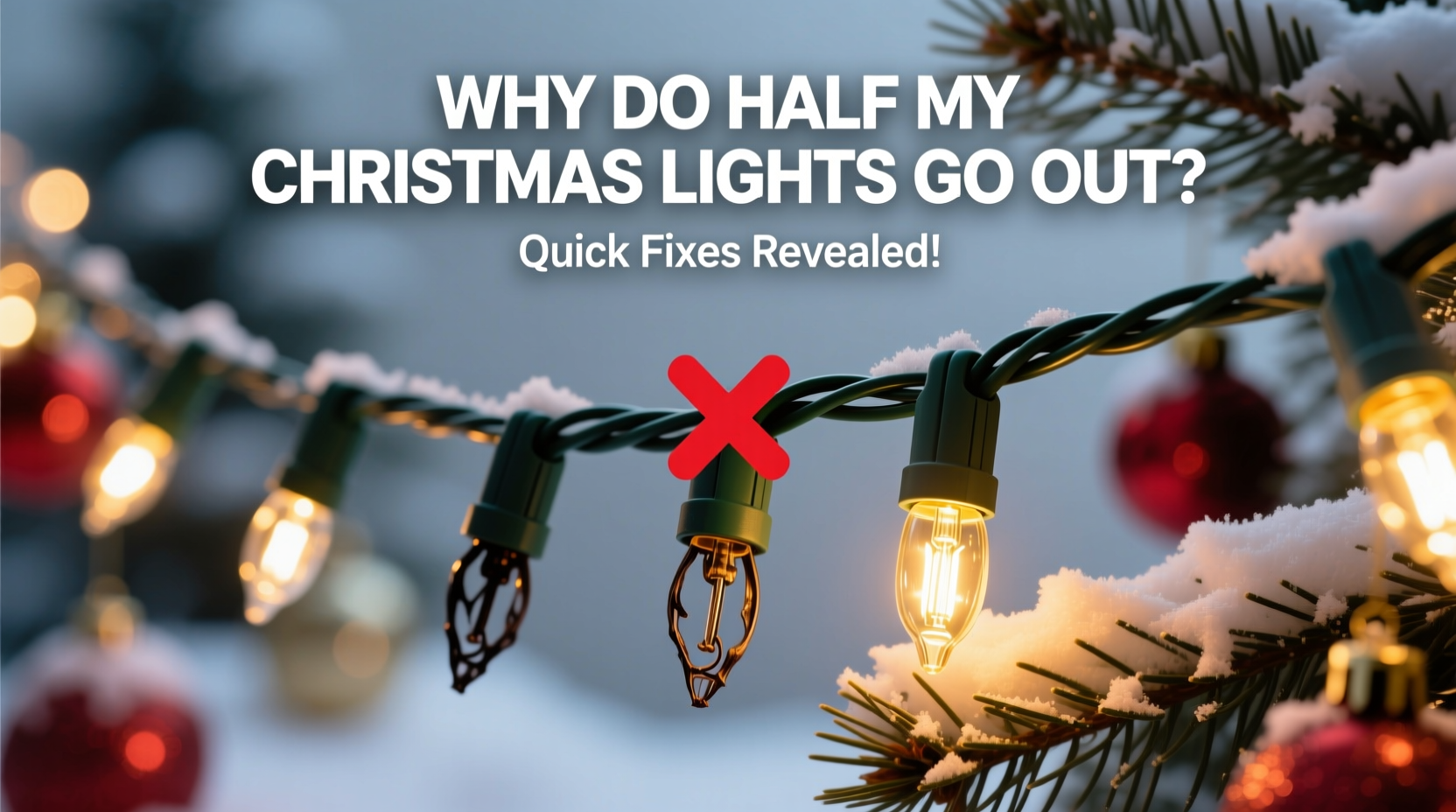
Most traditional incandescent mini-lights operate on a series circuit design. In this configuration, electricity flows through each bulb in sequence before returning to the power source. If any single bulb becomes loose, burns out, or develops a faulty shunt (a small bypass wire inside the bulb), the circuit breaks—often cutting power to all bulbs downstream.
This explains why only half the strand goes dark: the failure occurs somewhere in the middle, stopping current from reaching the second half. Some newer LED strands use parallel wiring or split circuits, which reduce the risk of cascading failures, but many budget-friendly options still rely on series wiring.
Common Causes of Half-Strand Failure
Several factors can lead to partial illumination. Identifying the root cause is essential for choosing the correct fix.
- Faulty or missing bulb: A single loose, broken, or improperly seated bulb can break the circuit.
- Blown shunt: Inside each bulb is a tiny shunt designed to maintain continuity if the filament fails. If the shunt doesn’t activate, the circuit stops.
- Loose socket connection: Over time, vibrations or improper storage can cause sockets to degrade or disconnect.
- Damaged wire: Pinched, chewed, or frayed wires—even microscopic damage—can interrupt current flow.
- Sectional fuse failure: Some strands include secondary fuses or resistors for divided sections, though this is rare in standard sets.
“Over 70% of partial-light failures in holiday strings are due to a single compromised bulb or poor contact in the socket.” — Greg Thompson, Electrical Technician & Holiday Lighting Specialist
Step-by-Step Guide to Fixing Half-Dead Christmas Lights
Follow this systematic process to diagnose and repair your malfunctioning strand efficiently.
- Unplug the strand and lay it out on a flat surface where all bulbs are visible.
- Inspect visually for obvious issues: broken bulbs, dislodged sockets, or damaged wires.
- Check the ends of the dark section. The first non-working bulb is often the culprit.
- Test each suspect bulb by gently wiggling it in its socket. Sometimes reseating restores contact.
- Remove and examine bulbs one at a time from the start of the dark half. Look for darkened glass, broken filaments, or corroded bases.
- Replace questionable bulbs with known-working spares. Most light sets come with extra bulbs; keep them stored with the strand.
- Use a light tester (available at hardware stores) to identify dead bulbs without removing them. Simply hold the device near each bulb while the strand is plugged in—the tester detects electromagnetic fields from live current.
- Examine wire integrity along the dark section. Run your fingers lightly along the wire for kinks, cuts, or soft spots indicating internal breaks.
- Reconnect or splice broken wires using waterproof wire connectors or electrical tape if damage is found.
- Plug in and test after each adjustment to confirm progress.
Do’s and Don’ts When Repairing Christmas Light Strands
| Do | Don't |
|---|---|
| Use replacement bulbs from the same manufacturer and voltage rating | Mix different bulb types or wattages, which can overload the circuit |
| Store lights on cardboard reels or in specialized containers to prevent tangles | Crush or tightly wrap lights around sharp objects |
| Label repaired sections with colored tape for future reference | Force bulbs into sockets—they can crack or misalign |
| Test strands before and after storage to catch issues early | Leave lights outdoors in extreme weather without proper rating |
| Use insulated tools when handling wires | Attempt repairs with wet hands or on damp surfaces |
Mini Case Study: Reviving a Family Heirloom Strand
The Miller family had used the same 50-bulb red-and-green light strand for over 15 years. Every December, they’d hang it across the front porch—until last year, when only the first 25 bulbs lit up. Initial attempts to replace end bulbs failed. Frustrated, they nearly discarded the set.
Instead, they followed a methodical inspection. After isolating the first dark bulb, they noticed slight discoloration at the base. Upon removal, the filament was intact—but the shunt had not activated. They inserted a new bulb from their spare kit, ensuring a snug fit. The entire strand lit immediately.
The key lesson? Even if a bulb looks fine, its internal shunt may have failed. Replacement is often faster and more reliable than trying to repair old components.
Quick Fixes That Actually Work
Sometimes, you need results fast. These proven shortcuts can revive a strand in minutes.
- The Wiggle Test: Plug in the strand and gently wiggle each bulb in the dark section. If lights flicker, you’ve found a loose connection.
- Bulb Rotation: Rotate suspect bulbs 180 degrees in their sockets. Oxidation on the base can block contact; rotating exposes a clean surface.
- Socket Tap: Lightly tap the base of dark bulbs with a plastic tool. This can reseat internal components or activate dormant shunts.
- Parallel Jump Start: For advanced users, temporarily connecting a jumper wire across a suspect bulb can confirm if it’s the break point (unplug immediately after testing).
When to Replace vs. Repair
Not every strand is worth fixing. Consider these guidelines:
If the strand shows multiple broken sockets, brittle wires, or signs of overheating (melting, charring), replacement is safer and more cost-effective. Modern LED strands consume less energy, last longer, and are often pre-divided into independent circuits, reducing the risk of half-strand failure.
However, sentimental or vintage strands may justify extra effort. For these, consider retrofitting with compatible LED bulbs, which generate less heat and reduce strain on aging wiring.
“LED retrofits can extend the life of older strands by five or more seasons—if the wiring is still sound.” — Lena Park, Sustainable Holiday Lighting Advocate
FAQ
Why do only half my Christmas lights work when all the bulbs look fine?
Even if bulbs appear intact, a failed shunt inside one bulb can break the circuit. The filament might be gone, but the shunt didn’t activate to keep current flowing. Use a tester or substitute bulbs to locate the defective one.
Can I connect two half-working strands together to make one full strand?
No. Each strand relies on complete circuits. Connecting two half-lit strands won’t restore functionality and could create a fire hazard due to uneven load distribution. Repair or replace individually.
Are there Christmas lights that don’t go half-out when one bulb fails?
Yes. Look for “parallel-wired” or “shunt-protected” LED strings. These are marketed as “if one bulb goes out, the rest stay lit.” They cost slightly more but save long-term hassle.
Preventive Maintenance Checklist
Extend the life of your lights with this seasonal routine:
- ✔️ Unplug and inspect strands before storing
- ✔️ Replace any flickering or dim bulbs immediately
- ✔️ Wrap lights around a cardboard tube or use a storage reel
- ✔️ Store in a cool, dry place away from rodents
- ✔️ Label boxes by location (e.g., “Porch Lights – 100 Red”) for easy retrieval
- ✔️ Test all strands in November to allow time for repairs
Conclusion: Brighten Your Holidays with Smart Fixes
A strand of Christmas lights with half its bulbs dark doesn’t mean the end of its usefulness. With a clear understanding of series circuits, a few basic tools, and systematic troubleshooting, most issues can be resolved quickly. Whether you’re repairing a sentimental favorite or preparing for this year’s display, these strategies ensure your lights shine brightly and safely.
Take action now: pull out your problem strands, apply these fixes, and enjoy a fully illuminated holiday. Share your success stories or ask questions in the comments—let’s help each other keep the season glowing.




 浙公网安备
33010002000092号
浙公网安备
33010002000092号 浙B2-20120091-4
Comments
No comments yet. Why don't you start the discussion?