
It’s the night before Christmas Eve. You’ve just plugged in your favorite vintage-style LED string—warm white, 100 bulbs, wrapped around the mantle with care—and only the first 50 glow. The rest sit dark, stubborn and silent. No flicker. No warning. Just a clean, abrupt cutoff halfway down the line. This isn’t random failure. It’s a signature symptom of how modern mini-light strings are engineered—and how easily they fail when one small component misbehaves. Unlike older incandescent sets wired in parallel, today’s affordable, energy-efficient light strings rely on series-wired circuits with built-in fail-safes. When half goes dark, you’re not seeing chaos—you’re seeing physics, engineering, and decades of cost-cutting decisions made visible. Understanding *why* this happens—and how to isolate the cause—is the difference between tossing a $25 string or restoring it in under 15 minutes.
The Core Reason: Series Wiring with Shunt Protection
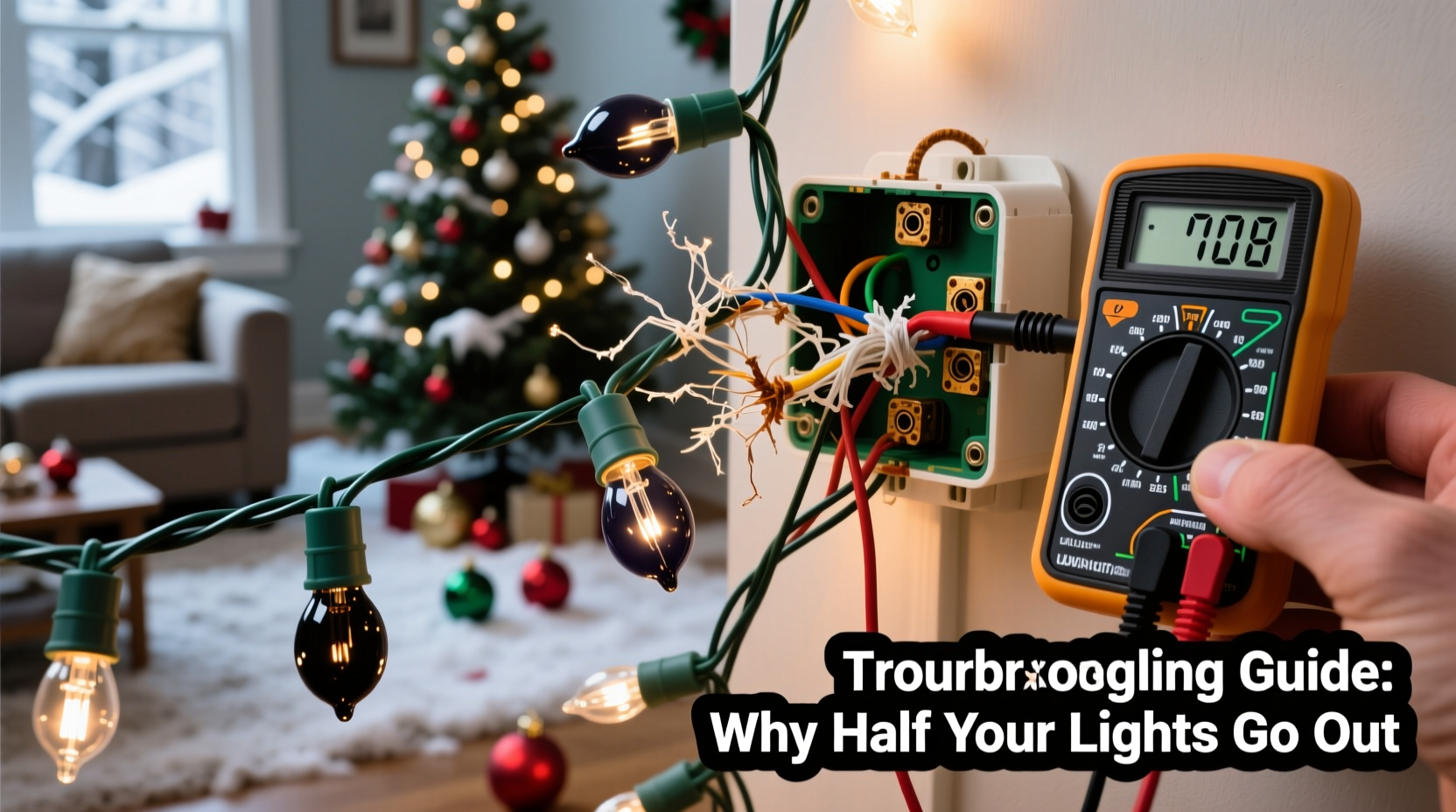
Most modern mini-light strings (especially those with 50–100 bulbs) use a series circuit design: electricity flows from the plug, through each bulb socket in sequence, and back to the transformer or controller. If one bulb burns out completely—or its filament breaks—the entire circuit opens and all lights go dark. To prevent that, manufacturers embed a tiny device inside each bulb base called a shunt. A shunt is a microscopic wire-wrapped resistor coated in insulating material. When the bulb is intact, current flows normally through the filament. But when the filament fails and voltage spikes across the broken gap, the insulation on the shunt overheats, melts, and shorts the two contacts—bypassing the dead bulb and allowing current to continue flowing to the rest of the string.
This system works—until it doesn’t. Shunts degrade over time. They can oxidize, corrode, or fail to activate due to low-quality materials or repeated thermal cycling. When a shunt fails *open* instead of *closing*, current stops at that point. Since the rest of the string relies on continuity through that bulb’s socket, everything downstream goes dark. That’s why “half” goes out: the break occurs at the exact location where the shunt failed to engage—often near the midpoint, especially in strings divided into two 50-bulb sections for easier manufacturing and voltage management.
“The ‘half-out’ symptom is rarely coincidence—it’s usually the first shunt failure in a long series chain, and it tells you precisely where to start looking.” — Mark Delaney, Electrical Engineer & Holiday Lighting Consultant, UL-certified test lab since 2003
Step-by-Step Troubleshooting Protocol
Don’t guess. Follow this field-tested sequence—designed for safety, speed, and repeatability. Works for both incandescent and LED mini-strings (though LED strings may also involve driver or controller issues).
- Unplug the string immediately. Never work on live circuits. Verify no power is present using a non-contact voltage tester if available.
- Inspect the plug and cord end. Look for bent prongs, scorch marks, melted plastic, or frayed insulation near the entry point. A damaged plug often causes intermittent or partial failure.
- Locate the midpoint bulb. Count bulbs from the plug end. For a 100-light string, examine bulb #49 through #52. For a 50-light string, check #24–#27. This is the most common failure zone—not because of position, but because mid-string sockets endure the most flex, heat buildup, and manufacturing variance.
- Test each suspect bulb with a known-good replacement. Use a spare bulb from the same string (not a generic one—voltage ratings differ). Insert it into each socket one by one, starting at the first dark bulb. If the string reignites after inserting the new bulb into socket #51, the original bulb in that socket had a failed shunt—even if it looked intact.
- Check for “ghost voltage” with a multimeter (optional but definitive). Set to AC voltage (~20V range). With the string plugged in (and safely isolated), probe the two contacts inside each dark socket, beginning at the first dark one. A reading near line voltage (e.g., 120V) means the break is *upstream*—the shunt before this socket failed open. A reading near 0V means the break is *downstream*—the shunt here failed, but current is still reaching this point.
Four Common Culprits Beyond the Obvious Bulb
A failed shunt is the leading cause—but it’s not the only one. Here’s what else creates the “half-out” effect, ranked by frequency and fixability:
| Cause | How It Triggers Half-Out | Diagnosis Clue | Fix Difficulty |
|---|---|---|---|
| Fused shunt in first dark bulb | Shunt fails open → breaks circuit at that point → all downstream bulbs lose power | Bulb looks fine; replacing it restores full function | Easy (1 min) |
| Loose or corroded socket contact | Intermittent connection mimics an open shunt; often worsens when string is jostled | Wiggling the bulb or socket temporarily restores light | Moderate (clean contacts with isopropyl alcohol + cotton swab) |
| Internal wire break at midpoint connector | Many strings have a molded “splitter” or inline controller at the 50-bulb mark; internal solder joint fatigue cracks | No voltage reading on either side of the connector; visible micro-fractures in housing | Hard (requires soldering or bypassing connector) |
| Failed rectifier or driver IC (LED-only) | LED strings use constant-current drivers; partial failure may cut output to second half only | First half glows dimly or flickers; second half completely dark; warm/humming driver housing | Expert-level (replace driver board or entire string) |
Mini Case Study: The Mantle String Mystery
Sarah, a high school art teacher in Portland, bought a 100-light warm-white LED string last November. She hung it along her stone fireplace mantle—tight bends, no slack, exposed to ambient heat from the gas logs. By December 10th, only bulbs 1–48 lit. She tried swapping bulbs, checking fuses, even plugging it into another outlet. Nothing worked—until she noticed the string had a small, rectangular black box clipped onto the cord at bulb #50. Inside, she found a cracked plastic housing and faint charring near a metal tab. Using a multimeter, she confirmed 0V on the output side of the box. She carefully cut out the box, twisted the two internal wires together, insulated them with heat-shrink tubing, and retested. All 100 bulbs lit evenly. Later, she learned the box was a cheaply made “dual-section controller”—designed to let the first 50 blink while the second stayed steady. Its solder joints had fatigued from thermal expansion/contraction. Her fix lasted the season—and taught her to avoid strings with unnecessary inline electronics.
Prevention & Longevity Best Practices
Troubleshooting fixes today’s problem. These habits prevent next year’s half-out crisis:
- Store coiled—not knotted. Tight bends stress internal wires and accelerate shunt corrosion. Use wide-diameter cardboard tubes or commercial light-reel organizers.
- Unplug before adjusting. Yanking or twisting bulbs while powered increases arcing risk and degrades shunt reliability.
- Replace bulbs in matched sets. Mixing old and new bulbs—even same model—introduces subtle resistance mismatches that strain shunts over time.
- Use outdoor-rated strings indoors. Their higher-grade sockets, thicker wire insulation, and better shunt metallurgy withstand seasonal storage better than “indoor-only” versions.
- Test before decorating. Plug in every string for 10 minutes before hanging. Early detection catches weak shunts before they fail mid-season.
FAQ: Quick Answers to Real Reader Questions
Can I replace just the fuse in the plug—and will that fix half-out?
No. The fuse protects against overcurrent (e.g., short circuits), not open circuits caused by shunt failure. If the fuse were blown, the entire string would be dead—not half. Replacing it won’t restore partial operation. Only replace the fuse if it’s visibly discolored or broken—and then investigate why it blew (e.g., pinched wire, moisture ingress).
Why do some strings have two fuses—and what if only one is blown?
Higher-voltage strings (e.g., 24V or 36V systems used in commercial displays) sometimes use dual fuses for redundancy. In standard 120V household strings, two fuses usually indicate a split-circuit design: one fuse feeds the first 50 bulbs, the other the second 50. If only one fuse is blown, that explains the half-out pattern. Check both fuses with a multimeter’s continuity setting—don’t assume visual inspection is enough.
Is it safe to bypass a dead bulb by twisting the wires together?
Not recommended. Twisting exposes live conductors, creates fire hazards, and risks shorting adjacent sockets. Always use a proper replacement bulb with an intact, rated shunt. If no replacements exist, discard the string. Modern LEDs draw so little power that removing one bulb rarely affects brightness—but skipping the shunt’s protective role invites cascading failures.
Conclusion
That sudden, frustrating cutoff—half bright, half dark—isn’t a sign that your holiday spirit needs fixing. It’s a signal. A precise, engineer-readable message pointing to a specific failure mode in a system designed for mass production, not longevity. You now know why it happens: shunt degradation, socket fatigue, connector flaws, or driver limitations—not bad luck or cosmic irony. You have a repeatable method to locate the culprit in under ten minutes. You understand which fixes are safe and effective, and which cross into hazardous territory. Most importantly, you hold the knowledge to extend the life of future strings—not through wishful thinking, but through intentional handling, smart storage, and informed purchasing.
Don’t wait for next December. Tonight, pull out last year’s strings. Test them. Replace weak bulbs. Clean corroded sockets. Label them. Store them properly. Turn troubleshooting from a reactive panic into a quiet, confident ritual—one that honors both the craftsmanship behind these small lights and the peace they’re meant to bring.




 浙公网安备
33010002000092号
浙公网安备
33010002000092号 浙B2-20120091-4
Comments
No comments yet. Why don't you start the discussion?