
It’s a familiar holiday frustration: you plug in your favorite string of Christmas lights, only to find that half the strand remains dark. The other half twinkles cheerfully, but no amount of wiggling or plugging in again seems to revive the dead section. This issue affects millions of households every year, turning festive preparations into electrical puzzles. The good news is that this problem is both common and solvable. With a clear understanding of how modern light strings are wired and some practical diagnostic steps, you can restore full illumination—often without replacing the entire set.
The root cause typically lies in the series-wired design used in most incandescent mini-light strands. In these setups, each bulb acts as part of a continuous electrical circuit. If one bulb becomes loose, burns out, or fails, it breaks the circuit for all bulbs downstream—resulting in exactly half (or sometimes a third) of the strand going dark. While LED strings often use different configurations, they’re not immune to similar issues due to shunt failure or wiring faults. Understanding the structure and weak points allows for targeted fixes rather than wholesale disposal.
How Series-Wired Light Strings Work
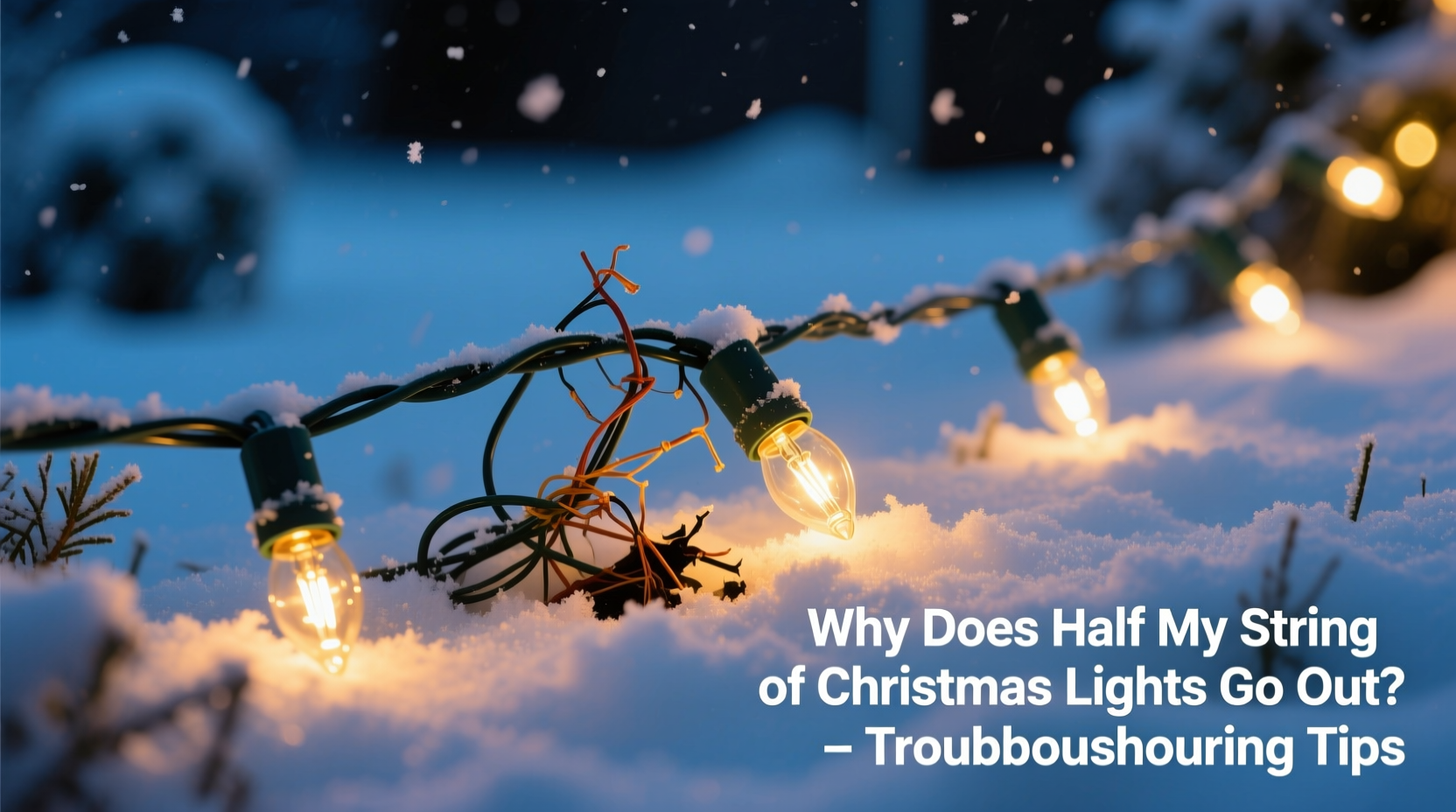
Most traditional Christmas light strings, especially older incandescent models, are wired in series. That means electricity flows from the plug through each bulb socket in sequence before returning to complete the circuit. Each bulb must maintain continuity for the current to reach the next one. Think of it like a relay race—if one runner drops the baton, the rest of the team can’t finish.
In many strands, manufacturers split the series into two parallel circuits. This is why exactly half the lights may go out: one entire circuit has failed while the other still functions. Visually, the division is often apparent—top vs. bottom, left vs. right, or alternating sections along the cord. Each circuit contains around 50–100 bulbs depending on voltage, and a single faulty bulb or poor connection in one circuit will shut down only that half.
Modern LED light strings sometimes use series-parallel hybrids or rectified circuits that allow for greater efficiency and reliability. However, even these can suffer from partial failure due to manufacturing defects, physical damage, or moisture ingress. Recognizing whether your string uses series or parallel wiring helps determine where to focus your troubleshooting efforts.
Step-by-Step Guide to Diagnosing Half-Out Lights
Restoring function to a partially working string doesn’t require advanced tools or electrical training. Follow this systematic approach to identify and resolve the issue efficiently.
- Unplug the strand immediately. Safety first—never handle damaged or malfunctioning lights while connected to power.
- Inspect visually for obvious damage. Look for cracked sockets, frayed wires, missing bulbs, or signs of melting. Pay close attention to the point where the working and non-working sections meet.
- Check all bulbs in the dead section. Remove each bulb gently and examine the filament (for incandescents). A broken or sagging filament indicates a burnout. For LEDs, look for dark spots or internal cracks.
- Re-seat every bulb firmly. Even if a bulb looks fine, it may be slightly dislodged. Press each one down until it clicks or feels secure.
- Test after reseating. Plug the strand back in. If the lights come on, the issue was likely a loose connection.
- Use a light tester if available. Devices like the “Light Keeper Pro” send pulses through the strand to clear shunt failures or reset faulty bulbs without removing them.
- Replace suspect bulbs one at a time. Insert known-working replacements into questionable sockets, starting near the midpoint of the dark section.
- Examine the shunts (in incandescent bulbs). Some bulbs have built-in shunts designed to bypass a burned-out filament. If the shunt fails to activate, the circuit breaks. You can test this by using a multimeter across the base of a removed bulb.
- Trace continuity with a multimeter (optional). Set to continuity mode and check from the end of the live section into the first few sockets of the dark half. A break in continuity pinpoints the location of the fault.
- Consider wire damage. If no bulb issues are found, inspect the copper wire beneath the insulation for kinks, cuts, or rodent damage—especially near bends or entry points to sockets.
This process usually resolves the issue within 15–30 minutes. Most cases stem from just one problematic bulb or connection.
Common Causes of Partial Light Failure
Beyond simple bulb burnouts, several factors contribute to half-lit strands. Knowing what to look for speeds up diagnosis.
- Loose or improperly seated bulbs: Vibration during storage or rough handling can unseat bulbs just enough to break contact.
- Shunt failure in incandescent bulbs: When a filament burns out, a small wire (shunt) should activate to keep the circuit closed. Sometimes corrosion or poor manufacturing prevents this.
- Frayed or broken internal wiring: Especially in older sets, repeated bending or outdoor exposure weakens the thin copper conductors inside the insulated cord.
- Water damage or moisture ingress: Outdoor lights exposed to rain or snow may develop short circuits or corrosion at connection points.
- Damaged male/female plug connectors: The junction between strings is a high-stress area. Bent prongs or cracked housings disrupt power transfer.
- Overloading circuits: Daisychaining too many strands can overload transformers or trip internal fuses, affecting only part of the run.
- Manufacturing defects: Occasionally, a strand leaves the factory with a cold solder joint or incomplete circuit.
“About 70% of partial outages I see in holiday repair clinics are caused by a single loose bulb or failed shunt. It’s rarely the whole string.” — Greg Thompson, Seasonal Lighting Technician, Minneapolis Holiday Repair Collective
Troubleshooting Checklist
- ✅ Unplug the light string
- ✅ Inspect for visible damage (cracks, frays, melted areas)
- ✅ Ensure all bulbs are present and fully seated
- ✅ Replace any visibly damaged or burnt-out bulbs
- ✅ Use a light tester tool (e.g., Light Keeper Pro)
- ✅ Test continuity with a multimeter if comfortable
- ✅ Check plug connections and daisy-chained loads
- ✅ Try plugging into a different outlet
- ✅ Verify fuse status in plug (if accessible)
- ✅ Reassemble and test under safe conditions
Do’s and Don’ts: Best Practices for Christmas Light Maintenance
| Do | Don’t |
|---|---|
| Store lights coiled loosely around a cardboard spool or reel | Toss lights into a box without protection, causing tangles and wire stress |
| Label strands by location and color for easy setup next year | Mix indoor and outdoor-rated lights indiscriminately |
| Use clips instead of nails or staples to hang lights | Pull on the cord to remove lights from gutters or trees |
| Test each strand before installation | Daisy-chain more than three strands unless labeled for it |
| Keep spare bulbs and fuses on hand | Leave lights on unattended or overnight indefinitely |
Real Example: Sarah’s Front Porch Fix
Sarah had used the same set of 200-count icicle lights on her porch for five years. One November evening, she plugged them in to decorate and noticed only the top half lit up. Frustrated, she nearly tossed the set—until her neighbor suggested trying a bulb-by-bulb inspection.
She unplugged the strand and laid it across her garage workbench. After reseating all visible bulbs, she replaced the third one from the start of the dark section with a spare. The moment she plugged it back in, the entire lower half illuminated. The original bulb had a micro-fracture in its base that prevented proper contact, despite appearing intact. By spending less than 20 minutes on diagnostics, Sarah saved $28 and avoided unnecessary waste.
Now, she keeps a small kit with spare bulbs, a light tester, and a labeling system for all her seasonal lighting.
Frequently Asked Questions
Can I replace incandescent bulbs with LED ones in the same string?
No, unless explicitly stated by the manufacturer. Incandescent and LED bulbs operate at different voltages and currents. Swapping them can overload the circuit or cause flickering. Use only the bulb type specified for your strand.
Why do only half the lights go out instead of all of them?
Many light strings are divided into two independent circuits wired in parallel. If one circuit fails due to a bad bulb or connection, the other continues to function. This design improves usability but masks individual failures until they accumulate.
Are there Christmas lights that won’t go half-out when one bulb fails?
Yes. Many modern LED strings use parallel wiring or have built-in redundancies so that one bulb failure doesn’t affect others. Look for labels like “StayLit,” “Energy Star certified,” or “shunt-protected.” Brands like GE, Philips, and Christmas Lights, Etc. offer such models.
Preventing Future Issues
Maintaining your lights properly extends their lifespan and reduces troubleshooting time each season. Begin by handling strands carefully during removal. Instead of yanking them down, disconnect at the plugs and wind them slowly around a flat cardboard template or a dedicated light-reel device.
Before storing, test each string and label it with a tag indicating functionality and color. Discard any with cracked insulation or persistent flickering. Store in a cool, dry place away from rodents—consider plastic bins with dividers to prevent crushing.
When installing, avoid sharp edges, excessive tension, or exposure to standing water. Use UL-listed extension cords rated for outdoor use and never exceed the maximum load for your circuit. Timers help reduce wear by limiting daily runtime.
Conclusion
A partially dark string of Christmas lights isn’t a lost cause—it’s a fixable glitch in a seasonal tradition. With basic observation, methodical testing, and an understanding of how these circuits operate, most outages can be resolved quickly and inexpensively. Beyond convenience, repairing rather than replacing supports sustainability and saves money over time.
As you prepare your holiday display this year, treat each strand with care and intention. Small habits—like checking bulbs before storage, using proper reels, and keeping spares—make future setups smoother and more joyful. The warmth of twinkling lights begins not just with electricity, but with thoughtful maintenance.




 浙公网安备
33010002000092号
浙公网安备
33010002000092号 浙B2-20120091-4
Comments
No comments yet. Why don't you start the discussion?