
Most solids sink when placed in their liquid form. Ice, however, defies this expectation by floating on liquid water—a phenomenon so common we rarely question it. Yet this simple act of buoyancy plays a crucial role in sustaining life on Earth. From preserving aquatic ecosystems to shaping global climate patterns, the fact that ice floats is not just a curiosity—it’s a cornerstone of planetary stability. The answer lies in the molecular behavior of water, a substance with highly unusual properties driven by its chemical structure.
The Role of Density in Buoyancy
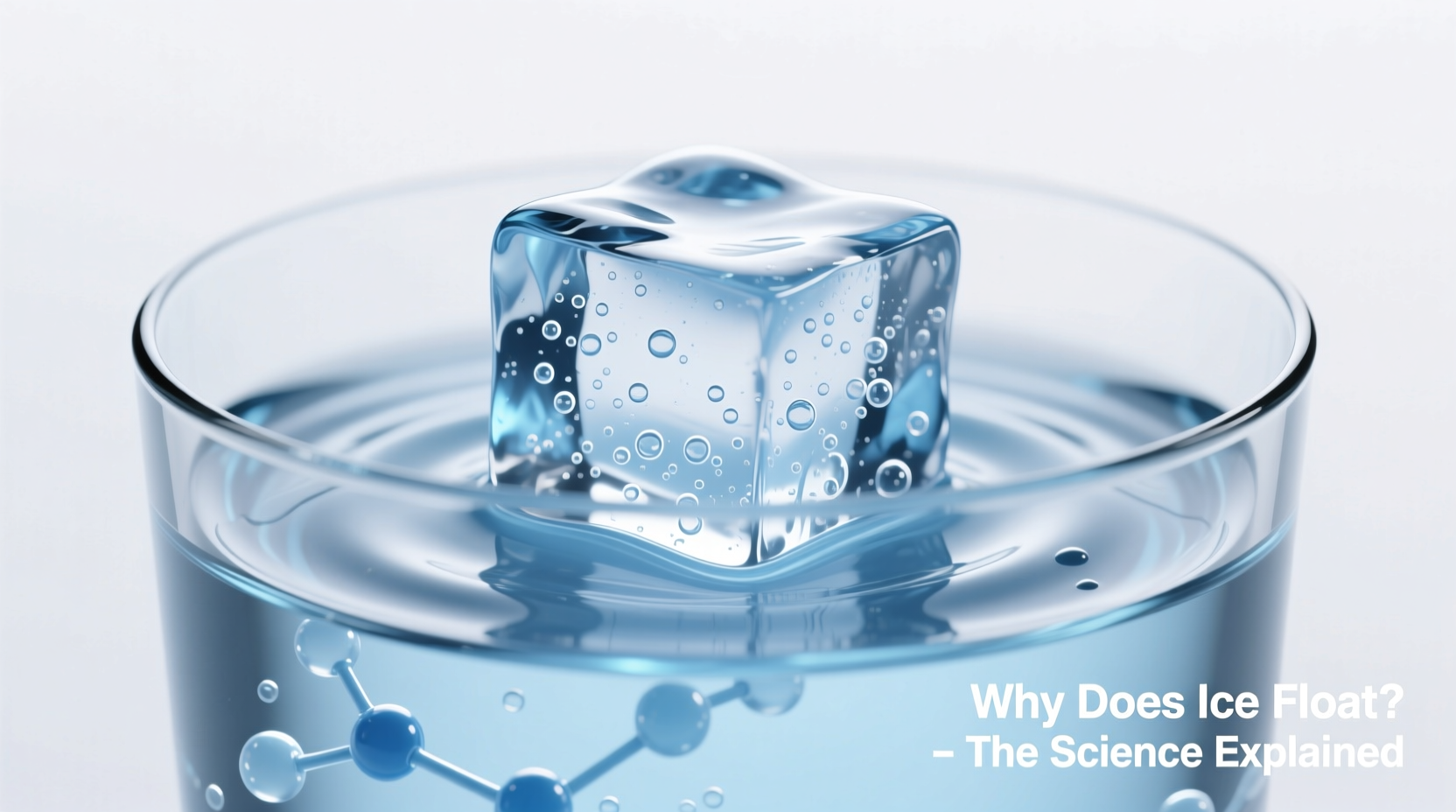
Density determines whether an object sinks or floats in a fluid. An object will float if it is less dense than the liquid it displaces. For most substances, the solid phase is denser than the liquid phase because molecules pack more tightly as they lose thermal energy and transition into a rigid structure. Water, however, behaves differently.
As water cools from room temperature toward freezing, its density increases—just like any other liquid. But at approximately 4°C (39°F), something remarkable happens: water reaches its maximum density. As it continues cooling toward 0°C (32°F) and begins to freeze, it expands and becomes less dense. This means that ice occupies more volume than the same mass of liquid water, making it lighter per unit volume—and thus able to float.
Hydrogen Bonding: The Key to Expansion
The reason behind water’s expansion upon freezing lies in its molecular structure and the nature of hydrogen bonding. A water molecule consists of two hydrogen atoms bonded to one oxygen atom (H₂O). Oxygen is highly electronegative, meaning it pulls electrons more strongly than hydrogen, creating a partial negative charge on the oxygen and partial positive charges on the hydrogens.
This polarity allows water molecules to attract one another through hydrogen bonds—weak electrostatic attractions between the hydrogen of one molecule and the oxygen of another. In liquid water, these bonds are constantly forming and breaking due to thermal motion, allowing molecules to remain relatively close together.
When water freezes, the molecules slow down and arrange themselves into a hexagonal crystalline lattice. Each molecule forms four stable hydrogen bonds with its neighbors, locking them into fixed positions with greater spacing than in the liquid state. This open structure creates empty space within the ice crystal, increasing volume and reducing overall density.
“Water’s hydrogen-bonded network gives rise to many anomalies, but none more important than the decrease in density upon freezing.” — Dr. Rebecca Thompson, Physicist and Science Communicator at the American Physical Society
Why This Matters: Ecological and Environmental Impacts
If ice sank instead of floated, Earth’s natural systems would function very differently. Lakes and rivers would freeze from the bottom up, eliminating habitable environments for fish, plants, and microorganisms during winter months. Over time, bodies of water could become permanently frozen below the surface, drastically altering climate regulation and nutrient cycling.
Instead, floating ice acts as an insulating layer. It reduces further heat loss from the underlying water, slowing additional freezing and maintaining liquid conditions beneath. This allows aquatic life to survive cold seasons and supports seasonal ecological balance.
In polar regions, sea ice formation follows the same principle. Although seawater has a lower freezing point due to salinity, the resulting ice still floats. This reflective surface helps regulate Earth’s temperature by bouncing solar radiation back into space—a process known as the albedo effect. Melting sea ice reduces this reflectivity, contributing to accelerated warming in a feedback loop linked to climate change.
Comparative Behavior of Other Substances
Water is rare in expanding upon freezing. Most materials contract when transitioning from liquid to solid. The table below illustrates how water compares to other common substances:
| Substance | Phase Change | Density Change | Does Solid Float? |
|---|---|---|---|
| Water (H₂O) | Liquid → Solid | Decreases | Yes |
| Carbon Dioxide (CO₂) | Gas → Solid (dry ice) | Increases | No (sinks in liquid CO₂) |
| Iron (Fe) | Liquid → Solid | Increases | No |
| Mercury (Hg) | Liquid → Solid | Increases | No |
| Silicon (Si) | Liquid → Solid | Decreases slightly | Rarely (under specific conditions) |
This uniqueness makes water essential for life as we know it. No other liquid exhibits such a combination of thermal anomalies, solvent capabilities, and phase behaviors critical to biological and geological processes.
Real-World Example: Winter Survival in Freshwater Lakes
Consider a deep freshwater lake in northern Minnesota during winter. Air temperatures drop well below freezing, causing the surface water to cool. As it reaches 4°C, it becomes denser and sinks, replaced by warmer water rising from below—a process called convection. This mixing continues until the entire water column stabilizes at 4°C.
Further cooling affects only the top layer. Once surface water reaches 0°C, ice begins to form. Because ice is less dense, it remains on the surface. Underneath, the water stays liquid, typically around 4°C—the temperature of maximum density. Fish, amphibians, and plankton continue to thrive in this protected environment, insulated from extreme cold above.
If ice were denser than water, it would sink immediately after forming. The lake would freeze progressively from the bottom upward, eventually becoming a solid block of ice. Such conditions would make long-term survival of most aquatic species impossible.
Frequently Asked Questions
Why doesn’t saltwater ice float as well as freshwater ice?
Sea ice does float, but it’s slightly less buoyant than freshwater ice due to impurities like salt trapped within the crystal structure. However, even with these differences, sea ice remains less dense than the surrounding seawater and therefore floats.
Can water be supercooled so it doesn’t freeze even below 0°C?
Yes, under very clean and still conditions, water can remain liquid below its freezing point in a state called supercooling. However, once nucleation occurs—triggered by dust, vibrations, or contact with ice crystals—it rapidly freezes, and the resulting ice still floats.
Does boiling water before freezing affect how ice floats?
Boiling removes dissolved gases and can lead to clearer ice with fewer imperfections, but it doesn’t alter the fundamental density difference between ice and water. Regardless of treatment, frozen water will always float on its liquid form under standard conditions.
Practical Tips for Understanding and Teaching the Concept
- Use a clear container to demonstrate ice floating versus a metal object sinking—highlighting the contrast between water and typical solids.
- Show students how ice cubes shrink slightly when melted, reinforcing the idea that frozen water takes up more space.
- Conduct experiments measuring the volume of water before and after freezing using a graduated cylinder and freezer-safe container.
- Discuss real-life consequences: what would happen to marine life if ice sank?
- Compare water to other liquids like oil or alcohol, which do not expand when frozen.
Conclusion: A Small Phenomenon with Massive Consequences
The fact that ice floats may seem trivial at first glance, but it underpins some of the most vital processes on our planet. From enabling life to persist through harsh winters to influencing global climate dynamics, this single physical anomaly has far-reaching implications. Understanding the science behind it—rooted in hydrogen bonding and density changes—reveals just how extraordinary water truly is.




 浙公网安备
33010002000092号
浙公网安备
33010002000092号 浙B2-20120091-4
Comments
No comments yet. Why don't you start the discussion?