
The letter \"k\" appears everywhere as a shorthand for 1,000 — in salaries ($75k), social media followers (100k likes), and product specifications (4K resolution). But why exactly is \"k\" used to mean one thousand? It’s not the tenth letter of the alphabet for nothing. The answer lies in linguistic history, scientific standardization, and cultural evolution. Understanding this simple symbol reveals deeper insights into how we communicate numbers efficiently across disciplines.
The Origin of \"K\" as 1,000
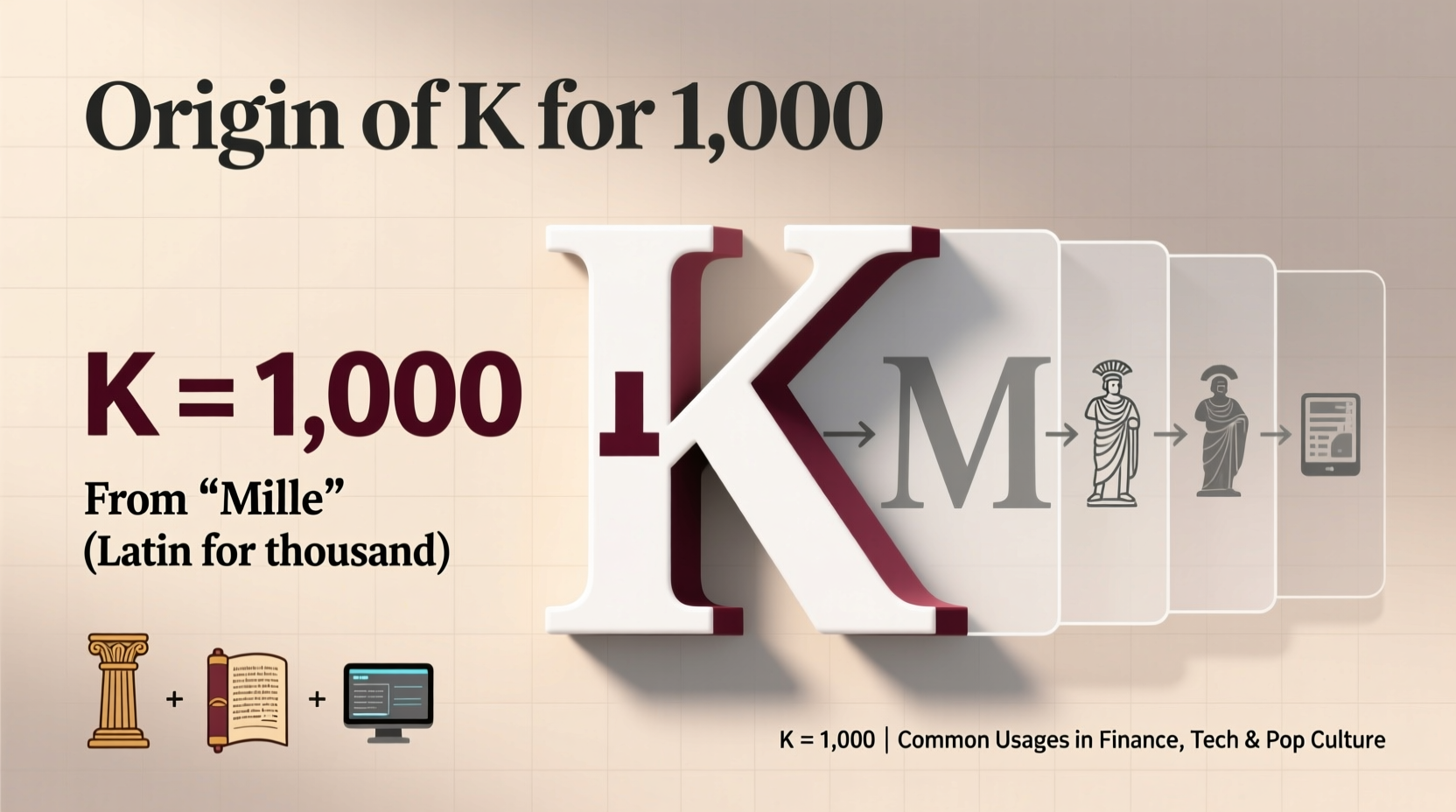
The use of \"k\" to denote 1,000 originates from the metric prefix \"kilo-\", derived from the Greek word *chilioi* (χίλιοι), meaning \"thousand.\" When the metric system was formalized in the late 18th century, French scientists adopted \"kilo-\" as a prefix to indicate multiplication by one thousand. For example, a kilogram equals 1,000 grams, and a kilometer equals 1,000 meters.
Over time, \"kilo-\" was abbreviated to just \"k\" in scientific, engineering, and eventually popular usage. This shorthand became especially valuable in fields where large numbers are routine, such as computing, finance, and manufacturing. The lowercase \"k\" stuck because it was concise, unambiguous in context, and aligned with international standards like the International System of Units (SI).
“Scientific notation thrives on brevity and clarity. The adoption of 'k' for kilo was a natural step toward universal numerical literacy.” — Dr. Alan Reeves, Metrology Historian, National Institute of Standards
Common Usage Across Industries
Today, \"k\" transcends technical domains and has entered mainstream communication. Its versatility makes it ideal for expressing large figures without cluttering text or speech.
Finance and Salary Reporting
In job listings and salary discussions, \"$60k\" is far more convenient than \"sixty thousand dollars.\" It saves space in ads, resumes, and contracts. Employers often use \"k\" to generalize compensation packages, allowing flexibility while conveying scale.
Technology and Data
Digital storage and processing power frequently use \"k\" to describe capacity. A file size of \"2MB\" may be broken down into \"2,048 KB,\" where \"KB\" stands for kilobyte (1,024 bytes in binary systems, though often rounded to 1,000 in decimal contexts). Similarly, network speeds might be listed as \"500 kbps\" (kilobits per second).
Social Media and Pop Culture
On platforms like Instagram, YouTube, and TikTok, user counts are routinely expressed with \"k.\" Gaining \"10k followers\" is a milestone celebrated widely. Here, \"k\" serves both practical and psychological purposes: it simplifies big numbers and makes growth feel more tangible.
K vs. Other Numerical Abbreviations
While \"k\" stands for 1,000, other abbreviations exist for larger magnitudes. These follow SI prefixes and help maintain consistency across measurement systems.
| Symbol | Prefix | Value | Example |
|---|---|---|---|
| k | kilo- | 10³ = 1,000 | 5k race = 5,000 meters |
| M | mega- | 10⁶ = 1,000,000 | 10M subscribers |
| G | giga- | 10⁹ = 1,000,000,000 | 8GB RAM |
| T | tera- | 10¹² = 1,000,000,000,000 | 2TB hard drive |
Note that uppercase \"K\" can sometimes cause confusion. In temperature, \"K\" stands for Kelvin. In finance, some mistakenly capitalize \"K\" instead of using lowercase \"k,\" but SI standards specify lowercase for \"kilo-.\"
Historical Evolution and Misconceptions
A common misconception is that \"k\" comes from the word \"grand,\" which itself is American slang for $1,000 (possibly from early 20th-century criminal jargon, where a \"grand\" sum meant $1,000). However, \"k\" has no etymological link to \"grand\" — it predates modern slang by over a century through its roots in the metric system.
Another myth suggests \"k\" stands for \"kay,\" an informal pronunciation of \"thousand\" in military or aviation circles. While \"kay\" is indeed spoken aloud to mean 1,000 (e.g., “We’re flying at 30 kay”), this usage evolved from the written \"k,\" not the other way around.
The real story is simpler: \"k\" gained legitimacy through science and standardization. As globalization increased, so did the need for consistent units. The SI system provided that framework, and \"k\" became a universally recognized symbol — even outside textbooks and laboratories.
Best Practices for Using \"K\" Correctly
Despite its widespread acceptance, misuse of \"k\" can lead to misunderstandings. Follow these guidelines to ensure clarity and professionalism.
- Use lowercase \"k\" for kilo-: Per SI rules, the correct symbol is lowercase. \"KB\" for kilobyte is acceptable only when distinguishing from \"Mb\" (megabit), but \"kB\" is technically preferred.
- Avoid mixing cases: Writing \"10K\" when referring to income may look flashy, but it blurs the line between metric precision and stylistic choice. Reserve uppercase for trademarks (e.g., \"10K race\") or brand names.
- Clarify context when needed: In formal reports or international communications, spell out \"thousand\" if there's any risk of misinterpretation.
- Don’t assume universal knowledge: Not all audiences know that \"k\" means 1,000. Older generations or non-technical readers may benefit from brief explanations.
- Be consistent: If you start using \"k\" in a document, stick with it throughout rather than switching between numerals and words.
Mini Case Study: The Rise of \"4K\"
No modern example better illustrates the cultural penetration of \"k\" than the term \"4K.\" Originally a technical descriptor in digital imaging, \"4K\" refers to a horizontal resolution of approximately 4,000 pixels (typically 3840 × 2160). When consumer TVs began marketing \"4K Ultra HD\" in the early 2010s, the public absorbed the term rapidly — despite most viewers not knowing what \"K\" stood for.
Manufacturers chose \"4K\" over \"four thousand\" because it sounded technical, futuristic, and compact. Retailers followed suit, embedding \"k\" into mainstream tech vocabulary. Today, people casually refer to videos, monitors, and cameras as \"4K\" without questioning the \"k.\" This case shows how standardized abbreviations can transition from expert jargon to everyday language.
FAQ
Is \"k\" always exactly 1,000?
In most contexts, yes — especially in finance and general usage. However, in computing, \"kilo\" traditionally meant 1,024 due to binary systems (2¹⁰). To reduce confusion, the IEC introduced \"KiB\" (kibibyte) for 1,024 bytes, while \"KB\" now officially means 1,000 bytes in decimal terms. In practice, the distinction is often ignored outside technical documentation.
Can \"k\" stand for anything else?
Yes, depending on context. In chemistry, \"K\" is the symbol for potassium (from Latin *kalium*). In physics, \"K\" denotes Kelvin. In texting, \"k\" can mean \"okay\" or \"cool.\" Always consider context to avoid misinterpretation.
Why not use commas instead of \"k\"?
Commas work well in formal writing, but \"k\" offers brevity in headlines, charts, labels, and digital interfaces. Compare \"Revenue: $2,500,000\" with \"Revenue: $2.5M\" — the latter is faster to read and scales better across formats.
Conclusion
The letter \"k\" as a symbol for 1,000 is more than a shortcut — it’s a legacy of scientific rigor, linguistic adaptation, and practical necessity. From its roots in ancient Greek to its dominance in digital culture, \"k\" bridges precision and accessibility. Whether you're negotiating a salary, analyzing data, or tracking online engagement, understanding the meaning and proper use of \"k\" enhances both clarity and credibility.




 浙公网安备
33010002000092号
浙公网安备
33010002000092号 浙B2-20120091-4
Comments
No comments yet. Why don't you start the discussion?