
Music has a unique power to bypass logic and speak directly to the emotions. A single phrase in a song can bring tears to your eyes, while a swelling crescendo might send shivers down your spine—literally. These physical reactions, often described as \"chills\" or \"frisson,\" are more than poetic metaphors. They are measurable physiological events rooted in the brain’s intricate wiring. Scientists have long been fascinated by this phenomenon: why do certain musical moments trigger such intense bodily responses? The answer lies at the intersection of neuroscience, psychology, and evolution.
When music gives you chills, it's not just your imagination—it's your brain releasing dopamine, activating reward centers, and synchronizing neural networks in ways that mirror responses to food, sex, and even drugs. Understanding this process reveals not only how music affects us but also why it holds such a central place in human culture across time and geography.
The Physiology of Musical Chills
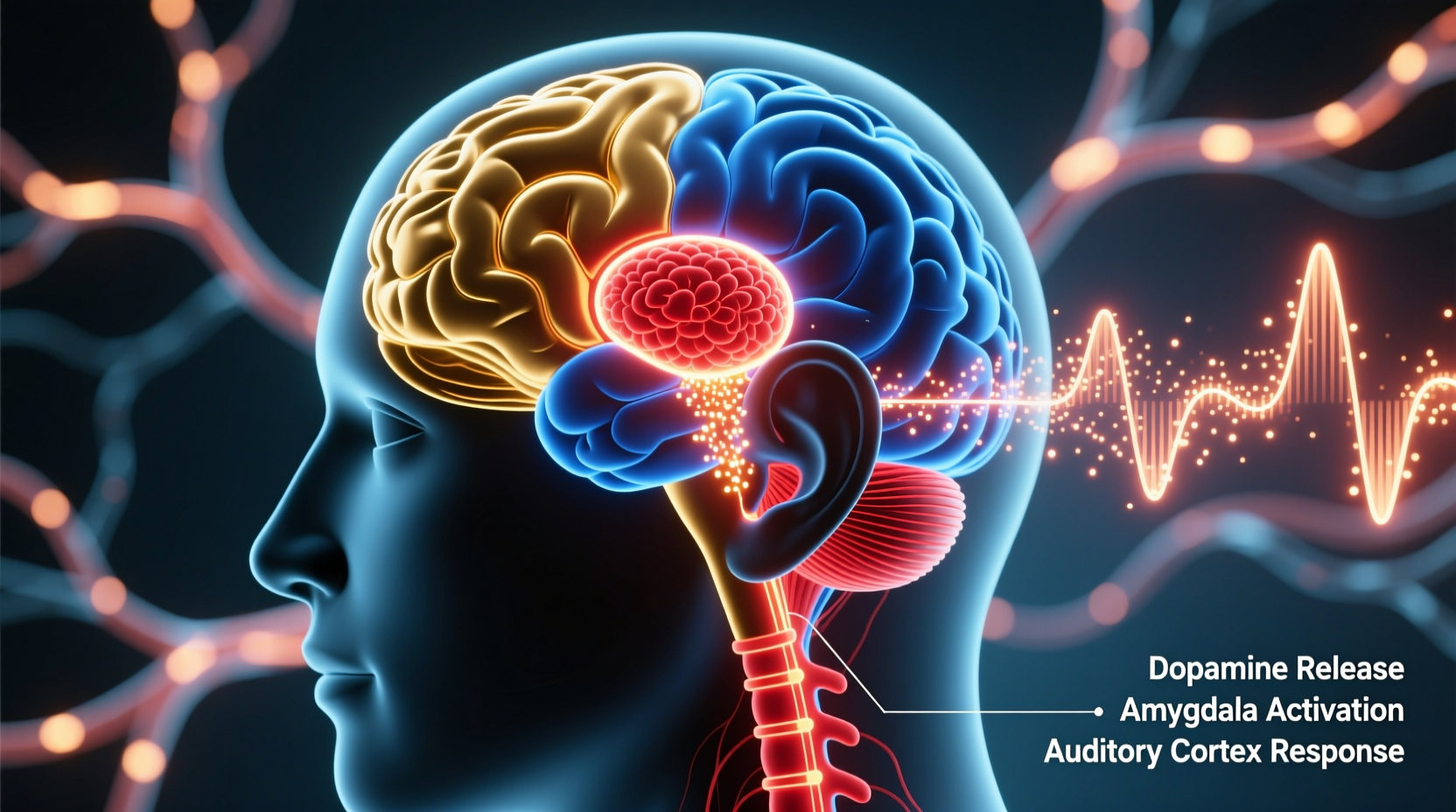
Musical chills, scientifically known as *frisson*, refer to brief, pleasurable waves of goosebumps, tingling skin, or shivers that occur in response to emotionally powerful stimuli—most commonly music. These sensations typically travel from the back of the neck down the spine and arms, lasting anywhere from a few seconds to half a minute.
Frisson is an autonomic nervous system response. It involves the activation of the sympathetic branch—the same system responsible for the “fight-or-flight” reaction. However, in this case, the arousal is pleasant rather than stressful. Heart rate increases, skin conductance rises (indicating sweat gland activity), and pupils may dilate—all signs of emotional engagement.
Not everyone experiences frisson equally. Studies suggest that between 55% and 86% of people report having had music-induced chills at some point. Individual differences in personality, particularly openness to experience, correlate strongly with susceptibility. Those who score high on traits like imagination, aesthetic sensitivity, and emotional depth are more likely to feel chills when listening to music.
Neural Mechanisms: How Music Activates the Brain’s Reward System
The key to understanding musical chills lies in the brain’s reward circuitry. Functional MRI studies have shown that when people experience frisson, two critical areas light up: the nucleus accumbens and the ventral tegmental area (VTA). These regions form part of the mesolimbic pathway, which governs pleasure, motivation, and reinforcement learning.
Dopamine, the neurotransmitter most associated with pleasure and anticipation, plays a central role. In a landmark study conducted by neuroscientist Valorie Salimpoor and her team at McGill University, participants who experienced chills while listening to their favorite music showed significant dopamine release in the nucleus accumbens—up to 9% higher than baseline levels.
What’s particularly fascinating is that dopamine peaks not only during the most emotionally intense parts of a song but also in the moments leading up to them. This anticipatory phase activates the caudate nucleus, a region involved in prediction and expectation. The brain essentially rewards itself for correctly predicting a pleasurable resolution—such as a harmonic shift, a vocal run, or a sudden silence.
“Music engages the same neural pathways as primary rewards like food and sex, even though it provides no direct survival benefit.” — Dr. Robert Zatorre, Cognitive Neuroscientist, McGill University
Why Certain Musical Elements Trigger Chills
While personal taste varies widely, research has identified several recurring musical features that commonly induce frisson:
- Unexpected harmonies or modulations: A sudden key change or dissonant chord that resolves beautifully can create emotional tension and release.
- Dynamic shifts: Rapid changes in volume (crescendos) or instrumentation can heighten emotional impact.
- Vocal expression: Raw, emotive singing—especially with vibrato or falsetto—often triggers strong reactions.
- Personal associations: Songs tied to meaningful memories amplify emotional resonance.
- Silence or pauses: Strategic breaks before a climactic moment build suspense and intensify payoff.
These elements work together to violate or fulfill expectations. The brain constantly predicts what comes next in a melody based on learned patterns. When music deviates slightly—just enough to surprise but not confuse—the result is a surge of emotional arousal. Too predictable, and the brain tunes out; too chaotic, and it disengages. The sweet spot lies in what cognitive scientists call “controlled unpredictability.”
A classic example is the opening of Adele’s “Someone Like You.” The sparse piano, vulnerable vocal delivery, and unexpected melodic leaps—particularly on the line “Never mind, I’ll find someone like you”—trigger chills in countless listeners. The emotional authenticity combined with subtle musical surprises creates a perfect storm for frisson.
Individual Differences and Personality Traits
Not all brains respond to music in the same way. Functional connectivity—the degree to which different brain regions communicate—varies significantly among individuals and influences susceptibility to musical chills.
People who experience frequent frisson tend to have stronger connections between auditory processing areas (like the superior temporal gyrus) and emotional-regulation centers (such as the insula and anterior cingulate cortex). This enhanced cross-talk allows for deeper integration of sound and feeling.
Personality also matters. The Big Five trait of *openness to experience* is the strongest psychological predictor of frisson frequency. Open individuals are more likely to seek out novel, complex, and emotionally rich experiences—including music. They also tend to engage in “absorption,” a state of deep mental focus where external awareness fades and emotional immersion intensifies.
| Personality Trait | Correlation with Frisson | Explanation |
|---|---|---|
| Openness to Experience | Strong Positive | Higher sensitivity to beauty, emotion, and complexity in art and sound. |
| Neuroticism | Moderate Positive | Greater emotional reactivity may amplify responses to sad or intense music. |
| Extraversion | Negligible | More linked to enjoyment of upbeat music, less to deep emotional chills. |
| Conscientiousness | Negative | Prefers structure and predictability; may avoid emotionally overwhelming music. |
Step-by-Step Guide to Enhancing Your Musical Chills Experience
If you want to maximize your chances of experiencing frisson—or deepen its intensity—consider the following science-backed approach:
- Select music with emotional contrast: Choose pieces that feature dynamic shifts, unexpected harmonies, or powerful vocal performances. Instrumental builds (e.g., film scores) and soulful ballads are often effective.
- Listen attentively: Avoid multitasking. Use headphones in a quiet space to eliminate distractions and enhance auditory immersion.
- Engage emotionally: Let yourself connect with the mood of the music. Recall personal memories or visualize scenes that align with the song’s tone.
- Focus on anticipation: Pay attention to moments before the climax—where tension builds. This is when dopamine begins to rise.
- Experiment with new genres: Expand your playlist beyond familiar styles. Classical, post-rock, ambient, or world music may offer novel pathways to chills.
- Revisit meaningful tracks: Re-listen to songs tied to pivotal life moments. Emotional memory amplifies physiological response.
Mini Case Study: Sarah and the Power of Live Music
Sarah, a 34-year-old teacher, had always enjoyed music casually but rarely experienced physical reactions to it. That changed during a live performance of Sigur Rós, an Icelandic post-rock band known for ethereal vocals and slow-building instrumentals. Midway through the song “Sæglópur,” as the drums kicked in and the bowed guitar swelled, she felt a sudden rush of cold tingles down her arms and back. Her breathing slowed, and tears welled up without warning.
Afterward, she described the moment as “transcendent.” What made it possible? Several factors converged: the immersive acoustics of the concert hall, the emotional weight of the music, and her heightened focus in a distraction-free environment. She later learned that her openness to new experiences—she enjoys poetry, hiking, and abstract art—likely predisposed her to such a reaction. Since then, she actively seeks out music that challenges her emotionally, using curated playlists to recreate similar moments at home.
Evolutionary Perspectives: Why Did We Evolve to Respond to Music?
From an evolutionary standpoint, the question remains: why does the brain treat music like a reward when it doesn’t contribute directly to survival? Unlike food or shelter, music offers no tangible benefit. Yet, its universality across cultures suggests deep biological roots.
One theory, proposed by cognitive psychologist Steven Pinker, famously dubbed music “auditory cheesecake”—a pleasurable byproduct of other adaptive systems, like language and emotion recognition. But many neuroscientists now challenge this view. If music were merely decorative, why would it activate ancient reward circuits so powerfully?
An alternative hypothesis suggests that music evolved as a social bonding mechanism. Group singing or dancing strengthens cohesion, synchronizes emotions, and fosters trust—advantages in early human communities. The chills response may have served as a biofeedback signal, reinforcing participation in communal rituals. Even today, shared musical experiences—concerts, weddings, funerals—create profound feelings of connection.
In this light, musical chills aren’t just individual pleasures; they’re echoes of our collective past, linking us to others through rhythm and resonance.
FAQ
Can instrumental music cause chills as easily as vocal music?
Yes. While vocal expressiveness often enhances emotional impact, many people report chills from purely instrumental pieces—especially orchestral works, film scores, or electronic builds. The key factor is emotional contour, not the presence of lyrics.
Is it normal to cry when experiencing musical chills?
Absolutely. Crying during intense musical moments is common and reflects deep emotional processing. It often occurs when music evokes nostalgia, longing, or a sense of beauty too vast for words.
Can I train myself to feel chills more often?
You can’t force frisson, but you can create conditions that make it more likely. Practice mindful listening, explore diverse genres, and revisit emotionally significant music. Over time, your sensitivity may increase.
Conclusion: Embrace the Shiver
Musical chills are more than fleeting sensations—they are windows into the brain’s emotional machinery. They reveal how deeply music is woven into our neurobiology, capable of triggering ancient reward systems and forging connections across time and space. Whether it’s a symphony’s final note, a singer’s impassioned cry, or a quiet guitar riff that hits just right, these moments remind us of music’s unparalleled ability to move us—literally.
Understanding the science behind frisson doesn’t diminish its magic; it enhances it. Now that you know what happens in your brain when music gives you chills, you can appreciate those shivers not as random quirks, but as proof of your brain celebrating something profoundly human.




 浙公网安备
33010002000092号
浙公网安备
33010002000092号 浙B2-20120091-4
Comments
No comments yet. Why don't you start the discussion?