
It begins with a single note—a swell in the orchestra, a sudden vocal run, or a quiet guitar line that cuts through silence. Then, without warning, your skin prickles. A shiver runs down your spine. Your breath catches. You’re not cold. You’re not afraid. You’re experiencing a chill from music—and you’re far from alone.
This phenomenon, known scientifically as *frisson* (from the French word for \"shiver\"), affects up to 75% of people at some point in their lives. It’s more than just goosebumps; it’s a full-body emotional response to sound. But why does it happen? What exactly is your brain doing in those electrifying moments? And why do certain songs trigger it while others fall flat?
The answer lies at the intersection of neuroscience, psychology, and music theory—an intricate dance between expectation, reward, and deep-seated emotion.
The Neuroscience of Musical Chills
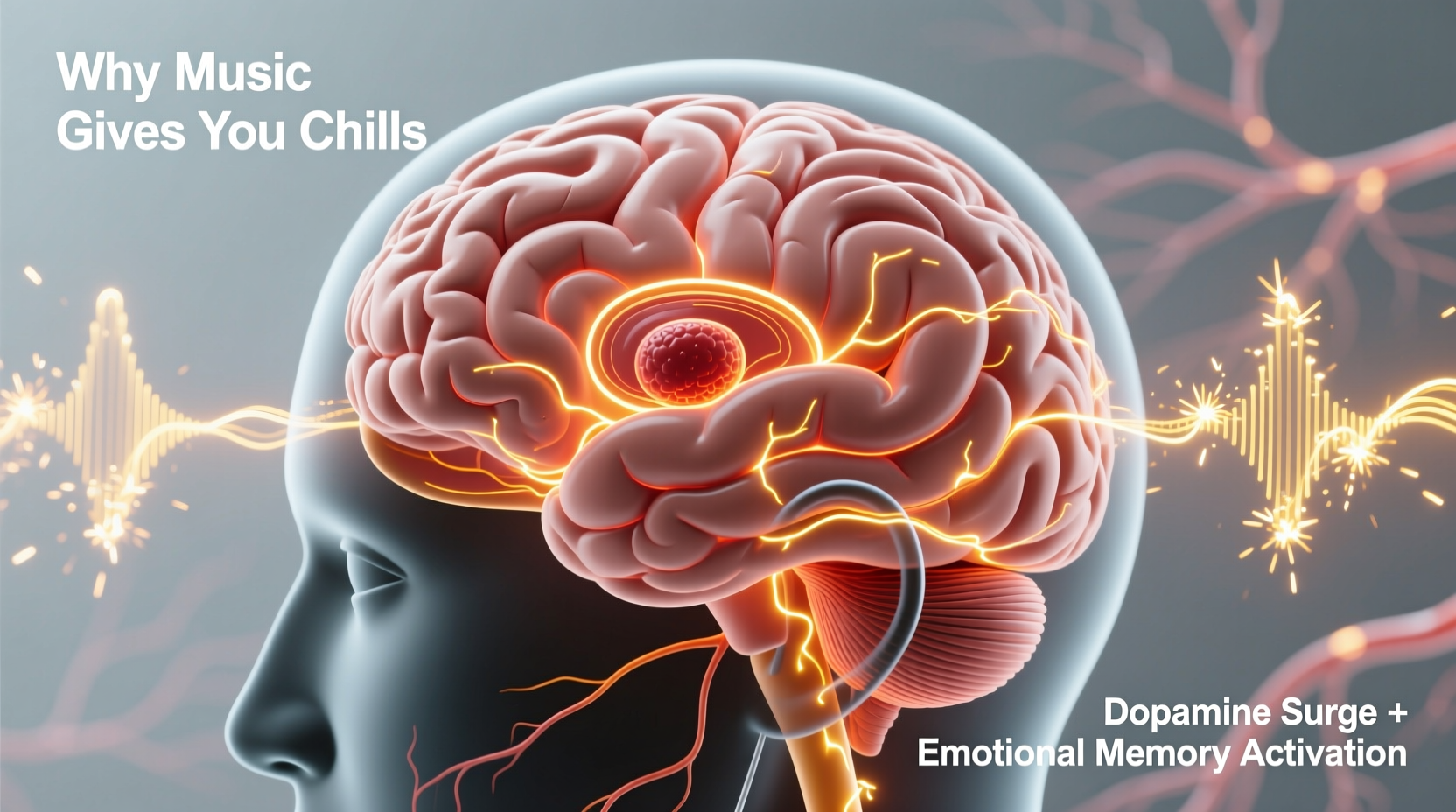
When music triggers chills, your brain doesn’t just “hear” the sound—it reacts to it like a complex narrative unfolding in real time. Functional MRI studies show that during peak emotional moments in music, multiple brain regions activate simultaneously.
The primary player is the **nucleus accumbens**, a key component of the brain’s reward system. This region releases dopamine—the neurotransmitter associated with pleasure, motivation, and reinforcement—just before and during emotionally powerful musical passages. Interestingly, dopamine release often occurs in anticipation of a climax, not just during it. That means your brain rewards you not only for hearing a beautiful resolution but for predicting it.
Other areas involved include:
- Insula: Processes visceral bodily sensations and emotional awareness. It helps translate abstract sound into physical feeling.
- Anterior cingulate cortex: Regulates emotional responses and monitors conflict—such as when a chord surprises you or resolves in an unexpected way.
- Auditory cortex: Decodes pitch, rhythm, and timbre, forming the foundation for musical understanding.
- Orbitofrontal cortex: Evaluates aesthetic value and emotional significance, helping determine whether a moment feels “beautiful” or “moving.”
Together, these regions form what neuroscientists call the “musical emotion network.” When synchronized by a particularly evocative passage, they produce a psychophysiological storm: increased heart rate, changes in skin conductance, pupil dilation—and yes, chills.
Why Some People Get Chills and Others Don’t
Not everyone experiences musical frisson. Studies suggest around 25–30% of people rarely or never feel chills from music. The difference may lie in personality traits and neural connectivity.
Research led by Dr. Matthew Sachs at Harvard University found that individuals who experience frequent chills tend to have denser neural connections between the auditory cortex and the areas responsible for emotion and memory. In other words, their brains are wired to integrate sound and feeling more deeply.
“We found structural differences in the brains of people who get chills. There’s literally more wiring between the parts that process sound and those that generate emotion.” — Dr. Matthew Sachs, Cognitive Neuroscientist
Personality also plays a role. People high in **openness to experience**—a trait linked to imagination, curiosity, and appreciation for art—are significantly more likely to report musical chills. They tend to engage more deeply with music, analyzing lyrics, noticing nuances in instrumentation, and allowing themselves to be emotionally absorbed.
Interestingly, empathy levels correlate too. Those who score higher on empathy scales are more prone to frisson, possibly because they mentally simulate the emotions expressed in the music—as if feeling alongside the performer.
What Triggers the Chills? The Anatomy of a Frisson Moment
While personal taste varies, certain musical features consistently provoke chills across cultures and genres. These aren’t random—they exploit cognitive expectations and emotional vulnerability.
Key Triggers of Musical Frisson
| Musical Element | How It Works | Example |
|---|---|---|
| Sudden dynamic change | A rapid increase in volume or intensity catches the brain off guard, triggering arousal. | The orchestral swell in Adele’s “Someone Like You” after the piano verse. |
| Harmonic surprise | An unexpected chord progression creates tension and resolution, activating reward circuits. | The shift to the relative major in Radiohead’s “Pyramid Song.” |
| Vocal expression | Raw, vulnerable vocals—especially with vibrato or falsetto—signal emotional urgency. | Jeff Buckley’s soaring voice in “Hallelujah.” |
| Entrance of new instrumentation | The addition of strings, choir, or percussion enhances grandeur and emotional weight. | The string section entering in Hans Zimmer’s “Time” from *Inception*. |
| Resolution of tension | After prolonged dissonance or suspense, a harmonic or melodic resolution brings relief. | The final chord of The Beatles’ “A Day in the Life.” |
These elements work best when layered. A quiet passage followed by a sudden crescendo, paired with a lyrical climax and harmonic release, maximizes the chance of inducing chills. Composers and producers often use these tools deliberately—placing them at emotional turning points in a song or film score.
Step-by-Step: How to Increase Your Chances of Feeling Musical Chills
If you want to experience frisson more frequently—or deepen your existing sensitivity—here’s a practical timeline based on psychological and neurological research.
- Listen attentively (Days 1–7): Avoid background listening. Sit quietly, close your eyes, and focus entirely on one song. Let yourself be drawn into the texture of the music.
- Choose emotionally resonant music (Ongoing): Pick songs tied to personal memories or strong feelings. Nostalgia amplifies emotional impact.
- Explore new genres (Weeks 2–3): Expand beyond your comfort zone. Try post-rock, choral music, or minimalist compositions. Novelty heightens attention and surprise.
- Notice the build-up (Week 4): Before the big moment, observe how tension is created—through rising pitch, increasing tempo, or layering instruments.
- Reflect afterward (Daily): Journal briefly about how the music made you feel. This strengthens the memory-emotion connection in the brain.
Mini Case Study: Sarah and the Power of Live Music
Sarah, a 34-year-old teacher, had always loved music but rarely experienced chills—until she attended a live performance of Max Richter’s *On the Nature of Daylight*. Sitting in a dimly lit concert hall, she focused on the slow rise of the strings, each note lingering like a held breath.
About three minutes in, the ensemble swelled, layering harmonies that seemed to suspend time. Suddenly, a wave of warmth passed through her chest, followed by sharp tingles along her arms. Tears welled up. She later described it as “feeling remembered by something I didn’t know I’d forgotten.”
What changed? The live setting amplified immersion. The absence of visual distractions, the physical vibration of sound in the air, and the shared silence of the audience created optimal conditions for frisson. For Sarah, it wasn’t just the composition—it was the context.
Since then, she seeks out intimate concerts and listens more mindfully. She now experiences chills several times a month, often during transitions in classical or ambient music.
Do’s and Don’ts of Chasing the Chill
| Do | Don’t |
|---|---|
| Revisit songs that moved you in the past | Force the experience—chills can’t be willed into existence |
| Listen with high-quality audio equipment | Play music too loudly; clarity matters more than volume |
| Pair music with meaningful memories | Expect every song to deliver a powerful reaction |
| Experiment with binaural beats or spatial audio | Neglect rest and mental state—fatigue dampens emotional responsiveness |
| Share powerful tracks with others | Compare your reactions to others’—sensitivity is highly individual |
Frequently Asked Questions
Can instrumental music cause chills as easily as songs with lyrics?
Yes, and sometimes even more effectively. Instrumental pieces often rely on pure emotional arc—building tension, releasing it, and manipulating dynamics without the cognitive load of language. Film scores and classical works are especially potent.
Are chills a sign of being “deep” or more emotional?
Not necessarily. While openness to experience correlates with frisson, anyone can feel it under the right conditions. It’s less about being “emotional” and more about neural sensitivity and attentional focus.
Is there a link between musical chills and ASMR?
There’s overlap, but they’re distinct. ASMR (Autonomous Sensory Meridian Response) typically involves gentle, repetitive stimuli like whispering or tapping and produces a calming, tingling sensation. Musical frisson is more intense, brief, and tied to emotional peaks. Both involve similar brain regions, but frisson activates the reward system more strongly.
Conclusion: Embrace the Ripple Effect of Sound
Music gives you chills because it speaks directly to the oldest and newest parts of your brain at once. It taps into primal emotional circuits while engaging sophisticated cognitive machinery that anticipates, interprets, and rewards. When all these systems align, you don’t just hear music—you feel it in your bones, your skin, your soul.
Understanding the science behind frisson doesn’t diminish the magic—it deepens it. Knowing that dopamine surges before a favorite chorus, that your insula translates harmony into heat, that your brain celebrates resolution like a solved puzzle—this knowledge invites you to listen more intentionally, more openly, more completely.




 浙公网安备
33010002000092号
浙公网安备
33010002000092号 浙B2-20120091-4
Comments
No comments yet. Why don't you start the discussion?