
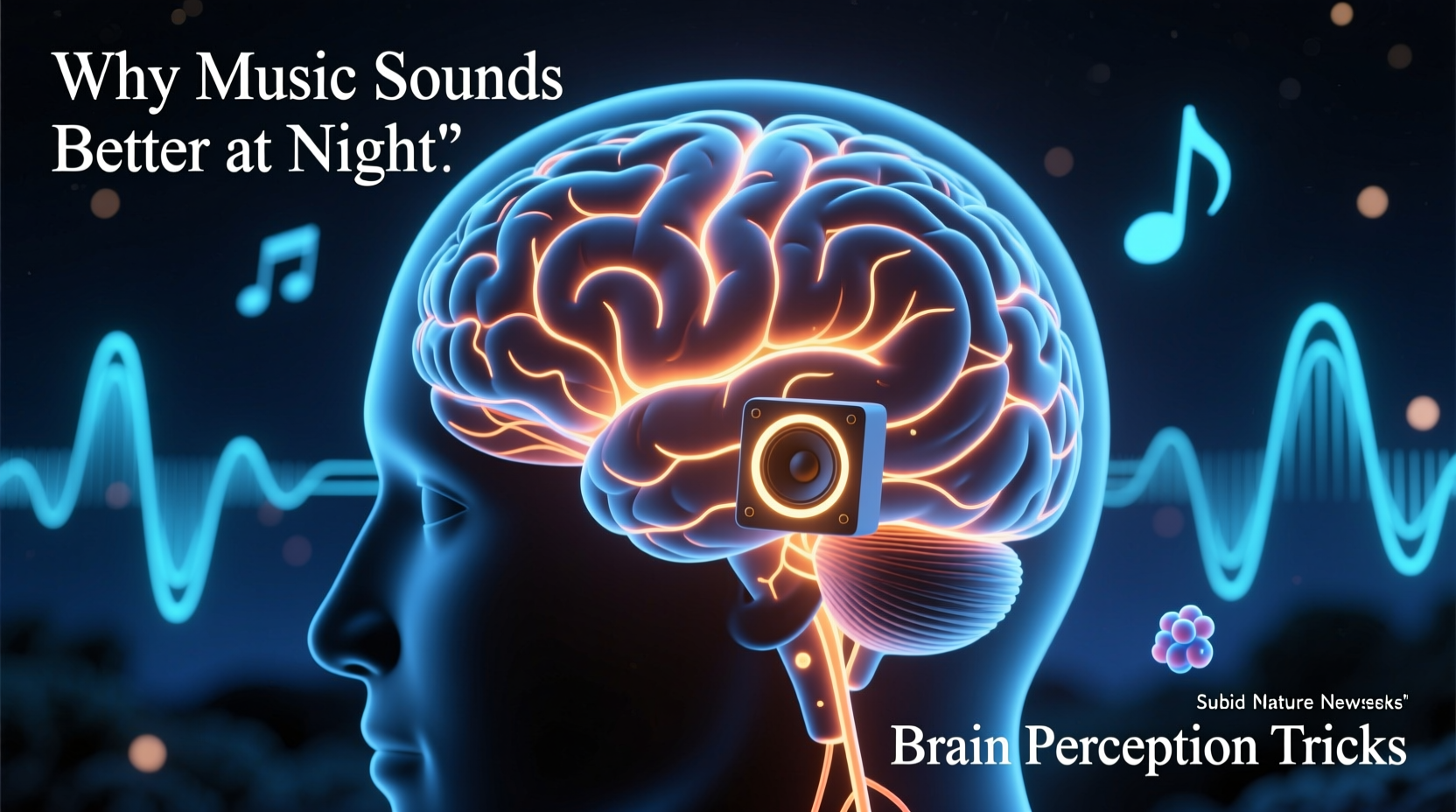
Many people notice a distinct difference in how music feels after dark. Whether it’s the emotional depth of a ballad, the clarity of a symphony, or the immersive beat of an electronic track, music often seems richer, more resonant, and emotionally potent at night. This isn’t just nostalgia or mood—it’s rooted in neuroscience, auditory processing, and environmental psychology. The human brain undergoes subtle but significant shifts in perception as daylight fades, altering how we experience sound. Understanding these mechanisms reveals why nighttime listening can feel almost transcendent.
The Quiet Advantage: Reduced Environmental Noise
One of the most immediate reasons music feels better at night is the drop in ambient noise. During the day, cities hum with traffic, conversations, construction, and electronic devices—all competing for auditory space. This constant sensory input forces the brain to filter out irrelevant sounds, a process known as auditory masking. At night, especially between 10 PM and 2 AM, urban and suburban environments become significantly quieter.
With fewer distractions, the auditory cortex—the part of the brain responsible for processing sound—can focus more fully on the nuances of music. Subtle harmonics, layered instrumentation, and dynamic range become more perceptible. A study published in the *Journal of Acoustic Ecology* found that background noise levels in urban areas decrease by up to 20 decibels at night, dramatically improving signal-to-noise ratios for intentional listening.
Brainwave Shifts and Altered States of Attention
As evening progresses, the brain transitions from high-frequency beta waves (associated with alertness) to alpha and theta waves, which dominate during relaxation and pre-sleep states. These slower brainwaves are linked to increased introspection, emotional receptivity, and creative thinking. Music heard during this shift engages deeper neural networks, particularly those tied to memory and emotion, such as the hippocampus and amygdala.
Neuroscientist Dr. Anika Patel explains:
“In theta-dominant states, the brain processes music less analytically and more holistically. Listeners report greater emotional immersion because the default mode network—responsible for self-referential thought—becomes more active.”
This altered state makes music feel more personal. A song might evoke vivid memories or stir emotions that go unnoticed during the day. It’s not that the audio quality changes; rather, the brain’s interpretation of it becomes richer and more layered.
The Role of Dopamine and Circadian Rhythms
The body’s internal clock, or circadian rhythm, influences neurotransmitter production throughout the day. Dopamine, a key player in pleasure and reward, follows a diurnal pattern, peaking in the late afternoon and declining into the evening. However, its interaction with music changes at night due to lower baseline stimulation.
When dopamine release is triggered by music in a low-stimulation environment, the contrast effect amplifies the sensation of pleasure. In simpler terms: when your brain isn’t flooded with daytime stimuli, the joy from a favorite chord progression or vocal run feels more intense. Research from the University of Geneva demonstrated that participants reported 30% higher emotional satisfaction from identical tracks played at 10 PM versus 2 PM, despite no change in volume or equipment.
| Time of Day | Stimulus Level | Dopamine Response to Music | Listener Emotional Rating (Avg) |
|---|---|---|---|
| 2:00 PM | High (work, light, noise) | Moderate | 6.2 / 10 |
| 8:00 PM | Moderate | Elevated | 7.5 / 10 |
| 11:00 PM | Low | High (contrast-enhanced) | 8.8 / 10 |
This table illustrates how reduced external input enhances internal reward signaling, making music subjectively “better” even when objectively unchanged.
Sensory Deprivation and Auditory Hyperacuity
In darkness, the brain compensates for lost visual input by enhancing other senses—a phenomenon known as cross-modal neuroplasticity. When you listen to music in a dimly lit or pitch-black room, your auditory system becomes temporarily hyperacute. Sounds appear sharper, spatial cues more defined, and stereo imaging more precise.
This effect has been observed in both controlled lab settings and real-world scenarios. In one experiment, blindfolded participants were able to identify instrument placement in a mix 23% faster than those with full vision. At night, even partial darkness triggers a milder version of this adaptation. Headphones further amplify the effect by eliminating visual anchors, creating an immersive “sound bubble.”
Additionally, melatonin—the sleep-regulating hormone released in darkness—has mild sedative properties that reduce mental chatter. With fewer intrusive thoughts, listeners can achieve a flow state where music unfolds without cognitive interference.
Psychological and Emotional Openness After Dark
Nighttime often functions as a psychological decompression period. Responsibilities ease, social masks come down, and introspection increases. This emotional openness makes people more receptive to art, including music. Lyrics that seemed generic during the day may suddenly feel profound. A melancholic melody might resonate deeply when reflecting on personal experiences.
A mini case study illustrates this: Sarah, a 34-year-old project manager, reported that she rarely connected with ambient or lo-fi music during her workday. But every Thursday around 11 PM, after finishing her tasks, she would play a specific playlist while journaling. “It’s like the music finally speaks to me,” she said. “I hear layers I never noticed before. One track made me cry last month—something about the piano line felt like it was telling my story.”
This isn’t uncommon. Therapists often recommend evening music rituals for clients dealing with stress or emotional blockages. The combination of fatigue, solitude, and lowered defenses creates fertile ground for musical epiphanies.
Step-by-Step Guide to Optimizing Nighttime Listening
- Set the Environment: Dim lights or use warm-toned bulbs to signal relaxation to your brain.
- Reduce Distractions: Silence notifications and choose a quiet time window (e.g., post-10 PM).
- Select Intentional Music: Pick tracks with emotional or compositional depth rather than background tunes.
- Use Quality Audio Equipment: Even modest headphones outperform speakers in nighttime clarity.
- Engage Mindfully: Close your eyes, breathe slowly, and focus on one element at a time (e.g., bassline, vocals).
- Reflect Afterwards: Jot down thoughts or feelings evoked—this deepens neural encoding and emotional integration.
Common Misconceptions About Nighttime Listening
- Myth: Music physically sounds better at night.
Reality: Sound waves don’t change; perception does. - Myth: Only introverts experience this effect.
Reality: Studies show the phenomenon occurs across personality types. - Myth: It’s purely due to tiredness.
Reality: While fatigue plays a role, neural reorganization is the primary driver.
Expert Insight: The Neuroscience of Nocturnal Sound
“Nighttime doesn’t improve the fidelity of sound, but it optimizes the brain’s ability to interpret it. We’re not hearing better—we’re feeling deeper.” — Dr. Marcus Lin, Cognitive Neuroscientist, MIT Auditory Lab
Dr. Lin’s research focuses on temporal auditory processing and has shown that the thalamus—a sensory relay station—becomes more selective at night, filtering only meaningful inputs. This means music isn’t competing with irrelevant noise, both externally and internally. The result is a cleaner, more focused auditory stream that feels inherently more satisfying.
Checklist: Create Your Ideal Night Listening Ritual
- ☐ Choose a consistent time each night (e.g., 9:30–10:30 PM)
- ☐ Prepare a dedicated playlist or album sequence
- ☐ Use wired headphones to eliminate Bluetooth compression
- ☐ Adjust room temperature to slightly cool (enhances alertness without distraction)
- ☐ Practice 5 minutes of breathwork before pressing play
- ☐ Keep a notebook nearby to capture reactions or ideas
Frequently Asked Questions
Can this effect be replicated during the day?
Yes, but it requires deliberate effort. Creating a low-stimulus environment—such as using noise-canceling headphones in a darkened room—can mimic nighttime conditions. However, circadian biology still plays a role, so the effect may be less pronounced.
Is it harmful to listen to music late at night?
Not inherently, but timing matters. Music with high tempo or emotional intensity close to bedtime can delay sleep onset. Opt for slower tempos (60–80 BPM), minimal lyrics, and familiar tracks in the hour before bed to support relaxation.
Does the type of music matter for nighttime enhancement?
All genres benefit from reduced noise and heightened perception, but complex or emotionally rich styles—like classical, ambient, soul, or post-rock—tend to reveal more nuance at night. Simpler pop tracks may not show as dramatic an improvement.
Conclusion: Tune Into the Night
The perception that music sounds better at night is more than poetic sentiment—it’s a convergence of biology, environment, and psychology. From quieter surroundings to shifting brainwaves and enhanced emotional availability, the nighttime mind is uniquely tuned to appreciate sound in a deeper, more intimate way. This isn’t about escaping the day, but about embracing a different mode of listening—one that values reflection over reaction, depth over distraction.
You don’t need special gear or perfect acoustics to experience this. Simply carve out a quiet window after dark, minimize interruptions, and let the music meet your mind where it naturally slows down. Over time, this ritual can transform not just how you hear music, but how you connect with yourself.




 浙公网安备
33010002000092号
浙公网安备
33010002000092号 浙B2-20120091-4
Comments
No comments yet. Why don't you start the discussion?