
It happens to nearly everyone: a song comes on the radio, and suddenly you’re transported. You can smell the perfume of your first love, feel the sticky vinyl seat of your childhood car, or hear the laughter at a long-ago party. Music has an uncanny ability to pull us back in time, evoking emotions and memories with startling clarity. But why? What is it about sound, rhythm, and melody that makes them so deeply intertwined with our past? The answer lies not in magic, but in neuroscience, psychology, and the unique way our brains process music.
Unlike most sensory inputs, music doesn’t follow a single path through the brain. It’s processed across multiple regions simultaneously—auditory cortex, limbic system, hippocampus, prefrontal cortex—and this widespread engagement is precisely what gives music its powerful mnemonic properties. This article explores the science behind music-triggered memories, explains why certain songs stick with us for decades, and reveals practical ways to harness this connection for emotional well-being and cognitive health.
The Brain's Musical Network
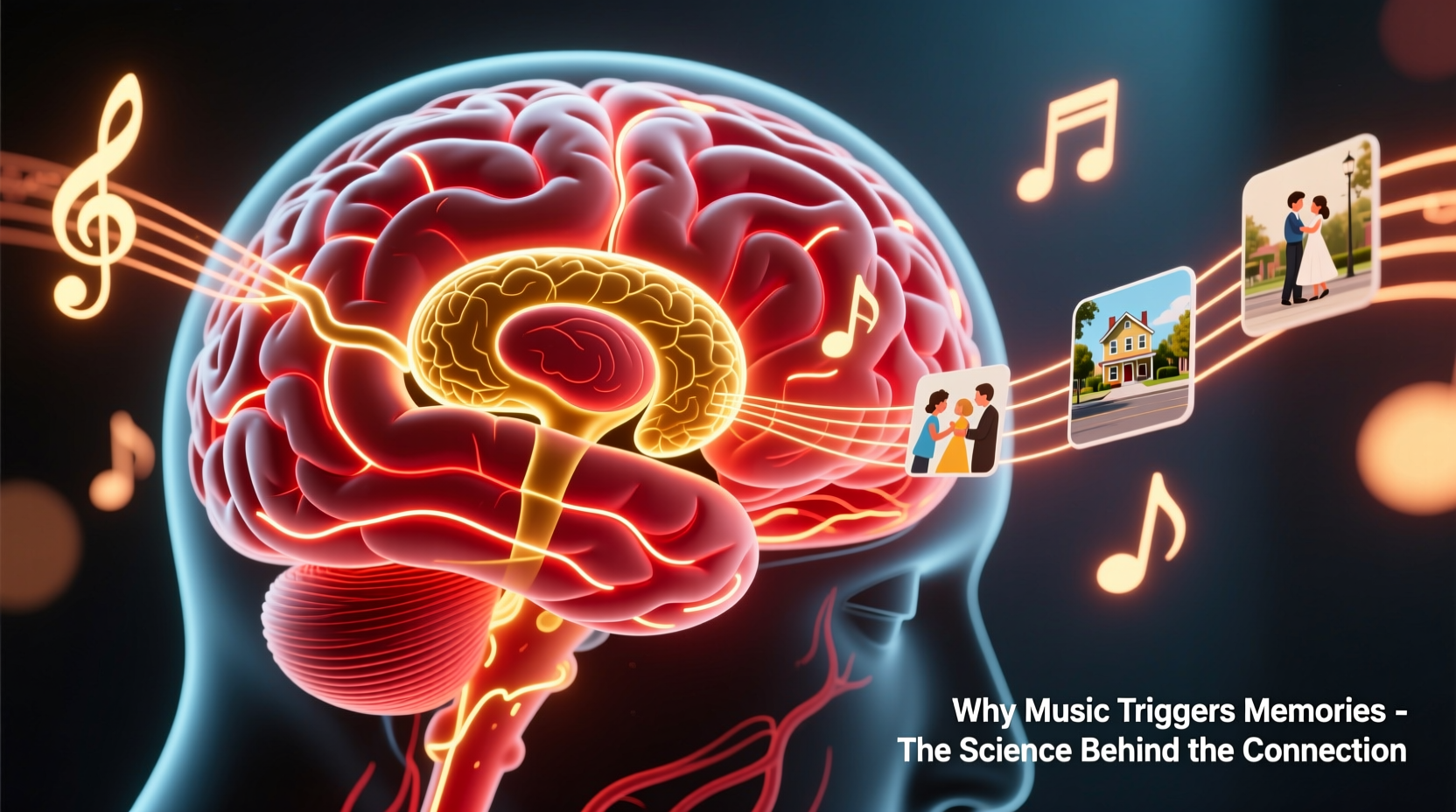
When we listen to music, our brains light up like a symphony of electrical activity. Sound waves enter the ears and are converted into neural signals that travel to the auditory cortex, where pitch, rhythm, and timbre are decoded. But music doesn’t stop there. It quickly spreads to other critical areas:
- Hippocampus – Central to memory formation and retrieval, especially autobiographical memories.
- Amygdala – Processes emotions, particularly those tied to fear, joy, and nostalgia.
- Nucleus accumbens – Involved in reward processing; releases dopamine when we hear pleasurable music.
- Prefrontal cortex – Engages in higher-level interpretation, such as recognizing lyrics or anticipating musical patterns.
This multi-region activation creates a rich neural tapestry. When a piece of music is linked to a significant life event—your wedding song, a breakup ballad, the anthem of your high school years—the entire network fires together. Later, hearing that same song reactivates the same pattern, effectively \"replaying\" not just the sound, but the emotional and contextual memory associated with it.
“Music accesses parts of the brain that remain intact even in advanced dementia. It’s one of the last things people lose.” — Dr. Oliver Sacks, neurologist and author of *Musicophilia*
Why Music Is a Superior Memory Trigger
Compared to other stimuli—smells, photos, or written words—music often elicits more vivid and emotionally charged recollections. Several factors contribute to this superiority:
Temporal Structure and Predictability
Music unfolds over time, creating a narrative arc. Our brains are wired to anticipate what comes next—a rising chord, a lyrical pause, a drum fill. This predictive engagement strengthens memory encoding. When we later hear the same sequence, our brain recognizes the pattern and retrieves the context in which it was first experienced.
Emotional Resonance
Music bypasses rational thought and speaks directly to emotion. A sad melody can make us tear up even if we don’t understand the lyrics. Because emotions enhance memory consolidation, emotionally charged music becomes deeply embedded in our neural circuitry. Studies show that people remember songs from their teenage and early adult years more vividly than any other period—a phenomenon known as the “reminiscence bump.”
Multisensory Association
Music rarely exists in isolation. We usually hear it during events: dancing at a prom, driving cross-country, working out at the gym. These concurrent sensory inputs—sights, smells, physical sensations—get woven into the memory. When the music plays again, it acts as a key that unlocks the entire sensory package.
The Role of the Hippocampus and Autobiographical Memory
The hippocampus, a seahorse-shaped structure deep within the brain, is essential for forming new memories and retrieving old ones. It’s particularly active during episodes of autobiographical recall—memories of personal experiences tied to time, place, and emotion. Research using fMRI scans shows that when people listen to familiar music from their youth, the hippocampus activates alongside emotional centers.
A 2015 study published in *Neuropsychologia* found that participants could recall significantly more details about past events when cued by music compared to verbal prompts. The researchers concluded that music serves as a “super-retrieval cue,” capable of accessing memories that might otherwise remain dormant.
This effect is especially pronounced in individuals with Alzheimer’s disease and other forms of dementia. Even when patients struggle to recognize family members or recall recent events, they may still sing along to songs from their youth. Music therapy is now widely used in care homes to reduce agitation, improve mood, and stimulate conversation among residents.
Case Study: Henry’s Transformation Through Music
In the acclaimed documentary *Alive Inside*, we meet Henry, a man in late-stage dementia who barely speaks or responds to his environment. When caregivers play his favorite Cab Calloway records through headphones, something remarkable happens. His eyes open wide, he begins singing, tapping his foot, and sharing stories about his life. “The music opens me up,” he says. “It gives me the meaning of life.”
Henry’s response isn’t anecdotal fluke—it reflects real neuroplasticity. While dementia damages many brain pathways, the auditory and emotional networks activated by music often survive longer. For patients like Henry, music becomes a bridge back to selfhood.
How Memories Are Formed and Reawakened by Music
Memory formation occurs in three stages: encoding, storage, and retrieval. Music enhances all three:
- Encoding: When we experience something meaningful while listening to music (e.g., falling in love during a road trip with a certain album), the emotional intensity strengthens the encoding process.
- Storage: The memory becomes consolidated during sleep, with the hippocampus replaying the experience and integrating it into long-term storage.
- Retrieval: Hearing the same music later triggers a cascade of neural activity that reconstructs the original memory, including sights, sounds, and feelings.
This retrieval isn’t always accurate—our brains fill in gaps based on expectation and emotion—but it feels real because the emotional core remains intact. That’s why a song can make you cry even if you can’t quite remember the exact circumstances in which you first heard it.
Timeline of a Music-Memory Event
| Time | Event | Brain Activity |
|---|---|---|
| Age 16 | Hear \"Mr. Brightside\" at first dance | Hippocampus encodes event; amygdala tags with excitement |
| Age 20 | Hear song at friend’s party | Memory reinforced; additional context added |
| Age 35 | Song plays unexpectedly in supermarket | Hippocampus retrieves full memory network; emotion resurfaces |
| Age 70 | Hear song in nursing home | Limbic system activates despite cognitive decline |
Practical Applications: Using Music to Enhance Well-Being
Understanding the science behind music and memory isn’t just intellectually fascinating—it has real-world applications. Whether you want to preserve cherished moments, support aging loved ones, or improve mental health, music can be a powerful tool.
Checklist: Building a Personal Memory Soundtrack
- Identify key life periods (e.g., college, first job, parenthood)
- Recall songs that were popular or personally meaningful during those times
- Create playlists labeled by era or theme (e.g., “Summer 2003,” “Heartbreak Songs”)
- Add notes about where you heard each song or what it reminds you of
- Listen periodically to reinforce memory connections
- Share playlists with family to spark intergenerational conversations
Do’s and Don’ts of Music-Based Memory Recall
| Do | Don't |
|---|---|
| Use familiar music to calm anxiety or stress | Force someone to listen to music they dislike |
| Pair music with journaling to deepen reflection | Assume all emotional reactions are positive—some songs may trigger trauma |
| Introduce nostalgic music to older adults gently | Play loud or chaotic music in sensitive environments |
| Explore forgotten genres to uncover hidden memories | Overuse the same songs—variety keeps the brain engaged |
“The brain loves patterns, and music is structured pattern. That structure helps organize memory.” — Dr. Aniruddh Patel, cognitive neuroscientist and expert in music cognition
Frequently Asked Questions
Why do certain songs bring back memories more than others?
Songs that were present during emotionally intense, novel, or repetitive experiences tend to form stronger memory links. Adolescence and early adulthood are peak periods for music-related memory formation due to heightened emotional sensitivity and identity development.
Can unfamiliar music also trigger memories?
Rarely in the same way. While new music can evoke general moods or imagery, it lacks the personal history needed for autobiographical recall. However, instrumental pieces with strong emotional arcs (e.g., film scores) may activate generic memory templates or imagined scenarios.
Is it possible to forget a song-linked memory?
Yes, especially if the memory wasn’t emotionally significant or if the song hasn’t been heard in decades. However, even “forgotten” memories can sometimes be partially revived with repeated exposure, particularly in therapeutic settings.
Conclusion: Harness the Power of Your Playlist
The connection between music and memory is one of the most profound features of human cognition. It transcends language, withstands neurological decline, and connects us to our past selves in ways few other stimuli can. By understanding the science behind this link, we gain more than knowledge—we gain agency. We can curate soundtracks that uplift us, comfort us, and remind us who we’ve been and who we still are.
Start today. Dig into your old playlists. Ask your parents about the songs that shaped their youth. Create a memory jar where you note down the story behind each meaningful track. Music isn’t just entertainment; it’s a living archive of your life. Treat it with intention, and let it guide you back to moments worth remembering.




 浙公网安备
33010002000092号
浙公网安备
33010002000092号 浙B2-20120091-4
Comments
No comments yet. Why don't you start the discussion?