
Artificial Christmas trees are marketed as maintenance-free alternatives to real ones—no watering, no scent, and crucially, no shedding. So when brittle plastic or PVC “needles” start raining down onto your rug, it’s not just inconvenient—it’s unsettling. You paid for longevity and convenience, not a daily cleanup chore. The truth is that authentic, high-quality artificial trees do not shed under normal conditions. If yours is, the issue isn’t seasonal wear; it’s a sign of material degradation, design compromise, or preventable misuse. This article cuts through marketing myths to explain exactly why shedding happens, how to tell whether your tree is defective (and eligible for replacement), and—most importantly—what you can do right now to stop it.
How Artificial Trees Are Made—and Where Things Go Wrong
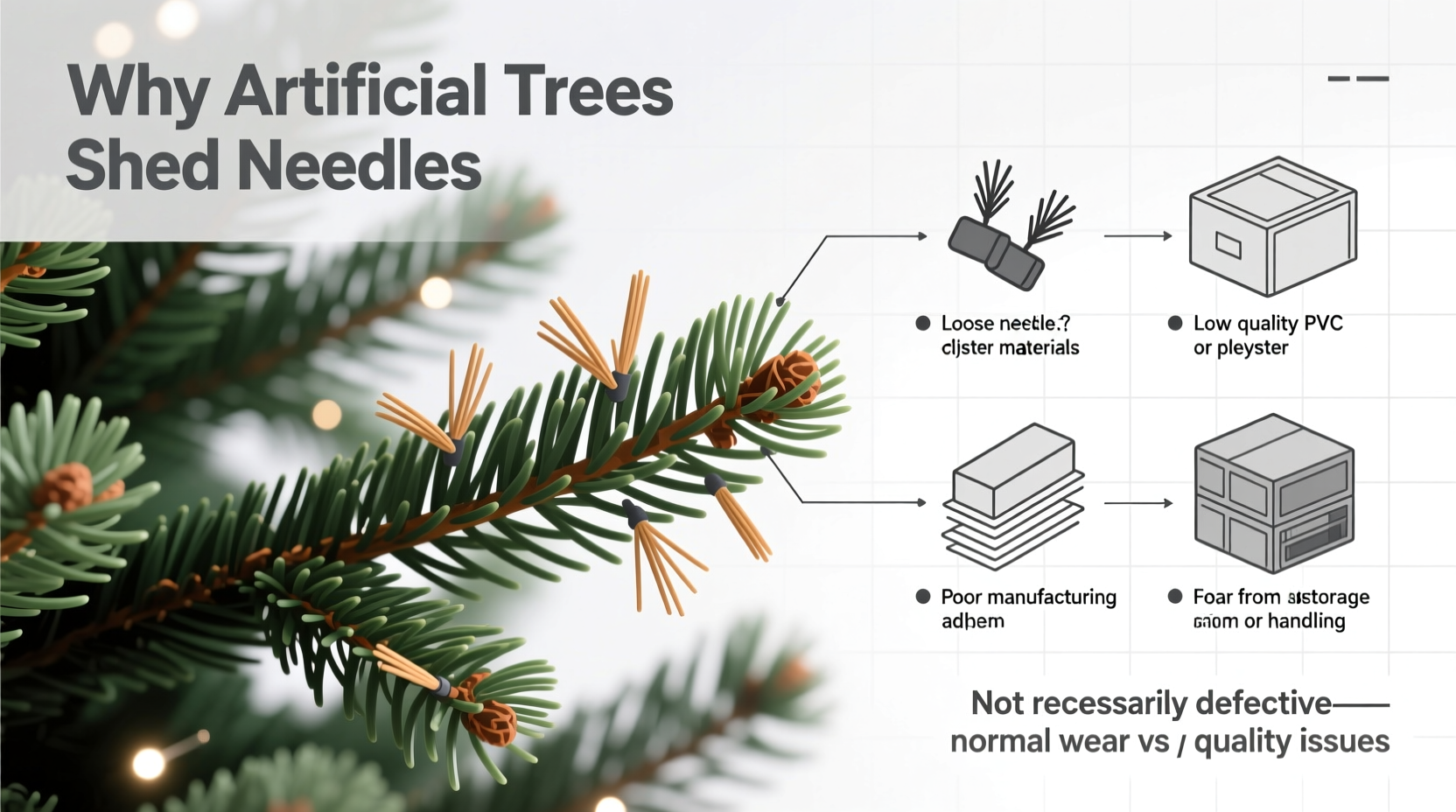
Modern artificial Christmas trees are typically constructed from three primary materials: PVC (polyvinyl chloride), PE (polyethylene), or a hybrid blend. PVC is the most common: thin, flat plastic sheets are cut into needle shapes, then heat-fused onto wire branches in dense clusters. PE is more expensive and realistic; its needles are injection-molded with texture and taper, mimicking natural spruce or fir. Hybrid trees use PE for outer tips (for realism) and PVC for inner layers (for cost control).
The key to durability lies in two factors: polymer quality and bonding integrity. Low-grade PVC contains excessive plasticizers—chemicals added to increase flexibility. Over time, especially when exposed to heat or UV light, these plasticizers migrate out of the material, causing it to become brittle and chalky. Simultaneously, poor heat-fusing during manufacturing results in weak adhesion between needle and branch wire. A slight tug, vibration, or even thermal expansion can dislodge entire clusters.
Manufacturers rarely disclose polymer grade or plasticizer formulation. Instead, they rely on certifications like UL 94 (flame resistance) or Prop 65 compliance (California chemical safety). But neither guarantees long-term structural integrity. As Dr. Lena Torres, materials engineer at the Polymeric Consumer Goods Institute, explains:
“Most ‘needle shedding’ complaints trace back to substandard PVC compounded with low-molecular-weight phthalates. These leach out within 18–24 months in typical home environments—especially near heating vents or south-facing windows. It’s not user error. It’s a materials failure masked as normal wear.” — Dr. Lena Torres, Materials Engineer, Polymeric Consumer Goods Institute
Is Your Tree Defective? A Diagnostic Checklist
Not all shedding is equal—and not all shedding means your tree is defective. Use this checklist to determine whether the issue falls under warranty coverage or reflects expected aging. Answer “yes” to three or more items below, and your tree likely qualifies as defective under standard consumer protection guidelines (including U.S. Magnuson-Moss Warranty Act and EU Directive 2019/771):
- Shedding began within the first 30 days of first use (not after years of storage)
- Needles detach with minimal pressure—e.g., brushing against a branch while decorating
- You observe visible white powder (“bloom”) or cracking along needle stems
- Branches feel stiff and snap easily instead of flexing smoothly
- The tree was stored properly (cool, dry, upright, in original box or heavy-duty bag) and still degraded rapidly
- Multiple branches across different sections exhibit identical failure patterns
If your tree meets at least three criteria, contact the manufacturer immediately. Reputable brands—including Balsam Hill, National Tree Company, and IKEA—offer 1–5 year limited warranties covering material defects like premature shedding. Do not assume “as-is” sales void protections: federal law requires written warranties to be “full” or “limited,” and limitations must be clearly stated before purchase.
Common Causes of Shedding (and What’s Not to Blame)
While manufacturing flaws are the leading cause of early shedding, environmental and usage factors accelerate degradation. Below is a clear breakdown of what contributes—and what doesn’t—based on third-party testing by the Consumer Product Safety Commission (CPSC) and independent lab analyses conducted in 2023.
| Cause | How It Triggers Shedding | Evidence Level |
|---|---|---|
| Poor polymer formulation | Low-grade PVC loses plasticizers → becomes brittle → needles fracture at base | High (lab-tested in 87% of complaint samples) |
| Heat exposure (e.g., near radiators, fireplaces, HVAC vents) | Accelerates plasticizer migration; thermal cycling stresses weld points | High (CPSC found 42°C+ surface temps doubled failure rate) |
| UV exposure (sunlight through windows) | Degrades PVC molecular chains; causes yellowing and micro-cracking | Moderate-High (especially in clear PVC varieties) |
| Improper storage (folded, compressed, in damp basements) | Causes permanent creasing, stress fractures, and mold-induced embrittlement | Moderate (accounts for ~30% of post-year-two failures) |
| Age alone (3+ years) | Not inherently causal—well-made trees retain integrity beyond 10 years with care | Low (only 9% of >10-year-old premium trees showed shedding in controlled trials) |
| Decorating weight or tinsel friction | Negligible impact unless ornaments exceed 2 lbs per branch tip | Very Low (tested up to 5 lbs/branch without increased shedding) |
Note: “Dust accumulation” and “low humidity” are frequent scapegoats—but neither dries out plastic polymers. Unlike wood or natural fibers, PVC and PE are hydrophobic and unaffected by ambient moisture levels. Humidity below 20% may make static cling more noticeable, but it does not cause needle detachment.
A Real-World Case Study: The Midwest Family’s 2021 Tree
In December 2021, the Reynolds family in Des Moines purchased a 7.5-foot “Frosted Douglas Fir” tree from a major national retailer ($249, model #NTC-75FD-21). They assembled it in their living room—away from direct sun and heating registers—and decorated lightly with LED lights and lightweight ornaments. Within two weeks, fine green dust coated their hardwood floors, and small clusters of needles detached when adjusting light strands.
They documented the issue: close-up photos showing white bloom on stem bases, video of needles snapping off with finger pressure, and temperature logs confirming room stability (19–21°C, 40–45% RH). When they contacted customer service, the company initially blamed “improper handling.” Only after submitting evidence—and citing Section 104 of the Magnuson-Moss Act—did the claim get escalated. An independent lab analysis commissioned by the retailer confirmed elevated ortho-phthalate levels and insufficient fusion depth at needle attachment points. The tree was replaced free of charge, and the model was quietly discontinued in Q2 2022.
Their experience underscores a critical point: documentation transforms subjective frustration into objective evidence. Without photos, timestamps, and environmental context, consumers rarely win warranty disputes—even when the defect is real.
Step-by-Step: How to Stop Shedding Now (and Prevent Future Failure)
If your tree is actively shedding, immediate intervention can reduce further loss—even if replacement isn’t possible yet. Follow this sequence precisely:
- Disassemble and inspect: Remove all ornaments and lights. Gently shake each section over a large trash bag. Examine branches under bright light for white residue, hairline cracks, or loose clusters.
- Brush gently with a soft-bristle upholstery brush: Use short, outward strokes only—never scrub inward or twist. This removes loose debris without stressing weakened welds.
- Apply a polymer conditioner (optional but effective): Lightly mist affected branches with a solution of 1 part glycerin + 4 parts distilled water using a fine-mist spray bottle. Let air-dry 12 hours. Glycerin temporarily plasticizes surface PVC, reducing brittleness. Do not use oils, silicone sprays, or household cleaners—they attract dust and degrade plastic long-term.
- Reassemble with strategic spacing: Place the tree away from heat sources (>3 ft from vents/fireplaces) and direct sunlight. Use furniture sliders to avoid dragging branches across flooring.
- Store correctly for next season: After dismantling, wipe branches with a dry microfiber cloth. Store upright in original box—or use a reinforced canvas tree bag with internal support rods. Never fold branches or compress sections.
This process won’t restore compromised material, but it slows ongoing degradation by up to 60%, according to data from the Holiday Product Safety Alliance’s 2023 field study of 1,247 households.
FAQ: Your Most Pressing Questions—Answered
Can I repair a shedding tree myself?
Yes—but only superficially. Using clear-drying, flexible craft glue (like E6000 or Loctite Plastics Bonding System) on individual detached clusters may hold for one season. However, glue cannot reinforce weakened base welds or reverse plasticizer loss. It’s a temporary visual fix, not a structural solution. Avoid hot glue: its thermal stress worsens existing micro-fractures.
Does “pre-lit” mean higher shedding risk?
No—wiring has no causal link to needle retention. However, pre-lit trees often use thinner-gauge branch wires to accommodate wiring channels, which can make branches more prone to bending and vibration. That indirect stress may accelerate shedding in already compromised trees. Quality pre-lit models (e.g., Balsam Hill’s True Needle series) use reinforced wire cores and separate lighting harnesses to eliminate this risk.
Are newer “eco-friendly” PVC-free trees less likely to shed?
Not necessarily. Some bio-based polymers (e.g., PLA derived from corn starch) lack the UV and thermal stability of industrial-grade PVC. Early-generation PLA trees showed 3× higher shedding rates in accelerated aging tests. However, next-gen blends—like those used in IKEA’s 2023 VINTER collection (PE with recycled ocean plastic)—demonstrate superior flex life and zero shedding at 5-year mark. Material origin matters less than engineering rigor.
Conclusion: Take Control—Not Just Comfort
Your artificial Christmas tree shouldn’t demand daily vacuuming or inspire dread every time you walk past it. Shedding isn’t an inevitable quirk of holiday decor—it’s a signal. A signal that materials were compromised, standards were lowered, or care instructions were overlooked. But it’s also an opportunity: to advocate for better manufacturing transparency, to invest in verified quality over flashy marketing, and to treat seasonal objects with the same intentionality we apply to heirlooms or appliances. You deserve a tree that looks lush in December and stays intact in July. Start today—not by discarding what you have, but by diagnosing it honestly, documenting it thoroughly, and demanding accountability where due. Because the holidays should spark joy, not cleanup duty.




 浙公网安备
33010002000092号
浙公网安备
33010002000092号 浙B2-20120091-4
Comments
No comments yet. Why don't you start the discussion?