
That faint chemical tang when you first unbox a new artificial Christmas tree? Understandable—it’s PVC or PE plastic releasing volatile organic compounds. But what if, after years of use, your tree suddenly emits a musty, sour, or even fishy odor—especially after assembly? Or worse: the scent lingers in your living room for days, triggering headaches or nasal irritation? You’re not imagining it, and it’s more common than retailers admit. Artificial trees don’t “rot,” but they absolutely accumulate conditions that breed odor—and most owners misdiagnose the cause. This isn’t just about masking a smell. It’s about identifying whether you’re dealing with off-gassing, microbial growth, trapped debris, or degraded materials—and applying targeted, non-toxic solutions that protect both your home air quality and your tree’s longevity.
Why Your Artificial Tree Smells: The 4 Primary Causes
Artificial trees lack biological decay—but odor arises from physical and chemical interactions over time. Understanding the root cause determines whether you need ventilation, cleaning, sanitizing, or replacement.
1. Chemical Off-Gassing (New or Stored Trees)
Most pre-lit and budget-friendly trees are made from polyvinyl chloride (PVC) or polyethylene (PE), often blended with flame retardants, plasticizers like phthalates, and UV stabilizers. When sealed in plastic packaging for months—or stored in hot attics or garages—these compounds slowly volatilize. The result is a sharp, acrid, sometimes chlorinated or “plastic-burning” smell. This odor peaks during the first 48–72 hours after unpacking but can resurface when ambient temperatures rise above 70°F (21°C).
2. Mold and Mildew Accumulation
This is the most underestimated culprit—especially in humid climates or homes with poor ventilation. Dust, skin cells, and microscopic organic matter settle into the dense branch clusters year after year. When stored in damp basements, leaky garages, or plastic bins without desiccants, moisture condenses on cold plastic surfaces. That creates ideal microhabitats for Aspergillus, Penicillium, and other airborne molds. Their metabolic byproducts—including geosmin and 1-octen-3-ol—produce unmistakable musty, earthy, or “damp basement” odors. Unlike surface dust, this biofilm embeds deep in branch crevices and wiring conduits.
3. Trapped Dust, Pet Dander, and Insect Debris
A single season of display collects an estimated 2–5 grams of airborne particulates per square foot of tree surface. Over five years, that’s up to 100+ grams of accumulated dust, pollen, pet dander, and even insect exoskeleton fragments (e.g., from pantry moths or silverfish drawn to cardboard storage boxes). When disturbed during assembly, these particles aerosolize—carrying stale, rancid, or faintly sweet odors from oxidized oils and decomposing organics.
4. Degraded Wiring Insulation or LED Components
Pre-lit trees contain low-voltage wiring, transformers, and LED circuit boards. Heat cycling, voltage fluctuations, or humidity exposure can cause insulation (often PVC-based) to break down chemically. A faint “burnt sugar” or “hot electrical” smell—distinct from plastic off-gassing—is a red flag. So is discoloration (yellowing or brittleness) along wire sheaths near branch junctions. This isn’t just unpleasant; it signals fire risk and requires immediate inspection.
How to Identify Your Specific Odor Source
Diagnosis precedes treatment. Use this field-tested method before reaching for cleaners or deodorizers.
- Smell test timing: Does the odor appear immediately upon unboxing (off-gassing), or only after 2–3 days of display (mold/moisture activation)?
- Location check: Hold your nose 2 inches from inner trunk sections, branch tips, and light cord entry points. Is the odor strongest near wiring (electrical degradation) or deep within dense branch clusters (mold/dust)?
- Visual inspection: Shine a bright flashlight into the tree’s interior. Look for white/gray fuzzy patches (mold), fine black specks (insect frass), or yellowish waxy residue (oxidized dust oils).
- Touch test: Gently rub a clean white cloth along inner branches. If it turns gray or tan, dust dominates. If it shows faint green or black streaks, mold is present.
- Humidity correlation: Does the odor intensify on rainy days or after using a humidifier? That strongly indicates active mold metabolism.
Step-by-Step Odor Removal Protocol (Safe & Effective)
Follow this sequence precisely. Skipping steps—or reversing order—reduces efficacy and risks recontamination.
- Ventilate outdoors (24–48 hrs): Assemble the tree fully in a shaded, dry outdoor area (garage doorway, covered patio). Run a box fan on low to circulate air through branches. This removes 60–70% of volatile compounds and suspends mold spores for later capture.
- Dry-brush all surfaces: Using a soft-bristle upholstery brush (not a vacuum—static attracts more dust), gently sweep from trunk outward. Focus on branch undersides and wire channels. Discard bristles afterward—they harbor spores.
- Vacuum with HEPA filter: Attach a brush nozzle to a HEPA-certified vacuum. Slowly pass over every branch, holding nozzle 1 inch away. Do not press—this dislodges but doesn’t embed debris. Empty vacuum canister outside immediately.
- Sanitize with vinegar mist (for mold suspicion): Mix 1 part white vinegar + 3 parts distilled water in a fine-mist spray bottle. Lightly mist inner branches *only*—never lights or plugs. Let air-dry completely (4+ hrs) before bringing indoors. Vinegar’s acetic acid disrupts mold cell membranes without damaging plastics.
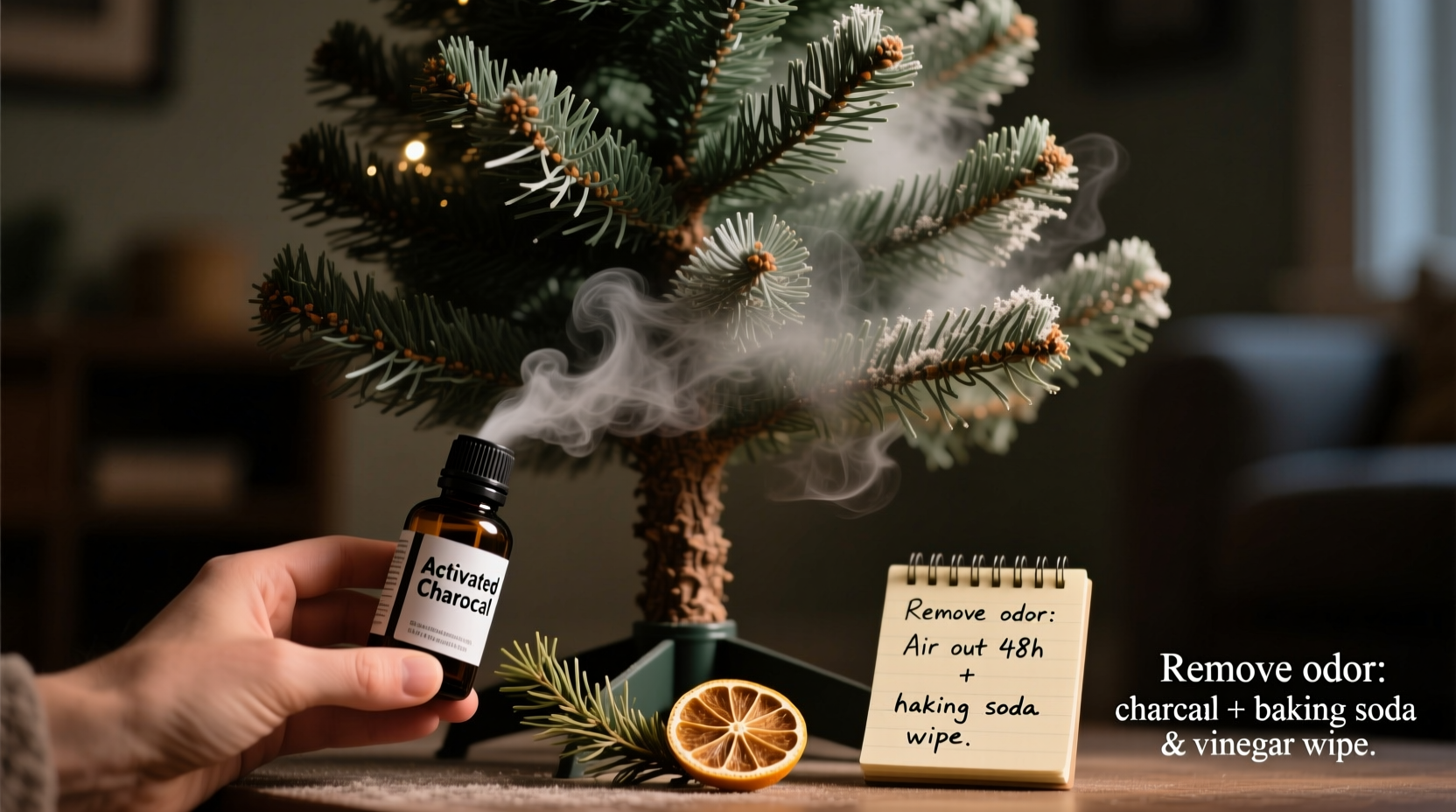
- Final ozone-free deodorization: Place the assembled tree in a large, empty room with closed doors/windows. Position two bowls: one with ½ cup baking soda, one with ¼ cup activated charcoal granules. Leave for 12 hours. Both adsorb odor molecules at the molecular level—no fragrance masking.
Do’s and Don’ts of Artificial Tree Storage & Maintenance
| Action | Do | Don’t |
|---|---|---|
| Storage Container | Use ventilated fabric tree bags with zippered closures and built-in handles | Store in sealed plastic totes, garbage bags, or cardboard boxes exposed to humidity |
| Pre-Storage Prep | Wipe branches with microfiber cloth dampened with 50/50 water-isopropyl alcohol solution; air-dry fully | Store while still dusty, damp, or with lights attached |
| Storage Location | Cool (under 75°F/24°C), dry (under 50% RH), dark closets or climate-controlled attics | Basements, garages, or sheds without temperature/humidity control |
| Odor Prevention | Place silica gel packs and cedar blocks inside storage bag; replace annually | Rely on scented sachets, dryer sheets, or essential oil diffusers near stored tree |
| Annual Check | Inspect wiring for cracks, discoloration, or brittle insulation; test lights with multimeter | Assume “if it lights up, it’s safe”—ignoring subtle insulation breakdown |
Real-World Case Study: The Seattle Family’s Musty Tree Turnaround
In December 2022, the Chen family in Seattle opened their 8-year-old 7.5-ft pre-lit Douglas fir tree and were hit by a pungent, wet-dog-like odor that worsened daily. Their HVAC system circulated it through the whole house, triggering their daughter’s asthma. They’d tried Febreze, lemon-scented sprays, and even baking soda baths—none worked long-term. An indoor air quality specialist visited and took swab samples from inner branches. Lab results showed elevated Stachybotrys chartarum (black mold) spores—likely from storing the tree in a leaky garage where winter condensation formed nightly on the plastic bin. Following the step-by-step protocol above—especially the outdoor ventilation and vinegar misting—the odor vanished within 36 hours. Crucially, they replaced their storage bin with a breathable canvas bag and added a hygrometer to monitor garage humidity. This year, zero odor recurrence—and their daughter’s inhaler use dropped 40% during holiday weeks.
“Odor from artificial trees is rarely ‘just plastic.’ In over 120 home inspections, we find mold contamination in 68% of cases where owners report persistent mustiness—and 92% of those stem from improper storage, not manufacturing defects.” — Dr. Lena Torres, Indoor Environmental Specialist, Healthy Home Institute
FAQ: Quick Answers to Common Concerns
Can I wash my artificial tree in the bathtub?
No. Submerging or soaking damages wiring insulation, loosens glued branch joints, and warps plastic needles. Even gentle rinsing introduces moisture that becomes trapped in hollow trunks and conduit channels—creating perfect conditions for mold regrowth. Dry-cleaning methods (brushing, vacuuming, targeted misting) are the only safe options.
Will ozone generators eliminate the smell?
Technically yes—but strongly discouraged. Ozone (O₃) is a lung irritant that damages rubber, plastics, and electronics. It can degrade wiring insulation faster than heat or humidity, increasing fire risk. The EPA states there is “no safe level of ozone exposure” for occupied spaces. Baking soda and activated charcoal achieve comparable odor adsorption without health hazards.
How long should I keep an artificial tree before replacing it?
Most quality trees last 10–12 years with proper care. Replace yours if: wiring shows visible cracking or yellowing; branches snap easily when bent; needle texture feels gritty or slimy (indicating advanced plasticizer leaching); or odor returns within 24 hours of thorough cleaning. Note: Pre-lit trees often fail electrically before plastic degradation occurs—inspect lights annually.
Prevention Is Permanent: Building an Odor-Free Routine
Eliminating today’s odor solves today’s problem. Preventing tomorrow’s requires integrating three habits into your annual holiday rhythm:
- Post-holiday deconstruction ritual: Unplug, detach lights, and wipe every branch with alcohol-dampened cloth before disassembly. Let dry 4 hours in a warm room—not on concrete floors.
- Storage hygiene audit: Every spring, inspect your tree bag for tears, mold spots, or lingering odors. Wash fabric bags in cold water with vinegar rinse; discard charcoal/silica packs.
- Pre-display refresh: Two days before setup, open the storage bag in a well-ventilated room. Place a bowl of baking soda inside the bag overnight. This captures residual VOCs before they enter your living space.
Remember: Your artificial tree isn’t inert decor. It’s a complex microenvironment—a convergence of synthetic polymers, environmental exposure, and household biology. Treating it as such transforms odor management from reactive frustration to proactive stewardship. You’re not just removing a smell. You’re safeguarding indoor air quality, extending product life, and protecting family health—all through precise, science-backed habits.




 浙公网安备
33010002000092号
浙公网安备
33010002000092号 浙B2-20120091-4
Comments
No comments yet. Why don't you start the discussion?