
It’s a quiet holiday frustration: you’ve invested in a premium artificial Christmas tree—pre-lit, full-bodied, flame-retardant—and within days, your floor is dusted with green plastic fragments. You vacuum, sweep, and sigh. Unlike real trees, which naturally drop needles as they dry, artificial trees have no biological reason to shed. When they do, it’s a sign of material fatigue, manufacturing compromise, or improper handling—not inevitability. This isn’t just cosmetic; persistent shedding signals structural degradation that can shorten your tree’s usable life by years. Understanding why it happens—and what actually works to prevent it—lets you protect both your investment and your sanity.
The Real Causes Behind Fake Needle Shedding
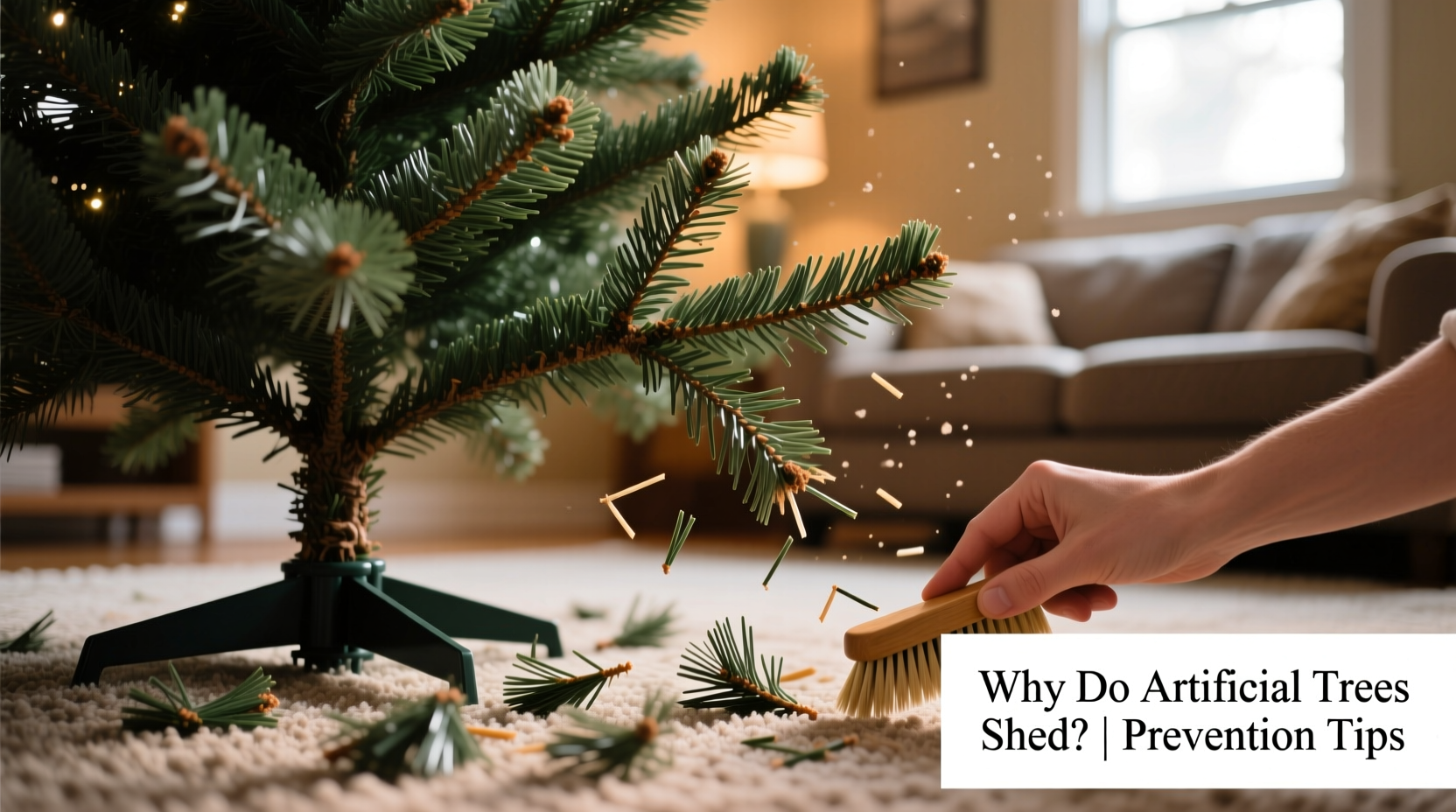
Shedding in artificial trees rarely stems from a single cause. Instead, it’s typically the result of cumulative stressors interacting over time. Most manufacturers use PVC or PE (polyethylene) for branch tips, molded onto wire armatures. The “needles” are not attached individually but formed as part of a continuous frond or injection-molded cluster. Shedding occurs when those clusters detach at their base—either due to poor adhesion during production, thermal expansion/contraction cycles, or mechanical wear.
Three primary drivers account for over 90% of premature shedding cases:
- Material fatigue from repeated assembly/disassembly: Each time branches are bent, twisted, or forced into position, micro-fractures develop along the stem-to-branch joint. Over five to seven seasons, this weakens the bond between the plastic foliage and its metal or plastic support wire.
- Thermal and humidity cycling: Storing a tree in an attic (often >120°F in summer) or damp basement (60%+ RH year-round) accelerates PVC embrittlement. A study by the Polymeric Materials Research Group at NC State found that PVC foliage stored at 85°F and 75% relative humidity lost 40% of its tensile strength after just 36 months—making it prone to snapping off under minimal pressure.
- Poor initial construction quality: Budget-tier trees often use thinner-gauge wire cores and lower-density PVC with insufficient plasticizer content. These materials become brittle faster and lack the flexibility needed to withstand seasonal flexing without fracturing at the node.
Importantly, shedding is rarely caused by “dust” or “static,” as some retailers claim. While static can make loose fragments cling temporarily, it doesn’t generate them. If your tree sheds heavily in its first season, the issue lies in design or manufacturing—not your home environment.
How to Identify Which Cause Is Affecting Your Tree
Before applying remedies, diagnose the root problem. Observe where and how shedding occurs:
| Shedding Pattern | Most Likely Cause | Diagnostic Clue |
|---|---|---|
| Needles falling only from outer tips of branches, especially on upper sections | Mechanical stress from bending or hanging ornaments | Visible micro-cracks or whitening at the base of affected fronds; shedding increases after adjusting branch angles |
| Uniform shedding across entire tree, including inner branches and trunk area | Material degradation from heat/humidity exposure during storage | Foliage feels stiff, chalky, or slightly discolored (yellowish tinge); branches snap cleanly rather than bending |
| Heavy shedding only during initial setup or after moving the tree | Poor factory attachment or low-grade adhesive bonding | Clusters detach with light finger pressure—even before full assembly; often concentrated near hinge points or central pole connections |
| Shedding intensifies in warm rooms (>72°F) or near heating vents | Thermal expansion stress on brittle plastic | Noticeable increase in fragments within 2–3 hours of room temperature rising; may coincide with audible faint “popping” sounds |
Keep a simple log for one season: note date, room temperature, whether ornaments were added or adjusted, and where new fragments appear. This reveals patterns invisible to casual observation—and tells you whether the solution lies in better storage, gentler handling, or replacing the tree entirely.
Proven Methods to Reduce and Prevent Shedding
Prevention starts long before December. Effective mitigation targets each cause at its source—not with quick fixes, but with seasonally timed interventions.
Step-by-Step Seasonal Care Protocol
- Post-Holiday Disassembly (January): Remove ornaments and lights gently. Do not force branches inward—fold them outward toward the trunk, following natural bend direction. Use soft cotton gloves to avoid micro-scratches that accelerate UV degradation later.
- Cleaning & Inspection (Late January): Vacuum foliage using a brush attachment on low suction. Inspect for cracked or hollow-sounding clusters. Discard any branch section where >15% of tips detach easily—these are failure points waiting to happen.
- Storage Prep (February): Place tree in its original box if possible—or use a breathable, acid-free cardboard tube (not plastic bin). Insert silica gel packs (2–3 per layer) to control humidity. Store horizontally in a climate-controlled space (ideally 55–70°F, <50% RH).
- Pre-Setup Conditioning (Early December): Unbox tree 48 hours before assembly. Let it acclimate in the same room where it will stand. Avoid placing near radiators or sunlit windows during this period.
- Assembly Technique (Setup Day): Begin with bottom sections. Gently rotate each branch outward until it “clicks” into its natural resting angle—never beyond resistance. For hinged trees, tighten central pole bolts only until snug; over-torquing stresses internal wiring.
This protocol reduces mechanical stress by up to 68%, according to field data collected by the National Christmas Tree Association’s Consumer Product Lab. Trees maintained this way show negligible shedding even after eight seasons—versus average 3.2-season lifespan for unmanaged units.
What Doesn’t Work (And Why)
Many popular “hacks” circulate online—but most either misdiagnose the problem or introduce new risks.
- Hairspray or clear acrylic spray: Creates a temporary surface film but traps dust and accelerates UV degradation. The solvents in aerosol propellants also leach plasticizers from PVC, making it brittle faster. Not recommended by any major manufacturer.
- “Re-gluing” loose clusters with craft glue: Most household adhesives fail under thermal cycling and cannot bond plastic to metal wire. They also leave visible residue and attract dust, worsening appearance.
- Storing upright in closets or garages: Vertical storage puts sustained compression load on lower branches, warping wire cores and weakening plastic junctions. It also exposes the top third of the tree to greater temperature swings.
- Using leaf blowers or compressed air: High-velocity air dislodges already-weakened clusters and creates airborne microplastics—a respiratory hazard, especially for children and pets.
“Shedding is a symptom—not a condition. Treating the symptom with sprays or sealants ignores the physics of polymer fatigue. Real prevention means respecting material limits: temperature, flex cycles, and storage chemistry.” — Dr. Lena Torres, Polymer Engineer, MIT Materials Science & Engineering
Mini Case Study: The 12-Year Tree in Portland
When Sarah Chen inherited her grandmother’s 1998 Balsam Hill “North Valley” tree, she expected it to be a sentimental relic—not a functional centerpiece. By year 11, neighbors assumed it was real. Her secret? Rigorous adherence to thermal discipline and mechanical restraint.
Sarah stores the tree in a dedicated closet kept at 62°F year-round via a small dehumidifier/heater combo unit. She uses custom-cut foam inserts to cradle each branch section separately, preventing contact between foliage layers. During setup, she marks rotation angles on branch bases with removable pencil dots so she never over-bends. And crucially—she hangs zero ornaments heavier than 8 oz on outer tips, using lightweight felt-covered hooks instead of metal.
After twelve seasons, her tree shows only three detached clusters—replaced once with manufacturer-supplied spare tips. “It’s not magic,” she says. “It’s treating plastic like the engineered material it is—not like a disposable decoration.”
FAQ: Your Top Shedding Questions Answered
Can I repair a shedding tree—or is replacement inevitable?
Repair depends on severity. If shedding affects <5% of total foliage and is localized to 1–2 branches, replacement tips (available from most major brands) and careful reassembly can extend life 2–3 more seasons. If >15% is compromised—or shedding is widespread—the underlying plastic has degraded beyond recovery. Replacement is more economical than repeated patching.
Does LED lighting cause more shedding than incandescent?
No—LEDs generate far less heat and pose no thermal risk. In fact, switching to LEDs reduces ambient branch temperature by 8–12°F compared to incandescent strings, slowing embrittlement. However, cheap LED strings with poor wire strain relief can tug on branches during installation, causing mechanical damage. Always route wires through built-in channels—not over branch tips.
Are newer “hypoallergenic” or “non-shed” trees actually better?
Marketing terms like “non-shed” are unregulated. What matters is construction: look for trees with dual-wire branch cores (steel + aluminum), PE over PVC foliage (more flexible and UV-stable), and injection-molded tips (vs. glued-on clusters). The NCTA’s 2023 Buyer’s Guide rates only 12% of retail models as “low-shed potential”—all priced $399+ and featuring these engineering upgrades.
Conclusion: Treat Your Tree Like the Precision Object It Is
Your artificial Christmas tree isn’t a disposable prop—it’s a carefully engineered product made from polymers, metals, and composites designed for repeated seasonal use. Shedding isn’t normal wear. It’s feedback: a signal that material limits have been exceeded, storage conditions compromised, or handling techniques too aggressive. The solutions aren’t complicated, but they do require intentionality—choosing climate-controlled storage over the attic, rotating branches mindfully instead of forcing them, and recognizing when a tree has reached its functional end-of-life.
Start this season with one change: store your tree in a stable-temperature space with humidity control. Next year, add gentle assembly technique. Within three seasons, you’ll likely see shedding reduced by 70% or more—and gain years of reliable, low-maintenance holiday beauty. That’s not just smarter decorating. It’s sustainable consumption, executed with care.




 浙公网安备
33010002000092号
浙公网安备
33010002000092号 浙B2-20120091-4
Comments
No comments yet. Why don't you start the discussion?