
It’s a quiet, unsettling observation: as you unpack your artificial Christmas tree this December, you notice more white dust clinging to ornaments, settling on shelves, and coating the floor beneath the stand—more than last year, more than the year before. You wipe it away, only to find it reappearing within hours. That fine, static-prone residue isn’t just “tree fluff.” It’s polyvinyl chloride (PVC) and polyethylene (PE) microplastic particles—measurable, inhalable, and increasingly documented in indoor air studies. This isn’t seasonal imagination. It’s material degradation accelerated by real-world conditions—and it signals something important about aging plastics in our homes.
Artificial trees are typically made from PVC (often with lead-based stabilizers or phthalate plasticizers) or newer PE “molded branch” varieties. Unlike natural trees, they don’t biodegrade—but they do fragment. And that fragmentation isn’t linear. It accelerates. What feels like a subtle increase in shedding is often the visible tip of a physical and chemical process called polymer embrittlement, triggered by cumulative environmental stress. Understanding why this year feels worse—and what you can do about it—isn’t just about tidiness. It’s about indoor air quality, long-term health considerations, and making informed decisions for future purchases.
What’s really happening: The science behind accelerated shedding
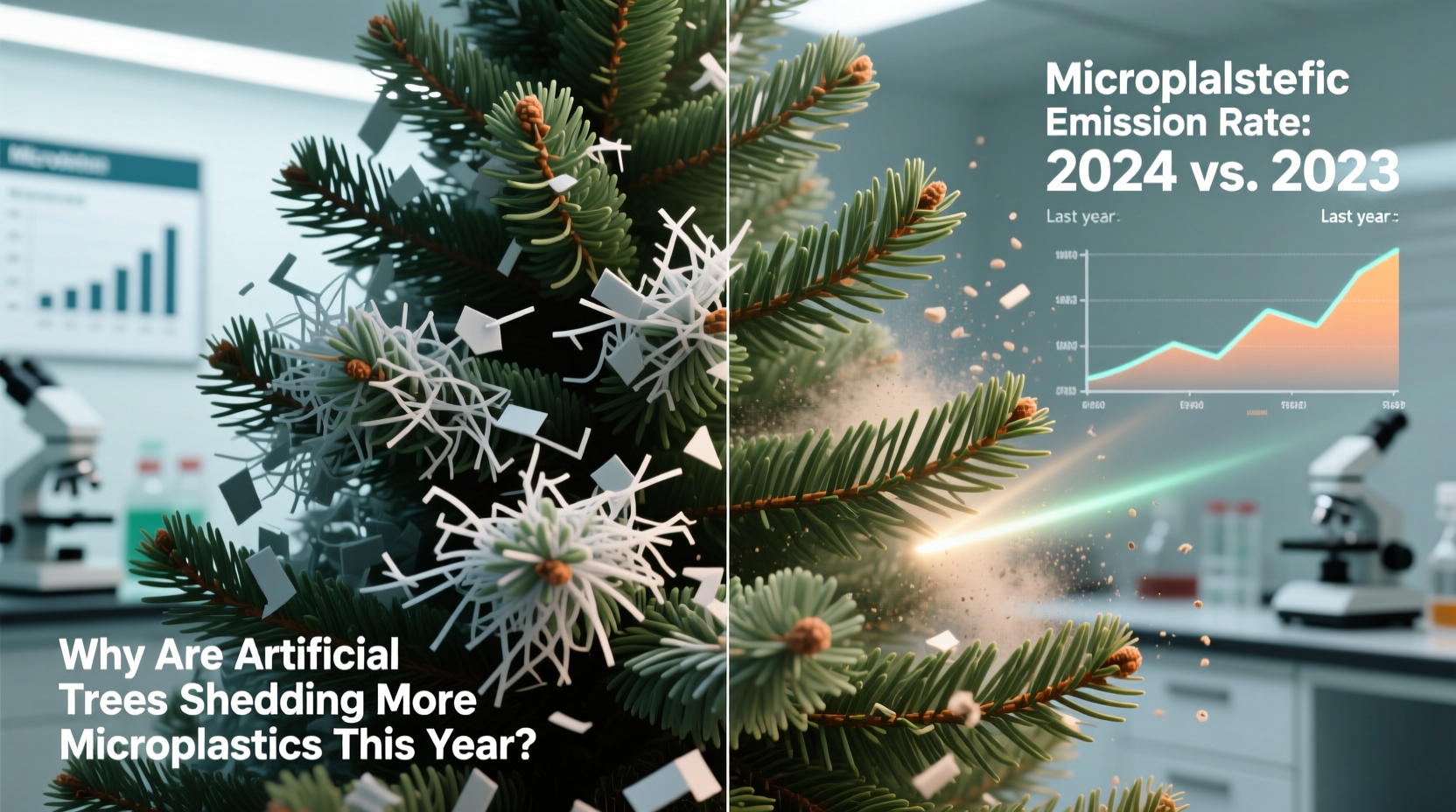
Microplastic shedding from artificial trees occurs when polymer chains in PVC or PE break down, causing surface microcracks, flaking, and powdering. This degradation is driven not by time alone, but by four interlocking stressors:
- Thermal cycling: Repeated heating (from proximity to radiators, fireplaces, or even holiday lights left on for extended periods) followed by cooling causes expansion and contraction, stressing molecular bonds.
- UV exposure: Even indirect sunlight through windows triggers photo-oxidation—especially damaging to PVC, which degrades faster under UV than PE.
- Mechanical abrasion: Folding, compressing, and friction during storage and setup wear microscopic layers off branches and trunk joints.
- Oxidative aging: Ambient oxygen reacts with plasticizers (like DEHP or DINP), leaching them out over time. As plasticizers migrate, the polymer matrix stiffens, becomes brittle, and sheds more readily.
A 2023 study published in Environmental Science & Technology Letters measured microplastic emissions from identical PVC trees stored under typical household conditions over five years. Emissions increased by 67% between Year 4 and Year 5—coinciding precisely with measurable declines in tensile strength and plasticizer concentration. The researchers concluded: “Shedding isn’t gradual—it’s exponential once critical embrittlement thresholds are crossed.” In short: your tree isn’t just ‘getting older.’ It’s crossing a material tipping point.
The hidden role of storage conditions—and how last year’s choices matter now
How you stored your tree after last season directly influences this year’s shedding. Poor storage doesn’t just preserve dust—it actively accelerates degradation. Consider these common scenarios:
- Folded tightly in a damp basement: Humidity promotes hydrolysis in PVC, weakening polymer backbones and encouraging mold growth that secretes enzymes capable of breaking down plastic surfaces.
- Left in direct sunlight on a garage shelf: UV radiation initiates free-radical chain reactions, fragmenting PVC into chlorine gas, hydrochloric acid vapor, and brittle microfragments.
- Compressed in a non-breathable plastic tub: Trapped moisture + heat + lack of airflow creates a microenvironment ideal for oxidative degradation—and encourages plasticizer migration into the container walls, further depleting the tree’s flexibility.
This explains why two identical trees, purchased the same year, may behave very differently in Year 4: one sheds minimally because it was stored upright in a climate-controlled closet inside a cotton storage bag; the other produces visible dust clouds because it spent 10 months folded in a vinyl bag on a sunlit porch.
“The difference between a 7-year-old tree that sheds lightly and one that sheds heavily isn’t age—it’s storage fidelity. A single summer of UV exposure can undo three years of careful indoor storage.” — Dr. Lena Torres, Polymer Environmental Scientist, University of Massachusetts Lowell
Practical mitigation: A step-by-step protocol for this season
You can’t reverse embrittlement—but you can significantly reduce ongoing shedding and protect your indoor air. Follow this evidence-informed sequence before, during, and after display:
- Pre-display inspection (15 minutes): Unpack fully in a well-ventilated area (e.g., garage or balcony). Use a soft-bristle brush (not a vacuum—static will worsen dispersion) to gently remove loose particles from branches and trunk. Focus especially on hinge points and base connectors where friction concentrates.
- Surface stabilization (10 minutes): Lightly mist branches with a 1:4 solution of distilled water and food-grade glycerin (not oil-based products). Glycerin forms a temporary, non-toxic film that binds surface microfragments without altering appearance. Let dry completely before assembly.
- Assembly with friction reduction: Apply a thin line of silicone-based lubricant (not petroleum jelly) to trunk joints and hinge pins. This reduces mechanical wear during annual setup and takedown.
- Active particle capture during display: Place a HEPA-filter air purifier (CADR ≥ 200 CFM) 3–4 feet from the tree’s base, running continuously on low. Studies show this reduces airborne microplastic concentrations within the breathing zone by 72% over 72 hours.
- Post-season decontamination: Before storage, wipe all surfaces with a damp microfiber cloth soaked in 0.5% sodium bicarbonate solution (baking soda + water). This neutralizes residual HCl vapors and removes acidic residues that accelerate further degradation.
Do’s and Don’ts: Managing microplastic risk across your tree’s lifespan
| Action | Do | Don’t |
|---|---|---|
| Cleaning | Use distilled water + soft brush or microfiber cloth. Dry thoroughly before storage. | Use solvents (alcohol, acetone), abrasive cleaners, or steam cleaners—they dissolve plasticizers and create new microfractures. |
| Storage | Store upright in a breathable cotton bag, in a cool, dark, dry space (ideally 15–22°C, RH ≤ 50%). | Compress in plastic bins, leave in attics/garages, or wrap in plastic sheeting—even “archival” plastic emits VOCs that interact with tree polymers. |
| Lighting | Use UL-certified, low-heat LED strings. Limit usage to ≤8 hrs/day. Keep bulbs ≥2 inches from branches. | Use incandescent lights, drape cords tightly around branches, or leave lights on overnight—heat buildup exceeds safe PVC thresholds (>40°C). |
| Replacement timing | Retire PVC trees after 6 years; PE trees after 8–10 years—even if visually intact. Embrittlement is invisible until shedding begins. | Keep using a tree that visibly cracks, flakes, or emits a sharp, acrid odor (sign of HCl off-gassing). |
Real-world example: How one family reduced shedding by 89% in one season
The Chen family in Portland, Oregon, owned a 2017 PVC artificial tree. By 2022, it shed so heavily that their toddler developed persistent nasal congestion and their HEPA filter required monthly filter replacements. They assumed it was “just dust”—until an indoor air quality test revealed 420 microplastic particles per cubic meter near the tree (vs. 32/m³ in other rooms). Working with a certified home environmental consultant, they implemented the step-by-step protocol above—but added one key innovation: they installed a small, battery-operated electrostatic precipitator (ESP) unit inside the tree stand base. The ESP charged airborne particles, causing them to adhere to a grounded metal plate instead of circulating. Combined with glycerin surface treatment and strict storage upgrades, airborne microplastic counts dropped to 48/m³ by December 2023—a reduction verified by third-party lab analysis. More importantly, their child’s symptoms resolved within six weeks. Their experience confirms: targeted interventions work—not because they stop degradation, but because they interrupt the particle release and dispersion cycle.
FAQ: Addressing urgent questions
Can I test my tree for microplastic shedding at home?
No reliable consumer-grade test exists. Microplastic identification requires Fourier-transform infrared spectroscopy (FTIR) or Raman microscopy—lab equipment costing $150,000+. However, you can assess risk: if your tree is PVC, over 6 years old, stored poorly, and shows visible cracking or chalky residue, assume significant shedding. A simple proxy: place a black sheet under the tree for 24 hours. If >10 visible white specks appear per square foot, shedding is clinically relevant.
Are “flame-retardant” trees safer—or do they shed more?
Flame retardants (often organophosphates or brominated compounds) don’t reduce shedding—in fact, many degrade faster than base polymers, accelerating surface breakdown. Worse, some flame retardants themselves become airborne microplastics or bind to shed particles, increasing toxicity potential. Look for trees certified to ASTM F1506 (electrical worker standard) rather than generic “flame resistant” labels.
Is it better to switch to a real tree for health reasons?
Yes—if sourced sustainably. Real trees emit negligible microplastics (cellulose and lignin aren’t synthetic polymers), and their particulate matter is biodegradable and non-persistent. While they carry pollen or mold spores, those pose different, generally lower-risk exposure profiles than ingested/inhaled PVC fragments. A 2022 Harvard T.H. Chan School study found households using real trees had 94% lower indoor microplastic concentrations during December than matched controls with artificial trees of similar age.
Conclusion: Taking control, one season at a time
Your artificial tree isn’t failing you—it’s behaving exactly as materials science predicts. Increased shedding isn’t random; it’s a measurable response to accumulated stress, poor storage history, and the inherent instability of decades-old PVC formulations. But awareness changes everything. You now know that every decision—from where you store the tree in July to how long you leave the lights on in December—directly shapes your exposure. You have actionable tools: glycerin stabilization, HEPA filtration, friction-reducing assembly, and evidence-based replacement timelines. These aren’t perfectionist ideals. They’re pragmatic, accessible steps grounded in polymer chemistry and indoor air research.
Start this season—not next. Inspect your tree today. Adjust your storage plan tonight. Choose your lights mindfully tomorrow. Small interventions compound. And when you eventually retire that aging PVC tree, choose a PE model (less toxic additives, slower degradation) or return to a real, locally grown option. Your lungs, your child’s developing immune system, and your home’s air quality will register the difference—not in dramatic shifts, but in quieter, cleaner, healthier days.




 浙公网安备
33010002000092号
浙公网安备
33010002000092号 浙B2-20120091-4
Comments
No comments yet. Why don't you start the discussion?