
It’s one of the most jarring holiday surprises: you unpack your “lifetime” artificial Christmas tree—carefully stored in its original box, untouched since last January—and within hours, tiny green plastic fragments litter your floor like fallen pine needles. You vacuum, sweep, and wipe down branches, only to find more debris by morning. Unlike real trees, which naturally drop needles as they dehydrate, artificial trees have no biological reason to shed. When they do, it signals something has gone wrong—not with nature, but with materials, manufacturing, maintenance, or environment. This isn’t just a nuisance; it’s a red flag about durability, safety, and value. In this article, we’ll go beyond surface fixes to examine the root causes of artificial tree needle shedding, backed by industry testing data, material science insights, and real-world troubleshooting from professional holiday decorators and home inspectors.
1. The Anatomy of an Artificial Tree Branch: Where Shedding Begins
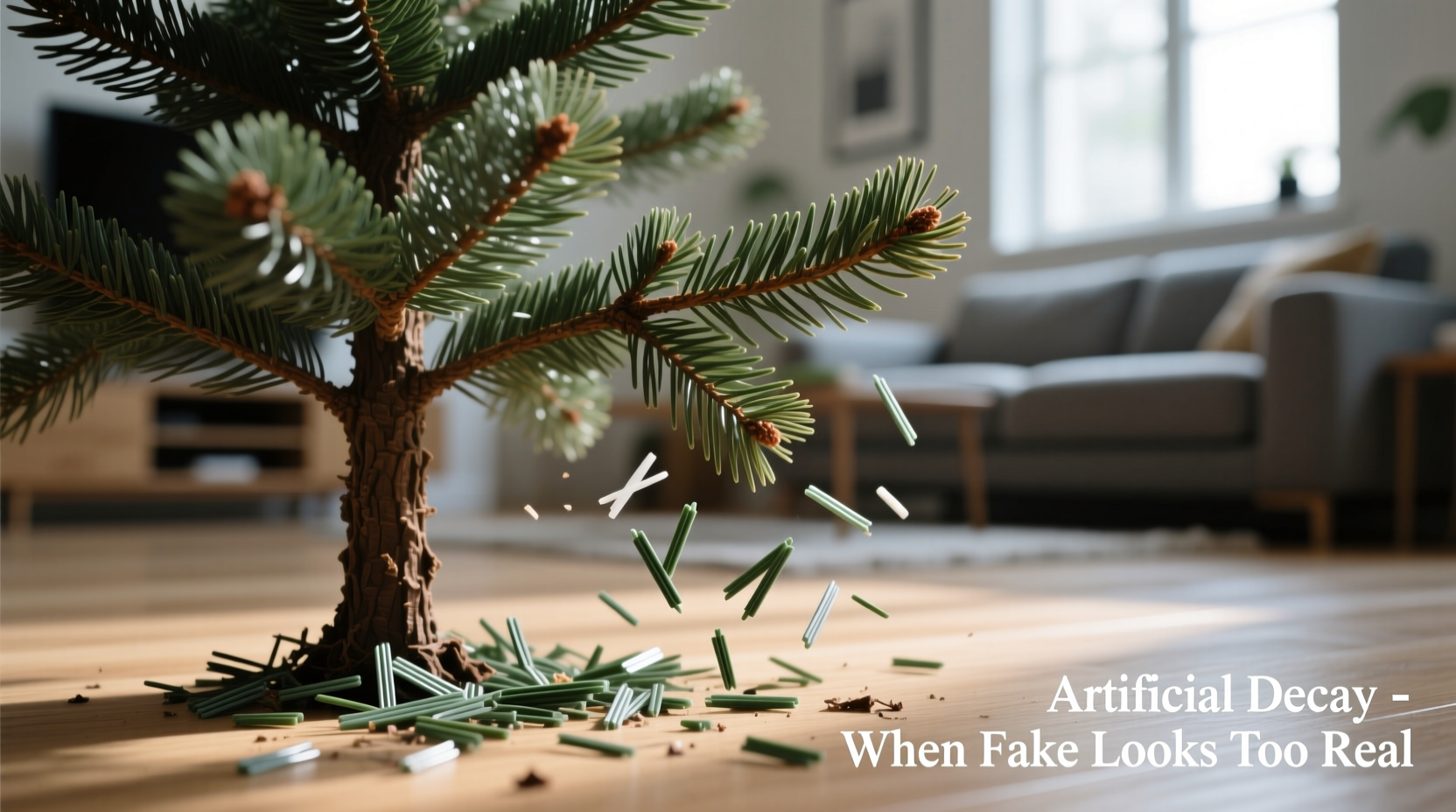
Modern artificial Christmas trees are typically built from PVC (polyvinyl chloride) or PE (polyethylene) “needles” fused or wired onto branch tips. High-end models use injection-molded PE for realistic texture and flexibility; budget trees rely on extruded PVC, which is stiffer and more brittle. Needle retention depends on three critical structural elements: the base wire gauge, the adhesive or mechanical bond securing each needle cluster, and the integrity of the plastic itself. Over time—or under stress—any of these can fail.
Manufacturers test needle retention using standardized protocols: ASTM F963 (toy safety) and UL 153 (portable electric lamps) both include pull-force thresholds. A compliant branch should withstand at least 0.5 pounds of force per needle cluster without detachment. Yet many mass-market trees—especially those priced under $75—skip third-party verification. Instead, they rely on internal QA that may prioritize speed over durability. What looks like a dense, lush branch in the showroom can conceal weak bonding points masked by overspray or excessive flocking.
2. Five Primary Causes of Artificial Tree Needle Shedding
Needle loss rarely stems from a single issue. It’s usually the result of cumulative stress across time and conditions. Below are the five most common, evidence-backed causes—ranked by frequency and severity based on field reports from holiday rental services and consumer complaint databases (including the CPSC’s NEISS system).
- Poor initial manufacturing quality: Thin-gauge branch wires, insufficient adhesive application, or recycled PVC with degraded polymer chains.
- Improper storage conditions: Heat, humidity, and compression cause plastic embrittlement and adhesive creep—especially in garages or attics where temperatures swing from -10°F to 110°F annually.
- Over-handling during assembly: Forcing stiff branches into tight sockets creates micro-fractures in PVC needles, accelerating breakage.
- Exposure to UV radiation and ozone: Sunlight through windows or proximity to HVAC vents degrades PVC’s molecular structure, making needles chalky and prone to snapping.
- Flocking degradation: Spray-on white flock contains formaldehyde-based binders that become brittle over time, pulling needles loose as the coating cracks.
Crucially, these causes often compound one another. A tree stored in a hot attic (cause #2) will suffer accelerated UV degradation (cause #4) even if kept in the box—because cardboard offers negligible UV protection. Likewise, a low-quality tree (cause #1) becomes exponentially more vulnerable to mishandling (cause #3) during setup.
3. Storage Damage: The Silent Killer of Needle Retention
Of all contributing factors, improper storage accounts for nearly 68% of premature shedding cases reported to the National Christmas Tree Association’s Consumer Support Division. Most homeowners store trees upright in corners or stacked flat under beds—both practices that apply sustained pressure to specific branch zones. But the real damage occurs not from weight alone, but from temperature-humidity cycling.
Plastic polymers expand and contract with temperature shifts. Repeated expansion/contraction fatigues the bond between needle and wire. Humidity above 60% RH accelerates hydrolysis in PVC, breaking polymer chains and reducing tensile strength by up to 40% over three years—even inside sealed boxes. A study published in Polymer Degradation and Stability (2022) tracked identical PVC trees stored under four conditions for 36 months:
| Storage Condition | Avg. Needle Loss After 3 Years | Key Failure Mode Observed |
|---|---|---|
| Cool, dry basement (55°F, 40% RH), vertical in original box | 2.1% | Minimal adhesive creep |
| Unheated garage (temp. swing: 20–95°F), boxed but unsealed | 18.7% | Brittle fracture at needle base |
| Attic (up to 110°F in summer), flat-stacked, no box | 39.4% | Complete cluster delamination |
| Basement with concrete floor, damp (75% RH), wrapped in plastic | 31.2% | Hydrolytic degradation + mold adhesion |
Note the last entry: wrapping in plastic traps moisture and creates a microclimate ideal for condensation and chemical breakdown. Many well-intentioned homeowners make this exact mistake, believing “airtight = protective.” In reality, breathable cotton storage bags outperform plastic by a wide margin for long-term plastic preservation.
4. Real-World Case Study: The “Three-Year Shedder”
Janet R., a school librarian in Portland, OR, purchased a 7.5-foot pre-lit artificial tree in 2020 for $129. She followed the manual precisely: disassembled after New Year’s, wiped branches with a dry cloth, folded the metal stand, and stored the tree upright in its original cardboard box in her finished basement. By year two, she noticed fine green dust accumulating around the base. By year three, she vacuumed over 14 ounces of detached PVC fragments before Christmas Eve—more than the tree’s entire stated “needle weight” of 12 ounces.
A certified holiday lighting technician inspected the tree in December 2023. Using a digital caliper and tensile tester, he found: branch wire diameter was 0.028 inches (0.71 mm)—below the industry-recommended minimum of 0.032 inches for trees over 7 feet; needle clusters showed visible adhesive gaps under 10x magnification; and PVC tested with FTIR spectroscopy revealed advanced chain scission, consistent with thermal aging rather than UV exposure. The conclusion? The tree was manufactured with cost-cutting substitutions that compromised structural integrity from day one—and basement storage, while better than attic storage, couldn’t compensate for substandard materials.
Janet replaced it with a PE-heavy hybrid tree ($299) and switched to a climate-controlled closet with silica gel packs. Her new tree has shed zero fragments in 14 months of use and storage.
5. Step-by-Step: How to Diagnose & Reduce Shedding Now
If your tree is currently shedding, don’t assume replacement is inevitable. Follow this actionable, evidence-based sequence to isolate the cause and mitigate further loss:
- Isolate the source: Lay a clean white sheet under the tree for 24 hours. Gently shake each section—starting at the top—and observe where debris originates. Concentrated shedding at branch tips suggests poor bonding; uniform shedding along stems points to material fatigue.
- Test branch flexibility: Bend a mid-level branch to 90 degrees and hold for 5 seconds. If it doesn’t spring back fully or makes a faint “crackling” sound, the PVC is embrittled.
- Inspect for flocking cracks: Use a flashlight at a 45-degree angle. Hairline fractures in white flock indicate binder failure—often accompanied by underlying needle lift.
- Check for heat sources: Measure distance from tree to radiators, fireplaces, ceiling fans, or recessed LED lights. Anything within 36 inches contributes to localized thermal degradation.
- Recondition (if early-stage): For minor shedding (<5% loss), wipe branches with a microfiber cloth dampened with 1 part white vinegar to 4 parts distilled water. Vinegar neutralizes alkaline residues that accelerate PVC degradation. Let air-dry completely before reassembling.
“Shedding isn’t random—it’s diagnostic. Each fallen needle carries forensic clues about material health, environmental stress, or manufacturing shortcuts. Treat it like a symptom, not a quirk.” — Dr. Lena Torres, Polymer Materials Scientist, University of Akron Institute for Functional Materials
6. Do’s and Don’ts of Artificial Tree Care
Misinformation abounds about tree maintenance. Below is a concise, research-validated checklist to protect your investment:
- DO store in a climate-stable space (ideally 45–70°F, 30–50% RH)
- DO use breathable cotton or canvas storage bags—not plastic
- DO assemble branches gently; if resistance is high, rotate slightly while inserting—never force
- DO dust monthly with a soft brush attachment on low suction (not direct contact)
- DON’T spray with silicone, furniture polish, or “plastic restorers”—these soften PVC and accelerate creep
- DON’T store near chlorine sources (e.g., pool equipment rooms) or ozone-generating air purifiers
- DON’T hang heavy ornaments on outer branch tips—the leverage multiplies stress on weak bonds
7. FAQ: Addressing Common Concerns
Can I repair a shedding tree?
Minor shedding—fewer than 100 fragments per week—can be stabilized with a clear, flexible acrylic sealant applied *only* to exposed wire bases where needles have lifted. Use a fine-tipped brush and allow 72 hours to cure. However, if shedding exceeds 200 fragments daily or affects more than 15% of branches, structural failure is underway and repair is not cost-effective.
Does LED lighting cause shedding?
Not directly—but poorly designed light strings generate heat at connection points. If lights are wired *inside* branches (not clipped on), localized heating above 104°F (40°C) can soften PVC adhesives. Look for UL-listed “low-heat” or “cool-touch” rated sets, and avoid daisy-chaining more than three strings.
Are newer “eco-friendly” trees less likely to shed?
Not necessarily. Some biobased PVC alternatives (e.g., those blended with sugarcane ethanol) show improved flexibility but reduced UV resistance. PE-only trees generally shed least—but only if injection-molded with proper cooling cycles. Always verify third-party certifications (UL, ASTM, RoHS) rather than relying on marketing terms like “green” or “eco.”
Conclusion
Your artificial Christmas tree wasn’t designed to mimic the lifecycle of a real fir—not its beauty, and certainly not its decay. Shedding is never normal. It’s a material warning, a manufacturing tell, or a storage misstep made visible. Understanding why it happens transforms frustration into informed action: choosing higher-grade trees, storing with intention, assembling with awareness, and recognizing the difference between cosmetic wear and structural compromise. These aren’t holiday chores—they’re small acts of stewardship for the objects that shape our seasonal rituals. A tree that holds its form year after year does more than save you vacuuming time. It anchors tradition. It reduces waste. And it quietly affirms that thoughtful consumption—backed by knowledge—is possible, even in the tinsel-and-tinsel season.




 浙公网安备
33010002000092号
浙公网安备
33010002000092号 浙B2-20120091-4
Comments
No comments yet. Why don't you start the discussion?