
That first whiff when you unpack your artificial Christmas tree—sharp, plasticky, faintly acrid, or worse, damp and moldy—is more than just unpleasant. It’s a red flag. Unlike real trees that emit fresh pine or cedar notes, artificial trees shouldn’t carry persistent off-putting odors. Yet many homeowners report lingering smells ranging from “burnt plastic” to “wet cardboard,” “chemical solvent,” or even “old basement.” These scents aren’t harmless background noise. They signal material degradation, improper storage, environmental contamination, or manufacturing residues—and they can affect indoor air quality, trigger sensitivities, and undermine the festive mood before the first ornament is hung.
This isn’t about masking smells with sprays or hoping they’ll fade. It’s about understanding root causes and applying targeted, science-informed interventions. Drawing on material science principles, HVAC hygiene guidelines, and decades of holiday decor maintenance experience—from professional prop stylists to indoor air quality consultants—we break down exactly why your tree smells off, and how to resolve it thoroughly, safely, and sustainably.
Why Your Artificial Tree Smells Weird: 4 Primary Causes
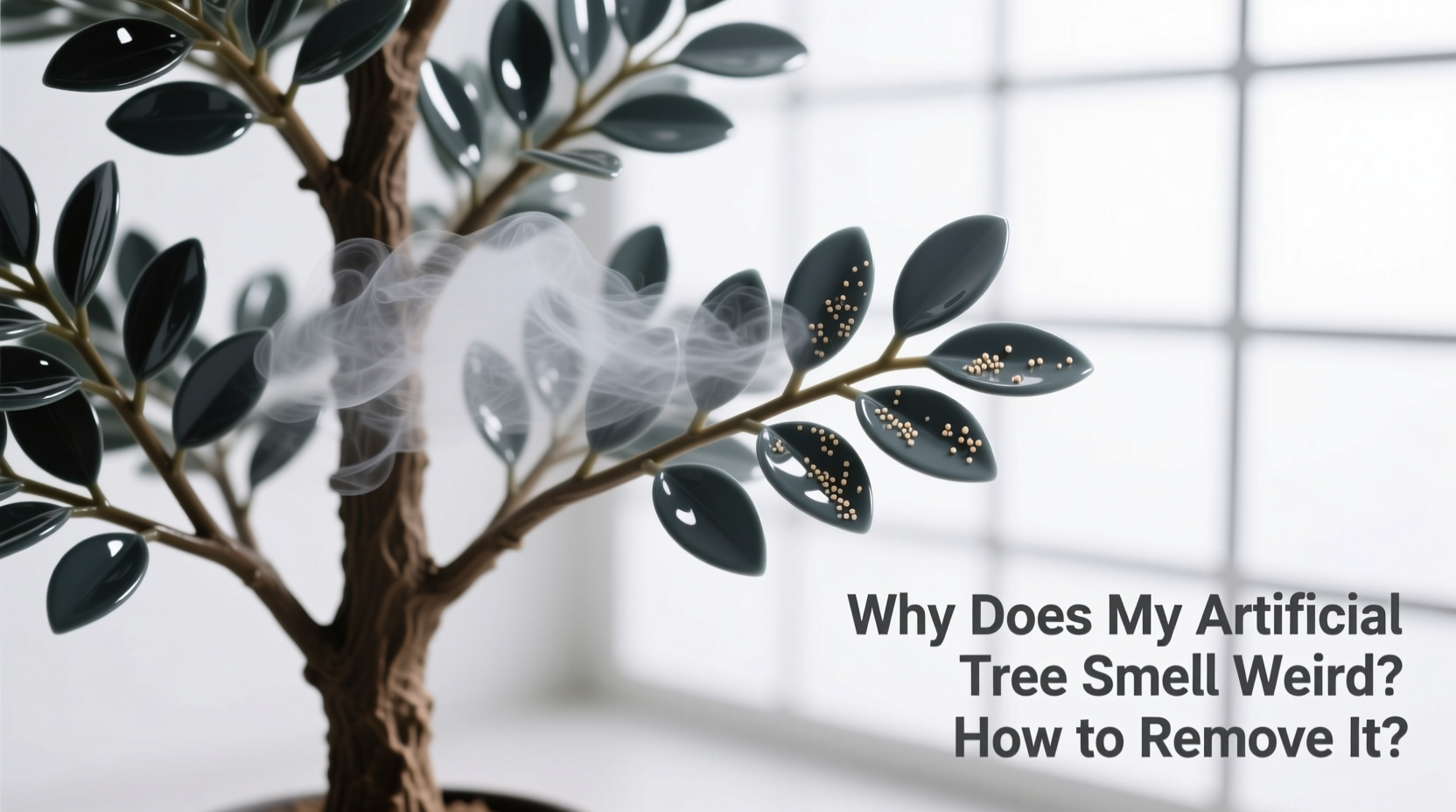
Artificial trees are complex assemblies—not just plastic, but combinations of PVC, PE (polyethylene), metal frames, flame retardants, adhesives, and sometimes fabric-wrapped branches. Odors arise not from a single source, but from interactions between materials, environment, and time.
1. Off-Gassing of Volatile Organic Compounds (VOCs)
New or recently unboxed trees often emit a sharp, synthetic odor caused by VOCs leaching from PVC and plasticizers like phthalates. These compounds are used to make rigid plastic flexible and durable—but they volatilize at room temperature, especially in warm, stagnant air. The smell intensifies after storage in hot garages or attics and peaks during the first 48–72 hours post-unboxing. While most VOC levels drop significantly within a week, sensitive individuals may detect residual fumes for days longer.
2. Moisture Trapping and Microbial Growth
This is the most common cause of *musty*, *earthy*, or *sour* smells—particularly in trees stored in basements, sheds, or non-climate-controlled units. Even trace condensation inside sealed bags creates micro-environments where mold spores and bacteria thrive on dust, skin cells, or organic debris trapped in branch crevices. Polyethylene needles don’t rot, but biofilm forms on their surfaces. When disturbed during setup, these microbes release geosmin and other microbial volatile organic compounds (mVOCs)—the same compounds responsible for the “rain-on-dry-soil” scent, but in enclosed spaces, they register as stale or foul.
3. Contamination During Storage
Trees absorb ambient odors like sponges. Stored near paint cans, gasoline, cleaning supplies, pet bedding, or even strongly scented candles, they pick up volatile molecules that bind to porous plastic surfaces. One homeowner reported her 2022 tree smelling unmistakably of lavender-scented mothballs—traced to a shared storage bin with seasonal linens. Dust itself carries hydrocarbons and skin oils that oxidize over time, generating rancid, waxy notes.
4. Degradation of Flame Retardants and Stabilizers
All UL-listed artificial trees contain flame-retardant additives (often brominated or phosphorus-based compounds) and UV stabilizers. Over 5–7 years—or sooner under UV exposure or heat stress—these chemicals break down. Their decomposition byproducts include aldehydes and halogenated hydrocarbons, which contribute to sour, chlorinated, or “swimming pool”-like odors. This degradation is irreversible and signals the end of the tree’s functional lifespan.
Step-by-Step: How to Remove the Smell (Safely & Effectively)
Eliminating odor requires a three-phase approach: diagnose → decontaminate → deodorize. Skipping diagnosis leads to wasted effort; skipping decontamination invites recurrence. Follow this sequence precisely—even if the smell seems mild.
- Unbox outdoors or in a well-ventilated garage. Let the tree air for 2–4 hours before bringing it inside. Use fans to accelerate VOC dispersion.
- Inspect every branch and trunk joint. Look for visible dust clumps, discoloration (grayish film = mold), or sticky residue (degraded plasticizer). Pay special attention to inner branches and base connectors.
- Vacuum thoroughly using a soft-brush attachment. Start at the top and work downward, holding branches gently to avoid bending. Vacuum both sides of each branch and all crevices in the trunk. Use a HEPA-filter vacuum to trap mold spores and fine particles.
- Wipe with a pH-neutral solution. Mix 1 cup distilled white vinegar + 1 quart lukewarm distilled water + 1 tsp mild castile soap. Dampen (not soak) a microfiber cloth and wipe branch surfaces systematically. Vinegar neutralizes alkaline odors and disrupts biofilm; castile soap lifts oils without residue. Rinse cloth frequently.
- Air-dry completely before reassembling. Lay branches flat on clean towels in indirect sunlight for 4–6 hours. Avoid direct sun—it accelerates UV degradation. Rotate branches halfway through.
- Final deodorization with activated charcoal. Place two open bowls of activated charcoal (not briquettes) near the assembled tree for 48 hours. Charcoal adsorbs VOCs and mVOCs at the molecular level without releasing fragrance.
Do’s and Don’ts: What Works (and What Makes It Worse)
| Action | Do | Don’t |
|---|---|---|
| Cleaning Solutions | Use diluted white vinegar, baking soda paste (for stubborn grime), or 70% isopropyl alcohol on cotton swabs for joints | Never use citrus-based cleaners (accelerates plastic oxidation), undiluted vinegar (can etch finishes), or oven cleaner (corrosive) |
| Drying Methods | Air-dry in shaded, breezy areas; use fans on low setting | Use hair dryers (heat warps branches), place near radiators, or store while damp |
| Odor Neutralization | Activated charcoal, unscented baking soda sachets, or zeolite mineral packs | Aerosol sprays, scented candles near the tree, or essential oil diffusers (oils attract dust and degrade plastic) |
| Storage Prep | Wipe branches dry, disassemble fully, store upright in breathable canvas bags with silica gel packs | Stuff into plastic trash bags, store horizontally in damp basements, or leave assembled year-round |
Real Example: The Basement Mold Incident
In December 2023, Sarah K., a teacher in Pittsburgh, opened her 8-year-old pre-lit artificial tree and was hit by an overwhelming “rotten egg” odor. She’d stored it in a concrete-floored basement with no dehumidifier—humidity regularly exceeded 70%. Upon inspection, she found grayish fuzz along the inner trunk seam and a slimy film on lower branches. Her initial attempt—spraying lavender air freshener—only intensified the smell, as the oils reacted with moisture and mold.
She followed the step-by-step protocol: vacuumed with HEPA, wiped with vinegar solution, and dried branches on racks in her sunroom. After 48 hours with activated charcoal, the odor vanished. Crucially, she replaced her storage method: now using ventilated canvas bags with two 5g silica gel canisters per bag, and storing the tree in a climate-controlled closet. “It wasn’t the tree’s fault,” she noted. “It was mine—for ignoring humidity control. Now it smells clean, crisp, and truly festive.”
Expert Insight: Material Science Meets Holiday Tradition
“Plastic trees aren’t inert objects—they’re dynamic systems interacting with temperature, humidity, and airborne chemistry. That ‘weird smell’ is often the first measurable sign of material fatigue. Addressing it early preserves structural integrity and indoor air quality. Ignoring it risks accelerated brittleness, wire corrosion, and respiratory irritation—especially for children and those with asthma.” — Dr. Lena Torres, Materials Scientist & Indoor Air Quality Consultant, National Institute of Building Sciences
Prevention Checklist: Stop Odors Before They Start
- ✅ After each season: Vacuum thoroughly, wipe with vinegar solution, and air-dry completely before packing
- ✅ Use breathable storage: Canvas or cotton tree bags—not plastic, vinyl, or garbage bags
- ✅ Control humidity: Store only in spaces with RH below 55%; add silica gel packs to storage bags
- ✅ Elevate off floors: Use pallets or shelves to prevent moisture wicking from concrete
- ✅ Rotate annually: If storing long-term, unpack and air out your tree for 2 hours each spring
- ✅ Replace every 7–10 years: Even with perfect care, plasticizers and flame retardants degrade irreversibly
FAQ
Can I wash my artificial tree in the bathtub?
No. Submerging or soaking damages wiring insulation, loosens glued components, and forces water into electrical housings—creating shock hazards and short-circuit risks. Spot-cleaning with damp cloths is safe; full immersion is not.
Will ozone generators remove the smell?
Technically yes—but strongly discouraged. Ozone (O₃) reacts aggressively with plastics, accelerating cracking and yellowing. It also poses serious health risks: the EPA warns ozone generators can worsen asthma and damage lung tissue. Safer, equally effective alternatives exist—like activated charcoal and proper ventilation.
My tree smells like burnt toast—what does that mean?
This is a critical warning sign. A “burnt toast” or “hot wire” odor almost always indicates overheating in the light string or transformer—often due to frayed wires, overloaded circuits, or damaged insulation. Unplug immediately. Do not attempt cleaning. Replace lights or consult a licensed electrician before reuse.
Conclusion
Your artificial Christmas tree should evoke warmth, nostalgia, and quiet joy—not chemical anxiety or the dread of opening a closet door. The weird smell isn’t inevitable, nor is it trivial. It’s diagnostic feedback—a signal that something in your storage, handling, or tree’s age requires attention. By understanding the chemistry behind the odor, applying targeted decontamination, and committing to intelligent storage habits, you reclaim control over your indoor environment and extend the life and pleasure of your holiday centerpiece.
Start this year with intention: unpack outdoors, inspect closely, clean deliberately, and store thoughtfully. Not because it’s tradition—but because it’s stewardship. Your lungs, your family’s comfort, and the integrity of your tree all depend on it. And when that first clean, neutral, quietly festive scent fills your living room? That’s not silence. That’s success.




 浙公网安备
33010002000092号
浙公网安备
33010002000092号 浙B2-20120091-4
Comments
No comments yet. Why don't you start the discussion?