
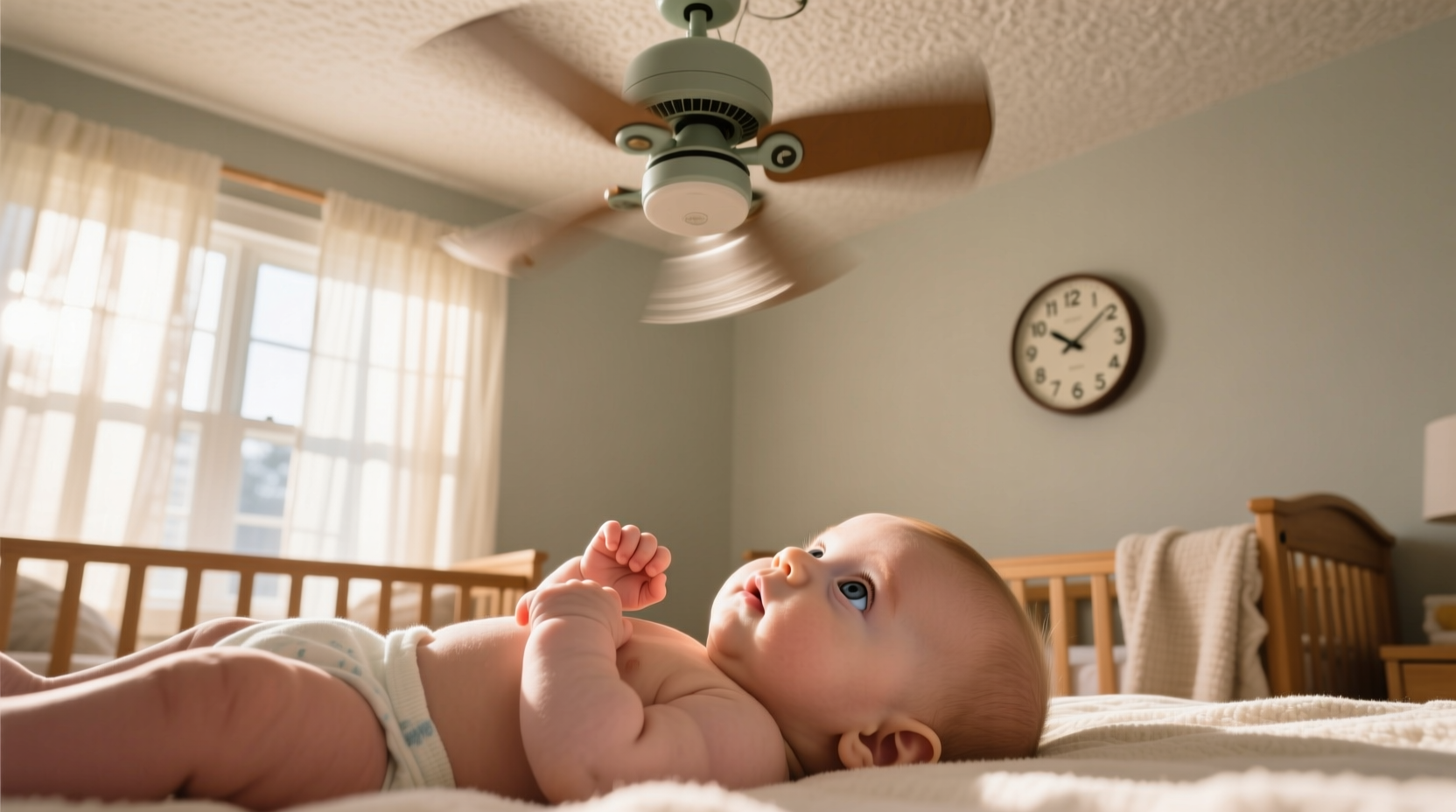
New parents often notice their infants fixating on unexpected things—mobiles, light fixtures, or especially ceiling fans. It’s not uncommon to see a baby lying still, eyes wide open, completely absorbed by the rotating blades above. While this behavior can seem strange, it's actually quite typical during early infancy. Far from being random, this fascination is deeply rooted in sensory development, visual processing, and cognitive growth. Understanding why babies are drawn to ceiling fans offers valuable insight into how their brains and senses evolve in the first months of life.
The Science Behind Visual Development in Infants
In the first few months after birth, a baby’s vision is still maturing. At birth, newborns can only see in black, white, and shades of gray. Their ability to perceive contrast is strong, but color detection develops gradually over the first 4–6 months. This is why high-contrast patterns—like bold stripes or spinning dark-and-light shapes—are particularly captivating.
Ceiling fans provide an ideal visual stimulus: movement, contrast, and repetition. The rotation creates a dynamic pattern that stands out against a typically static environment. Even if the fan blades aren’t sharply defined, their motion generates flickering light and shadow changes that stimulate the developing visual cortex.
Dr. Laura Jana, pediatrician and author of Heading Home with Your Newborn, explains:
“Babies are born with the hardware for vision, but they need real-world input to fine-tune the software. Moving objects like ceiling fans act as natural training tools for eye tracking, focus, and depth perception.” — Dr. Laura Jana, Pediatric Development Specialist
From a neurological perspective, watching motion helps strengthen the connections between the eyes and the brain. As infants follow the path of a spinning blade, they’re practicing smooth pursuit eye movements—critical for later skills like reading and hand-eye coordination.
Is Staring at Ceiling Fans a Sign of Healthy Development?
Yes—in most cases, staring at ceiling fans is not only normal but a positive indicator of healthy sensory and cognitive development. Around 6 to 12 weeks of age, babies begin to show increased visual interest in moving objects. This milestone aligns with improvements in visual acuity, attention span, and motor control.
Key developmental benefits include:
- Visual tracking: Following the fan helps refine eye muscles and coordination.
- Contrast sensitivity: Detecting edges and shadows enhances neural processing.
- Attention regulation: Sustained focus on one object builds concentration capacity.
- Sensory integration: Combining visual input with auditory cues (like the hum of the motor) supports multisensory learning.
Interestingly, researchers have observed that infants who spend time observing complex motion tend to reach visual milestones—such as recognizing faces and reaching for objects—slightly earlier than those with limited visual stimulation.
When Fascination Crosses Into Concern
While staring at ceiling fans is generally harmless and beneficial, certain patterns may warrant closer observation. In rare cases, intense fixation on spinning objects can be associated with developmental conditions such as autism spectrum disorder (ASD), particularly when combined with other behavioral markers.
According to the American Academy of Pediatrics, repetitive behaviors involving motion—like spinning wheels or obsessively watching fans—can be early signs of ASD. However, these behaviors alone are not diagnostic. What matters is the context and frequency.
Red flags include:
- Exclusive focus on spinning objects to the exclusion of people or faces.
- Lack of response to voices or social cues while engaged.
- Repetitive rocking or hand-flapping while watching motion.
- No eye contact or social smiling by 3–4 months.
If your baby enjoys watching fans but also responds to caregivers, tracks faces, and engages socially, there’s no cause for concern. But if you notice multiple atypical behaviors, discuss them with your pediatrician.
Case Example: A Parent’s Observation
Maria, a first-time mother from Portland, noticed her 8-week-old daughter would lie still for up to 20 minutes, eyes locked on the kitchen ceiling fan. Initially amused, she grew concerned when the baby seemed less interested in toys or facial expressions. After discussing it with her pediatrician, Maria learned that brief fascination was normal—but the lack of social engagement prompted further evaluation. Early screening revealed mild delays in joint attention, leading to timely intervention through play-based therapy. By six months, her daughter was making steady progress.
This example underscores the importance of viewing behaviors in context. Watching a fan isn't problematic; it’s what else the baby does—or doesn’t do—that provides meaningful clues.
How to Support Healthy Visual Exploration
Rather than discouraging your baby’s interest in ceiling fans, use it as an opportunity to support broader development. The goal isn’t to stop the staring but to expand the range of stimuli and interactions.
Step-by-Step Guide to Enrich Visual Stimulation
- Observe without interrupting: Allow your baby uninterrupted time to explore visually. Rushing to distract them limits independent attention-building.
- Comment aloud: Say things like, “You’re watching the fan go round and round!” This links visual experience with language.
- Introduce variety: Rotate mobiles, change wall art, or use soft-focus mirrors to diversify visual input.
- Engage socially: After a period of observation, gently redirect attention to your face or a toy to encourage social reciprocity.
- Limit screen exposure: Unlike real-world motion, screens emit blue light and rapid flicker that can overstimulate immature brains.
A balanced approach ensures that fascination with motion becomes a stepping stone—not a fixation.
Do’s and Don’ts of Responding to Fan Staring
| Do | Don’t |
|---|---|
| Allow short periods of independent observation | Panic or assume something is wrong |
| Talk about what they’re seeing | Forcefully redirect attention constantly |
| Use it as a chance to practice naming actions (\"spinning\") | Leave baby unattended under a fan for long durations |
| Offer alternative moving toys (e.g., crib mobiles) | Assume all repetitive behavior is a sign of autism |
| Monitor overall developmental milestones | Compare your baby excessively to others |
Frequently Asked Questions
Can staring at ceiling fans harm my baby’s eyes?
No. There is no evidence that watching ceiling fans damages infants’ eyes. The motion does not strain vision or affect eye health. However, ensure the fan is clean and safely installed to prevent dust or debris from falling.
At what age do babies typically stop staring at fans?
Most babies naturally lose intense interest in ceiling fans between 4 and 7 months. As their world expands—through crawling, babbling, and exploring objects—they shift focus to more interactive stimuli. Some may retain a passing interest, but prolonged fixation usually diminishes.
Should I remove ceiling fans if my baby stares at them too much?
No removal is necessary. Instead, observe the full range of your baby’s behaviors. If they engage socially, respond to sounds, and explore toys, fan-watching is simply part of normal development. Only consider environmental changes if advised by a healthcare provider after formal evaluation.
Conclusion: Embracing Curiosity as a Sign of Growth
Babies stare at ceiling fans because their developing brains are wired to seek out motion, contrast, and novelty. What might seem like a quirky habit is, in fact, a window into active neurological growth. From refining eye movements to building attention spans, these moments of quiet observation contribute meaningfully to early development.
As a parent, your role isn’t to correct or suppress this behavior but to understand it, support it, and ensure it exists within a broader context of healthy interaction. Celebrate your baby’s curiosity—even when it’s directed upward. That gaze toward the spinning blades may be the first sign of a mind learning to make sense of a complex world.




 浙公网安备
33010002000092号
浙公网安备
33010002000092号 浙B2-20120091-4
Comments
No comments yet. Why don't you start the discussion?