
Betta fish are known for their vibrant colors, flowing fins, and bold personalities. One of the most striking behaviors they exhibit is flaring—where they spread their gills, puff up their bodies, and display their full finnage in a dramatic show of aggression or excitement. If you’ve placed a mirror near your betta’s tank and noticed it suddenly transforming into an underwater warrior, you’re witnessing one of the most instinctive responses in its behavioral repertoire.
This reaction isn’t random. It’s deeply rooted in biology, territorial instincts, and social signaling. While flaring at a mirror might seem entertaining—or even endearing—it’s essential to understand what’s really happening beneath the surface. Overuse of mirrors can stress your fish, while occasional observation can provide mental stimulation and insight into its well-being.
In this article, we’ll explore the science behind betta flaring, explain why mirrors trigger this response, and guide you on how to use this knowledge responsibly to support your betta’s health and happiness.
The Biology Behind Betta Flaring
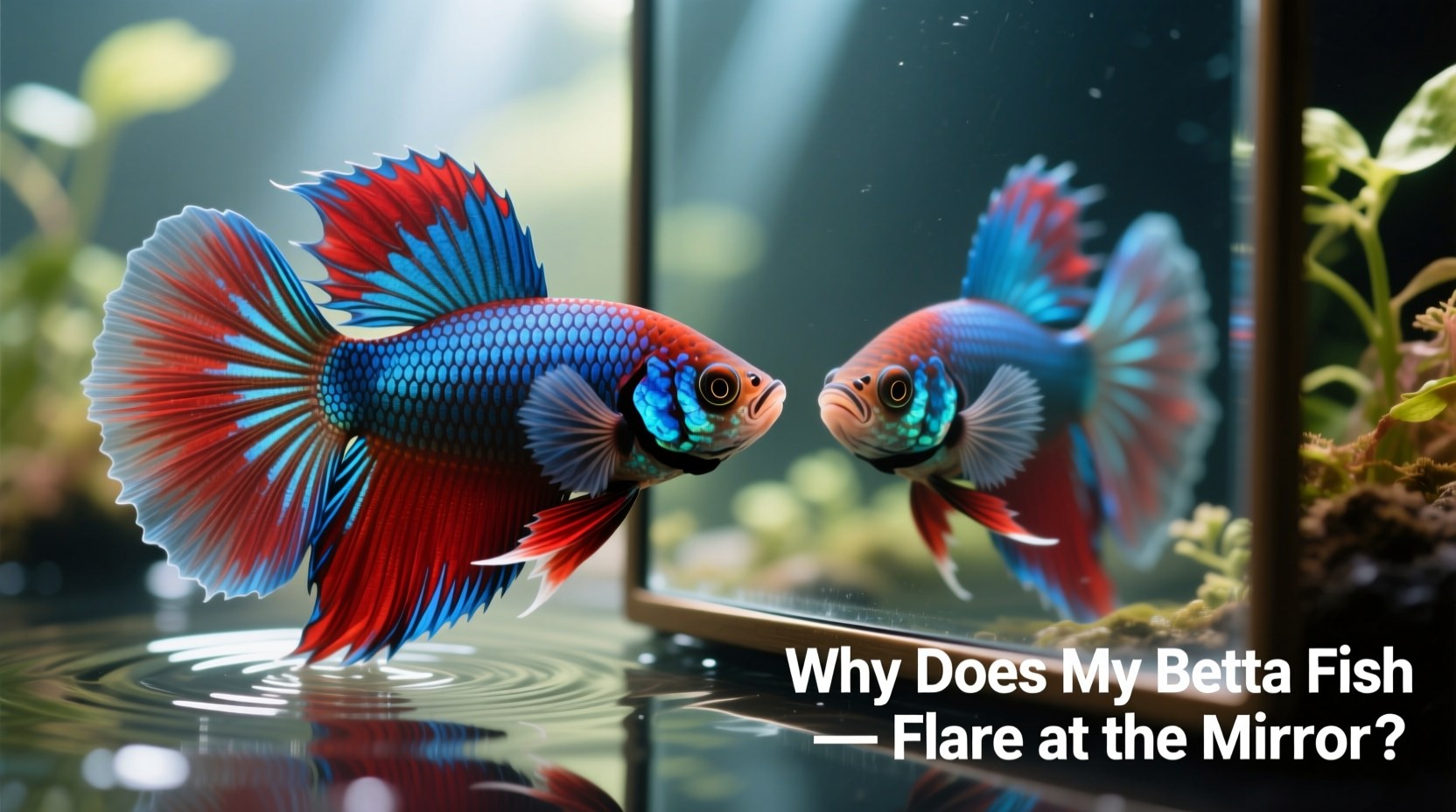
Flaring is a physical display where a betta fish expands its opercula (gill covers), spreads its fins wide, and often changes color slightly due to increased blood flow. This transformation makes the fish appear larger and more intimidating—a survival tactic honed through evolution.
In the wild, male bettas inhabit shallow rice paddies, slow-moving streams, and stagnant pools across Southeast Asia. These environments are densely populated with other males competing for space and mates. To avoid constant physical combat—which could result in injury or death—betta fish developed visual displays as warnings. Flaring serves as a non-lethal way to assert dominance: “I’m here, I’m strong, and this area is mine.”
The mirror triggers the same neurological and hormonal pathways as seeing another male. When a betta sees its reflection, its brain interprets the image as a rival encroaching on its territory. The hypothalamus activates stress and aggression responses, releasing hormones like cortisol and adrenaline. The fish then performs its full flaring routine, ready to defend its space—even though no real opponent exists.
Why Mirrors Trigger Flaring: A Psychological Perspective
Mirrors create a unique illusion that perfectly mimics the presence of another betta. Unlike static decorations or shadows, a mirror reflects movement, color, and shape in real time. To a betta, this looks exactly like a rival staring back—unyielding, symmetrical, and unresponsive to threats.
This leads to a frustrating loop: the betta flares, the “rival” flares back; it advances, the rival advances; it retreats, the rival follows. There’s no resolution. In nature, such encounters usually end when one fish submits and swims away. But with a mirror, submission never occurs. The confrontation is endless.
Dr. Helen Wu, aquatic biologist and researcher at the Tropical Fish Behavior Institute, explains:
“Mirror tests have long been used in animal cognition studies. For bettas, the reflection doesn’t just provoke aggression—it reveals their sense of self-perception and territorial awareness. They don’t recognize themselves, but they react to the threat with remarkable consistency.” — Dr. Helen Wu, Aquatic Ethologist
Interestingly, repeated exposure to mirrors can lead to habituation. Some bettas eventually stop responding, not because they’ve learned it’s a reflection, but because the stimulus loses emotional significance. However, this desensitization often comes at the cost of elevated baseline stress levels, which can weaken the immune system over time.
Is Flaring Harmful? Understanding the Risks and Benefits
Occasional flaring is natural and even beneficial. It allows bettas to exercise their muscles, maintain fin strength, and express innate behaviors. In captivity, where food is abundant and predators absent, mental and physical stimulation is crucial for psychological health.
However, excessive or prolonged flaring poses real risks:
- Chronic stress: Constant perception of threat increases cortisol levels, suppressing immunity and making fish vulnerable to diseases like fin rot or ich.
- Energy depletion: Flaring is metabolically costly. Repeated sessions without rest can exhaust younger or older fish.
- Sleep disruption: If a mirror remains visible at night, the fish may remain alert, reducing vital rest periods.
- Aggression transfer: Some bettas become hyper-vigilant, directing aggression toward tankmates or even their own reflection if decor creates reflective surfaces.
On the flip side, controlled mirror use offers several advantages:
- Provides enrichment in solitary tanks.
- Helps assess vitality—healthy bettas flare robustly; lethargic ones may not respond at all.
- Can be used to encourage activity in sedentary fish.
- Assists breeders in evaluating male readiness before introducing females.
Do’s and Don’ts of Mirror Use
| Do’s | Don’ts |
|---|---|
| Use a small hand mirror for brief sessions (1–3 minutes) | Leave a mirror taped to the tank permanently |
| Observe from a distance to minimize additional stress | Tap the glass or make sudden movements during flaring |
| Use flaring as a weekly check-in for health and vigor | Use mirrors with sick, injured, or newly introduced fish |
| Remove the mirror slowly to avoid startling the fish | Expect the fish to “get used to” the mirror safely over time |
Step-by-Step Guide: How to Safely Use a Mirror with Your Betta
If you want to observe flaring behavior without harming your fish, follow this responsible protocol:
- Prepare the environment: Ensure the tank is quiet, water parameters are stable, and no other stressors (e.g., loud noises, aggressive tankmates) are present.
- Choose the right mirror: Use a small, handheld mirror (like a makeup mirror). Avoid large mirrors that dominate the tank view.
- Introduce gradually: Hold the mirror outside the tank near the front glass. Do not touch the tank. Let your betta notice it naturally.
- Limit duration: Allow viewing for no more than 2–3 minutes. Watch for signs of exhaustion: rapid breathing, fading color, or sinking to the bottom.
- Monitor response: A healthy flare includes full fin extension and confident posture. Twitching, darting, or immediate hiding suggests fear rather than challenge.
- Remove slowly: Gently pull the mirror away. Avoid jerking it out of sight, which can startle the fish.
- Wait 5–7 days before repeating: This gives your betta time to recover and prevents habituation or stress buildup.
Real-Life Example: Monitoring Health Through Flaring
Sarah, a hobbyist from Portland, noticed her betta “Zephyr” had become less active after a water change. His colors dulled, and he spent most of his time near the heater. Concerned, she decided to perform a gentle mirror test.
She held a small mirror to the tank for 90 seconds. Zephyr initially ignored it, then slowly turned and flared—weakly, with only partial fin extension. Alarmed, Sarah tested her water parameters and discovered a spike in nitrites. She performed a 30% water change, added a bacterial supplement, and withheld mirror use for two weeks.
After correcting the issue, she repeated the test. This time, Zephyr lunged toward the glass with a full, vibrant flare. His recovery was evident—not just in behavior, but in color and stamina. The mirror served as a diagnostic tool, helping Sarah catch a problem early.
This case illustrates how, when used thoughtfully, mirror-induced flaring can act as a behavioral barometer for overall health.
FAQ: Common Questions About Betta Flaring and Mirrors
Does flaring hurt my betta fish?
Occasional flaring does not harm a healthy betta. It’s a natural behavior used in the wild for communication. However, frequent or prolonged flaring caused by mirrors, aggressive tankmates, or reflective surfaces can lead to stress-related illness. Moderation is key.
Can female bettas flare at mirrors too?
Yes, though less dramatically than males. Female bettas have smaller fins and are generally less territorial, but they still possess the same instinctual responses. They may flare when feeling threatened or challenged. Their reaction is typically shorter and less intense.
My betta ignores the mirror. Is something wrong?
Not necessarily. Some bettas are naturally shy, older, or less territorial. Others may have poor eyesight or be unwell. If your betta shows other signs of distress—loss of appetite, clamped fins, rapid breathing—consult a vet or test water quality. But if it eats well and swims normally, personality differences may simply explain the lack of reaction.
Conclusion: Respecting Nature, Enhancing Care
Understanding why your betta flares at the mirror opens a window into its primal instincts and emotional world. This behavior isn’t mere theatrics—it’s a complex interplay of survival, identity, and environmental response. By recognizing what flaring means, you move beyond casual observation to informed, compassionate care.
The mirror is neither a toy nor a tool to be exploited. It’s a temporary catalyst that, when used wisely, can enrich your betta’s life and deepen your connection with it. Respect its limits. Honor its purpose. And remember: the most vibrant flares come from fish that feel safe, healthy, and understood.




 浙公网安备
33010002000092号
浙公网安备
33010002000092号 浙B2-20120091-4
Comments
No comments yet. Why don't you start the discussion?