
It’s the holiday season. You’ve hung the string lights, queued up a playlist of classic Christmas carols, and powered on your Bluetooth speaker—only to hear crackling, buzzing, or muffled audio every time the lights flicker. The festive mood takes a hit. This isn’t just bad luck; it’s electromagnetic interference (EMI) in action. And while it might seem like a minor annoyance, understanding the root cause can save your holiday soundtrack—and possibly prevent long-term damage to your audio equipment.
The issue is surprisingly common: Bluetooth speakers, especially budget or compact models, are highly sensitive to nearby electrical noise. String lights—particularly older incandescent sets or low-quality LED strands—emit electromagnetic fields that interfere with wireless signals and analog circuitry. The result? Audio distortion, intermittent dropouts, or static during playback. But with a few smart adjustments, you can eliminate the problem entirely.
How Electromagnetic Interference Affects Bluetooth Speakers
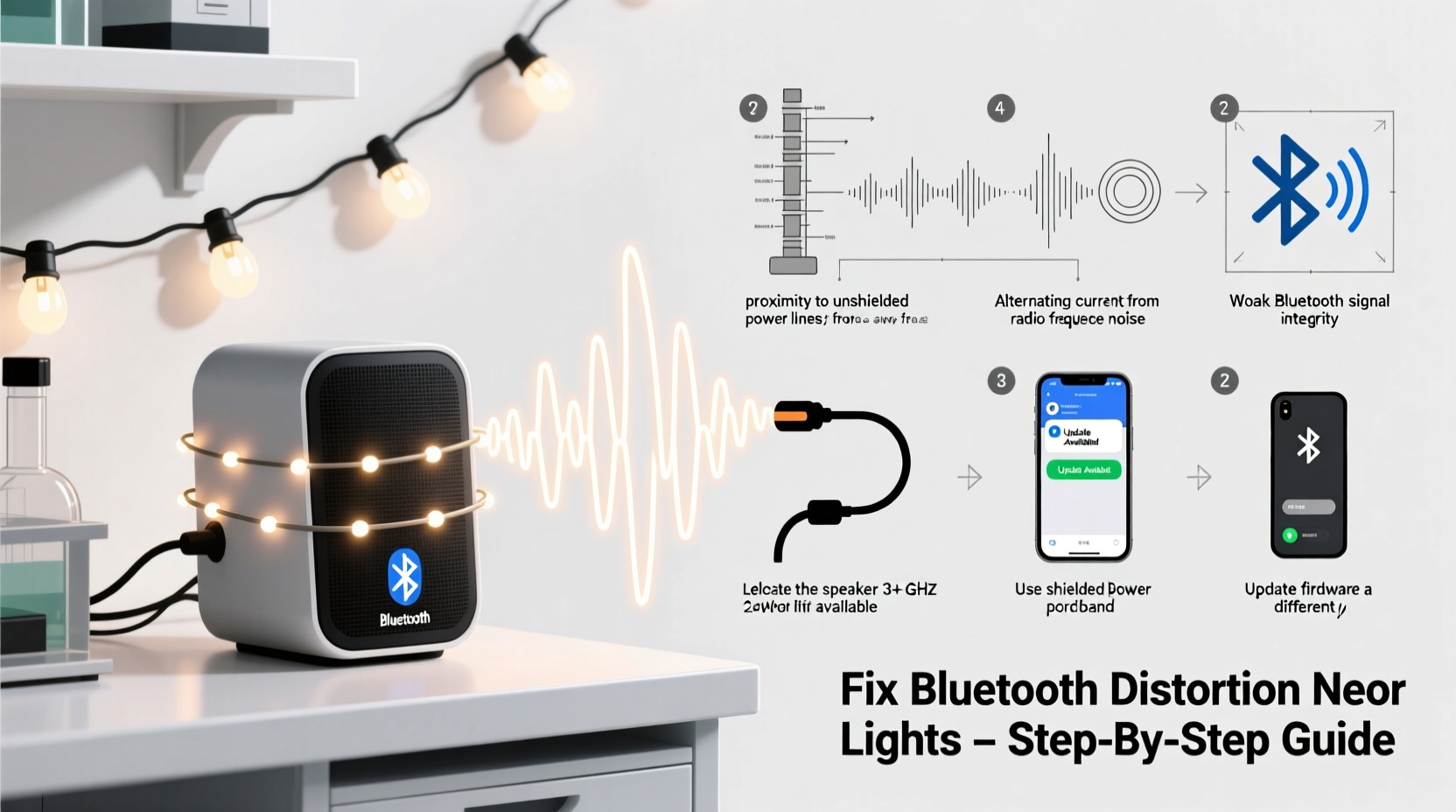
Bluetooth operates in the 2.4 GHz frequency band, the same range used by Wi-Fi, microwaves, and many household electronics. When multiple devices emit electromagnetic radiation in this spectrum, they create signal congestion. String lights, particularly those without proper shielding or using pulse-width modulation (PWM) for dimming, generate high-frequency electrical noise that overlaps with Bluetooth frequencies.
This interference doesn’t just disrupt data transmission—it can also affect the speaker’s internal amplifier and analog audio circuits. Even if the Bluetooth connection remains stable, the power supply feeding the speaker’s components may pick up ripple currents from nearby AC wiring, leading to audible hums or distortion in the output.
“Unshielded lighting systems act like miniature radio transmitters. When placed near sensitive audio gear, they introduce noise that degrades sound quality.” — Dr. Alan Reeves, Electrical Interference Researcher, MIT Media Lab
The effect is most noticeable with dynamic content like music, where subtle harmonics and rapid changes in volume make distortions more apparent. Carols, often rich in choral layers and sustained notes, amplify these flaws. A clean sine wave might survive the interference, but “Silent Night” certainly won’t.
Identifying the Source: Not All Lights Are Equal
Not every string of holiday lights causes interference. The risk depends on the type, age, and design of the lights. Here’s a breakdown:
| Light Type | Interference Risk | Why It Happens |
|---|---|---|
| Older Incandescent Sets | Medium | High current draw creates magnetic fields; loose wiring increases EMI. |
| Cheap LED Strands (Non-Rated) | High | Poorly regulated drivers emit RF noise; lack of EMI filters. |
| UL-Certified LED Lights | Low | Built-in shielding and compliance with FCC emission standards. |
| Smart RGB Lights (Wi-Fi/Bluetooth) | Very High | Dual wireless emissions + PWM dimming = severe interference. |
| Battery-Powered LED Lights | Low to None | No AC coupling; minimal electromagnetic leakage. |
If your speaker only distorts when certain light sets are on, you’ve likely pinpointed the culprit. Try turning off each set individually while playing a consistent audio track to isolate the offender.
Step-by-Step Guide to Eliminate Speaker Distortion
Fixing interference isn’t about replacing all your lights or buying expensive gear. Often, simple spatial and technical adjustments make all the difference. Follow this sequence:
- Relocate the Speaker: Move the Bluetooth speaker at least 6 feet (2 meters) away from any string lights, power strips, or transformers. Distance reduces field strength exponentially.
- Check Power Sources: Avoid plugging the speaker into the same outlet or power strip as the lights. Shared circuits amplify ground loop noise.
- Switch to Battery Power: If your speaker supports it, run it on internal battery instead of being plugged in. This breaks the conductive path for electrical noise.
- Use Shielded Cables: If connecting via auxiliary input, use a shielded 3.5mm cable. Unshielded cables act as antennas for EMI.
- Upgrade Light Quality: Replace unbranded or aging lights with UL-listed, FCC-compliant LED sets. Look for terms like “low EMI” or “audio-safe” on packaging.
- Enable Airplane Mode on Smart Lights: If using Wi-Fi-connected color-changing lights, disable their wireless functions temporarily during music playback.
- Test with Another Device: Pair a different Bluetooth source (phone, tablet) to confirm the issue isn’t originating from your playback device.
After each step, play a high-dynamic-range carol like “O Holy Night” and listen for clarity in the high notes and bass response. If distortion fades, you’ve found an effective solution.
Real-World Example: The Holiday Party Fix
Consider Sarah, who hosts an annual Christmas Eve gathering. Last year, her portable JBL speaker began distorting whenever she turned on the living room garland lights. Guests complained the music sounded “underwater.” She tried rebooting the speaker, re-pairing devices, and lowering the volume—all ineffective.
On a friend’s suggestion, she unplugged the lights and ran the speaker on battery. The audio cleared instantly. Further testing revealed her $12 Amazon LED strand lacked EMI suppression. She moved the speaker behind a bookshelf (adding physical shielding), switched to a higher-quality light set, and used a ferrite core on the aux cable as a backup. This year, her carols played flawlessly—even with full light displays.
Sarah’s case illustrates that solutions don’t require technical expertise—just observation and methodical troubleshooting.
Prevention Checklist: Keep Your Sound Clean Year After Year
- ✅ Audit all holiday lights for certification labels (UL, ETL, FCC)
- ✅ Keep audio devices at least 6 feet from decorative lighting
- ✅ Use battery operation for speakers during critical playback
- ✅ Install ferrite chokes on power and audio cables near interference zones
- ✅ Avoid daisy-chaining multiple light sets on one circuit
- ✅ Test audio setup before guests arrive or recordings begin
- ✅ Label problematic light sets for future reference
Advanced Solutions for Persistent Issues
If basic fixes fail, consider deeper interventions:
Ferrite Cores (Snap-On Chokes): These small cylindrical clamps absorb RF interference on cables. Place them on both ends of the speaker’s power cord and any connected audio lines. They’re inexpensive and effective for high-frequency noise.
Isolated Power Conditioners: Surge protectors with EMI/RFI filtering can clean incoming power. Models like the Furman PL-8 or Panamax M5400-PM provide filtered outlets specifically designed to protect audio equipment.
Wired Alternatives: As a last resort, bypass Bluetooth entirely. Use a 3.5mm AUX cable from your phone to the speaker. While less convenient, it eliminates wireless interference completely. For larger setups, consider a wired sound system with optical or coaxial inputs.
Faraday Placement: Position the speaker inside a partial metal enclosure (like a wire mesh cabinet) to block electromagnetic fields. Avoid fully enclosing it, which could overheat the unit or block Bluetooth signals.
“In professional audio environments, we assume all AC-powered decor is a threat until proven otherwise. Proactive isolation saves hours of debugging.” — Lena Torres, Live Sound Engineer
Frequently Asked Questions
Can LED lights really interfere with Bluetooth signals?
Yes. While LEDs themselves are low-emission, the driver circuits that regulate power often switch rapidly (using PWM), generating electromagnetic noise. Cheap or uncertified lights lack filtering components, allowing this noise to radiate into nearby devices.
Why does the distortion get worse when the lights dim or change colors?
Dimming and color shifting in LED strings rely on varying electrical pulses. These fluctuations increase electromagnetic variability, which can modulate with audio signals—creating rhythmic buzzing or warbling that syncs with light changes.
Will using a different Bluetooth codec help?
Not significantly. Codecs like aptX or AAC improve audio quality and latency but don’t enhance interference resistance. Bluetooth’s inherent protocol lacks robust error correction for EMI-related packet loss, so even high-end codecs suffer in noisy environments.
Final Thoughts: Harmony Between Lights and Sound
Holiday ambiance relies on both sight and sound. There’s no reason your cheerful rendition of “Jingle Bells” should be ruined by buzzing from a strand of lights. The interference is predictable, diagnosable, and almost always fixable with practical steps grounded in physics and real-world testing.
Start with distance and power separation. Upgrade outdated lights. Use shielding tools like ferrite cores. Most importantly, test early—don’t wait until Christmas morning to discover your sound system is compromised.
With a little attention to detail, you can have both a dazzling display and crystal-clear carols. The season deserves nothing less.




 浙公网安备
33010002000092号
浙公网安备
33010002000092号 浙B2-20120091-4
Comments
No comments yet. Why don't you start the discussion?