
It’s the holiday season, and you’ve carefully arranged your festive decor. The tree is up, lights are twinkling, and you've tucked your Bluetooth speaker inside the wooden base or trunk of your artificial tree stand—just out of sight but ready to fill the room with cheerful carols. But moments after starting your playlist, the music cuts out. You check your phone: the speaker shows as connected. Yet no sound plays. This frustrating scenario isn’t magic gone wrong—it’s physics.
The issue lies in how Bluetooth signals interact with physical materials, particularly dense ones like wood. While placing a speaker inside a tree stand may seem like a clever way to hide tech while amplifying ambiance, it can severely degrade wireless performance. Understanding the science behind this problem—and knowing how to solve it—can keep your holiday soundtrack uninterrupted.
How Bluetooth Works: A Signal-Sensitive Technology
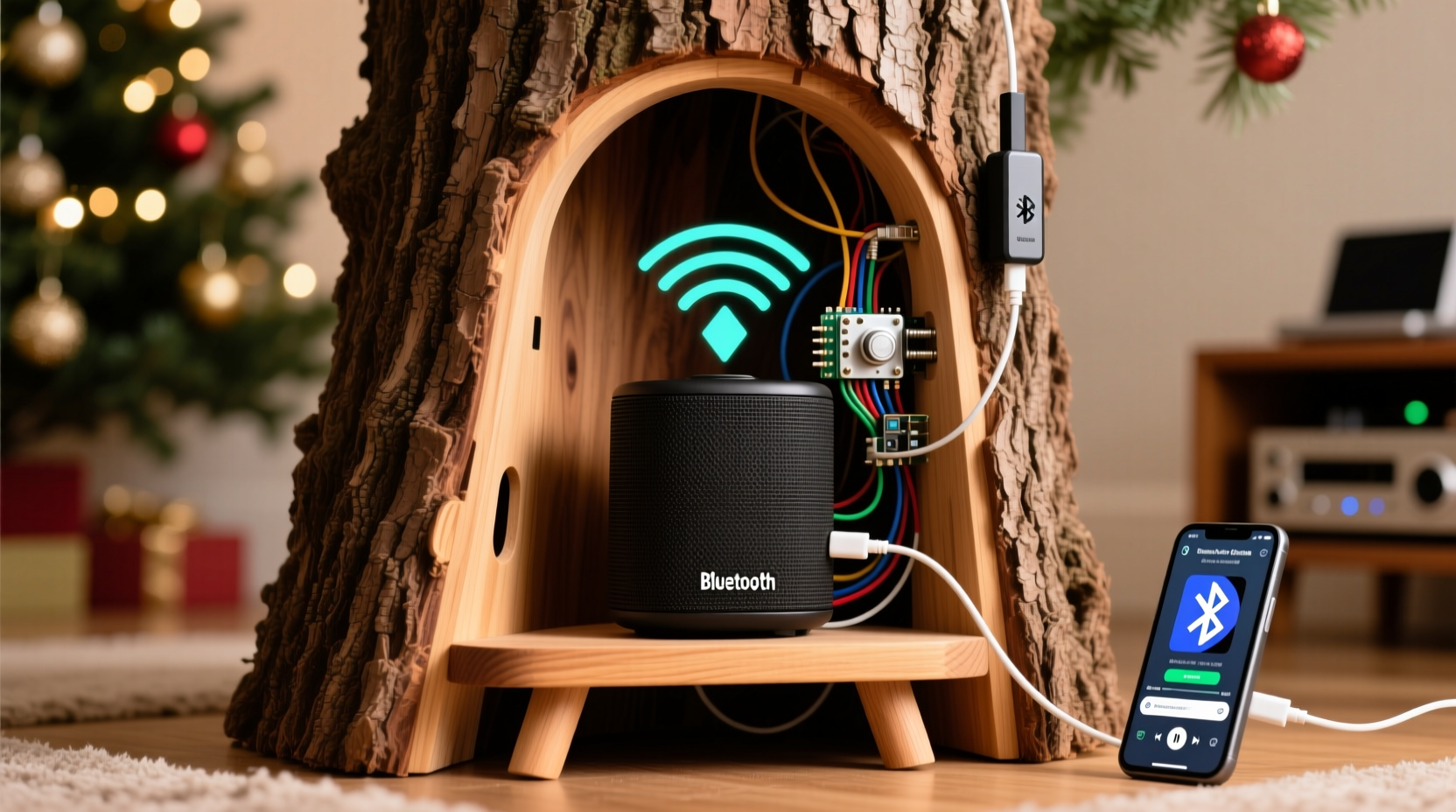
Bluetooth operates using short-range radio waves in the 2.4 GHz frequency band—the same range used by Wi-Fi routers, microwaves, and cordless phones. These signals transmit data wirelessly between paired devices, such as your smartphone and speaker, over distances typically limited to 30 feet (about 10 meters) in open space.
However, unlike wired connections, Bluetooth relies on line-of-sight propagation for optimal performance. When obstacles block or absorb these radio waves, signal strength diminishes. Materials like metal, concrete, water, and yes—wood—affect transmission differently based on density, thickness, and moisture content.
A wooden tree stand, especially one made from solid pine, oak, or MDF (medium-density fiberboard), acts as a partial barrier. Even though wood isn't a conductor like metal, its fibrous structure absorbs and scatters 2.4 GHz signals. The thicker and denser the wood, the greater the attenuation. If the speaker is fully enclosed within the stand, signal loss can exceed 70%, leading to frequent dropouts or complete disconnection.
“Bluetooth is designed for convenience, not penetration. Any enclosure—especially natural materials with high dielectric loss—will compromise reliability.” — Dr. Lena Park, Wireless Communication Engineer at MIT Media Lab
Why Holiday Decor Creates Unique Interference Challenges
Holiday setups introduce multiple layers of interference beyond just the wooden stand:
- Metal components: Many artificial trees contain steel frames or stands that reflect and disrupt radio waves.
- Water-based elements: Real trees retain moisture, and water strongly absorbs 2.4 GHz frequencies.
- Proximity to other electronics: Holiday lights, smart plugs, and streaming devices all operate in the same spectrum, increasing congestion.
- Physical obstructions: Gifts wrapped in foil paper, mirrors, or large furniture near the setup can create multipath interference (signals bouncing unpredictably).
In one documented case, a homeowner in Vermont reported consistent audio dropouts every time their holiday playlist reached “Jingle Bell Rock.” After testing various configurations, they discovered that the song’s higher bitrate caused slightly more data throughput, which overwhelmed an already weakened signal path due to the speaker being boxed in by a 1.5-inch-thick wooden base.
Material Impact on Bluetooth Signal Strength: A Comparative Overview
| Material | Signal Attenuation (dB loss per inch) | Effect on Bluetooth Range |
|---|---|---|
| Air (open space) | 0 dB | No reduction |
| Drywall | 1–2 dB | Slight weakening |
| Wood (solid pine) | 3–5 dB | Moderate reduction |
| MDF / Plywood | 6–8 dB | Significant degradation |
| Water (e.g., live tree sap/moisture) | 10+ dB | Severe blocking |
| Metal | 20+ dB | Near-total blockage |
This table illustrates why combining wood with potential moisture (from a real tree) or nearby metallic parts creates a perfect storm for signal failure. Each additional material layer compounds the loss exponentially, not linearly.
Step-by-Step Guide to Fixing Your Holiday Speaker Setup
If your Bluetooth speaker keeps cutting out during playback, follow this troubleshooting sequence:
- Relocate the speaker outside the tree stand. Place it on a nearby surface, angled toward the center of the room. Even moving it six inches away from the wood can restore full signal integrity.
- Ensure direct visibility between devices. Position your phone or tablet so there's a clear path to the speaker. Avoid placing either behind furniture or inside pockets.
- Reduce competing signals. Turn off unused Wi-Fi extenders, smart bulbs, or microwave ovens during extended playback sessions.
- Use lower-bitrate playlists temporarily. Streaming services often adjust quality based on connection; manually select standard quality instead of “high” or “lossless” if available.
- Pair again after relocation. Unpair and re-pair the speaker to reset the connection and force renegotiation of signal parameters.
- Test with a wired alternative. For critical events, consider using a 3.5mm AUX cable from your device to bypass Bluetooth entirely.
Real Example: The Case of the Silent Snowfall Playlist
In suburban Chicago, Maria Thompson decorated her living room each December with meticulous care. One year, she placed a compact JBL Flip 6 inside the hollow wooden pedestal of her pre-lit tree, proud of the invisible audio solution. As guests arrived, she queued up a curated “Silent Night & Cozy Fires” playlist.
Within minutes, guests noticed gaps in the music. The speaker would play for 30 seconds, then pause. Restarting the app didn’t help. She checked battery levels, restarted both devices, and even deleted and reinstalled the music app—all without success.
Only after consulting a neighbor who worked in AV production did she realize the issue: the speaker was effectively in a Faraday cage-like enclosure. The combination of thick engineered wood and a hidden location starved the Bluetooth signal. Once she moved the speaker onto a side table—still discreet but now exposed—the music played seamlessly throughout the evening.
Practical Tips to Maintain Audio Quality Without Sacrificing Aesthetics
You don’t have to choose between great sound and beautiful decor. With minor adjustments, both are possible:
- Place the speaker beneath the tree skirt rather than inside the stand—close enough to project sound upward through the branches.
- Choose Bluetooth 5.0+ devices, which offer better range and stability than older versions.
- Use a small rug or coaster to elevate the speaker slightly, reducing vibration absorption by carpet or wood flooring.
- Consider dual-speaker pairing (if supported) to distribute audio and reduce reliance on a single point of failure.
Checklist: Ensuring Reliable Holiday Bluetooth Playback
Before hitting play on your favorite seasonal mix, run through this quick checklist:
- ✅ Speaker is not enclosed in wood, metal, or thick plastic
- ✅ At least one side of the speaker faces open space
- ✅ No large electronic devices operating within 3 feet
- ✅ Phone/tablet battery is above 30% (low power can throttle Bluetooth)
- ✅ Device software is updated (fixes known connectivity bugs)
- ✅ Alternative audio method is ready (e.g., AUX cable or secondary speaker)
FAQ: Common Questions About Bluetooth and Holiday Setups
Can I use a Bluetooth extender or repeater for better signal?
Yes, though consumer-grade Bluetooth repeaters are rare. Most users achieve better results by upgrading to a mesh-enabled speaker system or using a Wi-Fi-based audio platform like Sonos, which bridges the gap between wireless convenience and structural resilience.
Will painting or varnishing the wooden stand make it worse?
Possibly. Finishes containing metallic pigments, gloss sealants with UV blockers, or thick epoxy coatings can increase signal reflection. Natural oils or matte finishes have minimal added impact.
What if I really want the speaker hidden inside the stand?
You can modify the stand to improve transmission. Drill small ventilation holes (¼ inch) spaced evenly around the top edge to allow signal leakage. Alternatively, line the interior with thin foam to prevent resonance while maintaining openness. Just avoid sealing all sides.
Conclusion: Harmony Between Tech and Tradition
The joy of the holidays often comes from blending tradition with modern comforts. Music plays a central role in setting the mood—but when technology falters under the weight of decor, the moment stumbles. The simple act of relocating a Bluetooth speaker just a few inches can preserve both aesthetic intent and audio reliability.
Understanding the limitations of wireless signals empowers smarter decisions. It’s not about rejecting innovation, but integrating it thoughtfully. This season, let your playlists flow freely, unblocked by well-meaning but signal-killing enclosures.




 浙公网安备
33010002000092号
浙公网安备
33010002000092号 浙B2-20120091-4
Comments
No comments yet. Why don't you start the discussion?