
If your Bluetooth tree speaker suddenly stutters or disconnects every time you open your oven, you're not imagining things — and it’s not a defect in your speaker. This is a real, physics-based phenomenon caused by electromagnetic interference (EMI) from your kitchen appliances. While it may seem minor, repeated signal disruption can degrade your listening experience and even shorten the lifespan of wireless connections over time. Understanding the root cause and implementing targeted fixes can restore uninterrupted playback and help you reclaim control over your smart home audio setup.
The Science Behind the Signal Drop
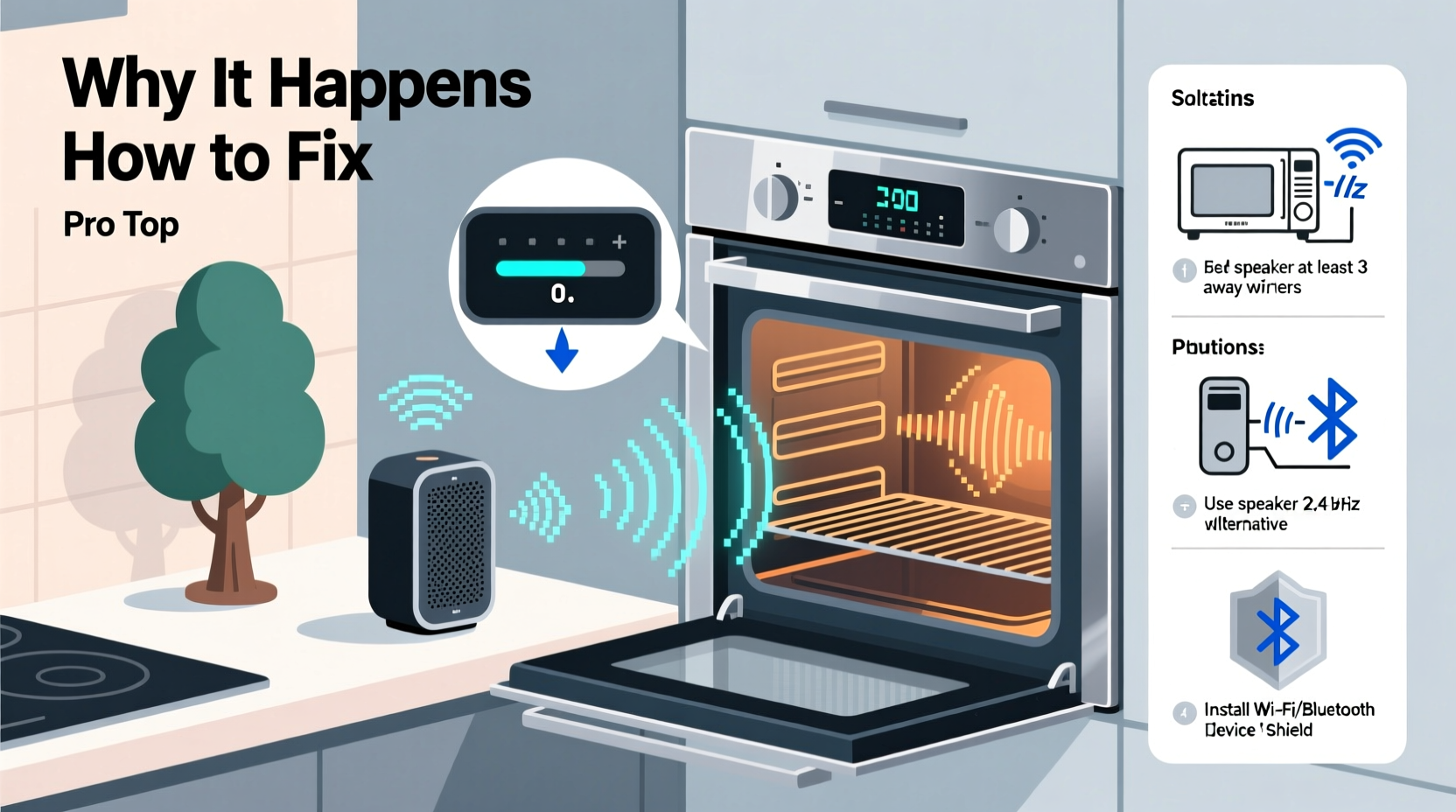
Bluetooth operates on the 2.4 GHz frequency band, the same range used by Wi-Fi routers, cordless phones, baby monitors, and many household appliances — including microwave ovens. When you open your oven door during or after heating, residual electromagnetic energy escapes, creating a brief but powerful burst of interference. Even if your oven isn’t actively microwaving, modern models often have digital displays, sensors, and internal circuitry that emit low-level radio frequency noise.
This interference doesn't \"target\" your tree speaker specifically. Instead, it floods the surrounding airwaves, overwhelming the relatively weak Bluetooth signal between your source device (like a phone or tablet) and the speaker. Because tree speakers are typically placed decoratively — near shelves, countertops, or kitchen corners — they often reside in close proximity to ovens, increasing exposure.
According to Dr. Lena Pruitt, an electrical engineer specializing in RF systems at MIT’s Wireless Communication Lab:
“Microwave leakage, even within safety standards, can momentarily saturate the 2.4 GHz ISM band. Bluetooth devices lack the power to compete with this kind of transient noise, especially when operating near physical obstructions like cabinetry or metal fixtures.” — Dr. Lena Pruitt, Electrical Engineer, MIT
How Ovens Disrupt Bluetooth: A Closer Look
Microwave ovens generate electromagnetic waves to agitate water molecules in food. These waves are contained within a shielded cavity, but no seal is perfect. Tiny amounts of radiation leak, particularly around the door seals. While these emissions are well below harmful levels for humans, they are strong enough to interfere with nearby wireless signals.
Additionally, the act of opening the oven door creates a sudden release of built-up energy and alters the electromagnetic field distribution in the kitchen. This dynamic shift can trigger momentary desynchronization in Bluetooth pairing protocols, causing reconnection delays or complete dropouts.
Tree speakers, designed more for aesthetics than high-powered transmission, often use Class 2 Bluetooth chips with a typical range of 10 meters (about 33 feet). Their compact size limits antenna efficiency, making them especially vulnerable to environmental disruptions.
Step-by-Step Guide to Diagnose and Fix the Interference
Resolving this issue requires a methodical approach. Follow these steps to identify the dominant source of interference and apply the most effective countermeasures.
- Confirm the correlation: Play a continuous audio stream through your tree speaker. Open the oven door multiple times to verify that disconnections consistently occur during or immediately after opening.
- Eliminate other variables: Turn off nearby Wi-Fi extenders, cordless phones, or USB 3.0 devices temporarily. Re-test to isolate whether the oven is the primary culprit.
- Relocate the speaker: Move the tree speaker at least 6–8 feet away from the oven, preferably out of direct line-of-sight. Avoid placing it behind metal objects or inside enclosed shelves.
- Switch audio sources: Try connecting from a different device (e.g., switch from phone to laptop). Some devices have stronger transmitters or better interference-handling firmware.
- Update firmware: Check the manufacturer’s app or website for updates. Many brands release patches to improve Bluetooth stability and EMI resistance.
- Test on battery: If your tree speaker supports battery operation, unplug it from AC power during testing. Power lines can carry electrical noise from the oven into connected devices.
- Use a wired alternative temporarily: Connect via AUX cable to confirm the speaker itself is functioning properly under stress.
By completing this diagnostic sequence, you’ll gain clarity on whether the problem is solvable through positioning, configuration, or requires additional hardware support.
Practical Solutions to Prevent Future Dropouts
Once you’ve confirmed the oven as the interference source, implement one or more of the following proven strategies to stabilize your connection.
1. Increase Physical Distance and Change Placement
Distance is the simplest and most effective mitigation. Electromagnetic field strength diminishes rapidly with distance (following the inverse-square law). Moving your speaker just a few feet farther from the oven can dramatically reduce signal disruption.
2. Use a Bluetooth Extender or Repeater
A Bluetooth repeater receives the original signal and rebroadcasts it from a new location, ideally on the opposite side of the oven. Place the repeater midway between your phone and the tree speaker to maintain a stable relay.
3. Switch to 5 GHz Wi-Fi for Streaming
If you’re streaming music via Wi-Fi (e.g., Spotify Connect, AirPlay), ensure your router broadcasts a 5 GHz network. Unlike 2.4 GHz, the 5 GHz band is immune to microwave interference and offers cleaner bandwidth. Connect your phone or streaming device to 5 GHz before sending audio to the Bluetooth speaker.
4. Install Ferrite Cores on Power Cables
Ferrite chokes suppress high-frequency noise traveling along power cords. Clip one onto the tree speaker’s power adapter near the plug. This reduces conducted interference that might otherwise amplify internal circuit noise.
5. Optimize Your Router Settings
If your Wi-Fi and Bluetooth share congestion, log into your router settings and manually set your 2.4 GHz channel to 1, 6, or 11 — the only non-overlapping channels. Avoid auto-selection, which may place your network too close to the microwave’s emission spectrum.
Comparison Table: Interference Sources & Mitigation Effectiveness
| Interference Source | Impact on Bluetooth | Effective Fixes | Difficulty Level |
|---|---|---|---|
| Microwave oven (in use) | Severe – full dropout likely | Distance, 5 GHz streaming, shielding | Medium |
| Oven control panel/sensors | Moderate – stuttering or lag | Ferrite cores, relocation | Low |
| Wi-Fi router on 2.4 GHz | Moderate – intermittent | Channel selection, 5 GHz shift | Low |
| USB 3.0 devices | Low to moderate | Distance, shielded cables | Low |
| Fluorescent lighting | Low – rare dropouts | Replace with LED | Medium |
Mini Case Study: Sarah’s Kitchen Audio Upgrade
Sarah installed a sleek Bluetooth tree speaker on her kitchen island to enjoy music while cooking. Within days, she noticed the audio would cut out every time she checked on dinner. At first, she assumed the speaker was faulty and considered returning it.
After reading about EMI, she decided to investigate. She turned off her Wi-Fi and tested the speaker using a locally stored playlist on airplane mode — the dropout still occurred when opening the oven. She then moved the speaker to a shelf in the adjacent dining area, six feet farther from the oven and behind a partial wall.
The result? No more interruptions. To further optimize, she began streaming from her phone connected to the 5 GHz Wi-Fi network and updated the speaker’s firmware. The combination eliminated all previous issues. Today, her speaker works flawlessly — even during peak cooking hours.
Checklist: Eliminate Oven-Induced Bluetooth Interference
- ✅ Confirm the oven is the source of interference
- ✅ Relocate the tree speaker at least 6 feet from the oven
- ✅ Connect your streaming device to a 5 GHz Wi-Fi network
- ✅ Update speaker firmware via manufacturer app
- ✅ Add a ferrite core to the speaker’s power cable
- ✅ Set router’s 2.4 GHz channel to 1, 6, or 11
- ✅ Test with a Bluetooth repeater if relocation isn’t possible
- ✅ Avoid placing speaker behind metal or dense materials
FAQ
Can a microwave permanently damage my Bluetooth speaker?
No. Microwave leakage within regulatory limits cannot physically damage your speaker. The effect is temporary signal disruption, not hardware degradation. However, frequent reconnect cycles may wear down software components over years of use.
Will switching to a different Bluetooth version help?
Partially. Bluetooth 5.0 and later offer better range, speed, and coexistence management with other 2.4 GHz devices. While not immune to oven interference, newer versions recover faster from dropouts and handle noisy environments more gracefully.
Is there a way to shield the speaker without moving it?
Yes, but with limitations. You can place a thin sheet of aluminum mesh (grounded, if possible) between the oven and speaker to reflect EMI. However, this may also block the Bluetooth signal unless carefully positioned. A better passive option is using furniture or decorative wood panels as non-conductive barriers.
Conclusion: Take Control of Your Smart Audio Environment
Your Bluetooth tree speaker shouldn’t fall silent every time you cook. The interference caused by opening your oven is predictable, diagnosable, and fixable. By understanding the role of electromagnetic fields and applying strategic placement, firmware updates, and network optimization, you can enjoy uninterrupted audio throughout your home — even in high-interference zones like the kitchen.
Don’t accept poor performance as inevitable. Small adjustments yield significant results. Start with relocation and firmware checks, then layer in technical enhancements like 5 GHz streaming or ferrite cores. Most importantly, test systematically so you know what’s working.




 浙公网安备
33010002000092号
浙公网安备
33010002000092号 浙B2-20120091-4
Comments
No comments yet. Why don't you start the discussion?