
It’s a familiar scene: you lie down, finally ready to rest after a long day, only for your mind to shift into overdrive. Suddenly, you’re replaying conversations from three years ago, planning next week’s grocery list, or worrying about a work deadline that feels both distant and urgent. Your body is still, but your brain won’t shut off. This phenomenon—racing thoughts at bedtime—is more common than many realize, affecting millions who struggle not with falling asleep due to physical fatigue, but because their minds refuse to disengage.
The irony is stark: the very act of trying to sleep can trigger mental hyperactivity. The quiet and stillness of the night remove external distractions, leaving room for internal noise to rise. Understanding why this happens—and what you can do about it—is key to reclaiming restful nights and improved daytime well-being.
Why Your Brain Races When You Try to Sleep
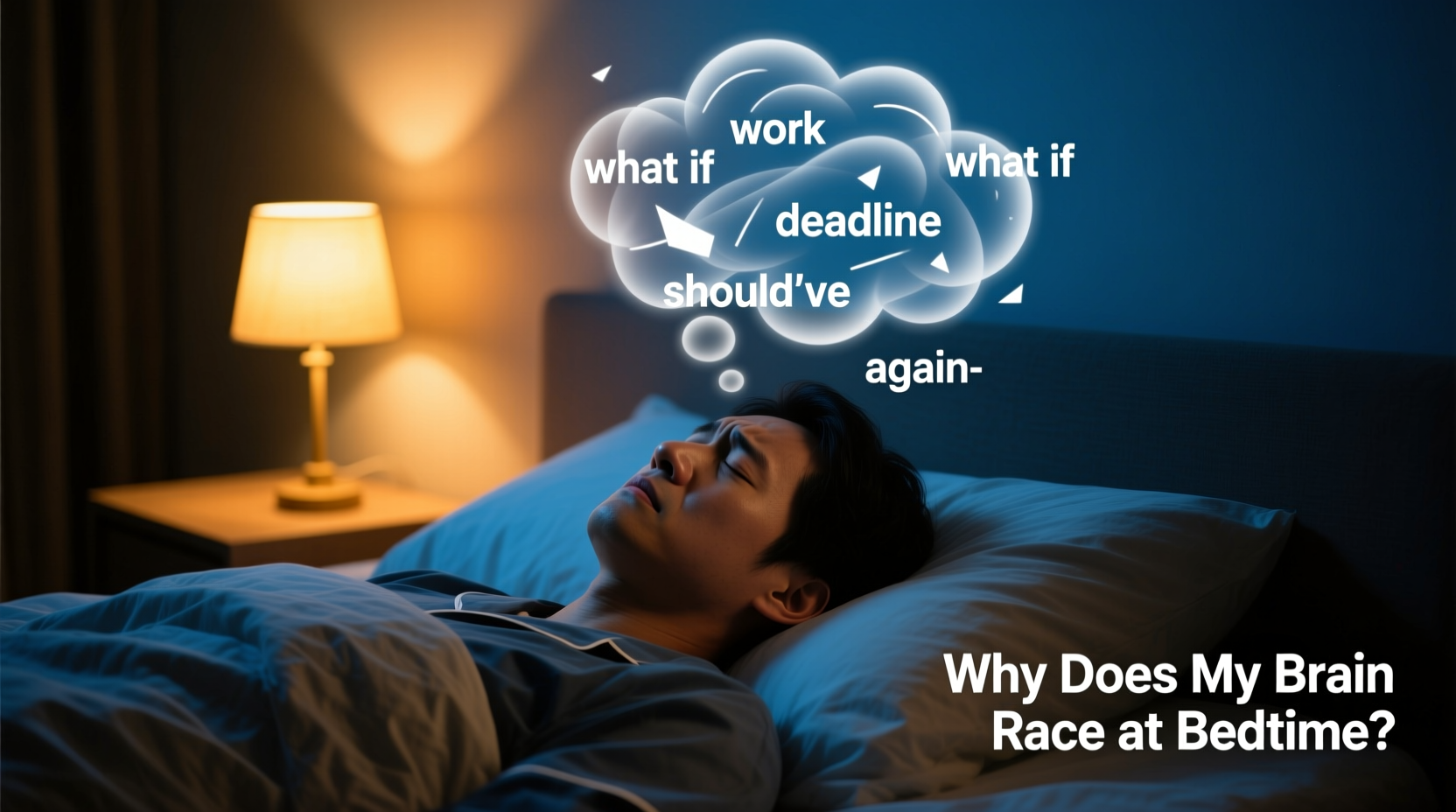
At its core, a racing mind at bedtime is often the result of an overactive default mode network (DMN)—a collection of brain regions active when we’re not focused on the outside world. During wakefulness, especially in silence and darkness, the DMN becomes more engaged, leading to self-referential thinking, rumination, and future projection.
Several factors contribute to this nighttime mental surge:
- Stress Accumulation: Daily stressors, even minor ones, build up cortisol levels. Without proper emotional processing during the day, the brain attempts to “catch up” at night.
- Lack of Mental Boundaries: Constant connectivity—emails, social media, notifications—keeps the brain in a state of alertness, making it difficult to transition to rest.
- Unresolved Thoughts: Unfinished tasks or unresolved emotions activate the Zeigarnik effect—the psychological tendency to remember incomplete tasks more than completed ones.
- Circadian Misalignment: Going to bed too late or irregular sleep schedules can disrupt melatonin release, increasing alertness when you should be winding down.
- Anxiety Patterns: For those prone to anxiety, bedtime offers no escape from intrusive thoughts, which are often worse in the absence of distraction.
“Nighttime is when the mind reviews the day like a courtroom replaying evidence. If we don’t process emotions earlier, the trial happens at 2 a.m.” — Dr. Lena Patel, Cognitive Behavioral Therapist
Effective Strategies to Quiet Nighttime Thoughts
Quieting a racing mind isn’t about suppression—it’s about redirection, regulation, and routine. The goal is not to eliminate thoughts, but to change your relationship with them. Below are proven, practical techniques backed by neuroscience and clinical psychology.
1. Create a Pre-Sleep Mental Dump
One of the most effective ways to clear mental clutter is to transfer it out of your head. Spend 10–15 minutes before bed writing down everything on your mind—worries, to-dos, ideas, regrets. Use a notebook or digital journal, but avoid screens if possible.
This practice reduces cognitive load by signaling to your brain that nothing will be lost. Research shows that expressive writing before bed improves sleep onset and quality, particularly in individuals with high cognitive arousal.
2. Practice Structured Worry Time Earlier in the Day
Rather than letting worries surface unpredictably at night, schedule a dedicated 15-minute “worry window” earlier in the evening—say, between 6:00 and 7:30 p.m. During this time, allow yourself to focus entirely on concerns. Write them down, explore solutions, or simply acknowledge them.
When nighttime arrives and a worry emerges, remind yourself: “I already addressed this during my worry time,” or “I’ll save this for tomorrow’s session.” This trains the brain to defer rumination, reducing its urgency at bedtime.
3. Use Cognitive Shifting Techniques
When thoughts spiral, redirect attention with structured mental exercises:
- Counting Backward from 100 by 3s: Engages working memory and distracts from emotional loops.
- Mental Imagery: Visualize walking through a familiar, calming place—a forest path, a quiet beach, your childhood home.
- Alphabet Games: Name one animal, city, or food for each letter. Keeps the mind busy without emotional engagement.
These aren’t distractions; they’re cognitive placeholders that prevent rumination from dominating your mental space.
Step-by-Step Wind-Down Routine for a Calmer Mind
A consistent pre-sleep ritual signals safety and predictability to the nervous system. Follow this 45-minute wind-down sequence:
- 8:15 PM – Digital Sunset: Turn off phones, tablets, and laptops. Enable “Do Not Disturb” mode.
- 8:20 PM – Light Stretching or Gentle Yoga: Focus on slow movements and breath. Avoid vigorous exercise.
- 8:30 PM – Journaling Session: Complete your mental dump. Close the notebook physically and symbolically.
- 8:45 PM – Low-Stimulus Activity: Read a physical book (fiction or non-stimulating content), listen to calm music, or sip herbal tea.
- 9:00 PM – Dim Lights & Prepare Environment: Lower room lighting, set thermostat to cool (60–67°F ideal), ensure bed is comfortable.
- 9:15 PM – Mindfulness or Breathing Practice: Try 4-7-8 breathing: inhale for 4 seconds, hold for 7, exhale for 8. Repeat 4 cycles.
“The nervous system doesn’t distinguish between ‘productive’ thinking and stress. It only knows arousal. Our job is to lower the signal.” — Dr. Marcus Reed, Sleep Neurologist
Common Mistakes That Fuel Nighttime Mental Activity
Even with good intentions, certain habits inadvertently keep the mind active. Recognizing these pitfalls is half the battle.
| Mistake | Why It’s Harmful | Better Alternative |
|---|---|---|
| Using phone in bed to “relax” | Blue light suppresses melatonin; content triggers cognitive engagement | Read a paperback or listen to an audiobook with eyes closed |
| Drinking alcohol before bed | Disrupts REM sleep and increases nocturnal awakenings | Opt for chamomile tea or tart cherry juice |
| Trying hard to fall asleep | Creates performance pressure, increasing anxiety | Adopt passive intention: “I’m resting my body, sleep may come” |
| Keeping lights on when waking at night | Signals wakefulness to the brain, disrupting sleep continuity | Use dim red nightlight if needed; avoid overhead lights |
| Checking the clock repeatedly | Triggers time-related anxiety (“Only 3 hours left!”) | Turn the clock away or cover it |
Real-Life Example: How Sarah Regained Her Sleep
Sarah, a 34-year-old project manager, began experiencing chronic insomnia after a major work restructuring. Despite being exhausted, she’d lie awake for hours, mentally reviewing emails, anticipating meetings, and worrying about team dynamics. She tried meditation apps and sleeping pills, but nothing provided lasting relief.
Working with a sleep coach, Sarah implemented a structured wind-down routine and introduced “worry time” at 7:00 p.m. She also started using a physical notebook to log thoughts before bed. Within two weeks, her sleep latency dropped from 90 minutes to under 30. “It wasn’t that I had fewer thoughts,” she said. “It was that I stopped feeling responsible for solving them at midnight.”
After six weeks, Sarah reported deeper sleep and improved focus during the day. Her experience underscores a crucial insight: control over sleep begins long before the lights go out.
Checklist: 7 Daily Habits to Prevent Nighttime Overthinking
Long-term relief comes from daily practices that reduce baseline mental clutter. Use this checklist to build resilience against nighttime rumination:
- ✅ Schedule 15 minutes of “worry time” in the early evening
- ✅ Write down unfinished tasks before dinner
- ✅ Limit caffeine after 2 p.m.
- ✅ Avoid intense discussions or stressful media within 2 hours of bed
- ✅ Practice 5 minutes of mindfulness or box breathing during the day
- ✅ Keep a consistent wake-up time, even on weekends
- ✅ Reflect on one positive moment from the day before turning off lights
Frequently Asked Questions
Is a racing mind at night a sign of anxiety disorder?
Not necessarily. Occasional nighttime rumination is normal, especially during stressful periods. However, if racing thoughts occur most nights, interfere with sleep, and are accompanied by daytime tension or dread, it may indicate generalized anxiety disorder. In such cases, professional evaluation is recommended.
Can medication help with a racing mind at bedtime?
Short-term use of certain medications (like low-dose sedatives or melatonin agonists) may help break the cycle of insomnia, but they don’t address the root cause. Cognitive-behavioral therapy for insomnia (CBT-I) is considered the gold standard for chronic nighttime overthinking and has longer-lasting results than medication alone.
What if I don’t feel tired, but my mind is still active?
This is often a sign of misaligned circadian rhythm or poor sleep drive. Ensure you’re getting enough daylight exposure in the morning, avoid naps longer than 20 minutes, and consider gradually shifting your bedtime earlier by 15-minute increments until you begin to feel drowsy at your target hour.
Final Thoughts: Reclaiming Rest Through Intentional Stillness
A racing mind at bedtime is not a life sentence. It’s a signal—an invitation to examine how you process thoughts, manage stress, and transition from activity to rest. The solution lies not in forcing silence, but in creating systems that honor your mind’s need to process while guiding it toward peace.
Small, consistent changes compound over time. Whether it’s journaling, scheduled worry time, or a disciplined digital curfew, each step you take recalibrates your relationship with your thoughts. Sleep isn’t just about closing your eyes; it’s about giving your mind permission to let go.




 浙公网安备
33010002000092号
浙公网安备
33010002000092号 浙B2-20120091-4
Comments
No comments yet. Why don't you start the discussion?