
There are few things more frustrating than turning on your car’s air conditioning on a hot summer day, only to feel warm air blowing through the vents—especially when it happens only at idle. You press the gas, and suddenly cold air returns. This inconsistent cooling pattern is not just uncomfortable; it's a clear symptom of an underlying issue in your vehicle’s AC system. Unlike complete AC failure, this behavior points to specific mechanical or thermal inefficiencies that tend to surface when the engine isn’t under load.
The root causes often involve airflow, refrigerant pressure, or component performance at low engine speeds. Understanding why this occurs—and how to fix it—can save you from unnecessary repairs, wasted money, and sweltering commutes.
How Your Car’s AC System Works Under Load vs. Idle
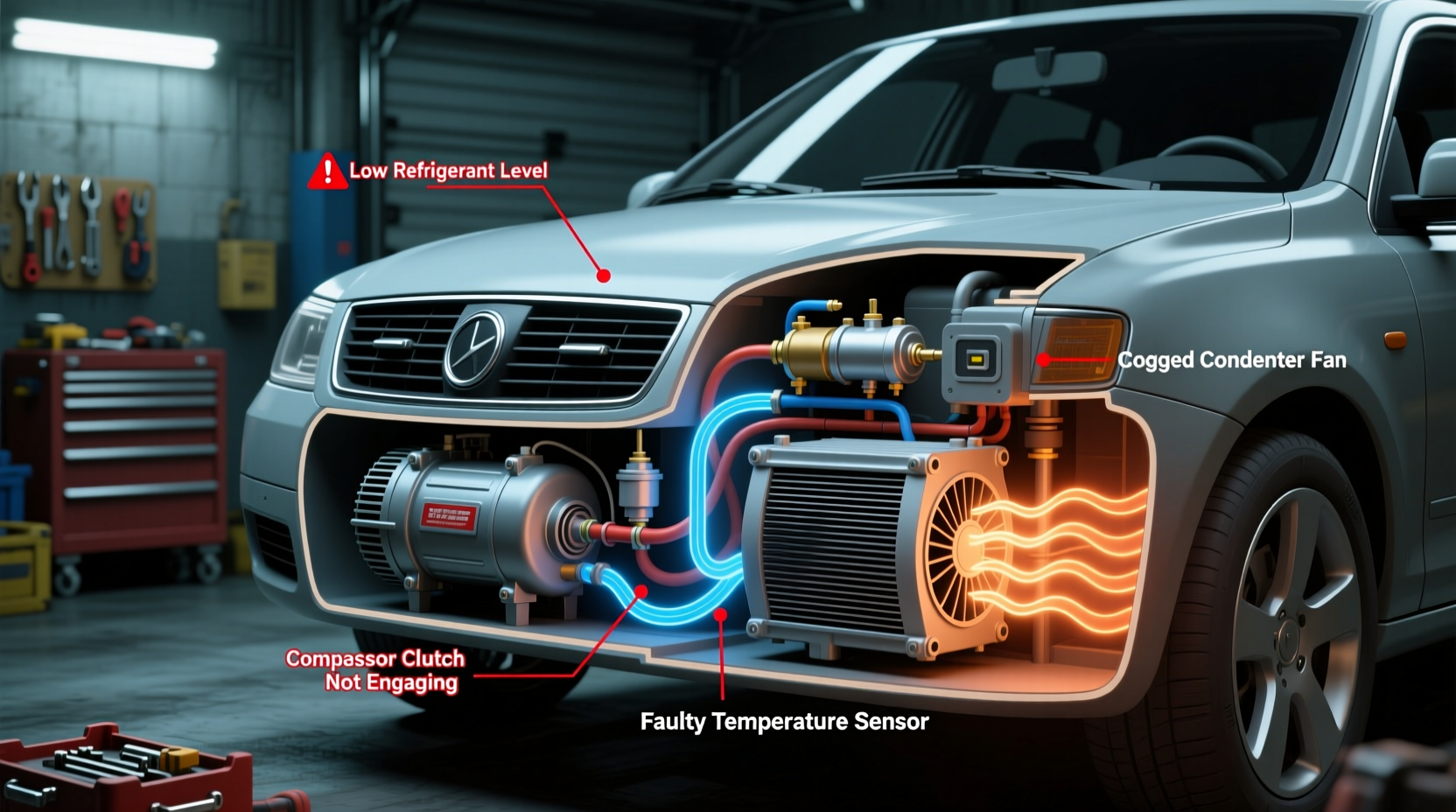
To understand why your AC fails at idle but works while driving, it helps to know how the system operates differently depending on engine speed.
The air conditioning system relies on several components: the compressor, condenser, evaporator, expansion valve, and refrigerant. The compressor, driven by the engine via a serpentine belt, pressurizes the refrigerant and circulates it through the system. When the engine runs faster (such as during acceleration), the compressor spins faster, increasing refrigerant flow and heat exchange efficiency.
At idle, however, engine RPM drops significantly—typically between 600 and 900 revolutions per minute. This reduced speed means the compressor cycles less frequently and generates lower pressure. If any part of the system is marginally weak or inefficient, this drop in performance becomes evident.
Additionally, the condenser—located in front of the radiator—relies heavily on airflow to dissipate heat from the refrigerant. While driving, natural airflow cools the condenser effectively. At a stop, the system depends entirely on the cooling fan. If that fan isn’t working properly, heat builds up around the condenser, reducing its ability to cool the refrigerant.
Common Causes of Warm Air at Idle
Several interrelated factors can cause your car’s AC to blow warm air only when idling. Most stem from reduced cooling efficiency under low-load conditions.
1. Failing Cooling Fan or Relay
The electric cooling fan pulls air through the condenser when the vehicle isn’t moving fast enough for ram air to do the job. If the fan motor burns out, the relay fails, or the fuse is blown, the condenser overheats during idle. As a result, high-side pressure rises, and the refrigerant can’t release heat efficiently, leading to warm air from the vents.
2. Low Refrigerant Charge
Even a slightly low refrigerant level can disrupt system balance. At higher RPMs, the compressor may still maintain enough pressure to produce cold air. But at idle, insufficient refrigerant prevents proper cycling. Many modern vehicles have pressure switches that disengage the compressor if pressure falls too low—a safety feature that kicks in more readily at idle.
3. Clogged or Dirty Condenser
Over time, the condenser accumulates dirt, bugs, leaves, and debris. A partially blocked condenser restricts airflow, impairing heat dissipation. This issue worsens at idle because there’s no forward motion to force air through. The trapped heat raises refrigerant temperature and pressure, compromising cooling.
4. Worn or Slipping AC Compressor
If the compressor clutch is worn or the internal valves are failing, it may not build sufficient pressure at low RPM. You might hear a clicking sound when the clutch engages and disengages rapidly—a sign the system is cycling due to pressure imbalances. At idle, this leads to intermittent cooling or no cooling at all.
5. Faulty Thermostatic Expansion Valve (TXV)
The TXV regulates refrigerant flow into the evaporator based on temperature and pressure. If it’s stuck or malfunctioning, it may not meter refrigerant correctly at low compressor speeds. This results in poor evaporator cooling, especially when demand is low—like at idle.
6. Engine Overheating Affecting AC Performance
While not directly part of the AC system, engine temperature impacts overall thermal load. If your engine runs hotter than normal—even within the “normal” gauge range—it increases underhood temperatures. This ambient heat affects the AC components, particularly the condenser, making it harder to reject heat from the refrigerant.
“Many drivers don’t realize that engine cooling issues can indirectly cripple AC performance at idle. It’s all about underhood thermodynamics.” — Carlos Mendez, ASE-Certified Master Technician
Step-by-Step Diagnostic Process
Before spending money on parts or professional service, follow this logical sequence to identify the source of the problem.
- Start the engine and turn on the AC at maximum cooling. Let the car idle for 3–5 minutes. Feel the air from the vents. Is it warm?
- Rev the engine slightly (to about 1,500 RPM). Does the air become noticeably colder within 30 seconds? If yes, the issue is likely related to airflow or low-speed compressor performance.
- Open the hood and observe the cooling fan(s) behind the radiator. After 2–3 minutes of idling with the AC on, the fan should activate. If it doesn’t, check the fuse, relay, and wiring. Use a multimeter to test voltage at the fan connector.
- Inspect the condenser visually. Look through the grille area. Is it clogged with debris? Use a flashlight to check for blockages between the fins. Gently clean with compressed air or a soft brush.
- Check refrigerant level using gauges (if experienced). Connect AC manifold gauges to the low and high-side ports. At idle with AC on, ideal readings are:
- Low side: 25–40 psi
- High side: 200–250 psi
- Listen for compressor clutch engagement. When you turn on the AC, you should hear a click, followed by a slight change in engine idle. If the clutch cycles on and off rapidly, it indicates low refrigerant or a pressure switch issue.
- Scan for trouble codes (if applicable). Some vehicles monitor AC pressure electronically. A faulty sensor or circuit may disable the compressor at idle. Use an OBD2 scanner to check for pending codes related to the AC system.
Possible Fixes and Repair Options
Based on your findings, here are targeted solutions for each potential cause.
Replace or Repair the Cooling Fan
If the fan isn’t running, start with the simplest fixes: replace the fuse or relay. These are inexpensive and easy to swap. If those are good, test the fan motor directly with 12 volts. If it doesn’t spin, replace the motor. In some cases, the fan control module (often integrated with the radiator fan assembly) fails and must be replaced as a unit.
Recharge the Refrigerant
If gauges show low pressure, the system likely has a leak. Simply adding refrigerant without fixing the leak is a temporary fix. However, if the system was recently serviced and lost only a small amount, a recharge may suffice. Use a refill kit with dye to help locate future leaks. Always follow EPA guidelines—never vent refrigerant into the atmosphere.
Clean the Condenser
Use a garden hose (low pressure) or compressed air to flush out debris from the front and back of the condenser. Avoid bending the delicate fins. For stubborn grime, use a coil cleaner designed for automotive condensers. Let it sit for a few minutes, then rinse thoroughly.
Repair or Replace the Compressor
If the compressor clutch slips, makes grinding noises, or fails to engage consistently, replacement is usually necessary. This is a complex job requiring evacuation of refrigerant, disassembly, and recharging. Expect labor costs to exceed parts in many cases. Always replace the receiver/drier or accumulator when opening the system to prevent moisture contamination.
Inspect and Replace the TXV or Orifice Tube
In systems with a thermostatic expansion valve, a malfunctioning TXV can cause poor metering at low flow rates. Some vehicles use a fixed orifice tube instead—check your service manual. If clogged, replace it. Flushing the system may be required if metal shavings or debris are present.
Do’s and Don’ts: AC Maintenance Checklist
| Do | Don't |
|---|---|
| Run the AC for at least 10 minutes weekly, even in winter, to keep seals lubricated. | Ignore strange noises like squealing or grinding from the compressor. |
| Clean the condenser annually, especially if you drive on dusty roads. | Use stop-leak products—they can clog the TXV or orifice tube. |
| Check the cooling fan operation every spring before summer hits. | Overfill refrigerant—too much is as harmful as too little. |
| Replace the cabin air filter every 12,000–15,000 miles. | Assume “R134a” cans from auto stores are plug-and-play—many lack accurate gauges or leak detection. |
Real-World Example: Solving a Persistent Idle Issue
Consider the case of a 2014 Honda Accord brought into a suburban repair shop. The owner complained that the AC blew warm air at traffic lights but cooled normally on the highway. Initial inspection revealed the cooling fan wasn’t activating. The technician checked the fuse—good—and swapped the relay with a known working one—still no fan.
Using a scan tool, he found no commands being sent to the fan control module. Further diagnosis traced the issue to a failing coolant temperature sensor sending erratic data. Even though the engine wasn’t overheating, the inaccurate signal prevented the AC system from enabling the fan. Replacing the sensor restored full fan operation and fixed the AC issue.
This case highlights how interconnected modern vehicle systems are. What seemed like an AC problem was actually rooted in engine management.
Frequently Asked Questions
Can low oil in the AC compressor cause warm air at idle?
Yes. The compressor relies on refrigerant oil for lubrication. If the system has leaked refrigerant, oil may have escaped too. Low oil leads to increased friction and heat, reducing compressor efficiency—especially at low RPM. However, oil loss is usually a consequence of a leak, not the primary cause.
Is it safe to drive with AC that only works when moving?
It’s safe mechanically, but not advisable in hot climates. Prolonged exposure to high cabin temperatures can lead to discomfort or heat stress. Additionally, ignoring the issue may lead to compressor damage due to overheating or inadequate lubrication. Address the root cause promptly.
Why does my car AC work fine in the morning but fail later in the day?
This often points to a marginal cooling fan or refrigerant issue. In cooler morning temperatures, the condenser can shed heat more easily, masking the problem. As ambient temperatures rise, the system’s weaknesses become apparent. Check the fan and refrigerant levels first.
Conclusion: Take Action Before Summer Peaks
Warm air from your car’s AC at idle isn’t something to ignore. It’s a warning sign that your cooling system is operating on the edge. Whether it’s a simple fan relay or a deeper refrigerant issue, early diagnosis saves money and keeps you comfortable on the road.
Start with visual and operational checks—fan function, condenser cleanliness, and basic performance under rev. If you’re unsure, consult a certified technician with AC experience. They can perform a vacuum test, pressure analysis, and leak detection with professional tools.
Your car’s air conditioning is more than a comfort feature—it’s part of your driving safety system, especially in extreme heat. By understanding the causes and solutions, you take control of your vehicle’s performance and reliability.




 浙公网安备
33010002000092号
浙公网安备
33010002000092号 浙B2-20120091-4
Comments
No comments yet. Why don't you start the discussion?