
Cats are natural hunters. Their instincts drive them to stalk, pounce, and bat at anything that moves—especially if it flickers, glows, or dangles unpredictably. During the holiday season, this instinct often collides with festive decor, particularly blinking Christmas lights. While charming in concept, a cat leaping at a lit tree can quickly turn into a safety hazard for both pet and household. Understanding why this behavior occurs is the first step toward managing it effectively.
The fascination isn’t random. Blinking lights mimic the erratic movements of prey: quick flashes simulate scurrying insects or darting rodents. Combined with the reflective surfaces of ornaments and the swaying motion of tinsel, a Christmas tree becomes an irresistible jungle gym for a curious feline. But unchecked, this play can lead to broken bulbs, chewed cords, knocked-over trees, and even electrocution or ingestion of foreign materials. The solution isn’t to suppress your cat’s instincts but to redirect them safely and humanely.
The Science Behind Feline Fascination with Lights
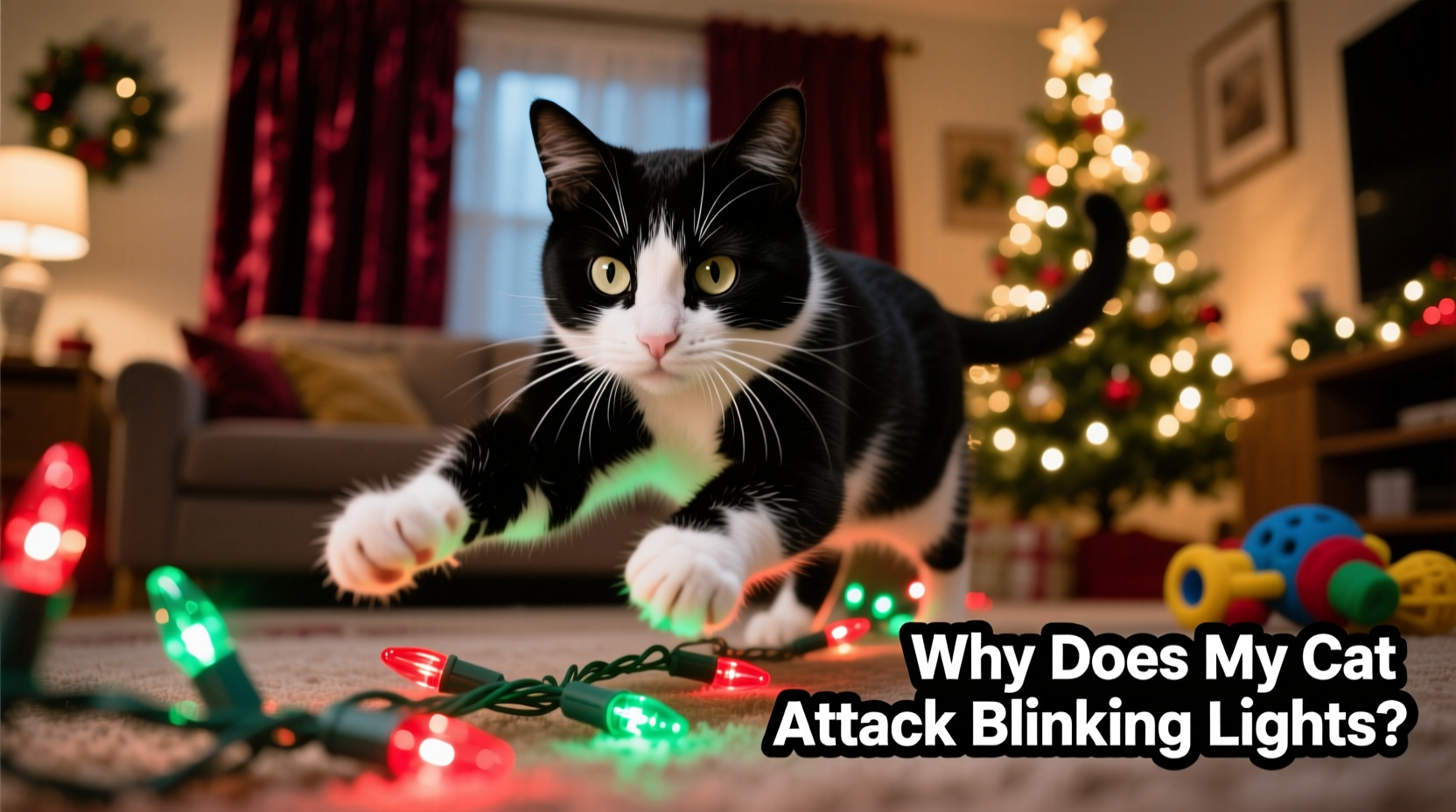
Cats perceive light differently than humans. Their eyes are optimized for detecting movement in low-light conditions, a trait inherited from nocturnal ancestors. The retina contains a high concentration of rod cells, which excel at spotting motion and processing flickering stimuli. This makes blinking or twinkling lights especially stimulating—even more so when they appear suddenly or pulse rhythmically.
Dr. Sarah Lim, a veterinary behaviorist at the American College of Veterinary Behaviorists, explains:
“Cats don’t just see blinking lights—they experience them as dynamic stimuli. Each flash triggers a micro-response in the visual cortex, activating hunting circuits in the brain. It’s not mischief; it’s neurology.”
In domestic settings, where real prey is scarce, cats rely on environmental cues to satisfy their predatory sequence: spot, stalk, chase, pounce, bite, and chew. A strand of blinking lights offers intermittent reinforcement—each flicker reignites attention and motivates another attempt. Over time, the behavior becomes self-reinforcing, especially if the cat receives any form of attention (even negative) after attacking the lights.
Common Risks of Unmanaged Light-Chasing Behavior
While the behavior may seem harmless or even endearing, allowing a cat unrestricted access to Christmas lights poses several risks:
- Electrical hazards: Chewing through cords can lead to electric shock or burns. Even low-voltage LED strands carry risk if damaged.
- Ingestion of materials: Broken glass from ornaments, plastic fragments, or tinsel can cause intestinal blockages—a medical emergency.
- Trauma from falling objects: A toppled tree can injure the cat or damage furniture and flooring.
- Stress and anxiety: Repeated scolding can increase fear-based behaviors, damaging trust between pet and owner.
How to Redirect Your Cat’s Attention Safely
Effective redirection doesn’t involve punishment. Instead, it relies on environmental enrichment, strategic management, and positive reinforcement. The goal is to make alternative activities more appealing than light-chasing.
1. Modify the Environment
Start by making the tree and surrounding area less accessible and less tempting:
- Use cord concealers or conduit tubing to hide electrical wires along baseboards.
- Secure the tree to a wall or ceiling bracket to prevent tipping.
- Avoid tinsel, ribbon, or small ornaments within reach—these are high-risk items for ingestion.
- Place citrus-scented cotton balls around the base (most cats dislike the smell, though test first).
2. Introduce Competing Stimuli
Provide engaging alternatives that satisfy the same sensory needs:
- Set up a “hunting station” nearby with motion-activated toys or laser pointers on timers.
- Use puzzle feeders filled with treats to encourage foraging behavior.
- Install a bird feeder outside a nearby window to offer natural visual stimulation.
3. Train with Positive Reinforcement
Teach your cat to associate the tree area with calm behavior:
- When your cat approaches the tree without swatting, immediately offer a treat or toy.
- Use a consistent verbal cue like “tree = calm” paired with rewards.
- Gradually increase the duration of calm behavior required before rewarding.
Over time, your cat learns that peaceful presence near the tree leads to better outcomes than attacking lights.
Step-by-Step Guide to Prevent Light Attacks
Follow this five-day plan to reduce and ultimately redirect your cat’s fixation on blinking lights:
- Day 1: Assess and Secure
Inspect all cords, anchor the tree, remove hazardous ornaments, and install barriers if needed (e.g., baby gates). - Day 2: Introduce Alternatives
Set up interactive toys, window perches, or a second “cat tree” decorated with safe, dangling toys. - Day 3: Begin Conditioning
Spend 10–15 minutes twice daily near the tree, rewarding calm behavior with treats or affection. - Day 4: Monitor and Redirect
If your cat lunges at lights, calmly say “no” and immediately redirect to a toy. Do not shout or punish. - Day 5: Evaluate and Adjust
Assess progress. If attacks persist, consider using motion-activated air sprayers (safe deterrents that startle without harm).
Do’s and Don’ts When Managing Light-Chasing Behavior
| Do’s | Don’ts |
|---|---|
| Use battery-operated lights to eliminate exposed cords | Leave cords exposed or unsecured |
| Supervise interactions during initial exposure | Allow unsupervised access early in training |
| Rotate toys weekly to maintain novelty | Use the same toys indefinitely |
| Offer food puzzles near the tree area | Punish or yell when your cat jumps |
| Choose shatterproof, lightweight ornaments | Hang fragile or valuable decorations within reach |
Real-Life Example: Redirecting Luna’s Tree Obsession
Luna, a 3-year-old tabby from Portland, Oregon, had a history of scaling the Christmas tree every holiday season. Her owners reported shattered ornaments, chewed wires, and one incident where she pulled the entire tree onto the couch. After consulting a certified animal behavior consultant, they implemented a multi-pronged strategy:
- They replaced plug-in lights with battery-powered fairy lights.
- Installed a freestanding cat tree beside the Christmas tree, complete with dangling feather toys and a heated perch.
- Introduced a timed automatic laser toy that activated every 30 minutes in the living room.
- Began a reward system: every time Luna approached the real tree without touching it, she received a freeze-dried chicken treat.
Within two weeks, Luna’s interest in the Christmas tree dropped by over 80%. By mid-December, she spent most evenings napping on her own cat tree, occasionally glancing at the blinking lights but no longer engaging. Her owners noted improved confidence and reduced anxiety overall.
Expert Insight: Why Punishment Doesn’t Work
Many owners instinctively respond to destructive behavior with reprimands. However, experts agree this approach backfires. Dr. Karen Overall, a renowned veterinary behaviorist, states:
“Punishment disrupts learning. Cats don’t connect delayed consequences with past actions. Scolding a cat ten minutes after chewing a wire only teaches them to fear you—not the wire.”
Instead, focus on antecedent management—changing the environment before the behavior occurs—and reinforcing desirable actions. This builds trust and long-term behavioral change.
Checklist: Holiday-Proof Your Home for Cats
- ✅ Secure all electrical cords with covers or raceways
- ✅ Anchor the Christmas tree to a stable surface
- ✅ Replace glass ornaments with soft, fabric, or plastic alternatives
- ✅ Remove tinsel, ribbons, and small decorative items within reach
- ✅ Install motion-activated deterrents (e.g., compressed air devices) if needed
- ✅ Provide multiple enrichment options: puzzle feeders, climbing shelves, window perches
- ✅ Supervise initial interactions with new decor
- ✅ Use pheromone diffusers (like Feliway) to reduce stress in shared spaces
Frequently Asked Questions
Can blinking lights hurt my cat’s eyes?
No evidence suggests that standard holiday lights cause eye damage in cats. However, prolonged exposure to bright, flashing lights may contribute to overstimulation or anxiety in sensitive individuals. Using warm-white, dimmable, or slow-blinking LEDs can reduce visual stress.
Are there cat-safe Christmas lights?
Yes. Battery-operated LED string lights are the safest option—they eliminate shock risk and often run cooler than plug-in versions. Look for models with shatterproof casings and low heat output. Avoid mini-lights with thin, chewable wires.
My cat only attacks lights at night. Why?
Cats are crepuscular—most active at dawn and dusk. Dim lighting at night enhances contrast, making blinking lights more prominent. Additionally, nighttime often means less human activity, leaving the cat alone with fewer distractions. Consider leaving a radio or TV on low volume to provide background noise and reduce fixation.
Conclusion: Coexisting with Curiosity
Your cat’s obsession with blinking Christmas lights isn’t defiance—it’s instinct in action. Rather than viewing it as a problem to eliminate, see it as an opportunity to enrich your cat’s world in safer, more constructive ways. By understanding the root causes, modifying the environment, and reinforcing positive behavior, you can enjoy the holidays without sacrificing your pet’s well-being or your peace of mind.
The key lies in empathy and planning. With thoughtful preparation, your home can remain festive while keeping your feline companion engaged, secure, and out of harm’s way. Start implementing these strategies early, stay consistent, and remember: a redirected instinct is far more powerful than a suppressed one.




 浙公网安备
33010002000092号
浙公网安备
33010002000092号 浙B2-20120091-4
Comments
No comments yet. Why don't you start the discussion?