
It happens every December: your cat freezes mid-stride, pupils dilated, tail twitching like a metronome—then launches at the twinkling string of lights on the tree. A flurry of paws, a startled yelp, a tangle of wires, and suddenly you’re holding a frazzled feline while untangling LED strands from its claws. This isn’t mischief—it’s biology in motion. Blinking lights trigger deeply wired predatory instincts in cats, activating neural pathways honed over millions of years of evolution. Understanding why this occurs—and how to respond without suppressing natural behavior—is essential for both safety and well-being. This article explains the science behind the sparkle-chase, debunks common myths, and offers practical, vet- and ethologist-approved methods to redirect that intense focus into healthy, satisfying outlets.
The Science Behind the Sparkle: Why Blinking Lights Trigger Hunting Instincts
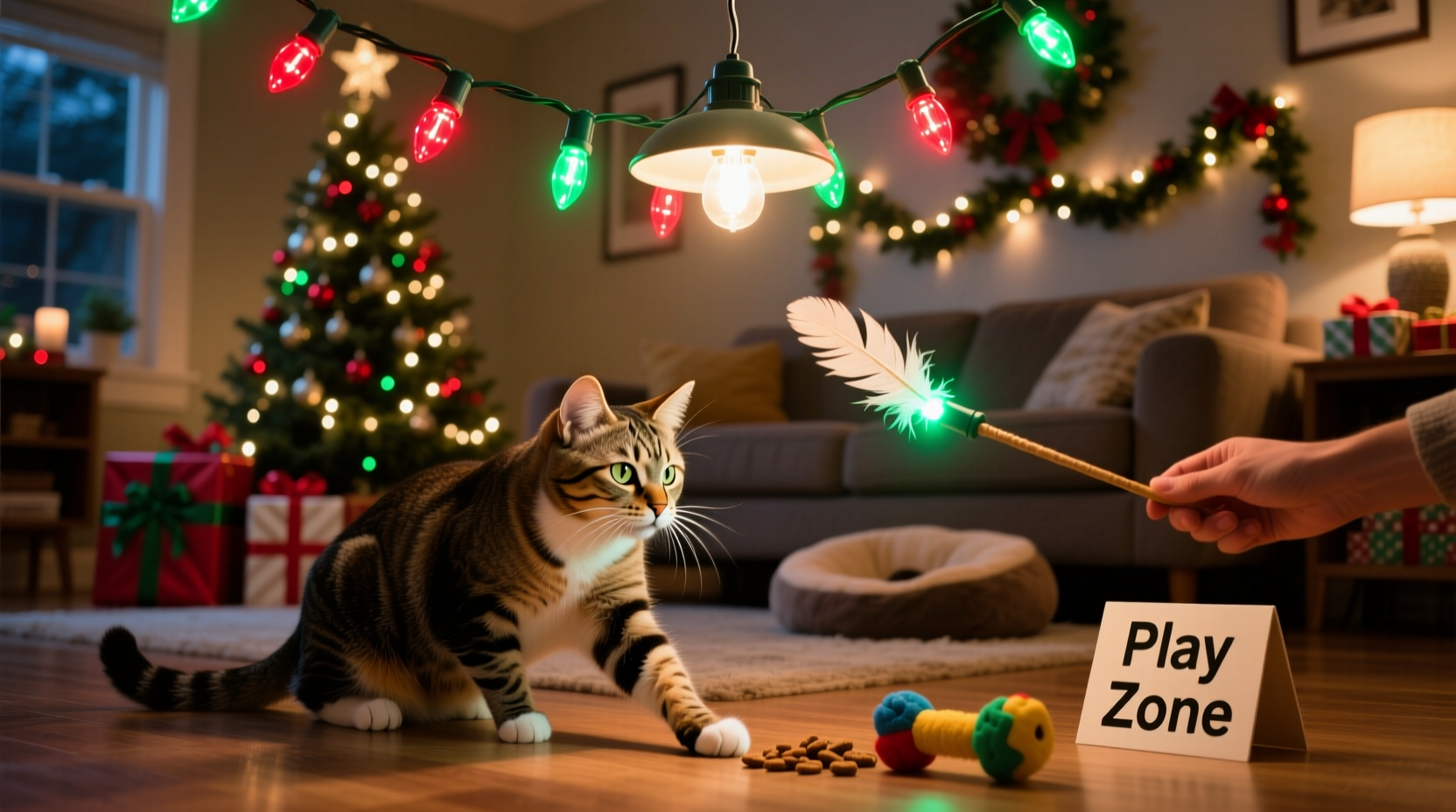
Cats are visual predators specialized for detecting rapid movement in low-light conditions. Their retinas contain a high density of rod photoreceptors—cells optimized for motion detection and contrast sensitivity—not color perception. Blinking or flickering lights mimic the erratic, high-contrast movement of small prey: a moth fluttering near a flame, a beetle skittering across dry leaves, or a field mouse darting through grass. Unlike steady light sources, intermittent illumination creates “flicker fusion,” where discrete flashes are perceived as continuous motion—exactly the kind of stimulus that activates the superior colliculus, a brain region responsible for orienting attention toward moving targets.
What makes blinking lights especially irresistible is their unpredictability. Random or rhythmic pulsing (like many modern LED strings) introduces temporal variation—the same quality that makes laser pointers so compelling. Dr. John Bradshaw, anthrozoologist and founder of the Bristol University Anthrozoology Institute, confirms:
“The flicker of holiday lights doesn’t just catch a cat’s eye—it hijacks their attentional system. It’s not ‘play’ in the human sense; it’s a full sensory engagement that closely resembles the early stages of prey capture: fixation, stalking, and explosive pursuit.”
This behavior is neither learned nor reinforced by attention—it’s innate. Kittens as young as three weeks old will orient toward and paw at moving light spots, even before they’ve ever seen real prey. The response is strongest in cats under five years old and those with high baseline energy levels—but it can surface in any cat, regardless of age or breed, when environmental enrichment is insufficient.
Why Redirecting (Not Suppressing) Is Essential for Feline Well-Being
Discouraging the light-chasing with punishment—or worse, covering the tree entirely—misses a critical point: the behavior itself isn’t the problem. The problem is the lack of appropriate outlets for behaviors hardwired into your cat’s neurobiology. When predatory drive goes unexpressed in safe, controlled ways, it often manifests as redirected aggression, chronic stress, overgrooming, or nighttime hyperactivity.
Studies published in the Journal of Feline Medicine and Surgery show that indoor cats who engage in daily, species-appropriate predatory sequences (stalking → chasing → pouncing → biting → “killing”) exhibit significantly lower cortisol levels and fewer behavioral disorders. The blink of a light isn’t inherently dangerous—but the absence of alternatives is.
A Step-by-Step Plan to Redirect Play Safely and Effectively
Redirecting predatory energy requires consistency, timing, and understanding feline motivation. Follow this six-step sequence daily during the holiday season—and continue year-round for lasting benefit.
- Observe & Identify Triggers: For two days, note exactly when and where light-chasing occurs (e.g., “5:30 p.m., near the east side of the tree, after dinner”). Note concurrent factors: Is your cat hungry? Has it napped recently? Is ambient lighting low?
- Preempt with Scheduled Play Sessions: Initiate a 10–15 minute interactive play session 30 minutes before peak trigger times (typically dusk and early evening). Use wand toys that mimic prey movement—horizontal sweeps, quick retreats, and brief pauses—not lasers alone.
- Introduce Novel Prey Substitutes: Rotate 3–4 toy types weekly: a motorized mouse with unpredictable turns, a treat-dispensing puzzle ball filled with kibble, and a crinkle tunnel with hidden feather wands inside. Novelty sustains engagement better than repetition.
- Create Visual Barriers (Not Punishment): Place a lightweight, breathable fabric drape (like linen or cotton) over the lower third of the tree—just enough to obscure the most active blinking zone—while leaving upper lights visible. This reduces visual stimulation without eliminating ambiance.
- Enrich the Environment Beyond the Tree: Install vertical space (wall-mounted shelves or cat trees near windows), add scent-based enrichment (catnip or silver vine in rotating locations), and scatter food puzzles around the home—not just near the tree.
- End Each Session with a “Kill” and Meal: Always conclude play with a tangible reward: let your cat “catch” a stuffed toy, then feed a small portion of its next meal from a lick mat or puzzle feeder. This completes the predatory sequence neurologically and satisfies the drive.
Do’s and Don’ts: A Practical Holiday Safety Table
| Category | Do | Don’t |
|---|---|---|
| Light Selection | Choose warm-white LEDs with slow, gentle fade patterns (not strobes or rapid blink modes); opt for battery-operated strings with secure, chew-resistant casings. | Use older incandescent bulbs (heat risk), strings with exposed wiring, or modes labeled “disco,” “flash,” or “random burst.” |
| Tree Setup | Anchor the tree securely to the wall; place lights higher than 3 feet; wrap trunk base in smooth, non-climbable material (e.g., smooth PVC pipe). | Let lights dangle within paw’s reach; use tinsel or glass ornaments at kitten/cat level; rely solely on spray deterrents. |
| Play Tools | Use wand toys with replaceable, non-toxic feathers; rotate toys every 48 hours; incorporate food rewards during play. | Leave string, ribbon, or yarn unattended; use laser pointers without a physical “kill” conclusion; offer only one toy type for days. |
| Environmental Design | Add perches overlooking the tree (so your cat observes, not attacks); install motion-activated bird feeders outside nearby windows. | Isolate your cat during holidays; block all access to living areas; use citrus-scented sprays near the tree (can cause respiratory irritation). |
Real-World Example: How Maya Transformed Her Cat’s Light-Chasing into Calm Observation
Maya, a veterinary technician in Portland, faced nightly chaos each December with her 2-year-old rescue tabby, Jasper. He’d sprint at the tree at 7 p.m. sharp, knocking over ornaments and chewing cords. She tried everything: double-sided tape on the floor, bitter apple spray (he licked it off), and even moving the tree to the garage (he followed). Exhausted, she consulted a certified feline behavior consultant.
The consultant observed Jasper’s routine and noticed he was consistently under-stimulated between 4–6 p.m.—a window when his natural crepuscular energy peaked but no play occurred. They implemented the step-by-step plan: scheduled play at 6:15 p.m. using a wand with a soft rabbit-fur tip, introduced a rotating set of treat balls, and draped the lower tree section with ivory linen. Within four days, Jasper stopped lunging. By Day 12, he sat calmly on a nearby shelf, tail swishing slowly, watching the lights with relaxed eyes—no tension, no fixation. “He didn’t stop being interested,” Maya shared. “He just stopped needing to *attack* it. Now he watches like it’s nature TV.”
FAQ: Addressing Common Concerns
Is it dangerous if my cat chews on Christmas light cords?
Yes—extremely. Even low-voltage LED strings carry enough current to cause oral burns, cardiac arrhythmia, or electrocution. Chewing also risks ingestion of plastic insulation or metal fragments, leading to gastrointestinal obstruction. If your cat shows interest in cords, immediately unplug and conceal them using cord covers or baseboard clips, and redirect to chew-safe alternatives like frozen tuna-stuffed Kongs or hemp rope toys.
Will my cat outgrow this behavior?
Some cats do mellow with age—especially after 7–8 years—as metabolic rate and neurological responsiveness decline. But this is not guaranteed. More importantly, waiting for “outgrowing” ignores the underlying need for daily predatory fulfillment. Cats who receive consistent, appropriate outlets rarely escalate light-chasing into destructive habits—even into senior years.
Can I use a laser pointer to redirect the behavior?
Laser pointers can be effective if used correctly, but they carry risk. Never use them exclusively or without concluding the session with a tangible “kill”—such as letting your cat catch a plush toy placed where the dot lands, followed by food. Without closure, frustration builds, potentially increasing obsessive behaviors. Limit laser use to 3–4 minutes per session, and always pair it with tactile, scent-based, or food-based enrichment afterward.
Conclusion: Honor the Instinct, Not Just the Holiday
Your cat isn’t misbehaving. It’s responding to stimuli with the same intensity and precision its wild ancestors used to survive. That spark of focus—the dilation of the pupils, the stillness before the leap—isn’t a quirk to be corrected. It’s a sign of vitality, health, and evolutionary fitness. The goal isn’t to eliminate the fascination with light, but to channel it into experiences that satisfy the mind, body, and spirit of your feline companion. When you replace correction with curiosity—when you trade scolding for structured play, and frustration for fulfillment—you don’t just protect your lights. You deepen trust. You reduce stress. You honor who your cat is, not who you wish it to be.
This holiday season, let your tree twinkle—not as a target, but as a backdrop to something richer: the quiet pride of watching your cat choose a sunbeam over a sparkle, or settle beside you instead of launching into the air. Start tonight. Pick up a wand toy. Set a timer for 12 minutes. End with a bite of food. Repeat tomorrow. Small, intentional acts compound into profound well-being—for both of you.




 浙公网安备
33010002000092号
浙公网安备
33010002000092号 浙B2-20120091-4
Comments
No comments yet. Why don't you start the discussion?