
Every December, a familiar scene repeats itself: a shimmering strand of tinsel dangles from the tree, and within seconds, your cat is pouncing, batting, chewing, and dragging it across the floor like captured prey. It looks playful — even festive — until you remember what veterinarians see in emergency rooms every holiday season: intestinal blockages, perforated stomachs, and life-threatening obstructions caused by ingested tinsel. This isn’t just “cute cat behavior.” It’s a serious, preventable risk rooted in deep biology — and understanding that biology is the first step toward keeping your cat safe.
The Instinct Behind the Attack: Why Tinsel Triggers Your Cat
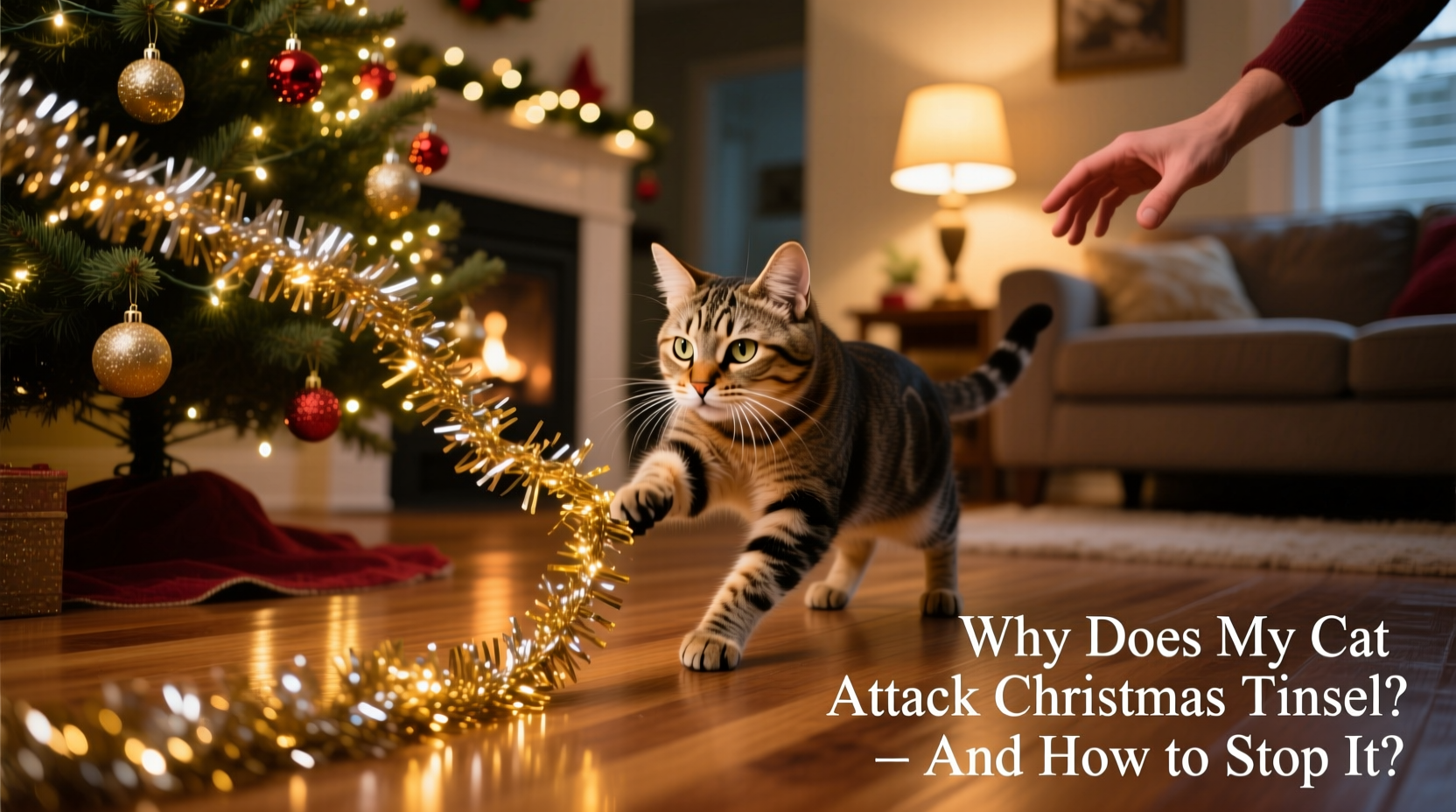
Cats don’t attack tinsel because they dislike it or find it annoying. They attack it because, to their sensory world, it perfectly mimics high-value prey. Their visual system is exquisitely tuned to detect rapid, unpredictable motion — especially thin, linear objects that dart and shimmer. Tinsel’s reflective surface catches ambient light, creating flickering highlights that trigger the same neural pathways activated by a fleeing insect or a slithering snake. Add to that its lightweight, flexible nature — it recoils, twitches, and coils when batted — and you have an irresistible stimulus for the predatory motor pattern known as “stalking-chasing-grabbing-biting.”
This behavior isn’t learned; it’s hardwired. Kittens begin practicing these sequences as early as three weeks old, refining coordination through play with littermates and environmental objects. What makes tinsel uniquely hazardous is that unlike grass blades or string toys designed for safety, tinsel doesn’t break down. Its metallic or plastic filaments resist digestion, snag on intestinal folds, and can cause linear foreign body obstruction — a condition where the tinsel anchors at one point (e.g., the base of the tongue or pylorus) while peristalsis pulls the gut tissue taut around it, leading to cutting, ischemia, and perforation.
“Tinsel is among the top three non-food items we surgically remove from cats each December. Its combination of allure and physical danger makes it uniquely treacherous — more so than ornaments or lights, which cats rarely ingest.” — Dr. Lena Torres, DVM, Board-Certified Veterinary Surgeon and Director of Feline Emergency Services at Midwest Animal Medical Center
Why “Just Supervising” Isn’t Enough — And What Really Works
Many owners assume that keeping an eye on their cat near the tree will prevent trouble. But feline opportunism operates on microsecond timing. A distracted moment — answering the door, stepping into another room, or even blinking — gives a motivated cat ample time to snatch, chew, and swallow several inches of tinsel. Worse, cats often hide after ingestion, delaying discovery until vomiting, lethargy, or refusal to eat appear 12–48 hours later — by which time surgical intervention may be unavoidable.
Effective prevention requires layering strategies: eliminating access, redirecting instinct, and modifying the environment *before* the behavior begins. Relying solely on vigilance fails not because owners are careless, but because cats are fast, stealthy, and driven by impulses far stronger than human supervision can reliably counter.
7 Vet-Backed Strategies to Stop Tinsel Attacks (and Keep Your Cat Safe)
These strategies are drawn from clinical experience, feline behavioral science, and decades of veterinary emergency data. They prioritize both immediate safety and long-term habit formation.
- Remove tinsel entirely — or use it only on the top third of the tree, secured with zip ties and anchored to rigid branches. If you choose to use tinsel, treat it like toxic bait: inaccessible, immobile, and visually minimized. Avoid spiral wrapping, which creates loose ends and increases movement.
- Install a physical barrier around the tree — not just a baby gate, but a freestanding pet fence with a solid lower panel (at least 18 inches tall). Cats can leap over low barriers, but a solid base prevents them from sliding underneath or nudging the tree base.
- Provide daily, scheduled predatory play sessions using wand toys that mimic the tinsel’s movement — but with safe, detachable, supervised components. Use feather wands with knotted cotton strings (not elastic or plastic) for 10–15 minutes twice daily, ending each session with a “kill” — letting your cat bite and hold a soft plush toy. This satisfies the full predatory sequence and reduces redirected hunting behavior.
- Introduce scent deterrents *before* decorating. Apply citrus-scented sprays (diluted orange or lemon essential oil in water — never undiluted oils) to the lower 3 feet of the tree trunk and nearby floor surfaces. Cats strongly dislike citrus odors, and early exposure conditions them to associate the tree area with unpleasant scent, not excitement.
- Replace visual stimulation with auditory and tactile enrichment elsewhere in the home. Place battery-operated crinkle balls inside cardboard boxes, hang wind chimes near windows (outside the cat’s reach), and offer puzzle feeders filled with kibble or freeze-dried treats. This disperses your cat’s attention-seeking energy away from the tree.
- Use motion-activated deterrents — specifically those emitting high-frequency sounds (ultrasonic, 20–25 kHz) — placed discreetly near the tree base. These are inaudible to humans but startling to cats, and studies show consistent use reduces approach behavior by up to 73% within five days when paired with positive reinforcement elsewhere.
- Designate a “tinsel-free zone” — a cozy, elevated perch near the tree (e.g., a window seat or cat shelf) stocked with calming pheromone diffusers (Feliway Optimum), soft bedding, and slow-blinking interaction from you. This transforms the tree area from a forbidden temptation into a calm observation post.
What to Do If Your Cat Already Has Tinsel in Its Mouth (or Stomach)
Act immediately — do not wait for symptoms. If you see your cat chewing or holding tinsel:
- Do NOT pull it. Tinsel can be anchored in the throat or stomach; pulling risks tearing tissue or worsening entanglement.
- Gently open the mouth and check for visible strands. If less than 1 inch is visible and loosely held, carefully snip it with blunt-tipped scissors — but only if your cat is fully cooperative. If there’s any resistance, stop and call your vet.
- Call your veterinarian or nearest emergency clinic immediately. Describe exactly what happened: how much tinsel was seen, whether it was swallowed, and your cat’s current behavior (eating, vomiting, activity level). Do not induce vomiting — tinsel can cause esophageal damage during retching.
- Monitor closely for 72 hours: Watch for repeated vomiting, loss of appetite, lethargy, abdominal tenderness, straining to defecate, or hiding. Any of these require urgent evaluation.
| Symptom Onset Timeline | Most Likely Cause | Recommended Action |
|---|---|---|
| Within 2–6 hours | Oral irritation or mild GI upset | Call vet for guidance; monitor closely |
| 12–24 hours | Early signs of linear foreign body (vomiting, restlessness) | Immediate veterinary exam — X-rays or ultrasound likely needed |
| 36–72 hours | Severe obstruction (lethargy, dehydration, abdominal pain) | Emergency surgery almost always required |
| No symptoms after 72 hours | May have passed naturally — but not guaranteed | Vet consultation still advised; fecal monitoring for fragments |
A Real Example: How the Chen Family Prevented Disaster
The Chen family adopted Luna, a 2-year-old Siamese mix, in November. Enchanted by her playful energy, they decorated their first tree together — adding cascading silver tinsel, glass ornaments, and twinkling lights. On Day 3, Luna spent 20 minutes intently stalking a single dangling strand. Her owners laughed — until she vanished under the sofa. An hour later, she reappeared, drooling slightly and refusing her evening meal. Alarmed, they checked her mouth and found no tinsel — but her gums were pale, and she flinched when they gently pressed her abdomen.
They rushed her to the emergency clinic. Radiographs confirmed a 6-inch length of tinsel coiled in her small intestine, causing partial obstruction. Surgery was performed that night. The vet removed the tinsel — along with 4 inches of damaged intestinal tissue — and warned that delay could have led to sepsis or death. In recovery, the Chens implemented all seven strategies: they replaced tinsel with matte-finish paper garlands, installed a 24-inch pet fence, began twice-daily wand play, and added a Feliway diffuser near Luna’s new perch beside the tree. This year, Luna watches the lights calmly from her shelf — tail flicking only in gentle rhythm, not predatory tension.
FAQ: Your Most Urgent Questions — Answered
Can I give my cat “safe” tinsel made from yarn or ribbon instead?
No. Yarn, ribbon, dental floss, and string pose identical linear foreign body risks. In fact, smooth, slippery materials like silk ribbon may be *more* dangerous because they’re harder for the gut to grip and expel. There is no safe ingestible linear material for cats.
My cat has never eaten tinsel before — is she really at risk?
Yes. Risk isn’t determined by past behavior but by opportunity and instinct. Over 80% of tinsel-related obstructions occur in cats with no prior history of ingesting foreign objects. A single novel stimulus — especially one that moves like prey — can override learned caution.
Will using a fake tree reduce the risk?
Only marginally. While artificial trees eliminate pine needle toxicity, they often have sturdier branches that hold tinsel more securely — increasing the chance of prolonged exposure. More importantly, the core issue isn’t the tree type; it’s the tinsel itself. A fake tree draped in tinsel remains just as hazardous.
Conclusion: Safety Is Not Sacrifice — It’s Smarter Celebration
You don’t need to strip your home of holiday magic to keep your cat safe. You simply need to shift your focus from decoration to design — designing an environment where your cat’s instincts are honored, redirected, and protected. Replacing tinsel with hand-cut paper chains, swapping glittering strands for wooden beads on natural jute, or hanging felt stars instead of metallic ribbons doesn’t diminish joy — it deepens it. It means waking up on Christmas morning knowing your cat is curled beside you, not recovering from surgery. It means laughter without anxiety, tradition without trauma.
This season, choose presence over peril. Choose curiosity over crisis. Choose to see your cat not as a problem to manage, but as a sentient being whose ancient wiring deserves thoughtful accommodation — not correction. Start today: take down the tinsel, set up the barrier, schedule that first wand-play session. Your cat won’t understand the science behind your choices — but they’ll feel the safety in them. And that, truly, is the most meaningful gift you can give.




 浙公网安备
33010002000092号
浙公网安备
33010002000092号 浙B2-20120091-4
Comments
No comments yet. Why don't you start the discussion?