
It’s a scene repeated in homes across the Northern Hemisphere every December: a perfectly decorated tree, twinkling with warm white LEDs—suddenly ambushed by a blur of fur, paws batting at wires, teeth clamping onto cord insulation, tail flicking like a metronome set to chaos. You sigh. You unhook the tangled strand. You check for chew marks—again. And you wonder: Why does my cat do this? Is it dangerous? And how do I stop it without turning my living room into a feline fortress?
This isn’t mischief for mischief’s sake. It’s behavior rooted in biology, environment, and unmet needs. Understanding the “why” transforms frustration into empathy—and empowers you to intervene effectively. This article draws on veterinary ethology, feline behavior science, and real-world experience from certified cat behavior consultants to explain what’s really happening—and exactly how to respond.
The Instinctive Roots: Why Lights Trigger Your Cat’s Hunting Drive
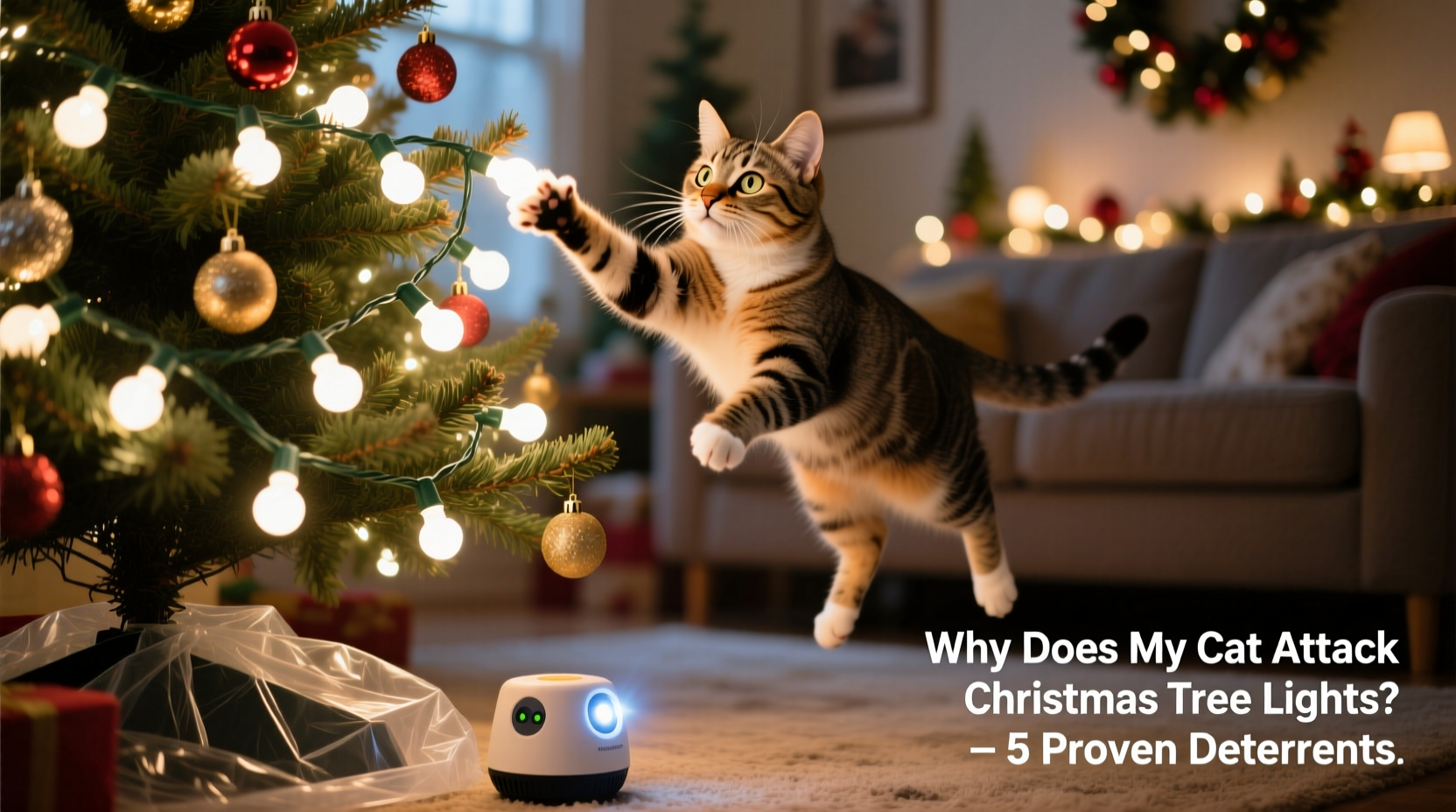
Cats don’t see blinking lights as festive décor. They perceive them as high-contrast, unpredictable stimuli that closely mimic prey movement—especially small, darting insects or rodents. The intermittent pulse of LEDs, the reflection off glass ornaments, and even the faint hum of low-voltage transformers activate neural pathways honed over 10 million years of evolution.
Dr. Mikel Delgado, Certified Cat Behavior Consultant and researcher at the University of California, Davis, explains:
“Flickering light falls squarely within the ‘biologically relevant motion’ category for cats. Their retinas contain up to 8 times more rod cells than humans’, making them exquisitely sensitive to rapid changes in luminance—even at low intensity. A single blinking bulb can register as a live, evasive target.”
This isn’t limited to kittens. Adult cats—even seniors—retain strong predatory sequencing: orient → stalk → chase → pounce → bite. The tree offers a vertical, multi-layered hunting ground: dangling tinsel mimics grasshoppers; swaying branches suggest bird perches; and those tiny, bright points? They’re irresistible targets for a species whose visual system evolved to detect the glint of an insect’s wing at dusk.
Sensory Overload & Environmental Shifts
Christmas trees introduce dramatic sensory changes that destabilize a cat’s sense of security:
- Olfactory disruption: Pine resin, citrus-scented ornaments, and synthetic fragrances (e.g., cinnamon sticks, pine-scented sprays) flood a space cats rely on for scent-marking and spatial orientation.
- Tactile novelty: Rough bark, slippery plastic stands, crinkly wrapping paper remnants, and unfamiliar textures underfoot create both confusion and fascination.
- Acoustic anomalies: The subtle electrical buzz of older incandescent strings—or the high-frequency whine of some LED drivers—can be audible to cats (who hear up to 64 kHz, compared to humans’ 20 kHz).
- Thermal gradients: Warm transformer boxes, heat-emitting bulbs (especially incandescents), and insulated cords act like miniature sunbeams—irresistible napping spots that double as play zones.
When combined, these shifts don’t just attract attention—they erode predictability. For a species that thrives on routine and environmental control, the tree becomes both a puzzle and a provocation.
Real Risk: Beyond Annoyance—What’s Actually Dangerous?
It’s easy to dismiss light-chasing as harmless fun—until you find frayed wiring, a scorched base, or your cat drooling after chewing plastic insulation. Here’s what poses genuine danger:
| Hazard | Risk Level | Why It Matters |
|---|---|---|
| Chewing electrical cords | High | Can cause oral burns, electrocution (even at low voltage), or life-threatening arrhythmias. PVC insulation may contain phthalates linked to kidney stress in cats. |
| Ingesting tinsel or ornament hooks | High | Tinsel causes linear foreign body obstructions—requiring emergency surgery. Metal hooks puncture intestines. |
| Falling from tree branches | Moderate–High | Especially risky for senior cats or those with undiagnosed arthritis or vestibular issues. Falls from >3 feet can fracture jaws or pelvises. |
| Stress-induced cystitis | Moderate | Chronic anxiety around the tree can trigger feline idiopathic cystitis (FIC), causing painful urination and urinary blockage—a medical emergency. |
| Fire hazard (overheated lights + dry pine) | Low–Moderate (but escalating) | Incandescent bulbs generate significant heat. One study found 27% of household fires involving Christmas trees originated from faulty or overloaded lighting circuits. |
A 2022 survey by the American Veterinary Medical Association found that 1 in 5 feline ER visits during December involved tree-related injuries—including electrocution, lacerations from broken ornaments, and ingestion of toxic plant material (like pine needles, which contain volatile oils irritating to the GI tract).
Proven, Humane Deterrence Strategies (Backed by Behavior Science)
Effective intervention requires addressing root causes—not just symptoms. Punishment (spraying water, yelling, startling) increases fear and redirects aggression elsewhere. Instead, use the following evidence-based approaches:
Step-by-Step Prevention Protocol (Start 2 Weeks Before Tree Setup)
- Pre-emptive enrichment: Begin daily 15-minute interactive play sessions using wand toys that mimic erratic prey movement (e.g., dragging feathers sideways, sudden upward jerks). End each session with a small meal—satisfying the full predatory sequence.
- Tree-zone desensitization: Place the bare tree stand in its intended location 7–10 days before decorating. Let your cat investigate freely. Reward calm observation with treats—but never reward pawing or biting.
- Light substitution: Replace blinking or color-shifting lights with steady-warm white LEDs (2700K–3000K). Avoid blue-rich or strobing modes—these trigger stronger orienting responses.
- Physical barrier installation: Use a freestanding pet gate (not a baby gate—cats jump them) or a low-profile, 30-inch-tall wire mesh enclosure anchored to wall studs. Ensure gaps are <2 inches wide.
- Post-decoration reinforcement: Place two or three of your cat’s favorite toys *just outside* the barrier zone—not inside. Rotate them every 48 hours to sustain novelty.
What Works (and What Doesn’t)
Many popular “solutions” lack scientific support—or backfire:
- Aluminum foil on the trunk: Effective short-term (cats dislike the texture/sound), but wears quickly and creates litter when shredded. Not recommended for long-term use.
- Double-sided tape: May deter stepping but doesn’t prevent leaping or batting from above. Can trap fur painfully.
- “Cat-safe” essential oil sprays: Many (e.g., eucalyptus, tea tree, citrus) are hepatotoxic to cats. Avoid entirely unless formulated and tested by a veterinary toxicologist.
- Leaving the tree lit only when supervised: Reinforces the association between lights and playtime—increasing anticipation and drive when you’re not present.
Instead, focus on redirection and environmental design. A 2023 study published in Applied Animal Behaviour Science showed cats exposed to structured play + barrier + consistent lighting had 82% fewer tree interactions over 14 days versus controls using scent deterrents alone.
Mini Case Study: Luna, 4-Year-Old Domestic Shorthair
Luna lived in a downtown Chicago apartment with her owner, Maya, who worked remotely. Every December, Luna would scale the 6-foot Fraser fir within 48 hours of setup—shredding lights, dislodging ornaments, and once, pulling the entire tree over while chasing a blinking red bulb.
After consulting with a veterinary behaviorist, Maya implemented a three-pronged plan:
- She replaced all lights with non-blinking, low-heat LEDs and wrapped cords in rigid, chew-resistant conduit.
- She installed a 32-inch hexagonal wire enclosure (anchored to floor and wall) around the trunk—leaving ample open space for air circulation and aesthetics.
- She introduced “tree-free” enrichment: a rotating circuit of puzzle feeders, a window perch overlooking a bird feeder, and twice-daily laser-pointer sessions ending with a treat-filled toy mouse.
Within 9 days, Luna stopped approaching the barrier. By Day 17, she was napping peacefully 3 feet away—on a heated pad placed deliberately outside the enclosure. Maya reported no incidents—and Luna’s overall activity level increased by 30%, measured via collar activity tracker.
Do’s and Don’ts: A Quick-Reference Checklist
✅ DO:
- Use battery-operated lights for the bottom 2 feet of the tree (eliminates cords entirely).
- Secure all cords with heavy-duty cable clips screwed into baseboard—not tape or Velcro.
- Provide alternative vertical spaces: tall cat trees, wall-mounted shelves, or window hammocks.
- Trim lower branches to reduce climbing footholds (cut at 45° angles to discourage gripping).
- Keep the tree water reservoir covered and inaccessible—pine water contains fertilizers and bacteria harmful if ingested.
❌ DON’T:
- Use tinsel, popcorn strings, or glass ornaments—these pose choking, obstruction, and laceration risks.
- Apply sticky or bitter sprays directly to lights or ornaments (chemical transfer risk + taste aversion to safe objects).
- Leave the tree unattended for >4 hours during peak activity windows (dawn and dusk).
- Place the tree near furniture that enables launching (sofas, bookshelves, side tables).
- Assume “calm” cats won’t engage—low-key observers often strike when unsupervised.
FAQ
Will my cat outgrow this behavior?
Not reliably. While some kittens decrease tree interaction after age 2–3, many adult cats retain strong predatory motivation—especially if the behavior has been reinforced (e.g., by attention, play, or successful “capture” of a light). Consistent management is more effective than waiting for natural cessation.
Are fiber-optic or projection trees safer alternatives?
Yes—with caveats. Fiber-optic trees eliminate electrical hazards and have no loose cords, but their soft, flexible branches still invite climbing. Projection trees (which cast light patterns onto walls/ceilings) remove the physical tree entirely—making them ideal for high-risk households. However, projected lights can still trigger stalking if they move erratically. Use steady, slow-drifting patterns only.
My cat only attacks at night. Should I leave lights on a timer?
No. Timed lighting reinforces the association between darkness and stimulation. Instead, use motion-activated nightlights elsewhere in the home to reduce startle responses—and keep the tree dark overnight. If you desire ambiance, install a dim, steady LED strip *behind* the sofa or along baseboards, far from the tree.
Conclusion
Your cat isn’t trying to ruin Christmas. It’s responding to ancient instincts in a modern, sensory-overloaded environment—one where a $20 string of lights looks, sounds, and feels like the most compelling thing in the room. That understanding changes everything. It moves you from correction to compassion, from frustration to problem-solving, from reactive panic to proactive planning.
You don’t need to choose between holiday joy and feline well-being. With thoughtful preparation—starting before the first branch is trimmed—you can create a space where both coexist safely. Prioritize your cat’s biological needs first: movement, mastery, and predictability. Then decorate. The lights will shine brighter when they’re not tangled in fur or sparking from chewed insulation.
Start tonight. Swap one blinking string for a steady one. Clear a path for a new cat tree. Set a 10-minute timer for play. Small actions compound—into calmer holidays, healthier cats, and memories made without emergency vet calls.




 浙公网安备
33010002000092号
浙公网安备
33010002000092号 浙B2-20120091-4
Comments
No comments yet. Why don't you start the discussion?