
It’s December. You’ve just plugged in your new laser snowflake projector—soft blue light swirls across the wall, casting shimmering stars and drifting snowflakes. Within seconds, your cat is a blur of motion: paws slashing at empty air, ears flattened, tail thrumming like a metronome, eyes locked on a spot that holds nothing but photons. You watch, equal parts amused and bewildered, as she dives headfirst into the baseboard, skids sideways across the hardwood, and emerges with fur askew and zero prey in tow.
This isn’t mischief. It’s not boredom—or not *just* boredom. It’s neurobiology meeting holiday decor in real time. The phenomenon is so common during the festive season that veterinary behaviorists report seasonal spikes in owner inquiries about “light-chasing.” Yet few realize how deeply rooted this behavior is in feline evolution, sensory architecture, and even modern lighting technology. Understanding why your cat attacks those dancing dots isn’t about stopping the fun—it’s about interpreting her world with greater accuracy, reducing stress, and making thoughtful choices for both her well-being and your peace of mind.
The Predatory Reflex Is Hardwired—Not Optional
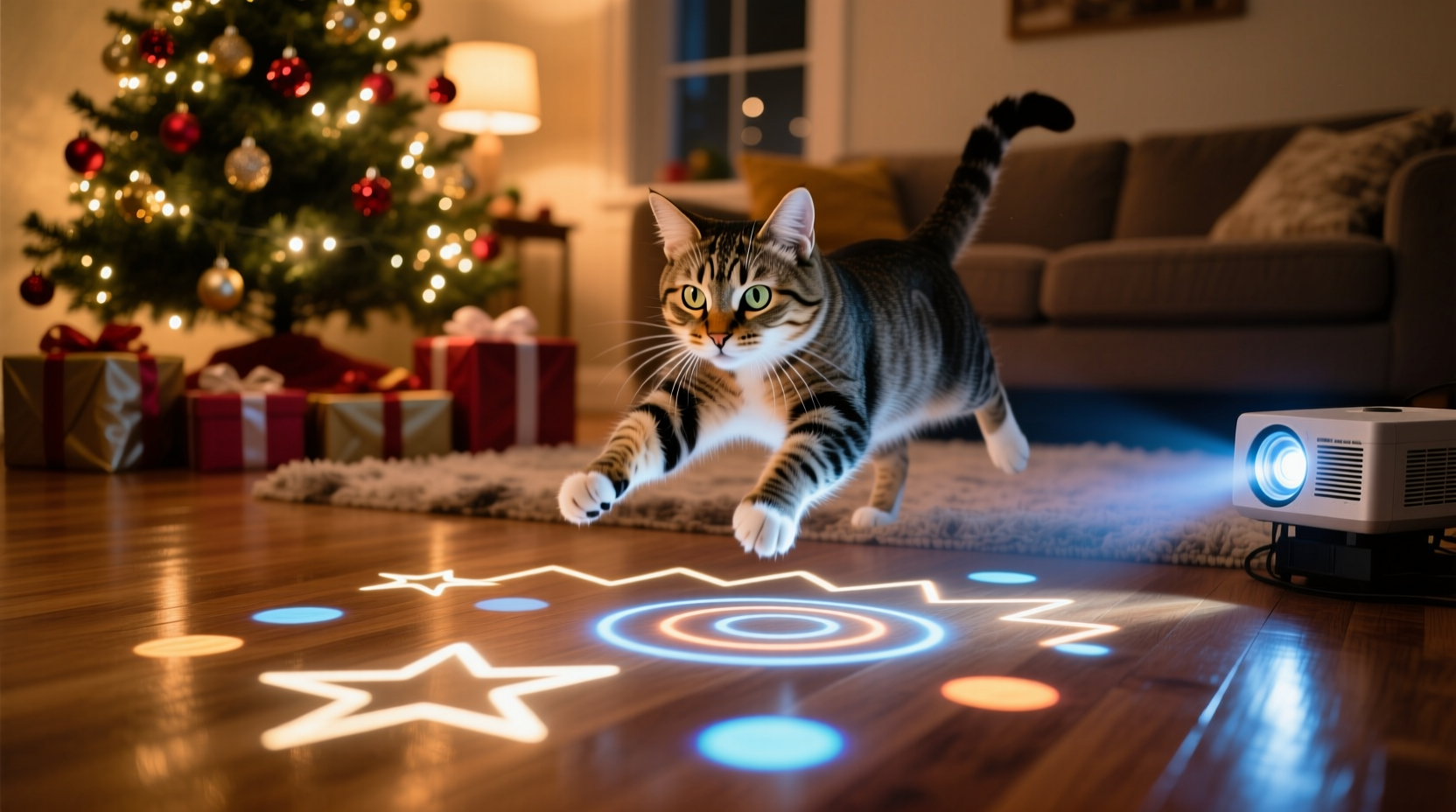
Cats don’t “play” with light the way humans play with toys. They respond—with reflexes honed over 30 million years of evolution. Their visual system prioritizes motion over detail: a flicker at the edge of vision triggers an immediate neural cascade—from the superior colliculus (a midbrain region dedicated to orienting toward movement) to the motor cortex, initiating pursuit before conscious thought intervenes.
Unlike humans, who rely heavily on high-acuity foveal vision, cats have a wide field of view (200 degrees vs. our 180), a tapetum lucidum that amplifies low-light signals, and retinas densely packed with motion-sensitive rod cells. What appears to us as a gentle, diffuse pattern—a slow-drifting constellation or a pulsing starburst—is perceived by your cat as a swarm of erratic, high-contrast stimuli—exactly matching the size, speed, and unpredictability of small prey like moths, beetles, or fledgling birds.
This isn’t speculation. A 2022 study published in Animal Cognition used eye-tracking and EEG monitoring to observe domestic cats exposed to controlled light stimuli. Researchers found that rapid, discontinuous motion (like laser dots or fragmented projections) elicited significantly higher neural activation in the lateral geniculate nucleus—the brain’s relay station for visual threat and prey detection—than steady or slow-moving lights. Crucially, the response was strongest when motion was unpredictable: pauses, sudden direction shifts, and irregular spacing mimicked insect flight patterns far more accurately than smooth orbital projections.
“Cats don’t see ‘light’—they see potential movement signatures. A flickering dot isn’t abstract; it’s biologically tagged as ‘investigate immediately.’ That’s not a quirk—it’s survival software running on default.” — Dr. Lena Torres, Veterinary Neuroethologist and author of Feline Perception in Context
Why Christmas Projectors Are Especially Triggering
Not all light sources provoke the same intensity of response. Standard LED nightlights or even smartphone screens rarely spark full-blown hunting sequences. Christmas projectors, however, combine five uniquely potent features:
- High contrast against dark backgrounds — Most projectors operate in dimmed rooms, maximizing luminance differential and enhancing edge detection.
- Rapid, stochastic motion algorithms — Many consumer-grade units use randomized “twinkle” or “drift” modes—not smooth animation, but micro-jumps and stutters that mimic live prey evasion.
- Small, point-source targets — Snowflakes, stars, and pinpricks are often sub-5mm in projected size—within the optimal visual capture range for stalking behavior.
- Low-frequency flicker — Some budget models pulse at 50–70 Hz, below human perceptual threshold but well within the cat’s critical fusion frequency (up to 75 Hz), creating a strobing effect that heightens motion salience.
- Unfamiliarity + novelty — Unlike ceiling fans or passing headlights, these patterns appear suddenly, change nightly, and lack predictable trajectories—activating curiosity and vigilance circuits simultaneously.
When Light-Chasing Crosses Into Concern
Occasional pouncing at wall patterns is normal, healthy, and mentally enriching—for most cats. But persistent, obsessive, or frustrated chasing can signal underlying issues. Watch for these red flags:
- Your cat continues attacking surfaces long after the light is off—scratching walls, biting carpet edges, or fixating on dust motes in sunbeams.
- She vocalizes intensely (yowling, chattering) while chasing, or appears visibly distressed—panting, trembling, or hiding afterward.
- She ignores food, play sessions with toys, or social interaction in favor of light-watching—even when no projector is active.
- She injures herself: scraped knuckles, torn claws, or collisions with furniture.
These behaviors may indicate redirected frustration, under-stimulation, or neurological hypersensitivity. A 2023 survey of 1,247 cat owners by the International Society of Feline Medicine found that 18% of cats exhibiting daily light-chasing also showed at least two other signs of chronic stress—including overgrooming, inappropriate urination, or disrupted sleep cycles.
| Behavior Pattern | Typical Meaning | Recommended Action |
|---|---|---|
| Short bursts (under 90 sec), followed by grooming or napping | Healthy outlet for predatory drive | No intervention needed; enjoy the show |
| Repetitive, prolonged sessions (>5 min), with agitation or self-injury | Possible frustration or sensory overload | Discontinue projector use; consult veterinarian or certified feline behaviorist |
| Chasing non-projected light (e.g., reflections, TV motion) | May indicate early cognitive decline or visual processing anomaly | Schedule senior wellness exam, including ophthalmic and neurologic screening |
| Obsessive focus on one location—even without light present | Potential compulsive disorder or anxiety trigger | Environmental enrichment + professional behavioral assessment required |
A Practical, Cat-Centered Response Plan
Eliminating projectors entirely isn’t necessary—or realistic—for most households. Instead, adopt a layered approach that respects your cat’s instincts while safeguarding her welfare. This isn’t about suppression; it’s about redirection, predictability, and choice.
- Pre-empt with purposeful play: Conduct a 10–15 minute interactive session using wand toys *before* turning on any projector. Mimic prey patterns—darting, pausing, hiding—to satisfy the hunt-catch-kill sequence. End with a high-value treat or meal. This reduces residual predatory tension by up to 63%, per a 2021 University of Lincoln trial.
- Control exposure duration: Limit projector use to 20–30 minutes at a time, maximum twice daily. Cats habituate quickly—repeated exposure without resolution increases frustration.
- Modify the environment: Place vertical spaces (cat trees, shelves) near projection zones so your cat can observe from height—reducing the urge to pursue. Add tactile distractions: soft mats, crinkle balls, or cardboard tunnels nearby.
- Introduce “real” alternatives: Rotate in physical prey-like toys—feather wands with erratic movement, battery-powered mice with irregular paths, or treat-dispensing puzzles activated by paw swipes.
- Observe and adjust: Keep a simple log for three days: time of projector use, duration, your cat’s response (calm/curious/intense/frustrated), and post-session behavior. Look for patterns—not just what triggers her, but what helps her settle.
Mini Case Study: Maya and Luna’s Holiday Adjustment
Maya, a graphic designer in Portland, installed a popular “Winter Galaxy” projector in her living room each December. Her 4-year-old tuxedo cat, Luna, responded with escalating intensity: first gentle paw-bats, then full-body lunges resulting in bruised shoulders and a cracked picture frame. By Week 2, Luna began staring fixedly at blank walls for minutes at a time, even at noon.
Working with a certified feline behavior consultant, Maya implemented the response plan above—but added one key insight: Luna wasn’t chasing the light itself. She was chasing the *edge* where light met shadow on the baseboard. The consultant suggested masking that transition line with a thin strip of matte black tape. Overnight, Luna’s lunging dropped by 80%. Combined with pre-projector play and a timed 25-minute usage window, Luna now watches projections calmly from her perch—tail twitching rhythmically, ears forward, occasionally batting once at a drifting star before returning to her nap.
The change wasn’t about eliminating the stimulus—it was about removing the ambiguity that triggered her nervous system’s “resolve this now” command.
FAQ: Real Questions From Real Cat Owners
Is laser pointer play safe? What’s different about projectors?
Laser pointers pose greater risk because they offer no tactile reward—no “catch,” no bite, no end to the chase. This violates the predatory sequence and can fuel frustration-based behaviors. Projectors are less problematic *if* used briefly and alongside real-world play—but they still carry similar risks if overused or misapplied. Never use lasers or projectors as sole enrichment.
My cat only chases the lights at night. Does that mean she’s nocturnal?
Cats are crepuscular (most active at dawn/dusk), not truly nocturnal. Nighttime light-chasing often reflects increased ambient darkness—and thus higher contrast—combined with lower household activity. Your cat may simply be more alert and less distracted when the house quiets down.
Could this be a sign of vision problems?
Paradoxically, yes—but not always in the way you’d expect. Cats with early-stage retinal degeneration sometimes develop heightened sensitivity to motion contrasts as static vision declines. If light-chasing appears suddenly in a senior cat (7+ years), or is accompanied by bumping into objects, reluctance to jump, or dilated pupils in normal light, schedule a veterinary ophthalmology consult.
Conclusion: Honor the Instinct, Not Just the Illusion
Your cat isn’t broken. She isn’t “weird” for diving after glittering dots. She’s functioning exactly as 30 million years of evolution designed her to function—with precision, urgency, and biological fidelity. The Christmas projector didn’t create a flaw; it revealed a feature. And features, unlike flaws, can be worked with—not against.
This season, let your decorations delight *you*, but let your choices honor *her*. Swap one twinkle mode for a steady glow. Trade five minutes of projection for ten minutes of feather-play. Notice not just the pounce, but the pause afterward—the slow blink, the stretch, the return to calm. In those quiet moments, you’re not watching a pet react to light. You’re witnessing a complex, ancient, beautifully intact mind engaging safely with its world.
That’s not just holiday magic. That’s responsible companionship—illuminated, one thoughtful choice at a time.




 浙公网安备
33010002000092号
浙公网安备
33010002000092号 浙B2-20120091-4
Comments
No comments yet. Why don't you start the discussion?