
Every December, a familiar scene unfolds in homes across the country: tinsel strewn like confetti, ornaments dangling precariously, lights blinking erratically—and a wide-eyed feline perched triumphantly atop a swaying fir branch. It’s not mischief for mischief’s sake. Your cat isn’t “ruining” your holiday decor; it’s responding to deeply ingrained instincts, environmental triggers, and unmet behavioral needs. Understanding the root causes—rather than reacting with frustration—is the first step toward a peaceful, tree-friendly season. This article draws on veterinary ethology, feline behavior research, and real-world case outcomes to explain *why* cats target Christmas trees and, more importantly, how to redirect that energy effectively—without punishment, stress, or compromise.
The Instinctive Drivers Behind Tree Attacks
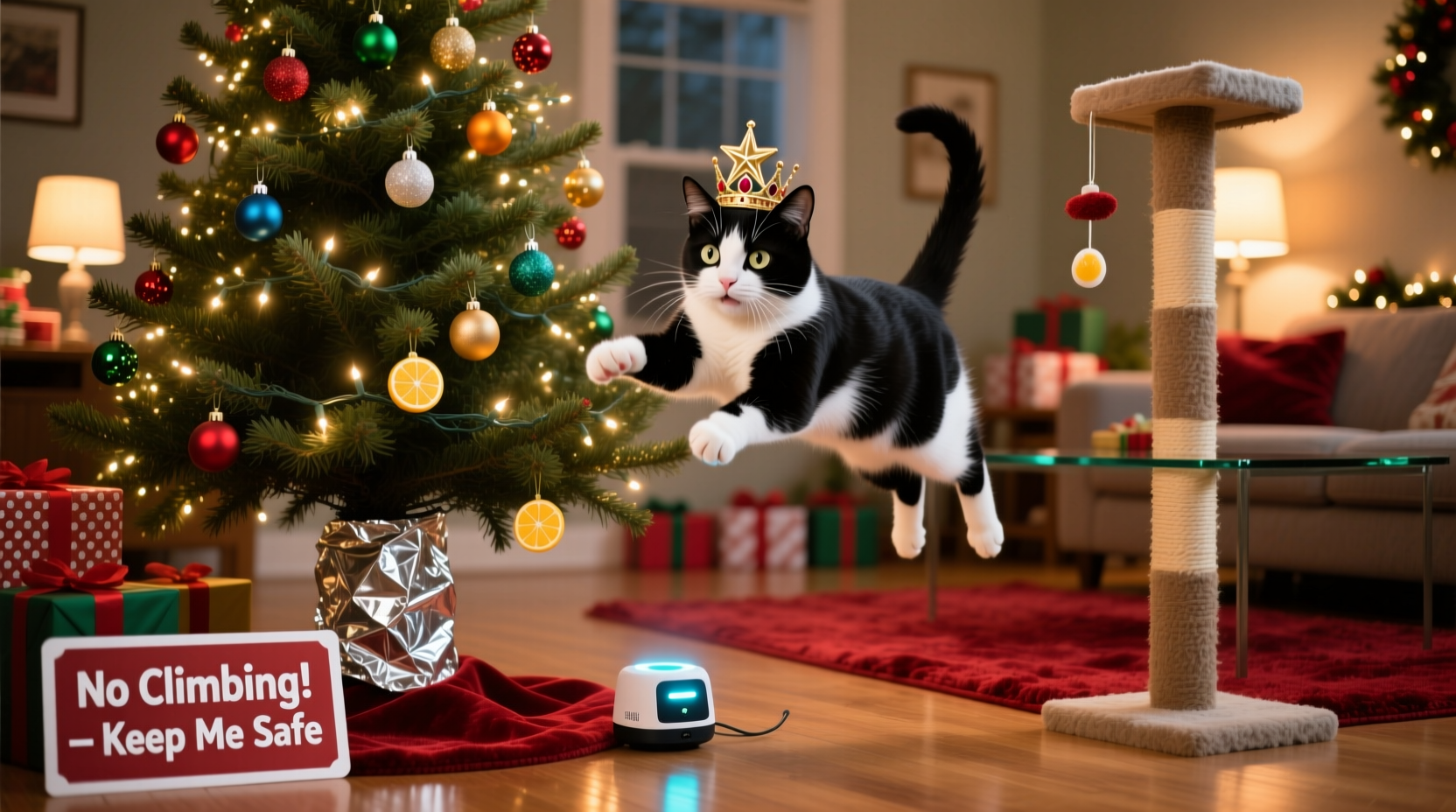
Cats don’t see a Christmas tree as festive décor. They perceive it as a dynamic, multi-sensory environment rich with evolutionary cues: vertical territory, novel textures, movement, scent, and opportunity. Three core instincts converge when your cat approaches the tree:
- Hunting drive: Swinging ornaments, flickering lights, and rustling tinsel mimic prey movement—activating the same neural pathways used to stalk birds or mice. Even adult cats retain 90% of their kitten-level predatory motivation, especially when under-stimulated.
- Vertical exploration: In the wild, elevated vantage points signal safety and dominance. A tall, stable-yet-swaying tree offers irresistible climbing architecture—particularly if indoor vertical space (cat trees, shelves, window perches) is limited or underused.
- Scent curiosity and marking behavior: Fresh-cut evergreens emit volatile organic compounds (terpenes like pinene and limonene) that are intensely stimulating to a cat’s olfactory system. Some cats rub against the trunk or scratch the bark—not out of aggression, but as a form of scent-mapping and territorial affirmation.
This isn’t “bad behavior.” It’s species-typical behavior expressed in a context that lacks appropriate outlets. As Dr. Sarah Heath, European Veterinary Specialist in Behavioural Medicine, explains:
“Cats don’t misbehave—they respond. When a cat climbs a Christmas tree, it’s rarely defiance. It’s an unmet need for predation, elevation, or sensory engagement—expressed in the most available, stimulating object in the room.” — Dr. Sarah Heath, FRCVS, Diplomate ECVBM-CA
Why Common “Solutions” Backfire (and What Works Instead)
Many well-intentioned owners reach for quick fixes: citrus sprays, aluminum foil skirts, or verbal corrections. While some reduce surface-level activity, they often ignore underlying drivers—or even escalate stress. Here’s what actually helps—and why:
Effective deterrence works on three levels: prevention (removing temptation), redirection (offering superior alternatives), and enrichment (addressing root needs). Below is a comparison of common tactics versus evidence-informed alternatives:
| Common Approach | Why It Often Fails | Better Alternative |
|---|---|---|
| Aluminum foil around the base | Startles only initially; many cats habituate within days or learn to step over/around it | Install a low-profile, textured barrier (e.g., rubber matting or double-sided tape *only at the very base*, paired with a nearby climbing structure) |
| Verbal scolding or clapping | Doesn’t teach the cat what to do instead; may increase arousal or fear, reinforcing the behavior via attention | Quietly remove the cat *before* escalation, then immediately engage in 3 minutes of interactive play with a wand toy |
| Using pine-scented air fresheners to “mask” the tree | Overwhelms the cat’s olfactory system; can cause nausea, respiratory irritation, or increased stress | Place calming pheromone diffusers (Feliway Classic) 3–4 feet from the tree—but *not* directly above it—to support baseline calm |
| Leaving the tree unattended while decorated | Gives the cat repeated unsupervised access to practice and reinforce the behavior | Use a physical barrier (e.g., baby gate shaped into a semi-circle) during unsupervised hours—even for short intervals—until new habits form |
A Step-by-Step Plan to Protect Your Tree (Without Stressing Your Cat)
Success hinges on consistency—not perfection. Follow this five-day plan to shift your cat’s relationship with the tree gradually and humanely:
- Day 1: Audit & Prep — Remove all breakable, dangling, or edible decorations (tinsel, popcorn strings, chocolate ornaments). Secure lights with cable ties *behind* branches—not visible. Test tree stability: gently shake the trunk. If it wobbles >2 inches, anchor it to a wall stud using a flexible, non-visible strap (e.g., nylon webbing with a cam buckle).
- Day 2: Introduce Alternatives — Place two new, highly engaging items *within 3 feet* of the tree: (a) a sturdy, carpeted cat tree with multiple levels and a hideout, and (b) a food puzzle or snuffle mat filled with kibble or freeze-dried treats. Rotate toys daily to maintain novelty.
- Day 3: Redirect & Reward — Each time your cat approaches the tree, calmly say “Good kitty,” then immediately toss a treat *toward the alternative perch*. Do not wait for climbing—reward proximity and orientation. Repeat 5x/day. Use high-value treats (e.g., tuna flakes or chicken breast bits) for maximum impact.
- Day 4: Enrich the Environment — Add two 10-minute interactive play sessions daily using feather wands or laser pointers *followed by a meal or treat*. This satisfies the hunt-catch-consume sequence, lowering residual predatory energy directed at the tree.
- Day 5: Reinforce Calm — Sit beside the tree for 15 minutes with your cat on your lap or nearby. Offer gentle petting *only if the cat remains relaxed*. If it stands or moves toward the tree, pause contact and redirect with a treat tossed to its perch. Repeat twice daily.
This plan leverages operant conditioning principles—specifically positive reinforcement and differential reinforcement of alternative behavior (DRA)—which studies show produce longer-lasting results than punishment-based methods.
Mini Case Study: Luna, a 3-Year-Old Domestic Shorthair in Portland, OR
Luna had knocked over her family’s Christmas tree three years running—each time within 48 hours of setup. Her owners tried everything: lemon-spray deterrents, covering the base with plastic carpet runners, even relocating the tree to a closed-off room (which led to door-scratching and vocalization). Veterinarian referral revealed no medical issues, but a certified feline behavior consultant observed Luna’s routine: she spent 14+ hours alone while her owners worked, had no elevated resting spots, and received only 2 minutes of play daily.
The intervention was simple but precise: • A wall-mounted shelf system installed along a sunlit window (providing height + visual stimulation) • Daily 12-minute “hunt” sessions with a wand toy ending in a food reward • A small, soft-sided cat tent placed 2 feet from the tree base—filled with silvervine and warmed with a microwavable heat pad • The tree anchored and decorated with only shatterproof ornaments placed *above* 3 feet
By Day 7, Luna napped in the tent daily. By Day 14, she’d climbed the shelf system 17 times—but never approached the tree trunk. Her owners reported she seemed “lighter,” less hyper-vigilant, and began initiating play more frequently. No scolding. No sprays. Just meeting needs.
Do’s and Don’ts: A Practical Checklist
Keep this checklist visible—on your fridge, in your holiday planner, or taped to the back of your tree stand—as a quick reference throughout the season:
- ✅ DO anchor your tree to a wall stud—regardless of height or weight
- ✅ DO use only shatterproof, lightweight ornaments above knee-height
- ✅ DO place at least one elevated, cozy perch within 5 feet of the tree
- ✅ DO schedule two 10-minute interactive play sessions daily—even on busy days
- ✅ DO rotate toys weekly to sustain interest and prevent habituation
- ❌ DON’T use tinsel, ribbons, or garlands made of string-like materials (high ingestion risk)
- ❌ DON’T decorate with edible items (candy canes, chocolate, popcorn) or toxic plants (holly, mistletoe, poinsettia sap)
- ❌ DON’T leave lights on unattended—especially older strands that overheat or have exposed wiring
- ❌ DON’T punish after the fact—even a few seconds later, your cat won’t connect the correction to the behavior
- ❌ DON’T rely solely on “cat-proof” tree stands; most are designed for stability, not deterrence
FAQ: Real Questions from Concerned Cat Owners
My cat only attacks the tree at night—why?
Cats are crepuscular (most active at dawn/dusk) and often conserve energy for nighttime exploration. If your cat is alone for long stretches during the day, it may channel pent-up hunting energy into nocturnal tree investigations. Increase daytime enrichment—especially scheduled play before dusk—and consider leaving a timed feeder or puzzle toy set for midnight activation.
Will getting a second cat solve this?
Not reliably—and potentially worsens it. Introducing another cat adds social complexity, stress, and competition for resources. Unless you’ve carefully assessed compatibility and have space for separate territories, adding a second cat is unlikely to reduce tree-directed behavior and may increase household tension. Focus first on individual enrichment and environmental design.
Is it safe to use a water spray bottle to deter climbing?
No. Spray bottles induce fear, erode trust, and often result in redirected aggression or avoidance behaviors. Research published in the Journal of Veterinary Behavior shows cats subjected to aversive training methods exhibit higher cortisol levels and are more likely to develop chronic anxiety disorders. Positive reinforcement consistently yields safer, more sustainable outcomes.
Conclusion: A Peaceful, Purr-Filled Holiday Is Possible
Your Christmas tree doesn’t have to be a battleground. Nor does your cat need to be “trained out” of natural behavior. What’s required is a shift in perspective—from seeing the tree as something to defend *against* your cat, to viewing it as an opportunity to deepen your understanding of feline needs. Every time you anchor the trunk, hang a toy on a nearby shelf, or spend ten focused minutes mimicking the rhythm of the hunt, you’re doing more than protecting ornaments. You’re honoring your cat’s biology, reducing its stress load, and building a relationship rooted in trust—not tension. The most beautiful holiday decor isn’t flawless—it’s shared, respectful, and alive with mutual care. Start small. Be consistent. Notice the subtle shifts: the glance away from the tree toward the perch, the relaxed blink mid-play, the quiet nap in the sunbeam beside the stand. That’s the real magic—and it lasts long after the tinsel is packed away.




 浙公网安备
33010002000092号
浙公网安备
33010002000092号 浙B2-20120091-4
Comments
No comments yet. Why don't you start the discussion?